Most RFPs are not lost on the solution. They are lost on a missed requirement, a page limit, a form nobody signed or an upload that started twenty minutes before the portal closed.
Printed from checkflow.io/templates/sales/rfp-response-checklist
An RFP response is a written answer that someone will score line by line against criteria they published in advance, so the work is as much about control as about writing. This free RFP response checklist is for bid and proposal managers, sales teams and founders at B2B companies answering private-sector RFPs and public-sector tenders. It runs from intake and a recorded bid/no-bid decision, through a compliance matrix, section owners, drafting and colour team reviews, to an approved price, an early upload and a debrief. Three questions at the start show the public procurement phase, the security questionnaire and the contract review tasks only when the RFP needs them.
An RFP Response Is Scored, Not Presented
A sales pitch is a conversation you steer. An RFP response is a document the buyer steers: they set the questions, the order, the format, the page limits and the scoring, and an evaluator who may never meet you marks each answer against those criteria. A brilliant answer in the wrong section, or a missing mandatory form, can score zero or rule the bid out before anyone reads it. That is why the checklist starts with a bid/no-bid decision and a compliance matrix, not with writing.
The buyer’s side runs its own process. Their vendor risk assessment is where your security questionnaire ends up, and their procurement compliance review is why they insist on exact formats, forms and deadlines. Reading the RFP as the evaluator will read it is most of the job. The rules differ most between private buyers and public bodies.
Private-sector RFP
The buyer writes the rules
Process, scoring and timetable set by the buyer and sometimes changed mid-way
Security questionnaire and data protection terms often decide the shortlist
Negotiation and a best-and-final offer are common after shortlisting
Feedback after a loss is at the buyer’s discretion, so ask for it
Public-sector tender
The law writes the rules
UK: Procurement Act 2023 regime since 24 February 2025, with supplier registration on the Central Digital Platform
US federal: registration in SAM.gov and the clauses the solicitation cites
Late or non-compliant bids are usually rejected without discretion
Clarification answers are generally shared with every bidder
Check which regime applies before you plan. The Procurement Act 2023 covers most public buyers in England, Wales and Northern Ireland and UK-wide bodies, while devolved Scottish authorities still follow the Scottish procurement regulations. In the US, the Federal Acquisition Regulation is part-way through a rewrite, so work from the clauses and provisions the solicitation actually cites rather than from last year’s bid.
What the RFP Response Checklist Covers
Seven phases run from intake to the debrief and content library update. Phase 4 appears only for public-sector tenders. The security questionnaire task in Phase 5 appears only when the RFP includes one, and the contract review task only when the RFP includes draft contract terms.
1
Qualify
Phase 1: Intake & Bid/No-Bid
5 tasks
Answer the scope questions first. They decide whether the public procurement phase, the security questionnaire and the contract review appear.
Log the RFP and every date in it — issue date, clarification deadline, submission date and time zone, portal, validity period and award date
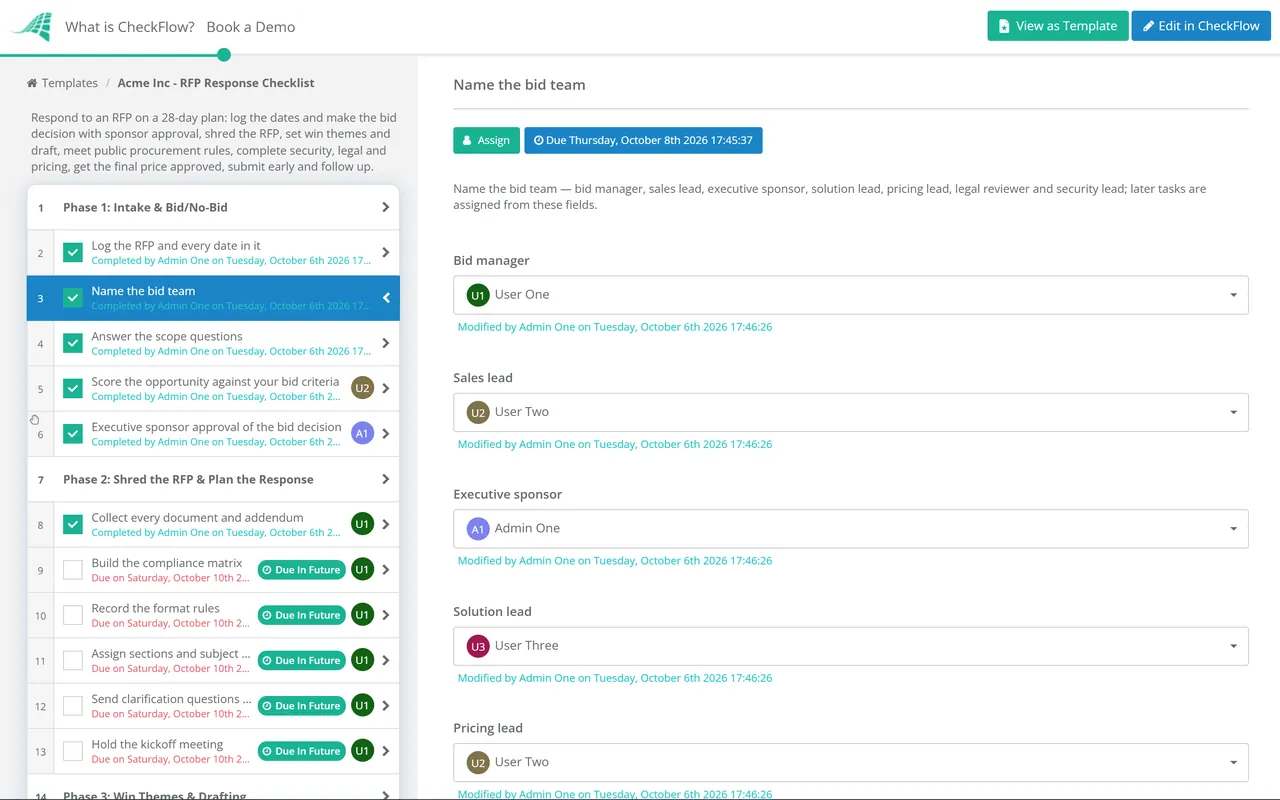
Name the bid team — bid manager, sales lead, executive sponsor, solution lead, pricing lead, legal reviewer and security lead; later tasks are assigned from these fields
Answer the scope questions — is this a public-sector tender, does it include a security questionnaire, and does it include draft contract terms
Score the opportunity against your bid criteria — fit, relationship with the buyer, incumbent, competition, ability to deliver, margin and the people needed to write it
Executive sponsor approval of the bid decision — the checklist stops here until the sponsor records bid or no-bid; a no-bid gets a short, polite note to the buyer
2
Plan
Phase 2: Shred the RFP & Plan the Response
6 tasks
Collect every document and addendum — main RFP, attachments, forms and pricing sheets, and switch on the portal notifications so later addenda are not missed
Build the compliance matrix — every shall, must and will, with the response section that answers it and its owner
Record the format rules — page limits, fonts, file types, file naming, upload size limits, signatures and the number of copies
Assign sections and subject matter experts — with internal deadlines worked back from the submission date, leaving time for reviews
Send clarification questions before the deadline — and log each answer, which usually changes the requirement for every bidder
Hold the kickoff meeting — bid decision, outline, schedule, review dates and who signs what
3
Draft
Phase 3: Win Themes & Drafting
6 tasks
Agree three or four win themes — each tied to a published evaluation criterion and backed by evidence, not adjectives
Draft the executive summary first — it frames every other section and is the first thing reviewers read
Pull approved answers from the content library — check each is current, accurate and rewritten for this buyer before it goes in
Write the solution, implementation and staffing sections — in the RFP’s order and numbering, answering the question that was asked
Confirm references, case studies and CVs — each referee agrees to be contacted and every named person is available to deliver
Run the pink team review — an early check of outline, storyboards and themes against the compliance matrix before full drafting
4
Public
Phase 4: Public Procurement Requirements
5 tasks
Shown only when the scope answer to ‘Is this a public-sector tender?’ is Yes.
Check your registration is current — UK Central Digital Platform on Find a Tender, or an active SAM.gov registration for US federal bids
Complete the mandatory forms and declarations — exclusion grounds, conflicts of interest and any certifications the tender lists
Read every clause and term the tender incorporates — including flow-downs to subcontractors and reporting duties after award
Map the evaluation method and weightings — price and quality split, pass or fail questions and minimum scores
Answer social value or small-business questions directly — where the tender scores them, with commitments you can evidence
5
Review
Phase 5: Security, Legal & Pricing
5 tasks
The security questionnaire and contract review tasks are shown only when the scope answers say the RFP includes them.
Complete the security questionnaire — shown only when the RFP includes one; offer the SOC 2 report or ISO 27001 certificate under NDA if asked
Review the draft contract and list exceptions — shown only when the RFP includes draft terms; liability, indemnity, IP, data protection and payment, raised where the RFP says
Build the price in the buyer’s pricing schedule — their format and units, every assumption written down and consistent with the solution
Run the red team review — reviewers score the full draft against the evaluation criteria as the buyer’s evaluators would
Fix the red team findings — every comment closed or consciously rejected by the section owner
6
Submit
Phase 6: Final Compliance & Submission
6 tasks
Recheck the compliance matrix against the final files — every requirement answered where the matrix says it is
Run the gold team review — a senior read of the finished response, price and risks before sign-off
Executive sponsor approval of the final price and submission — the checklist stops until the sponsor approves; nothing is uploaded before then
Produce the final files — file names, formats, page counts, signatures and a last read for another client’s name
Upload at least a day before the deadline — portals slow down near closing time and late submissions are usually rejected
Save the submission receipt — confirmation, timestamp and a copy of exactly what was sent
7
Follow-up
Phase 7: After Submission
5 tasks
Answer post-submission clarifications — by the buyer’s deadline and consistent with what you submitted
Prepare for orals or a demo if shortlisted — the presenters are the people who will deliver, and the story matches the written response
Request a debrief, win or lose — in writing and quickly, since some regimes set short windows
Update the content library — add the new approved answers and retire anything the reviews found out of date
Record the result and the reasons — won, lost or no decision, with the buyer’s feedback, for the next bid decision
Plan from the submission deadline backwards, not from the day the RFP arrives forwards. The plan below is a typical shape for a response due four weeks after issue. The buyer’s clarification deadline and submission time override it, and a shorter RFP compresses the drafting window, not the reviews.
Days 1–2
Intake and bid decision
Dates logged, opportunity scored and the sponsor’s bid or no-bid recorded. Every day spent undecided comes out of the writing time.
Days 3–4
Shred and kickoff
Compliance matrix built, sections and experts assigned with internal deadlines, and clarification questions drafted.
Days 5–9
Outline and pink team
Win themes, executive summary draft and storyboards reviewed before anyone writes full sections. Clarification questions go in before the buyer’s cut-off.
Days 10–18
Drafting, security and pricing
Sections drafted, the security questionnaire and contract exceptions completed, and the price built in the buyer’s schedule.
Days 19–22
Red team and fixes
The full draft is scored as an evaluator would score it, then every finding is fixed or consciously left.
Days 23–25
Gold team and sign-off
Final compliance check, gold team read and the sponsor’s approval of price and submission.
Days 26–28
Upload early, keep a buffer
Files produced and uploaded at least a day early, the receipt saved, and the last days kept for a portal failure or a late addendum.
Who does what. The bid manager owns the plan, the compliance matrix and the upload. The sales lead owns the buyer relationship, the win themes and the bid recommendation. Subject matter experts own their sections, the pricing lead owns the price and its assumptions, and the legal reviewer and security lead own exceptions and the questionnaire. The executive sponsor makes the two decisions that commit the company: whether to bid, and what to submit at what price.
Why Run RFP Responses in CheckFlow?
1
Every section has an owner and a date
Tasks are assigned from the bid team fields and carry due dates offset from the day the checklist starts, so a response started on the day the RFP lands has its internal deadlines set before anyone asks. Adjust any date to match the buyer’s timetable.
2
The bid and the price are decided on the record
The bid decision and the final price stop at an approval step until the sponsor answers, so nobody commits writing time to a bid nobody agreed or uploads a price nobody signed off. Both sit in the history beside the evidence.
3
One template for every kind of RFP
Dropdowns show the public procurement phase, the security questionnaire and the contract review only when a bid needs them. Attach the compliance matrix and receipt to their tasks, and use reports to see which live bids are behind.
Running several bids at once? CheckFlow approvals put the bid decision, the price and the final submission in front of the right approver at the right moment, with the reasons kept for the next bid.
Describe the process in a sentence and the AI checklist generator drafts the phases and tasks for you.
Frequently Asked Questions
What should an RFP response checklist include?
The RFP’s dates and a recorded bid/no-bid decision, a compliance matrix of every requirement, section owners with internal deadlines, clarification questions, win themes, drafting from approved content, pink, red and gold team reviews, the security questionnaire and contract exceptions where they apply, an approved price, a final compliance check, an early upload with a saved receipt, and a debrief request whatever the result.
How do you decide whether to bid on an RFP?
Score it against criteria you set in advance and let a named executive decide. Useful questions: did you know about this before it was published, does the buyer know you, is there an incumbent, can you meet every mandatory requirement, can you deliver at a margin you accept, and do you have the people to write it in time. An RFP you first see on the day it is issued, with an entrenched incumbent, is usually a no-bid.
What are pink, red and gold team reviews?
They are staged internal reviews named after colours, a convention from US government contracting. The pink team reviews the outline, storyboards and win themes early, before full drafting. The red team reviews a near-final draft and scores it against the evaluation criteria as the buyer would. The gold team is a final senior review of the finished response and price before sign-off. Smaller teams can run all three in a few hours each.
What is a compliance matrix in an RFP response?
It is a table of every requirement in the RFP, usually each shall, must or will statement plus format rules and mandatory forms, with the section of your response that answers it and the person responsible. Built at the start, it drives the outline and the assignments. Checked again at the end, it proves nothing was missed. Some buyers ask for it to be submitted with the response.
Can you get a debrief after losing a tender?
Usually yes in the public sector, and it is worth asking in the private sector too. Under the UK Procurement Act 2023, the buyer must send each bidder whose tender was assessed an assessment summary before publishing the contract award notice, and an eight working day standstill period follows. For US federal negotiated contracts, FAR 15.506 entitles you to a debriefing if your written request arrives within three days of the award notice.
Is CheckFlow free for this template?
14-day free trial, no card required. The Business plan is $10 per user per month after the trial. Full details at checkflow.io/pricing.
Submit Every RFP Complete, Approved and a Day Early