
Request for information
Use when: you do not yet know what the market offers, or who could supply it.
You get: capabilities, approaches and indicative pricing models. Nothing binding.
Watch for: letting one vendor’s answer become your specification.
No Credit Card Required
Printed from checkflow.io/templates/procurement-supply-chain/supplier-sourcing-rfp-checklist
This free supplier sourcing checklist is for buyers running a competitive event: procurement and category managers, operations leads buying a new service, and public bodies tendering a contract. It runs from the requirement and an approved business case, through an optional RFI, the RFP or RFQ pack with weightings fixed before release, clarifications, independent scoring and moderation, due diligence on the preferred supplier, and an approved award, to the signed contract and the handover to onboarding. One question at the start adds the Procurement Act 2023 notices for UK public buyers.
Most sourcing problems are visible in hindsight: a specification written around the incumbent, a weighting nudged after one bid looked good, a clarification answered for one supplier and not the others. Each one weakens the decision, and in the public sector each one is a ground for challenge. The fix is a fixed order of work, with the decisions that shape the outcome made and recorded before anyone has seen a price.
Start by choosing the right document. The three are often blurred, and a request for proposal sent when a request for quotation would do wastes everyone’s time.
Use when: you do not yet know what the market offers, or who could supply it.
You get: capabilities, approaches and indicative pricing models. Nothing binding.
Watch for: letting one vendor’s answer become your specification.
Use when: the requirement is fully specified and suppliers differ mainly on price and lead time.
You get: comparable prices against the same specification.
Watch for: the lowest price from a supplier that cannot meet the delivery terms.
Use when: you know the outcome but suppliers will propose different ways to deliver it.
You get: solutions and prices to score against weighted quality and price criteria.
Watch for: criteria vague enough to justify any answer.
This template is the buyer’s side. Suppliers answering a tender can use the RFP Response Checklist, which runs the seller’s bid from bid/no-bid to submission. UK public buyers have run tenders under the Procurement Act 2023 since it came into force on 24 February 2025, publishing notices on Find a Tender, the central digital platform. The Act does not generally apply to devolved Scottish authorities, which follow Scottish procurement legislation.
Seven phases run from the requirement to the handover. The RFI phase appears only when you run one, and the Procurement Act tasks only for UK public buyers. The business case and the award recommendation each halt the checklist until the budget holder approves them.
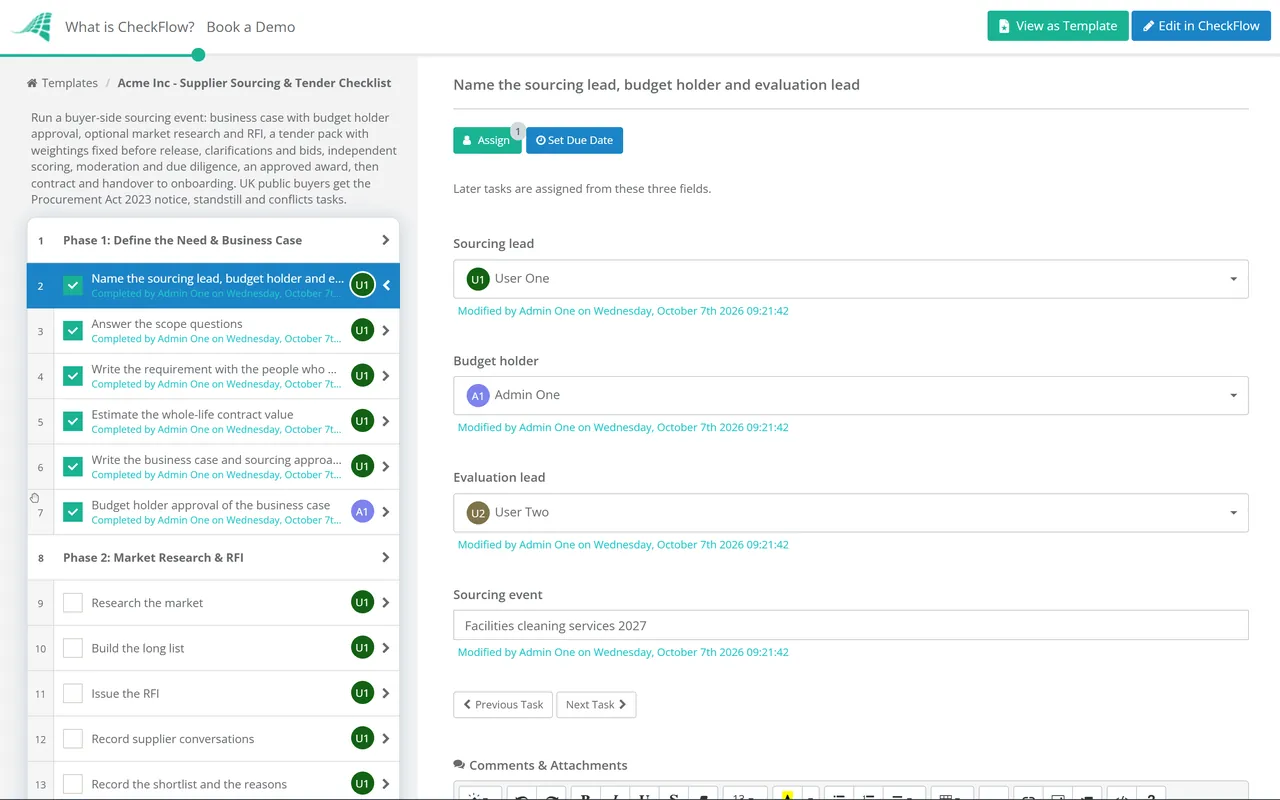
Owned by the sourcing lead. Scope questions: buyer type (Private sector / UK public sector under the Procurement Act 2023 / Other public sector), run an RFI before the tender (Yes/No). The approval is assigned from the budget holder field and halts the checklist.
Shown only when “Run an RFI before the tender?” is Yes. Owned by the sourcing lead.
Owned by the sourcing lead, with the criteria task assigned to the evaluation lead. Weightings are final when this phase closes.
Tasks marked UK public appear only when the buyer type is UK public sector. The last two tasks are due on the clarification and submission deadlines set in Phase 3.
Assigned to the evaluation lead. Scoring is done by each panel member alone before the moderation meeting.
The award approval is assigned from the budget holder field and halts the checklist before any supplier is told. Tasks marked UK public appear only for that buyer type.
Owned by the sourcing lead. The contract details notice task is due 30 days after the contract date field.
The matrix below is for a mid-sized services contract. The weights are an example, not a rule: set your own in Phase 3 and publish them with the pack. Each quality criterion is scored 0–5 against the guide, then multiplied by its weight. A 5 needs evidence, not adjectives.
| Criterion | Weight | What earns a 5 | What earns a 1 |
|---|---|---|---|
| Understanding of the requirement | 15% | Restates the outcome, names the real risks and proposes how to manage each | Repeats the specification back |
| Delivery approach and plan | 20% | Dated plan with named roles, dependencies and a credible mobilisation period | General method with no dates or owners |
| Team and capacity | 10% | Named people with relevant experience, and cover for absence and peaks | Role titles only |
| Service levels and reporting | 10% | Measurable service levels, reporting cadence and remedies when they are missed | Commitments without measures |
| Security and data protection | 5% | Current certification or evidence, plus clear answers on data location and access | A policy statement without evidence |
| Price (whole-life cost) | 40% | Lowest compliant price scores full marks; others score lowest price ÷ bid price × 40 | |
Use a scale with descriptions for every level, and agree it with the panel before scoring: 0 no answer, 1 poor, 2 weak, 3 acceptable, 4 good, 5 excellent. On price and quality, the balance depends on how much the solutions can differ. A specified commodity can carry most of the weight on price, while a complex service where delivery quality varies usually needs more on quality. Under the Procurement Act 2023, a UK public buyer awards to the most advantageous tender (section 19) against award criteria that must be clear, measurable and specific, with their relative importance set out in the tender notice or associated documents (section 23). Check the current text before you publish.
Moderation is where weak evaluations go wrong. Each evaluator scores alone first, so the loudest voice does not set the score. The moderator then works through each criterion, asks evaluators who differ by two points or more to explain, and records the agreed score with the reason. Never average scores without that discussion.
A private buyer runs a lean event. A UK public buyer gets the conflicts assessment, assessment summaries, notices and standstill in the order the Act sets. Skip the RFI when the market is known.
No supplier is approached before the budget holder approves the business case, and none is told the result before the award recommendation is approved. Both approvals halt the checklist until they are given.
The clarification log, declarations, score sheets and moderation notes sit on the tasks that produced them, and the audit trail shows who did what and when. A read-only share link can give an auditor the whole event.
CheckFlow is not an e-procurement or e-tendering platform: bids still arrive through your portal or Find a Tender. It runs the human process around them. Once the contract is signed, the Supplier Onboarding Checklist takes over, and CheckFlow’s vendor onboarding software keeps every new supplier on the same steps.
Buying goods from abroad? Agree the Incoterms® rule and who acts as importer at award, then run each shipment through the Import & Customs Compliance Checklist.

Supplier Onboarding Checklist
Vendor Risk Assessment Checklist

Purchase Order Approval

Contract Review & Approval

Supplier Performance Evaluation
Describe the process in a sentence and the AI checklist generator drafts the phases and tasks for you.
Define the requirement and get the business case approved; research the market, with an RFI if you need one; build the tender pack with criteria and weightings fixed before release; issue it and run clarifications fairly; check compliance, score independently and moderate; run due diligence on the preferred supplier; approve the award and notify every bidder; then sign the contract and hand the supplier to onboarding.
Before the tender is released, and publish them with it. Weightings chosen after the bids arrive invite the suspicion that they were chosen to fit a favourite, and bidders cannot write to criteria they cannot see. UK public buyers under the Procurement Act 2023 must set out the award criteria and their relative importance in the tender notice or associated tender documents.
A pause of eight working days, beginning with the day the contract award notice is published, before the contracting authority may enter into the contract (section 51). It gives unsuccessful suppliers time to consider their assessment summaries and challenge the decision. Some awards are exempt, including frameworks, light touch contracts and certain urgent direct awards, though a buyer can still choose to hold a voluntary standstill.
Under section 50 of the Procurement Act 2023, a UK public buyer must give each supplier that submitted an assessed tender a summary of how its tender was assessed, compared with the most advantageous tender, before publishing the contract award notice. Private buyers have no such duty, but giving each bidder its scores against the winner’s is good practice and makes the next tender stronger.
Enough to get real competition, few enough that each bidder thinks it can win and the panel can score every bid properly. For a private RFP, three to six credible suppliers is a common range; more than that and strong suppliers may decline to bid. Invite only suppliers you would genuinely award to, and record why each was chosen. An open public procedure has no invitation list, so plan the panel’s time for however many bids arrive.
Ask everyone who will influence the decision, including evaluators and advisers, to declare personal, professional or financial interests before they see any bid, and record how each one is managed. UK public buyers must take all reasonable steps to identify conflicts (section 81) and prepare a conflicts assessment before publishing the tender notice (section 83), keeping it under review until award.
14-day free trial, no card required. The Business plan is $10 per user per month after the trial. Full details at checkflow.io/pricing.
14-day free trial, no credit cardFull refund in your first 30 daysUS hosting, EU on request