Procurement is the function that spends the organisation’s money — and because of that, it sits at the intersection of financial risk, fraud risk, supplier risk, and an increasingly complex regulatory environment. Procurement policy violations are the most common finding in internal audits of commercial organisations: purchases approved by someone without sufficient authority, preferred suppliers used without a qualifying process, invoices paid without three-way matching, contracts renewed without review, and suppliers operating for months without a signed agreement. Beyond the internal policy dimension, the regulatory environment is expanding rapidly — the EU Corporate Sustainability Due Diligence Directive (CSDDD), Germany’s Supply Chain Act (LkSG), and the CSRD are requiring large companies to conduct and document supply chain due diligence for human rights, labour standards, and environmental impact. A procurement compliance review addresses all of this systematically: auditing spending authority, contract adherence, supplier qualification, payment accuracy, conflict of interest management, and supply chain ESG obligations in a single structured process. This free checklist gives procurement directors, CFOs, and internal auditors a structured framework for the full procurement compliance review.
What Procurement Compliance Reviews Must Cover Across Four Dimensions
Compliance & Governance
Policy adherence, spending authority validation, regulatory compliance, contract adherence, and approval documentation. The foundational question: is every purchase authorised by someone with the correct authority, within a valid contract, and consistent with policy?
Financial & Cost Management
Spend analysis by supplier, category, and department; invoice and payment accuracy; three-way matching compliance; duplicate payment detection; and cost optimisation opportunities (consolidated spend, renegotiated rates, volume commitments).
Risk Management
Conflict of interest identification, supplier concentration risk, supplier financial health monitoring, fraud indicators, and supply chain continuity assessment.
Process & Performance
Procurement cycle times, supplier on-time delivery against contract, purchase order compliance rate (orders raised before rather than after goods receipt), and procurement team KPIs against objectives.
What the Procurement Compliance Review Checklist Covers
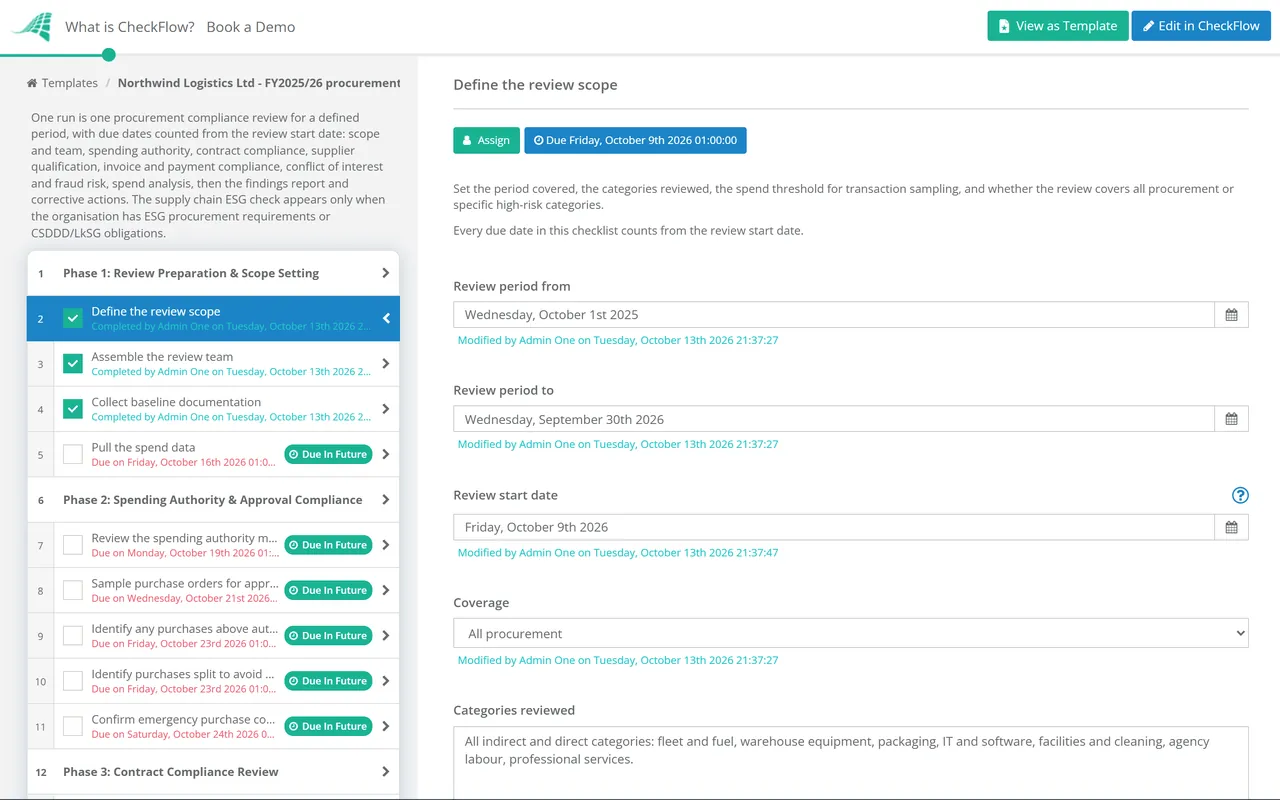
Eight phases covering the complete procurement compliance review — from scope setting and data collection through spending authority, contract compliance, supplier qualification, payment accuracy, fraud risk, spend analysis, and corrective action reporting.
- 1
Phase 1
Review Preparation & Scope Setting
4 tasks
- Define the review scope — period covered, categories reviewed, spend threshold for transaction sampling, and whether the review covers all procurement or specific high-risk categories
- Assemble the review team — procurement, finance, legal (for contract compliance), and internal audit where applicable; roles defined
- Collect baseline documentation — current procurement policy, spending authority matrix, approved supplier list, standard contract templates, and supplier qualification criteria
- Pull the spend data — for the review period; by supplier, category, department, and payment method; the raw data for all subsequent analysis
- 2
Phase 2
Spending Authority & Approval Compliance
5 tasksSpending authority violations are the most common procurement compliance finding. The purpose of authority limits is not bureaucratic — it is to ensure that every purchase is reviewed by someone with appropriate seniority and financial accountability for the decision.
- Review the spending authority matrix — is it current? Does it reflect the current organisational structure? Were any changes properly documented?
- Sample purchase orders for approval compliance — a random sample across value bands; confirm each was approved by someone with the requisite authority for that value and category
- Identify any purchases above authority limits — approved by someone below the required seniority; investigate and report
- Identify purchases split to avoid authority thresholds — multiple POs to the same supplier on the same day or for the same project, each below the threshold for higher approval; a common fraud and policy evasion pattern
- Confirm emergency purchase compliance — purchases made outside normal process under emergency authorisation are documented and retrospectively ratified appropriately
- 3
Phase 3
Contract Compliance Review
5 tasks
- Identify suppliers operating without a signed contract — cross-reference the active supplier payment list against the contract register; any supplier receiving payment without a signed contract or valid purchase order is a compliance finding
- Identify contracts operating beyond their expiry date — contracts that expired but where the supplier relationship is still active; immediate renewal or formal extension required
- Sample contracts for commercial terms compliance — are prices invoiced consistent with the contracted rates? Any unexplained price increases?
- Review contract renewal process compliance — were renewals reviewed and approved per policy? Any auto-renewals that occurred without a documented review decision?
- Confirm SLA compliance tracking — for contracts with service level obligations; are SLAs being measured and any credits or penalties being applied?
- 4
Phase 4
Supplier Qualification & Approved Supplier List
4 tasks
- Review the approved supplier list — is it current? When was it last reviewed? Are all current active suppliers on the list?
- Identify purchases from unapproved suppliers — any payments to suppliers not on the approved list; investigated and reported
- Sample supplier qualification records — for a selection of approved suppliers; are insurance certificates current? Are compliance documents (tax registration, sanctions screening) on file?
- Review supplier diversity and ESG compliance — for organisations with ESG procurement requirements or obligations under CSDDD/LkSG; evidence of due diligence on human rights, labour standards, and environmental practices in the supply chain
- 5
Phase 5
Invoice & Payment Compliance
4 tasks
- Review three-way matching compliance — sample invoices; confirm each is matched to a valid PO and a goods receipt or service confirmation before payment; any invoice paid without a matching PO is a compliance finding
- Identify payments without POs — “maverick spend” where goods or services were received and invoiced before a PO was raised; a key indicator of procurement policy bypass
- Screen for duplicate payments — same invoice number, same amount and supplier; or same invoice amount and date with slightly different reference; duplicate payments are common and frequently undetected
- Confirm payment terms compliance — are suppliers being paid within the contracted payment terms? Early payments on non-discount terms represent an opportunity cost; late payments create relationship and legal risk
- 6
Phase 6
Conflict of Interest & Fraud Risk Assessment
4 tasks
- Review conflict of interest declarations — for all procurement decision-makers; current and on file; any undeclared relationships with active suppliers
- Screen for related-party transactions — suppliers owned by or related to employees or directors; any such transaction requires disclosure and independent approval
- Analyse spending concentration — unusual concentration of spend with a single supplier (or a small number of suppliers) relative to what a competitive market would suggest; may indicate preference without commercial justification
- Review tender and quotation compliance — for purchases above the tender/quotation threshold; were minimum quotations obtained? Was the selection documented and justified?
- 7
Phase 7
Spend Analysis & Optimisation Opportunities
4 tasks
- Analyse spend by category — which categories represent the highest spend? Are they strategically managed with contracted rates and preferred suppliers?
- Identify tail spend — the large number of small-value purchases from many different suppliers that represent disproportionate administrative cost; tail spend consolidation is a common source of savings
- Identify spend under management percentage — the proportion of total spend that is under contracted terms with approved suppliers; organisations typically target 80%+ spend under management
- Identify consolidation opportunities — multiple suppliers in the same category where consolidation would provide volume leverage; or fragmented buying across departments that undermines negotiated rates
- 8
Phase 8
Findings Report & Corrective Action
4 tasks
- Compile the findings — categorised by severity (critical, major, minor) and dimension (governance, financial, risk, process)
- Assign corrective actions — to named owners with target completion dates; each finding has a specific, actionable corrective action
- Present to senior management — and the board or audit committee for material findings
- Track corrective action completion — at the defined intervals; report status at the next review
What Is Maverick Spend — and Why It Costs More Than the Purchase
Maverick spend (also called rogue spending) occurs when purchases are made outside the defined procurement process — bypassing the approved supplier list, the purchase order requirement, the competitive quotation threshold, or the approval authority. Research consistently shows that organisations with weak procurement controls have maverick spend rates of 30–60% of total addressable spend — meaning a significant proportion of all purchases bypass the controls designed to manage cost and risk.
The cost of maverick spend is not just the overpayment on the individual purchase — it is the erosion of negotiated rates (suppliers who know they will receive orders regardless of compliance have less incentive to maintain contracted pricing), the fraud risk (unapproved supplier relationships are the most common vector for procurement fraud), and the data gap (spend that bypasses the procurement system does not appear in spend analytics, making it impossible to manage strategically).
Why Run Your Procurement Compliance Review in CheckFlow?
1A structured annual review that covers every compliance dimension
A procurement review that focuses only on invoice processing misses conflict of interest. One that focuses only on supplier qualification misses maverick spend. CheckFlow’s procurement compliance review runs all four dimensions — governance, financial, risk, and process — in a single structured process.
Corrective actions tracked to closure
The procurement compliance finding that generates a corrective action that is never implemented is a finding that recurs in the next review. CheckFlow assigns each finding to a named owner with a deadline, tracks completion, and escalates overdue items to the review lead.
An audit-ready procurement governance record
Internal audit, board oversight, external audit, and regulatory compliance all depend on evidence that procurement controls are systematically operated and reviewed. Every procurement compliance review conducted through CheckFlow is documented, dated, and archived — providing the governance record that accountability requires.
Procurement compliance reviews often find purchase order approval failures. CheckFlow’s Purchase Order Approval Checklist covers the structured PO approval process that procurement compliance requires. See the Purchase Order Approval Checklist →
Supplier qualification compliance is one of the key areas of the procurement review. CheckFlow’s Supplier Onboarding Checklist covers the structured qualification process. See the Supplier Onboarding Checklist →