Security Questionnaire Response Checklist Template

A security questionnaire can stand between a supplier and a signed contract. Answered from last year’s spreadsheet by whoever is free, it goes back with out-of-date evidence and promises nobody checked against the contract.

Last reviewed: October 2026

Printed from checkflow.io/templates/cybersecurity/security-questionnaire-response-checklist

This free security questionnaire response checklist is for security, compliance and sales teams at suppliers who answer customers’ security questionnaires. One run answers one questionnaire from one customer or prospect, whether it is a Shared Assessments SIG, a CSA CAIQ, an EDUCAUSE HECVAT or the customer’s own spreadsheet. It records who asked, the due date and the people involved, checks an NDA is in place before any evidence is shared, fills in approved answers from the answer library, gathers the current SOC 2 report, ISO/IEC 27001 certificate, penetration test summary and policies and checks each is in date and in scope, and sends the rest to the people who own each area. Every answer that makes a promise is flagged, legal reviews the answers that commit the company, and the security lead approves the answers before they are submitted. Follow-up questions go through the same route, and new answers go back into the library.

Answering a Questionnaire Is Not Assessing a Vendor

A security questionnaire has two sides. The buyer sends it as part of their own review: the Vendor Risk Assessment Checklist for suppliers they depend on, or the SaaS Procurement Security Review Checklist before they buy a new cloud tool. They read your SOC 2 report with the SOC Report Review Checklist. This checklist is the other side: the supplier answering, with evidence that is current and promises the company can keep.

It is also not the work of building the evidence. Getting a first SOC 2 report is a project of its own, which the SOC 2 Readiness Checklist covers, and a questionnaire that arrives inside a tender is one task in the RFP Response Checklist. Run this checklist when the questionnaire is big enough to need its own owners, reviews and approval.

This checklist

Answering the questionnaire

Who: the supplier’s security, compliance and sales team.

When: each time a customer or prospect sends a questionnaire.

Output: approved answers, evidence shared under an NDA, a record of every commitment and an updated answer library.

The buyer’s side

Assessing the supplier

Who: the customer’s procurement, security or third-party risk team.

When: before buying, and again at each reassessment, in the Vendor Risk Assessment or SaaS Procurement Security Review checklist.

Output: a risk rating and a decision about you.

Before the first report

Building the evidence

Who: the supplier’s compliance lead and control owners.

When: months before a first SOC 2 audit, in the SOC 2 Readiness Checklist.

Output: controls that work and an audit window that can open.

What the Security Questionnaire Response Checklist Covers

Eight phases follow one questionnaire from the day it arrives to the answer library update. Every due date counts back from the customer’s due date, and the follow-up tasks count forward from it. Tasks appear for an existing customer, a customer portal, a missing NDA, out-of-date evidence, No or Partly answers, commitments that need legal review and follow-up questions. The security lead approves the answers before anything is submitted.

  1. Phase 1

    Phase 1: Intake & Triage

    6 tasks

    Record who asked, which questionnaire, by when and who is involved, then read it and sort the questions before anyone starts writing. Every due date counts back from the customer’s due date over 15 business days, which is this template’s choice. If the customer gave you less time, ask for more now.

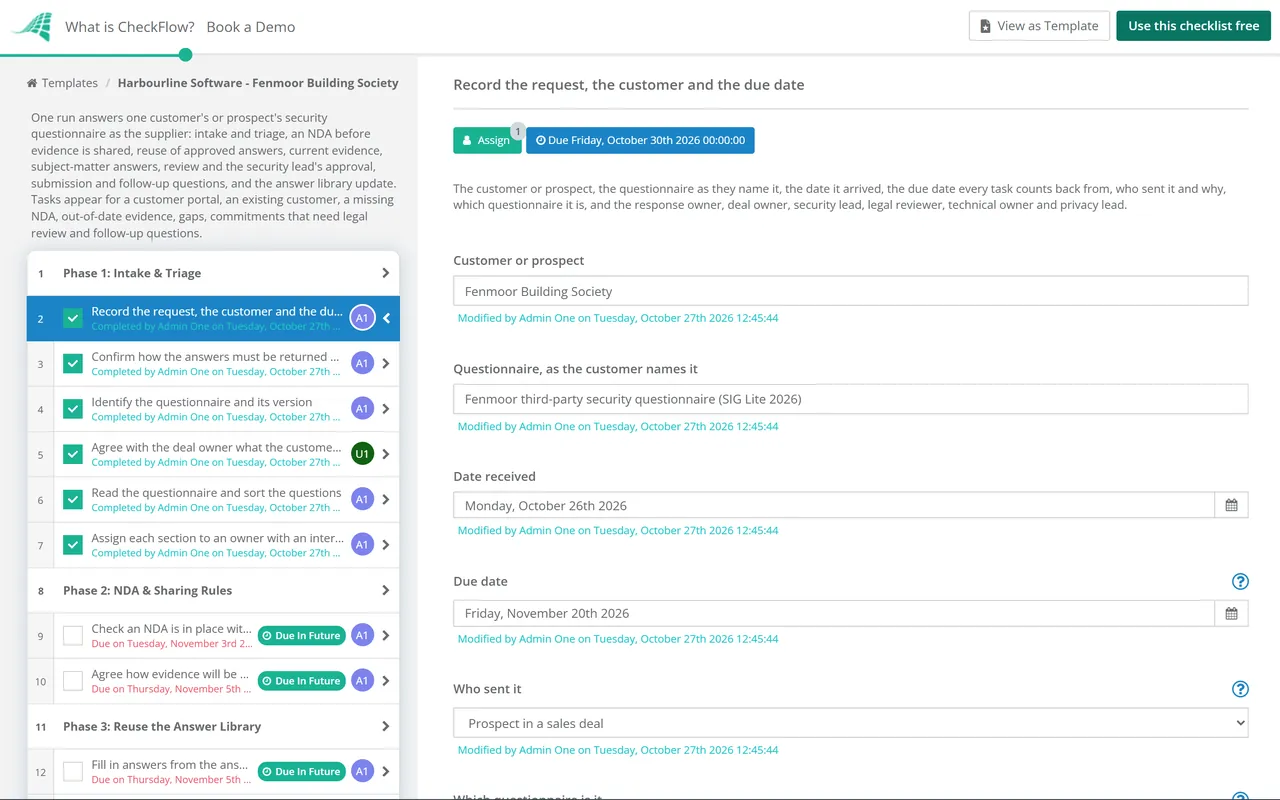
    • Record the request, the customer and the due date — the customer or prospect, the questionnaire as they name it, the date it arrived, the due date every task counts back from, who sent it and why, which questionnaire it is, and the response owner, deal owner, security lead, legal reviewer, technical owner and privacy lead
    • Confirm how the answers must be returned and who to ask — the customer’s format (their spreadsheet, a document or their online portal), whether attachments are allowed, the contact for questions about the questionnaire, and a request for more time now if the due date cannot be met
    • Identify the questionnaire and its version — the name, publisher and version or year, how many questions it has, and whether the customer changed or added to a standard questionnaire, so the right library answers and mappings are used
    • Agree with the deal owner what the customer needs — the deal stage, what the customer will use the answers for (a shortlist, the contract or an annual review), and whether a call or your standard security pack would answer it sooner
    • Read the questionnaire and sort the questions — each question marked as answered from the library, needs evidence, needs a subject-matter owner, does not apply, or asks the company to commit to something such as notice times, audit rights, data location or insurance
    • Assign each section to an owner with an internal date — every section or group of questions given one owner and a date that leaves time for the review in Phase 6, recorded in the table
  2. Phase 2

    Phase 2: NDA & Sharing Rules

    5 tasks

    Evidence such as a SOC 2 report or a penetration test summary is confidential. Check an NDA is in place before any of it leaves the company, and agree how it will be shared. A task appears when no NDA is signed yet, when the customer will not sign one, and when answers go back through their portal.

    • Check an NDA is in place with this customer — a signed NDA or a contract with confidentiality terms that covers security documents, its parties and its expiry date
    • Get access to the customer’s portal and read its terms — accounts for the people answering, who is allowed to submit, what the portal’s terms say about what you upload, and how to export a copy of your answers
    • Get an NDA signed before evidence is shared — the company’s standard NDA sent, or the customer’s reviewed by legal, and signed by both parties before any confidential document is shared
    • Agree what can be shared without an NDA — only documents meant for general use, such as a SOC 3 report, a certificate or a published CAIQ, with the confidential evidence described in the answers instead of attached
    • Agree how evidence will be shared — one route for this customer, such as a trust portal or a secure link with an access expiry date, so you know who received what and can take access away later
  3. Phase 3

    Phase 3: Reuse the Answer Library

    5 tasks

    Start from answers the company has already approved, and check each one is still true before it goes out again. An existing customer adds a task to find what you told them last time.

    • Find the answers you gave this customer last time — their last questionnaire, the evidence you sent and anything you promised, with what has changed since in your systems, suppliers or certifications
    • Fill in answers from the answer library — approved answers copied in for every question they match, each with its owner and the date it was last reviewed
    • Use a completed CAIQ or SIG where the questions match — if the company has already answered a standard questionnaire, its answers mapped to this one rather than written again, keeping the same wording for the same control
    • Check every reused answer is still true — hosting regions, sub-processors, tools, team names, policies and certifications checked against today, with anything that changed sent to its owner in Phase 5
    • Fit each reused answer to the question asked — Yes or No first where the question asks for one, then one or two sentences on how, for the service this customer buys, with no long extracts from policies
  4. Phase 4

    Phase 4: Current Evidence

    7 tasks

    Gather the current versions of the evidence the questionnaire asks for, and check each one is in date and covers the service this customer buys. A task appears when something is out of date, out of scope or missing. Evidence can go before the answers are approved; the NDA check in Phase 2 is what protects it.

    • Get the current SOC 2 report — Type 1 or Type 2, the period it covers and its end date, the services and trust services categories in scope, and the subservice organisations it leaves out
    • Check the ISO/IEC 27001 certificate is in date and in scope — the 2022 edition, the expiry date, a scope statement that covers the service and sites, and a certification body you can name, checked on IAF CertSearch where it is accredited
    • Get the latest penetration test summary — the testing firm, the test dates and scope, and confirmation that critical and high findings were fixed and retested; this template shares the summary or a letter from the tester, not the full report
    • Gather the policies and documents the questionnaire asks for — the current approved version of each one, such as the information security, incident response, business continuity and access control policies and the sub-processor list, with its review date
    • Check every piece of evidence is in date and covers the service — each document’s date, period or expiry checked against today and against the service this customer buys, with anything missing listed
    • Agree what to say about out-of-date or missing evidence — a bridge letter from your management for the time since the SOC 2 period ended, the date of the next report or audit, and plain words on what the evidence does not cover
    • Send the evidence through the agreed route and log it — only after the NDA check in Phase 2, through the sharing route agreed there, with each document, its version and the date it was shared recorded
  5. Phase 5

    Phase 5: Subject-Matter Answers

    8 tasks

    The people who own each area answer what the library could not. Answer the question asked, for the service the customer buys, and say No or Partly where that is the truth. A task appears when any answer is No or Partly.

    • Answer the infrastructure and application questions — hosting, encryption, network security, vulnerability management, logging and secure development, each answer describing what is in place today
    • Answer the identity, access and device questions — single sign-on and multi-factor authentication, joiners and leavers, privileged access, access reviews and how staff devices are managed
    • Answer the personal data questions — the personal data the service holds, where it is stored, sub-processors, the data processing agreement, retention, deletion and transfers out of the country
    • Answer the incident response and continuity questions — how incidents are handled and customers told, backups and restore tests, and recovery targets, stating only what your policies or contracts already commit to
    • Answer the people and supplier questions — background checks, security training, confidentiality agreements and how your own suppliers are assessed
    • Mark the questions that do not apply, with a reason — a short reason for each one, such as no on-site data centre or no card data handled, rather than a blank the customer will ask about
    • List every answer that is No or Partly — each question where the honest answer is No or Partly, with what is in place instead
    • Agree the wording of each No or Partly answer — the control in place instead, what is planned, and a date only where the company has approved one; never a Yes to win the deal
  6. Phase 6

    Phase 6: Review & Approval

    5 tasks

    Every answer is checked for gaps and consistency, and every answer that makes a promise is flagged. Legal reviews the flagged answers when any of them commits the company. The security lead approves the answers, and nothing after that step can be completed until a decision is recorded.

    • Check every answer is complete and consistent — no blank answers, the same answer to the same question in different sections, and nothing that contradicts the SOC 2 report, the certificate scope or your published policies
    • Flag every answer that makes a promise — notice times, audit rights, data location, deletion times, insurance, recovery targets and words such as always, never or within, each listed with where the promise already exists
    • Legal reviews the answers that commit the company — each flagged answer checked against the contract, the data processing agreement and the policies, with answers that go further marked subject to contract or changed
    • Check certifications and reports are named exactly — the full name and edition, such as ISO/IEC 27001:2022 or a SOC 2 Type 2 report for a stated period, and no claim for a service outside their scope; a SOC 2 report is an auditor’s report, not a certificate
    • Security lead approves the answers for submission — Approved, Approved with changes or Not approved, based on the answers, the gaps, the commitments and the legal review
  7. Phase 7

    Phase 7: Submission & Follow-Up

    8 tasks

    Submit in the customer’s format by the due date, keep an exact copy, and answer follow-up questions through the same review route. A task appears if the answers are not approved, and two more when follow-up questions arrive.

    • Rework the answers that were not approved — the answers the security lead listed fixed, then the security lead changes the decision on the approval task once they are right, which hides this task; the deal owner and the customer are told if the due date has to move
    • Submit the questionnaire in the customer’s format — by the due date, with any changes the security lead asked for made first, through the route the customer set, and the confirmation kept
    • Keep a copy of exactly what was submitted — the final answers, the evidence list and the date, filed where the account team can find them, because answers can become part of the contract
    • Agree the next step with the deal owner — what was sent, any answer the customer may question, and who handles the customer’s reply
    • Log any follow-up questions from the customer — each question the customer’s reviewer sends back, with the answer it refers to and the date they need a reply
    • Answer the follow-up questions — through the same owners, with any new commitment flagged and approved by the security lead, and legal where it commits the company
    • Hold a call with the customer’s security reviewer if they ask — the response owner and the right subject-matter owner on the call, with what was said and promised written down afterwards
    • Record the customer’s outcome — accepted, accepted with conditions or not accepted, and any condition or remediation the customer asked for, with its date
  8. Phase 8

    Phase 8: Answer Library Update & Close

    5 tasks

    Put every new and corrected answer back in the library, record what you promised this customer, and close access to the evidence you shared.

    • Record what you promised this customer — every commitment in the answers and follow-ups, such as a remediation date or a notice time, where the account and security teams will find it at renewal
    • Add new and corrected answers to the answer library — each new answer with its owner, the date it was approved and the evidence it relies on, so the next questionnaire starts from it
    • Retire answers that are no longer true — library answers found out of date during this response removed or rewritten, with their owners told
    • End access to the evidence you shared — portal links, data room access and shared folders closed on the access end date agreed in Phase 2, or extended in writing
    • Note what slowed this response down — questions with no library answer, evidence that was missing or late, and owners who were hard to reach, with the next review date for an existing customer

The Evidence Behind the Answers, and the Standard Questionnaires

These are the kinds of evidence this template gathers in Phase 4. Check each one before it is shared, because an expired certificate or a report for a different service undoes the answers it supports. The second table names the standard questionnaires and their current versions, read on 27 October 2026.

Evidence a questionnaire asks for

Evidence Issued by Check before you share it How this template shares it
SOC 2 Type 2 reportAn independent CPA firm, under AICPA standardsThe period it covers and its end date, the services and trust services categories in scope, subservice organisations left out, and exceptions in the test resultsUnder an NDA, through one sharing route, logged
SOC 2 Type 1 reportAn independent CPA firm, under AICPA standardsThe single date it reports on; it covers the design of controls, not how they operated over a periodUnder an NDA, through one sharing route, logged
SOC 3 reportAn independent CPA firm, under AICPA standardsThe same period and scope checks as the SOC 2 reportThe AICPA calls it a general use report that can be freely distributed, so it can go before an NDA
ISO/IEC 27001:2022 certificateA certification body, ideally one that is accreditedThe edition, the expiry date and a scope statement that covers the service and sites; an accredited certificate can be checked on IAF CertSearchThe certificate on request; the Statement of Applicability under an NDA
Penetration test summaryThe testing firmThe test dates, scope and tester, and that critical and high findings were fixed and retestedA summary or a letter from the tester, under an NDA; not the full report
Completed CAIQ in the STAR RegistryYou, published through the Cloud Security Alliance (STAR Level 1)Its version (v4.1 or v4.0) and date, and that its answers are still trueA link to the public registry entry
Cyber Essentials or Cyber Essentials Plus (UK)Certification bodies licensed by IASME, the NCSC’s delivery partnerThat it appears in IASME’s certificate search and covers the part of the organisation the customer deals withThe certificate on request
Policies and the sub-processor listYouThe current approved version, its owner and its review dateUnder an NDA, or described in the answers

Standard questionnaires

Questionnaire Published by Current version How it is made available
Standardized Information Gathering (SIG) questionnaireShared AssessmentsUpdated every year, in three tiers: SIG Lite, SIG Core and SIG Detail; offered as SIG EV (web) and SIG ExcelA paid subscription, or included with Shared Assessments membership
Consensus Assessments Initiative Questionnaire (CAIQ)Cloud Security AllianceSTAR Level 1: Security Questionnaire (CAIQ v4.1), released January 2026, built on the Cloud Controls Matrix v4.1A free download; completed answers can be published in the STAR Registry
Higher Education Community Vendor Assessment Toolkit (HECVAT)EDUCAUSE, with Internet2 and REN-ISACHECVAT 4, version 4.1.6Free for colleges and universities, and for their vendors in that business
The customer’s own questionnaireThe customerWhatever they sendIn their spreadsheet, document or portal

Versions. The Cloud Security Alliance accepts both CAIQ v4.0 and v4.1 in the STAR Registry until December 2027, then only v4.1; v4.0 is withdrawn in January 2028. Under IAF MD 26, every certification to ISO/IEC 27001:2013 expired or was withdrawn by 31 October 2025, so a 2013 certificate is no longer current. Record the version of each questionnaire you answer, because the next one may be newer.

Names matter. ISO asks that a certification is described with the standard’s full reference, for example “certified to ISO/IEC 27001:2022”. A SOC 2 report is an auditor’s report on your controls, not a certificate, and it covers the services and period it names.

Why Answer Security Questionnaires in CheckFlow?

1

Evidence goes out only under an NDA

The NDA check comes before any evidence is shared. When no NDA is signed yet, a task asks legal to get one; when the customer will not sign, a task agrees what can be shared without one. Every document sent is logged with its version and date, and access is closed when the agreed date comes.

2

Answers you can keep

Answers start from the library and are checked against today. Every answer that makes a promise is listed, legal checks commitments against the contract, and No or Partly answers get agreed wording instead of a hopeful Yes. Responses in progress show on the Reports Grid.

3

No answers go out unapproved

The security lead records Approved, Approved with changes or Not approved, and nothing after that approval step can be completed until a decision is recorded. Not approved adds a rework task, so the answers come back for approval before the customer sees them.

CheckFlow does not write your answers or score questionnaires. Your team answers from its own library and evidence. CheckFlow makes sure each response has an owner, an NDA before evidence is shared, a review of every promise and an approval on record. Compliance checklist software shows how repeated work like this is tracked.

Get the evidence ready with the SOC 2 Readiness Checklist and the ISO 27001 Compliance Checklist, keep the penetration test current with the Penetration Test Checklist, and handle the NDA itself with the NDA Processing Workflow Checklist.

AI generator

Didn’t find what you need? Describe it.

Describe the process in a sentence and the AI checklist generator drafts the phases and tasks for you.

Frequently Asked Questions

What is a security questionnaire?

A set of questions a customer sends a supplier to find out how it protects their data and service: access control, encryption, incident response, business continuity, personal data, staff and the supplier’s own suppliers. It may be a standard questionnaire such as the Shared Assessments SIG, the Cloud Security Alliance’s CAIQ or the EDUCAUSE HECVAT, or the customer’s own spreadsheet or portal. The answers feed the customer’s vendor risk assessment and can end up in the contract.

What is the difference between the SIG and the CAIQ?

The SIG, the Standardized Information Gathering questionnaire from Shared Assessments, is a broad third-party risk questionnaire covering 21 risk domains, updated every year and scoped as SIG Lite, SIG Core or SIG Detail. It is a paid product. The CAIQ, from the Cloud Security Alliance, is a free set of Yes/No questions on its Cloud Controls Matrix for cloud services. The current version, CAIQ v4.1, was released in January 2026, and completed answers can be published in the CSA STAR Registry.

Should we share our SOC 2 report with a prospect?

Yes, once an NDA or confidentiality terms cover it. A SOC 2 report describes your system and the auditor’s tests in detail. The AICPA describes a SOC 3 report as a general use report that can be freely distributed, so it can go to a prospect before an NDA is signed. This template checks the NDA first, shares evidence through one route with an access end date, and logs every document sent.

Do we need SOC 2 or ISO 27001 to answer a security questionnaire?

No. You can answer every question honestly without either. ISO says organisations implementing ISO/IEC 27001 can decide whether to go through certification, and a SOC 2 report is an examination a service organisation commissions from a CPA firm. Independent evidence does let the customer rely on more than your own word, and a customer can make one a condition of the contract. If you hold neither, say what controls you have and offer your policies under an NDA.

What is an answer library?

A store of approved answers to the questions customers ask most, each with its owner, the date it was last reviewed and the evidence it relies on. This template fills in library answers first, checks each one is still true, sends the rest to the people who own each area, and adds new and corrected answers back at the end, so the next questionnaire starts further on. A completed CAIQ or SIG works as part of the library.

What should we do when the honest answer is No?

Say No or Partly, then say what is in place instead and what is planned. A Yes that is not true can become a contract term you cannot meet. This template lists every No or Partly answer, the security lead agrees the wording, and a date for a planned change is given only where the company has approved one. Follow-up questions about gaps go through the same review.

Who should approve the answers?

Someone who can say whether each answer is true: in this template, a named security lead, who records Approved, Approved with changes or Not approved before anything is submitted. Legal reviews the answers that commit the company, such as notice times, audit rights or data location, against the contract. The deal owner agrees the next step with the customer, and the response owner runs the work and keeps a copy of what was sent.

How long does a security questionnaire response take?

The customer sets the deadline. This template spreads the work over 15 business days before the due date: intake and triage first, then the NDA, library answers and evidence, subject-matter answers, then review and approval two days before submission. If the customer gives you less time, ask for more at intake, or move the due date on the first task and the other dates move with it.

Is CheckFlow free for this template?

14-day free trial, no card required. The Business plan is $10 per user per month after the trial. Full details at checkflow.io/pricing.

Answer Every Security Questionnaire With Evidence You Can Stand Behind

Free trial — no credit card required.

14-day free trial, no credit cardFull refund in your first 30 daysUS hosting, EU on request