Sales Proposal Checklist Template

Proposals often go wrong before the buyer reads them: a discount nobody approved, terms legal never saw, a scope the delivery team cannot meet, or a document sent once and then left until it quietly expires.

Last reviewed: October 2026

This free sales proposal checklist is for account executives, sales managers, founders who sell and the solution and legal colleagues who help them. One run is one B2B proposal for one opportunity, from the decision to write it to a signed contract or a recorded loss. It confirms the deal is worth a proposal and plays the discovery back to the buyer, then scopes the solution and timeline, builds the price, approves any discount above the account executive’s limit and agrees the terms, with a legal review when the buyer asks for non-standard ones. The proposal is written in the buyer’s terms, checked and approved by the sales manager before it is sent, walked through with the buyer and followed up before it expires. Negotiation changes are logged as new versions, and the outcome decides the close: a signature and hand-off to delivery or customer success, or the loss reason and a debrief.

A Proposal Is Written for One Buyer, Not Scored by a Panel

A sales proposal is a document you write for one buyer, after discovery, setting out their problem, what you will do about it, what it costs and the terms. You choose its shape. That freedom is also where proposals go wrong: a discount agreed on a call and never approved, terms legal never saw, a scope the delivery team cannot meet, or a document sent and then left until it quietly expires.

This checklist runs one proposal from the decision to write it to a signature or a recorded loss. It is not the right tool when the buyer runs a formal tender: then the buyer sets the questions, the format and the scoring, and the RFP Response Checklist is built for that. Two other checklists cover the conversations either side of the proposal.

This checklist

One proposal, one buyer

Asks: is this deal worth a proposal, and is every price, discount and term in it approved and true?

When: after discovery, when the buyer has agreed to receive a proposal.

Output: an approved, versioned proposal, a follow-up record and a won or lost close with the reason.
When the buyer runs a tender

The RFP response

Asks: does the response answer every requirement in the buyer’s format, on time?

When: when the buyer issues a formal RFP or tender, in the RFP Response Checklist.

Output: a compliant submission, scored against criteria the buyer published.

Either side of it

The pitch and the follow-up

Asks: did the conversation uncover the problem, and does the buyer keep hearing from you?

When: before the proposal in the Sales Pitch Checklist, and after it in the Sales Follow-Up Checklist.

Output: discovery notes the proposal is built on, and a cadence that keeps the deal moving.

What the Sales Proposal Checklist Covers

Eight phases follow one proposal, from qualifying the opportunity to a signed contract or a recorded loss. A formal RFP shows a note pointing to the RFP Response Checklist, and a security questionnaire adds a task to agree who answers it. A discount above the account executive’s limit, non-standard terms and commercial changes during negotiation each add an approval or review task, the sales manager approves the proposal before it is sent, and the outcome decides the close tasks.

  1. Phase 1

    Phase 1: Qualify the Opportunity

    6 tasks

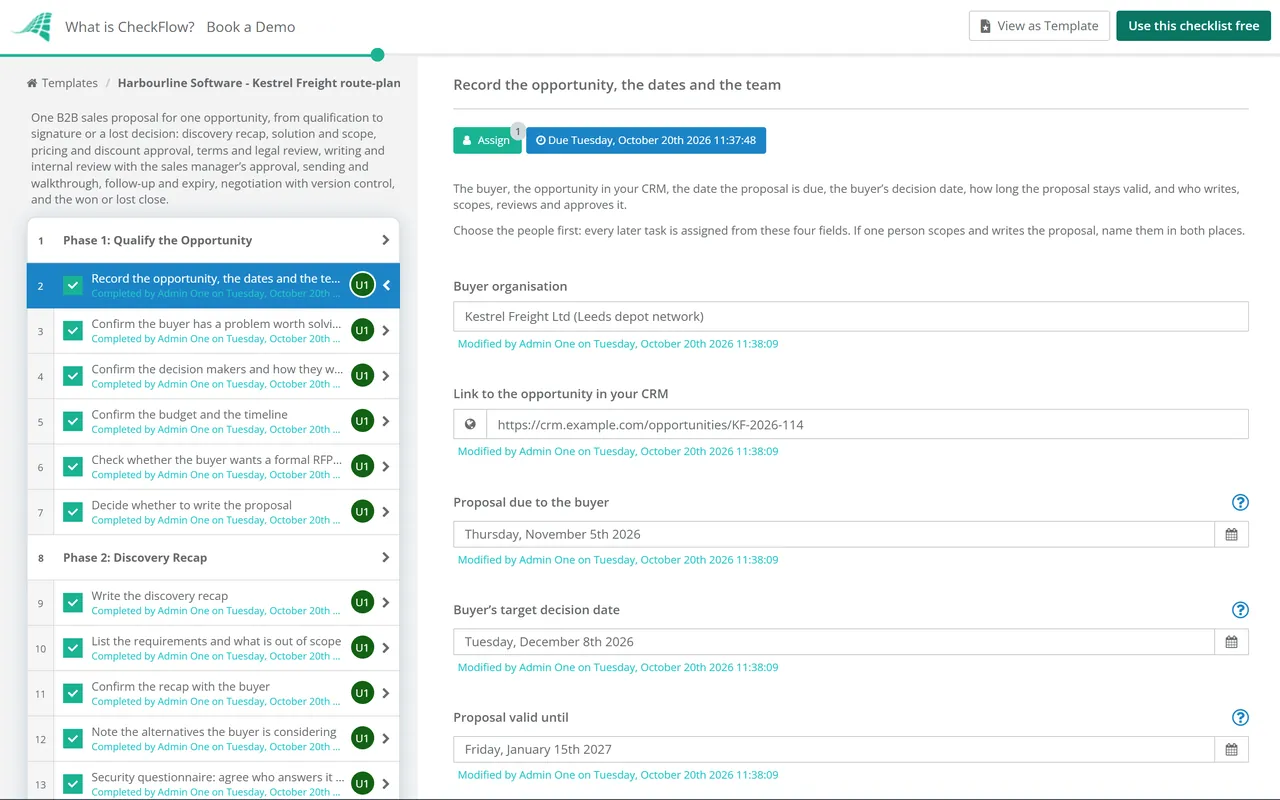
    Confirm the deal is worth a proposal before anyone writes one. Enter the three dates on the first task: due dates count from the date the proposal is due to the buyer, the buyer’s decision date and the date the proposal expires.

    • Record the opportunity, the dates and the team — the buyer, the opportunity in your CRM, the date the proposal is due, the buyer’s decision date, how long the proposal stays valid, and who writes, scopes, reviews and approves it
    • Confirm the buyer has a problem worth solving now — the problem in the buyer’s own words, what it costs them, why it matters now and what happens if they do nothing
    • Confirm the decision makers and how they will decide — the person who signs, everyone who influences the decision, their criteria, and the steps the buyer must go through to sign, such as procurement, legal or security review
    • Confirm the budget and the timeline — a budget range or approved spend, who holds it, the date they want to start and anything that would move the decision date
    • Check whether the buyer wants a formal RFP or a security questionnaire — a scored tender with fixed questions, a format and a deadline is a different process from a proposal you write for one buyer, and a security questionnaire needs its own owner
    • Decide whether to write the proposal — the deal is qualified, the buyer has agreed to receive the proposal and to a meeting to go through it, and the deal is worth the time it will take
  2. Phase 2

    Phase 2: Discovery Recap

    5 tasks

    Play back what you heard before you write anything. A proposal built on a recap the buyer has confirmed holds no surprises for them.

    • Write the discovery recap — the buyer’s situation, the problem and its impact, the outcomes they want and how they will measure success, in their words rather than yours
    • List the requirements and what is out of scope — the must-haves, the nice-to-haves and anything the buyer has asked for that you will not include, so the proposal says it plainly
    • Confirm the recap with the buyer — send it or go through it on a call, and correct anything they say you got wrong before the proposal is written
    • Note the alternatives the buyer is considering — another supplier, building it themselves, a cheaper option or doing nothing, and why your proposal is the better fit for this buyer
    • Security questionnaire: agree who answers it and by when — the person who answers each section, the evidence you can share and under what agreement, and the buyer’s deadline for the answers
  3. Phase 3

    Phase 3: Solution, Scope & Timeline

    4 tasks

    Scope the work with the people who will deliver it. Every line here becomes a promise in the proposal.

    • Match the solution to the buyer’s requirements — each requirement matched to what you will provide, with anything you cannot meet, or can only partly meet, stated plainly
    • Write the scope of work and the deliverables — what is included, what is not, what the buyer must provide, and the assumptions the price depends on
    • Agree the delivery timeline and milestones — a realistic start date, the milestones and go-live, checked with whoever will deliver the work
    • Confirm the people and capacity to deliver — the delivery or customer success team can start on the dates you propose, with the skills the scope needs
  4. Phase 4

    Phase 4: Pricing & Discount Approval

    4 tasks

    Price from your price list and the scope above. A discount above the account executive’s own limit adds an approval task for the sales manager, who passes it to finance when it is above their limit too.

    • Build the price from the price list and the scope — every line, quantity, term and one-off fee, matched to the scope and assumptions in Phase 3
    • Check the margin and any third-party costs — partner, licence, travel or delivery costs included, and the margin within your pricing policy
    • Record any discount and what the buyer gives in return — the discount, the reason for it, and what you get for it, such as a longer term, an earlier signature or a case study
    • Sales manager approves the discount — a discount above the account executive’s limit is approved, reduced or refused, and passed to finance when it is above the sales manager’s own limit
  5. Phase 5

    Phase 5: Terms & Legal Review

    5 tasks

    Agree the commercial terms before they go into the proposal. Non-standard terms requested by the buyer add a legal review.

    • Set the payment terms and invoicing — the payment schedule, how often you invoice, the currency and the payment days, from your standard terms
    • Set the contract length, renewal and notice — the initial term, whether it renews and how, and the notice either side must give to end it
    • Ask which terms the buyer needs to change — liability caps, indemnities, data protection, payment days or their own contract paper, asked about now rather than discovered at signature
    • Legal review of the requested terms — each requested change marked acceptable, acceptable with changes or not acceptable, with the position the proposal should state
    • Attach the terms the proposal is made on — your standard terms or order form, with any agreed changes, so the buyer signs exactly what was reviewed
  6. Phase 6

    Phase 6: Write & Review the Proposal

    7 tasks

    Write for the buyer, in the buyer’s words. The sales manager approves the proposal before it is sent, and nothing after that step can be completed until they record a decision.

    • Write the executive summary in the buyer’s terms — their problem, the outcome they want, how you will get them there and what it costs, on one page and before anything about your company
    • Write the scope, timeline and pricing sections — taken from Phases 3 to 5 without changes, so every figure matches the agreed scope and the approved price
    • Add case evidence only if it is real and permitted — a customer story, reference or result you have that customer’s permission to share, or nothing at all; never an invented figure or quote
    • Write the next steps and how to accept — what happens after a yes, who signs, the start date it secures and the date the proposal expires
    • Check the proposal for accuracy and pricing — the buyer’s name, people and figures throughout, every price against the worksheet and any approved discount, and nothing left over from another proposal
    • Check the brand, format and legal wording — your current template and logo, readable on a phone, the agreed legal positions worded as legal approved them, and the file named for the buyer
    • Sales manager approves the proposal to send — pricing, any discount approval, the terms and the legal review are all in place and match the proposal; the checklist stops here until the sales manager records a decision
  7. Phase 7

    Phase 7: Send, Walk Through & Follow Up

    4 tasks

    Present the proposal in a meeting where you can rather than only by email. The walkthrough and follow-up count from the due date, and a reminder falls due a week before the proposal expires.

    • Send the approved version and record it — the final file, its version number, who it went to and when
    • Walk the buyer through the proposal — a meeting with the decision makers to go through it, answer their questions and agree the next step and its date
    • Follow up on the dates you agreed — a first follow-up within a few working days, then on the dates agreed with the buyer, each one answering a question or adding something useful
    • Check the proposal’s expiry date before it lapses — extend it, re-issue it at a new price or let it lapse on purpose, and tell the buyer which
  8. Phase 8

    Phase 8: Negotiate, Revise & Close

    9 tasks

    Record every change as a new version. The outcome decides the close tasks: a win hands the customer to delivery or customer success, and a loss or no decision records the reason and holds a debrief.

    • Log each change the buyer asks for — what was asked, by whom, and your answer, in one place, so nobody agrees a change the others do not know about
    • Get the changed price or terms re-approved — the sales manager approves revised figures or a bigger discount, and legal any changed terms, before the buyer sees them
    • Issue each revision as a new version — a new version number and date on every revised proposal, the old version marked as replaced, and only the latest one sent for signature
    • Record the buyer’s decision — won, lost or no decision, with the date and the buyer’s reason in their words
    • Won: get the contract or order form signed — the version the buyer accepted, signed by someone with authority on both sides and filed with the deal
    • Won: hand the account to delivery or customer success — the discovery recap, the scope, every promise made and the buyer’s contacts, passed on in a handoff meeting rather than a forwarded email
    • Lost or no decision: record the reason — price, scope, timing, a competitor, no budget or no decision, from the buyer where they will say, and a date to get back in touch if the door is open
    • Lost or no decision: hold a short debrief — what to repeat and what to change next time, in qualification, pricing, the proposal and the follow-up
    • Close the opportunity in the CRM and file the proposal — the final version, the outcome, the value and the reason, so the pipeline and the forecast show the real result

What Goes in a Sales Proposal, and Who Checks It

Most B2B proposals share the same sections, whatever their length. This table is a practical guide drawn from common sales practice, not a standard: adapt the sections to your buyer and what they asked for. The last column matches who checks each part in the checklist.

Section What it should say Where it often goes wrong Checked by
Executive summaryThe buyer’s problem, the outcome they want, how you will get there and the price, on one pageIt opens with your company history instead of the buyer’s problemAccount executive, then the sales manager
Understanding of the problemThe discovery recap the buyer confirmed, in their wordsIt describes the problem the product solves, not the one the buyer hasThe buyer, before the proposal is written
Solution and scopeWhat you will deliver, what is not included and what the buyer must provideOut-of-scope items are left unsaid and turn into disputes after signatureSolution or delivery lead
TimelineA start date, milestones and go-live the delivery team has agreedA start date promised to win the deal with no one free to deliver itSolution or delivery lead
PricingEvery line from the price list, any discount and what the buyer gives for itA discount agreed on a call that nobody with authority approvedSales manager, and finance above the manager’s limit
TermsPayment, contract length, renewal, notice and any agreed changes to your standard termsNon-standard terms accepted in the proposal and found by legal at signatureLegal or contracts reviewer, when terms change
Case evidenceA real customer story or reference that customer has agreed you can share, or nothingA result or quote shared without permission, or a figure nobody can sourceAccount executive
Next steps and expiryHow to accept, who signs, what happens next and the date the offer lapsesNo expiry date, so an old price stays open for monthsSales manager, at the approval to send

Length. Write as much as the buyer needs to decide and no more. A short proposal that answers their problem, their questions and their approval steps beats a long one full of material they did not ask for.

A formal RFP is different. When the buyer sets the questions, format and scoring, follow their structure exactly with the RFP Response Checklist, even where it differs from the sections above.

Why Run Sales Proposals in CheckFlow?

1

No proposal goes out unapproved

The sales manager approves the proposal before it is sent, and nothing after that approval step can be completed until they record a decision. A discount above the account executive’s limit adds its own approval task, non-standard terms add a legal review, and a commercial change during negotiation is re-approved before the buyer sees it.

2

Dates that follow the deal

Three dates on the first task drive the run: the day the proposal is due, the buyer’s decision date and the expiry date. Preparation counts back from the due date, follow-up counts forward, and a reminder falls due a week before the proposal lapses. Overdue alerts go to the person assigned, and every open proposal shows on the Reports Grid.

3

One record from first call to close

The buyer’s problem in their words, the scope, the pricing worksheet, every version sent and the follow-up log sit on the tasks that produced them. The outcome shows the signature and hand-off tasks for a win, or the loss reason and debrief for a loss or no decision.

CheckFlow does not write the proposal, set your prices or replace your CRM. Those stay with your team, your price list and your pipeline. It makes sure each proposal is qualified, scoped, priced and approved before it goes, that nobody forgets to follow up, and that every deal closes with a reason recorded. Workflow software shows how handoffs between sales, delivery and legal run in CheckFlow.

Run the discovery conversation with the Sales Pitch Checklist, keep the deal moving after you send it with the Sales Follow-Up Checklist, and check each stage of the deal with the Sales Pipeline Stages Checklist. Answer a formal tender with the RFP Response Checklist, and when the deal is won, pass it on with the Sales to Customer Success Handoff Checklist.

AI generator

Didn’t find what you need? Describe it.

Describe the process in a sentence and the AI checklist generator drafts the phases and tasks for you.

Frequently Asked Questions

What should a sales proposal include?

An executive summary in the buyer’s terms, your understanding of their problem, the solution and scope (including what is not included), a timeline, the price with any discount, the terms, case evidence only where it is real and you have permission to share it, and the next steps with an expiry date. The table above sets out what each section should say and who should check it. A formal RFP follows the buyer’s own structure instead.

What is the difference between a sales proposal and an RFP response?

You write a sales proposal for one buyer after discovery, in a shape you choose. An RFP response answers a formal request the buyer has issued, usually to several suppliers, in their format, by their deadline, and is scored against criteria they published. Missing a requirement or a deadline can rule an RFP response out. If the buyer issues an RFP, run it with the RFP Response Checklist rather than this one.

Who should approve a sales proposal before it is sent?

Usually the sales manager, who checks that the price matches the price list and scope, that any discount was approved by someone with the authority to approve it, and that any non-standard terms have been through legal. A discount above the manager’s own limit normally goes to finance as well. Set the limits in your own discount policy; the checklist adds the approval task when the discount is above the account executive’s limit.

How long should a sales proposal be valid for?

Long enough for the buyer’s approval steps and short enough to keep your prices and delivery dates current. Many businesses use 30, 60 or 90 days, set by their own policy. Put the expiry date on the proposal, and decide before it lapses whether to extend it, re-issue it at a new price or let it go. The checklist sets a reminder a week before the date.

How do you follow up on a sales proposal?

Agree the next step and its date in the walkthrough, then follow up when you said you would. Send the first follow-up within a few working days if no date was agreed, and make each one useful: an answer to a question, a revised figure or a reference call, rather than just asking whether they have read it. The Sales Follow-Up Checklist sets out a full cadence.

Should you email a sales proposal or present it?

Present it if you can. A meeting with the decision makers lets you take them through the proposal, answer questions and agree the next step there and then, and send the file afterwards. A proposal that only arrives by email is easy to forward without context or leave unread. If the buyer insists on email, send it with a short note and book a call to go through it.

How do you manage proposal versions during negotiation?

Give every revised proposal a new version number and date, mark the old one as replaced, and log each change the buyer asks for with your answer. Have any change to the price, discount, scope or terms re-approved before the buyer sees it. Send only the latest approved version for signature, so the contract matches what everyone agreed.

Is CheckFlow free for this template?

14-day free trial, no card required. The Business plan is $10 per user per month after the trial. Full details at checkflow.io/pricing.

Send Every Proposal Checked, Approved and Followed Up

Free trial — no credit card required.

14-day free trial, no credit cardFull refund in your first 30 daysUS hosting, EU on request