B2B buyers spend only 17% of their total purchase time with all vendors combined. A sales pitch that opens with a company overview slide spends half that time on the rep’s agenda before a single question has been asked about the buyer’s.
The sales pitch is not a presentation. It is a conversation with a defined objective — and the objective is rarely to impress the buyer with features. It is to help the buyer understand that they have a problem worth solving, that the solution the rep is presenting solves it better than the alternatives, and that the next step is clear and easy to take. The pitches that consistently produce pipeline are built on thorough preparation (so the rep does not ask basic questions that a two-minute website search would answer) and genuine discovery (so the value proposition is built around the buyer’s specific situation, not a generic product description). A structured sales pitch checklist ensures every pitch is prepared and executed to the same standard: research done before the call, discovery questions planned and asked, value proposition tailored to what was discovered, objections prepared for and handled with evidence, next steps agreed and documented, and the CRM updated before moving to the next call. This free checklist gives B2B sales reps, account executives, and business development teams a structured framework for the full sales pitch process.
Discovery Call, Demo, Proposal — What Changes at Each Stage
Stage 1
Discovery Call
Understand the buyer’s situation, problems, implications, and priorities. The rep’s job is mostly to ask questions and listen.
Ratio: 70% listening, 30% talking.
Output: A qualified understanding of the buyer’s situation and whether there is a fit worth pursuing.
Stage 2
Demo / Presentation
Show specifically how the solution addresses the buyer’s particular situation — using what was learned in discovery.
Ratio: 50% demonstration, 50% discussion.
Output: The buyer understands the value and is ready to discuss moving forward.
Stage 3
Proposal Presentation
Present the specific commercial proposal; handle remaining objections; agree next steps toward close.
Ratio: 40% presentation, 60% discussion and negotiation.
Output: A clear decision or a defined path to one.
What the Sales Pitch Checklist Covers
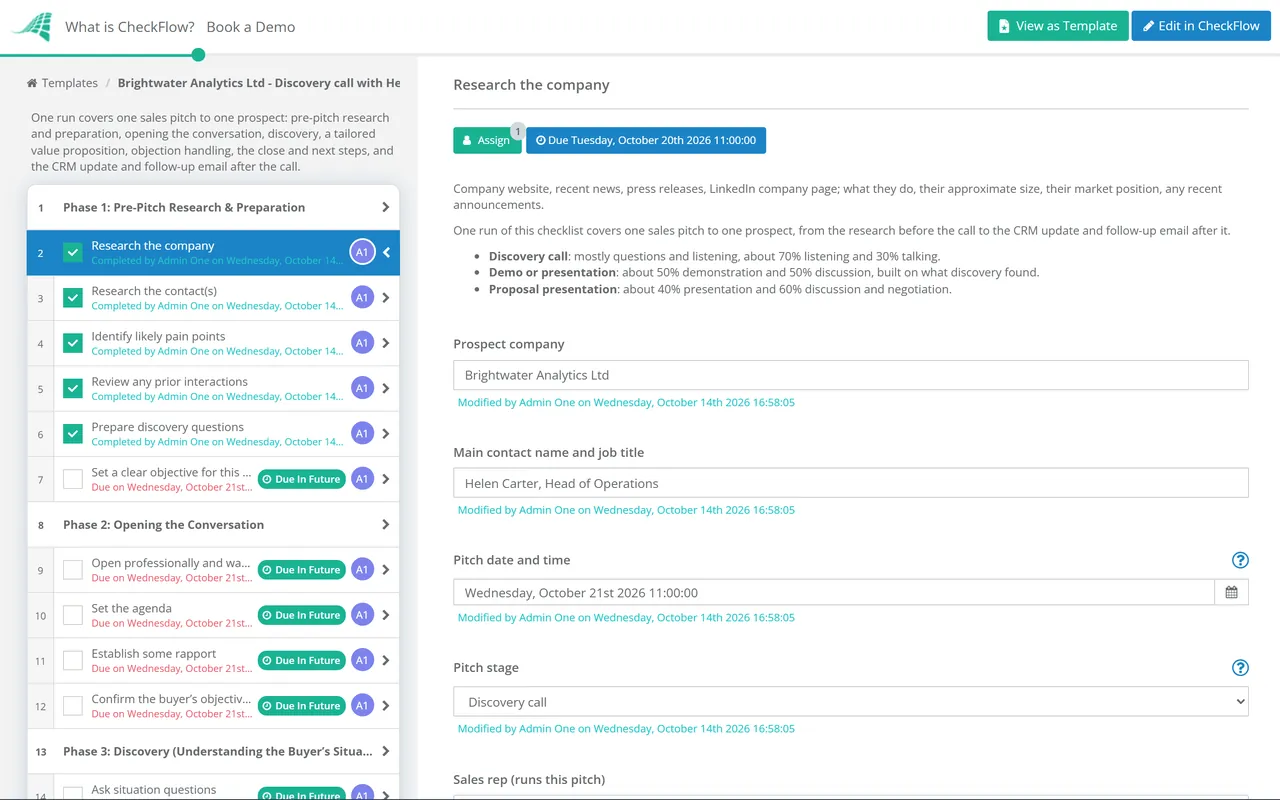
This checklist is structured across seven phases covering the full sales pitch process — from pre-call research through to CRM update and follow-up.
Phase 1
Phase 1: Pre-Pitch Research & Preparation
“The research that takes 15 minutes before a call prevents the 40 minutes of awkward questions during it. Buyers notice when a rep has done their homework. They also notice — and remember — when they have not.”
Research the company — company website, recent news, press releases, LinkedIn company page; what they do, their approximate size, their market position, any recent announcements
Research the contact(s) — LinkedIn profile; their role and responsibilities; how long in the role; any public content (articles, posts) that reveals their priorities
Identify likely pain points — for the contact’s role and company type; what problems do companies like this typically have that the product addresses?
Review any prior interactions — CRM history; previous calls, emails, demonstrations; what was said before; do not ask a buyer to repeat information already given
Prepare discovery questions — 3–5 open-ended questions that will reveal the buyer’s situation, current solutions, pain points, and priorities
Set a clear objective for this call — what is the single desired outcome? Agreement to a demo? An introduction to the decision-maker? A proposal request? Be specific
Phase 2
Phase 2: Opening the Conversation
Open professionally and warmly — introduce yourself and the company briefly; confirm the allotted time; ask if the timing still works
Set the agenda — “I’d like to spend a few minutes understanding your situation before I share how we might be able to help — does that work for you?”
Establish some rapport — genuine, not forced; a comment based on the research (a recent announcement, a shared connection, a relevant article they shared); not a generic opener
Confirm the buyer’s objective for the call — “What would make this a useful call for you today?”; the buyer’s objective may differ from the rep’s assumption
Phase 3
Phase 3: Discovery — Understanding the Buyer’s Situation
“The rep who pitches before discovering has guessed the buyer’s priorities. The rep who discovers first does not have to guess — they address what the buyer actually said matters. The quality of the pitch is entirely a function of the quality of the discovery that preceded it.”
Ask situation questions — current state; how they currently manage the problem; tools or processes already in use
Ask problem questions — what is not working well? What pain points or inefficiencies exist with the current approach?
Ask implication questions — what is the impact of the problem? Cost, time, risk, missed opportunities? Making the stakes explicit
Ask need-payoff questions — what would it mean for the business if this was solved? What does the ideal outcome look like?
Listen more than speak — 70% listening in discovery; let the buyer describe their situation fully before any pitch begins
Confirm understanding before pitching — “From what you’ve described, it sounds like [paraphrase the key pain]. Is that the priority?”; get explicit confirmation
Phase 4
Phase 4: Tailored Value Proposition
Lead with the buyer’s problem — not the product features; “Based on what you’ve told me, here’s what we see with teams like yours and how we address it”
Connect each capability to a specific stated pain — not a full feature list; the features that address what the buyer said they need; everything else is noise
Use specific evidence — a relevant customer story, a metric, or a specific outcome; “A customer similar to you reduced X by Y in Z weeks” is more compelling than “our customers love us”
Differentiate from the likely alternative — what is the buyer comparing to? Competing product, spreadsheet, or doing nothing? Address the comparison specifically
Phase 5
Phase 5: Objection Handling
Acknowledge, then respond — never dismiss or override an objection; “That’s a fair point — can I ask what’s driving that concern?”; understand before responding
Prepare for the most common objections — price (“too expensive”), timing (“not right now”), competition (“we use X”), and authority (“I need to speak to my team”); have evidence-based responses ready
Distinguish objections from stalls — an objection is a specific concern that can be addressed; a stall is avoidance; treat each differently
Confirm the objection is resolved — “Does that address your concern?” before moving on; do not assume a response resolved it
Phase 6
Phase 6: Close and Clear Next Steps
Summarise what was agreed — the buyer’s stated priorities; how the product addresses them; any remaining open questions
Ask for the next step — clearly and confidently; a specific next action, not “I’ll send you some information”; “Would it make sense to book a demo with your team this week?”
Confirm the next step is in the diary — before the call ends; a next step agreed but not scheduled is a next step unlikely to happen
Identify any other stakeholders — “Is there anyone else who should be involved in the next conversation?”; B2B now averages 6–10 decision stakeholders
Phase 7
Phase 7: CRM Update & Follow-Up
Update the CRM immediately — after the call; call notes including: key pain points stated, objections raised, what resonated, next step agreed, timeline, stakeholders identified
Log the outcome — qualified, not qualified, nurture, or closed; advance the pipeline stage if appropriate
Send the follow-up email — within 2 hours; summary of what was discussed, agreed next steps, any promised materials; confirms the conversation in writing
This checklist is available as a free, runnable template in CheckFlow — with tasks assigned to the rep, discovery phases structured into the workflow, and CRM documentation steps built in at the end of every call.
SPIN Selling — the Four Question Types That Build Buyer Conviction
Developed by Neil Rackham from research into over 35,000 sales calls, SPIN Selling identifies the question sequence that consistently drives buyer commitment in complex B2B sales.
S
Situation
Understanding the buyer’s current context — how things work today, what tools and processes are already in use.
“How do you currently manage [process]?”
Use sparingly — too many situation questions feel like an interrogation and slow the conversation down.
P
Problem
Identifying pain in the current situation — what is not working, what causes frustration, what creates risk or inefficiency.
“What are the main challenges with your current approach?”
Opens the buyer’s awareness of a problem worth solving.
I
Implication
Making the problem significant — the consequences for the business, the team, the outcome. Buyers who feel the pain more acutely are more motivated to act.
“What impact does that have on [outcome the buyer cares about]?”
N
Need-Payoff
The buyer articulates the value of a solution — in their own words, for their specific situation. The buyer sells themselves.
“How valuable would it be if you could [resolve the problem]?”
Top performers ask significantly more Implication and Need-payoff questions than average performers.
Why Run Sales Pitches in CheckFlow?
1
Pre-call preparation that happens every time
The rep who skips research on a busy Monday morning and asks the buyer what their company does has not just lost credibility — they have lost 17% of the buyer’s total available vendor interaction time on questions that should have been answered before the call. CheckFlow’s pre-pitch phase is a required step before the call begins.
2
Discovery documented for every pitch
The CRM notes that say “good call, following up” contain nothing useful for the next rep who takes over, the manager reviewing the pipeline, or the rep preparing for the next call. CheckFlow’s post-pitch phase requires specific notes: pain points stated, objections raised, what resonated, next step agreed. The notes that make the next interaction better.
3
Consistent pitch quality across the whole team
The best rep’s pitch is no better than an average pitch if it only happens in 20% of the team’s calls. A consistent pitch process — the same research, the same discovery framework, the same close discipline — applied to every call by every rep is the mechanism by which the team’s average improves.
A great pitch creates a follow-up obligation. CheckFlow’s Sales Follow-Up Checklist covers the structured multi-touch follow-up process that converts pipeline into closed deals. See the Sales Follow-Up Checklist →
Pitch outcomes feed the sales pipeline. CheckFlow’s Sales Pipeline Stages Template covers the structured pipeline management process from lead to close. See the Sales Pipeline Stages Template →
A sales pitch checklist covers seven phases: pre-pitch research (company and contact research, likely pain points, CRM history review, discovery questions prepared, call objective set), opening and rapport (professional warm opening, agenda setting, genuine rapport, buyer objective confirmed), discovery (situation, problem, implication, and need-payoff questions; 70% listening; understanding confirmed), tailored value proposition (lead with buyer’s problem, connect capabilities to stated pains, specific evidence, differentiation from alternatives), objection handling (acknowledge then respond, common objections prepared, stalls distinguished from objections, resolution confirmed), close and next steps (summary, specific next step asked, next step scheduled, additional stakeholders identified), and CRM update (call notes with pain points and next step, outcome logged, follow-up email within 2 hours).
What is SPIN selling?
+
SPIN Selling is a sales methodology developed by Neil Rackham based on research into over 35,000 sales calls. It identifies four question types that build buyer conviction in sequence: Situation questions (understanding the buyer’s current context), Problem questions (identifying specific pain points in the current approach), Implication questions (making the implications of the problem explicit and significant to the buyer), and Need-payoff questions (inviting the buyer to articulate the value of a solution). SPIN Selling research showed that top performers ask significantly more Implication and Need-payoff questions than average performers, while average performers ask more Situation and Problem questions.
How long should a B2B sales pitch be?
+
Length should match the format and stage. A discovery call should typically run 30–45 minutes, with the majority of that time spent on discovery questions rather than product description. A demo should typically run 45–60 minutes, with time for Q&A. A proposal presentation should run as long as the proposal requires, but should not exceed 90 minutes in a first meeting. The most important constraint is not duration but ratio: in a discovery call, the rep should be speaking less than 30% of the time. A pitch that spends more than half its time on the rep’s product narrative before understanding the buyer’s situation is a pitch built around the wrong agenda.
How should objections be handled in a sales pitch?
+
Objections should be handled in four steps: acknowledge (demonstrate that the objection has been heard — never dismiss, override, or talk past it), clarify (ask a question to understand the specific concern — “Can I ask what’s driving that concern?” — rather than immediately defending against what you think the objection means), respond with evidence (address the specific concern with a concrete response — a relevant customer example, a specific comparison, or an offer to address the concern in the proposal), and confirm resolution (“Does that address your concern?”).
Is CheckFlow free to use for this template?
+
You can start a free 14-day trial with no credit card required, giving you full access to all features including this template. The Business plan is $10 per user per month after the trial. Full details at checkflow.io/pricing.
Prepare Every Pitch, Discover Before You Pitch, and Close Every Call With a Next Step
Free trial — no credit card required.
Do you like cookies? 🍪 We use cookies to ensure you get the best experience on our website. Learn more