
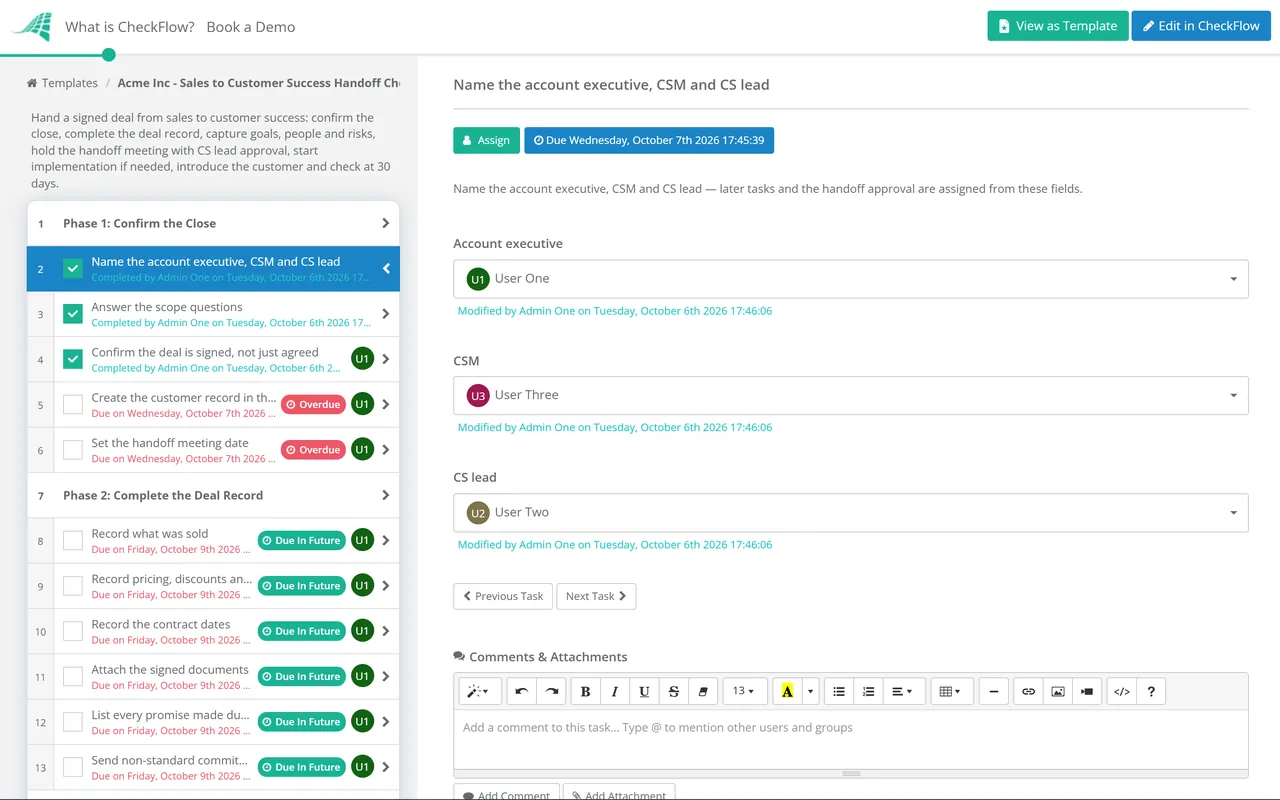
Sales to CS, inside your company
Starts at the signed order form and ends when the CSM has accepted the account, met the customer and booked the kickoff. It moves facts, promises and relationships from one team to another.
Last reviewed: October 2026
No Credit Card Required
Printed from checkflow.io/templates/customer-management/sales-to-cs-handoff-checklist
This free template is for account executives, customer success managers and the CS leads who manage both sides of the handoff. It runs from the signed order form to the moment the CSM owns the account: a complete deal record, the customer’s goals in their own words, the stakeholders, every promise made during the sale, an internal handoff meeting, a warm introduction and a check 30 days later that nothing was lost. Two scope questions tailor each run. A deal with non-standard terms or commitments shows a legal and product review task, and a customer who needs an implementation project shows the phase that hands the account to the implementation team.
A handoff fails in one of three ways. The information never moves: the CSM gets a CRM link and a two-line note, and the customer is asked at kickoff to repeat what they told sales. The information moves but is wrong: the record says 50 seats when the order form says 40, or the renewal date is the signature date rather than the start date. Or a promise moves only in the account executive’s memory: the integration that was “on the roadmap”, the discount that ends after year one, the response time agreed in an email thread. That last kind does the most damage, because the customer remembers it and the CSM has never heard of it.
The fix is a fixed list of what must be written down before the CSM accepts the account, a short meeting to walk through it, and a check 30 days later. This template is that list. It stops when the customer has met their CSM and the next stage is running.
Treat the handoff as part of the sale rather than admin after it. Account executives are usually paid on signature, so the record competes with the next deal for their time. Making acceptance a gate rather than a courtesy is what gets it done: until the CS lead accepts, the deal is closed but the handoff is still open, and both teams can see it.
Starts at the signed order form and ends when the CSM has accepted the account, met the customer and booked the kickoff. It moves facts, promises and relationships from one team to another.
Starts at kickoff: account set-up, training and the first real workflow. Run it with the SaaS Customer Onboarding Checklist or, for small accounts, the Simple Customer Onboarding Checklist.
Enterprise deals with a security review, single sign-on, integrations or data migration. Phase 5 here hands over to the Enterprise Customer Implementation Checklist.
Seven phases run from the signed order form to a 30-day check that nothing was lost. Phase 5 appears only when the customer needs an implementation project, and the legal and product review task in Phase 2 appears only when the deal included non-standard terms or commitments.
Start this checklist the day the order form is signed, not when the CSM has time.
Shown only when the customer needs an implementation project.
The days below suit a mid-market deal. Set the template’s due dates to match your own sales cycle, but keep the order: the record is complete before the handoff meeting, and the meeting happens before the customer meets the CSM.
The order form is signed and the opportunity is closed-won. The checklist starts, the roles are named and the scope questions are answered. The account executive thanks the customer and says a CSM will be in touch this week.
The account executive fills in what was sold, the contract dates, the promises and the customer’s goals while the conversations are fresh. Non-standard commitments go to legal and product.
Thirty minutes, account executive and CSM, record on screen. The CS lead accepts the account or sends it back with named gaps.
The account executive introduces the CSM by email or on a short call. Where an implementation project is needed, the implementation lead is introduced at the same time.
The CSM replays the goals, confirms the stakeholders and shares the onboarding plan. The customer should hear nothing they have to correct.
The CSM asks the customer directly whether anything promised is missing and rates the handoff. Patterns go back to the sales leader.
What the CS lead checks before accepting. Acceptance is not a formality. The CS lead reads the record against the order form and sends it back if any of these is missing or does not match:
Larger deals start earlier. For enterprise accounts many teams bring the CSM into late-stage calls, so the customer meets them before signature and the handoff meeting confirms what both already know. The checklist still applies; the record still has to be written down.
Start the checklist from your CRM’s closed-won event through the API and webhooks or Zapier, and every due date counts from the signature. Tasks go to the account executive, CSM and CS lead from the role fields.
The CS lead’s approval halts the checklist until the record is complete, so the CSM never meets a customer with half the story. Rejections and the reasons for them stay in the history.
The handoff sits between two other templates. Before it, the Sales Pipeline Stages Checklist defines what closed-won means. After it, the SaaS Customer Onboarding Checklist takes the customer to first value, or the Enterprise Customer Implementation Checklist runs the project for larger deals. Commitments made in a proposal belong in the deal record too; the RFP Response Checklist keeps them in one place.
Building a repeatable customer journey? CheckFlow for client onboarding runs the handoff, onboarding and implementation from templates, so every new customer starts with the same facts on file.
SaaS Customer Onboarding Checklist

Enterprise Customer Implementation Checklist

Sales Proposal Checklist

Quarterly Business Review (QBR) Checklist
MSP Sales-to-Onboarding Handoff Checklist
Describe the process in a sentence and the AI checklist generator drafts the phases and tasks for you.
Everything the CSM needs so the customer never has to repeat themselves: what was sold, the price and any discounts with their end dates, the contract start, renewal and notice dates, the signed documents, and every promise made during the sale. Add the customer’s goals in their own words, measurable success criteria, the stakeholders and the technical environment, plus the risks the account executive saw and why the customer bought now.
As soon as the contract is signed, and before the customer meets the CSM. Starting on the signature date catches the account executive’s memory while it is fresh and stops the customer waiting. A common pattern is a complete deal record within three working days, an internal handoff meeting by the end of the first week and a warm introduction straight after it. For larger deals, bringing the CSM into late-stage calls shortens the handoff further.
The CSM owns the relationship and the outcome from the moment the CS lead accepts the handoff. The account executive usually keeps a defined role: the executive relationship, escalations they can help with and, in many teams, expansion deals. Agree that split in the handoff meeting and write it down, so the customer knows who to call and two people are not contacting the customer about the same thing.
The handoff moves information inside your company; onboarding moves the customer to first value. The handoff ends when the CSM has accepted the account and met the customer. Onboarding starts at kickoff with account set-up, training and the first real workflow. Enterprise deals with security reviews, integrations and data migration add a third stage, an implementation project, which usually runs before the customer is fully live.
Not the internal one. The handoff meeting is where the account executive and CSM go through the record frankly, including the risks and the stakeholder who argued against the purchase, which is hard to do with the customer listening. The customer joins the warm introduction straight afterwards, where the account executive introduces the CSM and the CSM replays the goals so the customer can see nothing was lost on the way.
Make listing them a required task and make the CSM’s acceptance depend on it. The account executive writes down every commitment made on calls, in emails and in the proposal, and anything non-standard goes to legal and product for a yes, a no or a date. At 30 days the CSM asks the customer directly whether anything promised is missing, while there is still time to put it right.
14-day free trial, no card required. The Business plan is $10 per user per month after the trial. Full details at checkflow.io/pricing.
14-day free trial, no credit cardFull refund in your first 30 daysUS hosting, EU on request