
A structured contract review process that finds the risk before signature, not the liability after it — consistently, for every contract, regardless of how busy the legal team is.
Research from World Commerce & Contracting shows that poor contract management causes 9% of value erosion for organisations. That loss is not usually in a single dramatic contract failure — it accumulates across dozens of contracts where liability caps were not updated, payment terms were less favourable than standard, IP ownership was ambiguous, data protection obligations were not correctly captured, or termination rights were weaker than they should have been. A structured contract review process does not prevent all of this — but it consistently catches the material issues: verifying that the parties are correctly identified and authorised, that obligations and payment terms are clear and appropriate, that liability is correctly allocated, that data protection requirements are addressed, and that dispute resolution and termination rights are defined. Only 12% of legal teams had achieved end-to-end contract automation as of 2025 — for the 88% still running manual processes, a structured checklist is the primary quality control mechanism. This free checklist gives legal, procurement, and commercial teams a structured framework for the full contract review and approval cycle.
This checklist describes a process framework. It does not constitute legal advice. Consult qualified legal counsel for advice specific to your contracts and jurisdiction.
Not All Contracts Are Equal — a Risk-Based Triage Framework
High-Risk
Full Legal Review
Characteristics: High contract value; bespoke terms from the counterparty; significant liability exposure; IP or data-intensive; affects a critical business function.
Process: Full legal review; multiple internal stakeholder review; may require external counsel; Legal Director or GC sign-off.
Medium-Risk
Standard Legal Review
Characteristics: Material but not strategic; follows broadly standard form; value within normal business parameters.
Examples: Professional services agreements, standard vendor contracts, customer agreements on company template.
Process: Legal review of key clauses; business owner review; department head sign-off.
Low-Risk
Streamlined Review
Characteristics: Low value; standard form terms; limited liability exposure; well-understood counterparty and subject matter.
Examples: Standard NDAs on company paper, routine purchase orders, pre-approved vendor agreements within existing MSAs.
Process: Compliance check against approved template; business owner approval; no full legal review required.
The Contract Review & Approval Checklist
Six phases covering the full contract review and approval cycle — from intake and triage through legal review, negotiation, execution, and post-execution obligation tracking.
Phase 1
Contract Intake & Risk Triage
Intake quality determines review quality. A contract submitted without context — who sent it, what it is for, what the commercial terms are, who the authorising business owner is — cannot be triaged or reviewed efficiently.
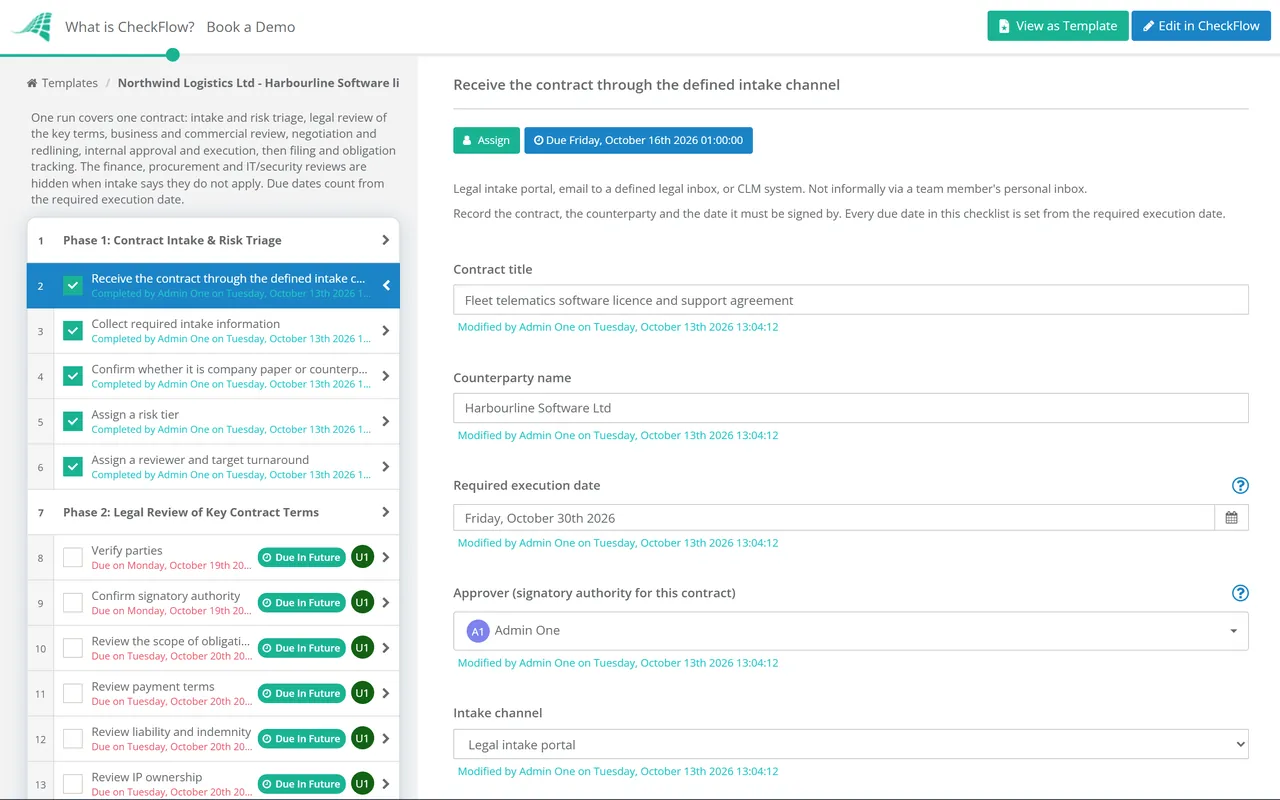
Receive the contract through the defined intake channel — legal intake portal, email to a defined legal inbox, or CLM system; not informally via a team member’s personal inbox
Collect required intake information — contract type, counterparty name, estimated contract value, business purpose, required execution date, and the internal business owner
Confirm whether it is company paper or counterparty paper — company paper (your standard template) is lower risk; counterparty paper requires full review
Assign a risk tier — high, medium, or low; based on value, contract type, counterparty paper, and business criticality
Assign a reviewer and target turnaround — based on the risk tier; communicate the expected turnaround time to the requestor
Phase 2
Legal Review of Key Contract Terms
Legal review is not a binary pass/fail. It is an identification of risk, negotiation positions, and required changes — prioritised by materiality. Not every imperfect clause is worth a negotiation round.
Verify parties — full legal names, registered addresses, and company registration numbers of all parties; confirm the signing entity is the correct legal entity
Confirm signatory authority — the counterparty’s signatory has actual authority to bind the organisation
Review the scope of obligations — are the deliverables, services, or goods clearly and specifically defined? Is ambiguity that could create dispute resolved?
Review payment terms — amount, due date, payment method, invoicing procedure, late payment interest; consistent with internal policy
Review liability and indemnity — liability cap (at what multiple of contract value?), indemnity triggers, consequential loss exclusion, and any uncapped liability carve-outs
Review IP ownership — who owns what is created under the contract; any licence grants back to the counterparty
Review data protection — processor/controller roles; lawful basis for processing; data processing agreement included or required; breach notification obligations
Review termination rights — for cause and for convenience; notice periods; consequences of termination (payment, return of materials, transition obligations)
Review governing law and dispute resolution — jurisdiction acceptable; dispute resolution mechanism (litigation, arbitration, mediation) appropriate for contract value and relationship
Review any unusual or non-standard clauses — audit rights, exclusivity, non-solicitation, assignment restrictions, change of control triggers
Phase 3
Business & Commercial Review
Business owner review — the internal business owner confirms the commercial terms accurately reflect the agreed deal; the scope is correct; the pricing and payment terms are as agreed
Finance review (where applicable) — for contracts above a defined value; payment terms impact on cash flow; budget approval confirmed
Procurement review — for vendor contracts; supplier qualification; purchasing policy compliance; preferred supplier status if applicable
IT/security review — for contracts involving data processing, software access, or significant IT integration; security standards confirmed
Confirm insurance requirements — the counterparty’s required insurance is in place; any company insurance requirements on the company side confirmed
Phase 4
Negotiation & Redlining
Consolidate all review comments — from legal, business, finance, and any other reviewers into a single redline; avoid multiple sets of comments creating conflicting positions
Prioritise negotiation points — must-have changes vs nice-to-have; the counterparty’s standard positions that are not worth a negotiation round vs genuinely material issues
Issue the redline to the counterparty — via the agreed method; tracked changes; explain significant changes briefly
Manage the negotiation correspondence — in the matter record; every version and exchange retained; no verbal agreed changes without written confirmation
Confirm all agreed changes are in the final version — compare the final document against the agreed redline; verbal agreements not in the document do not exist
Phase 5
Internal Approval & Contract Execution
Obtain all required internal approvals — per the signatory authority matrix; confirm the approver has authority for this contract type and value
Obtain legal sign-off on the final version — the reviewing attorney or legal operations confirms the final version reflects all agreed changes
Execute the contract — via e-signature or wet signature; confirm both parties’ signatories have executed
Confirm effective date — the date from which obligations run; confirmed and recorded correctly
Distribute executed copies — to all parties and relevant internal stakeholders; confirm receipt
Phase 6
Contract Filing & Obligation Tracking
File the executed contract — in the central contract repository; all versions, correspondence, and approvals retained
Update the contract register — party names, effective date, expiry/renewal date, key terms, obligations, and value
Set renewal and notice alerts — immediately; not at the start of the next year
Identify and assign ongoing contract obligations — reporting, insurance, SLA monitoring, payment milestones; named owner for each
Brief the business owner — on key obligations, renewal dates, and any restrictions or requirements they need to manage
This checklist is available as a free, runnable template in CheckFlow — with intake, review, negotiation, approval, and filing all tracked in a single workflow with a complete audit trail from the first review to execution.
The Four Elements Every Contract Must Have to Be Legally Enforceable
Capacity
Legal Capacity to Contract
Both parties must have the legal capacity to enter into a contract — the authority to bind themselves or their organisation. Verify: Is the signatory authorised? Does the organisation’s constitutional documents limit what it can contract for?
Consent
Free and Genuine Agreement
The agreement must be freely entered into without duress, undue influence, or misrepresentation. Verify: Is there a signed agreement by authorised representatives? Is the agreement free from clauses that could be challenged as agreed under duress?
Consideration
Mutual Exchange of Value
There must be a mutual exchange of value — each party gives something and receives something in return. Verify: Are both sides’ obligations clear? Is payment or counter-obligation explicitly defined?
Compliance
Legality of Purpose
The contract must not require either party to do something illegal, and must comply with applicable laws and regulations. Verify: Does the contract comply with data protection, employment law, competition law, and sector-specific regulatory requirements?
Why Run Contract Reviews in CheckFlow?
1
A consistent review process regardless of who is reviewing
Contract review quality should not depend on which attorney reviews a file or how busy the team is. CheckFlow’s contract review checklist walks through every material review area for every contract at its assigned risk tier — liability cap, IP ownership, data protection, termination rights, and signatory authority — ensuring consistent coverage regardless of who handles the matter.
Multi-party review coordinated in a single workflow
A contract review that involves legal, commercial, finance, and IT reviewers — with their comments consolidated into a single redline — requires coordination. CheckFlow assigns each review role to the appropriate team member, tracks outstanding reviews, and prevents the final approval stage from advancing until all required reviews are complete.
An auditable contract record from intake to execution
When a dispute arises over what was agreed, what was reviewed, and who approved what, the contract record in CheckFlow provides the complete history: the intake date, all review comments, the negotiation correspondence, the approval record, and the execution date. The record that protects the organisation in a dispute is created automatically as the process runs.
Once a contract is executed, it needs to be tracked for renewal. CheckFlow’s Contract Renewal Reminder Checklist covers the proactive process for managing upcoming expiry and renewal decisions. See the Contract Renewal Reminder Checklist →
For NDA-specific review and processing — a high-volume, faster-turnaround sub-category of contract review — CheckFlow’s NDA Processing Workflow covers the streamlined NDA-specific process. See the NDA Processing Workflow →
A contract review checklist should cover six phases: intake and triage (collecting context, assessing risk tier, assigning reviewer and turnaround), legal review (parties, signatory authority, scope, payment terms, liability and indemnity, IP ownership, data protection, termination rights, governing law), business and commercial review (commercial accuracy, finance approval, procurement compliance, IT/security assessment), negotiation (consolidated redline, prioritised negotiation points, version management), approval and execution (signatory authority matrix compliance, legal sign-off on final version, execution and distribution), and filing and obligation tracking (contract register update, renewal alerts, and obligation assignment).
What are the most important contract clauses to review?
+
The clauses with the highest risk if poorly drafted are: liability cap (does it adequately limit the organisation’s exposure, and are the carve-outs proportionate?), IP ownership (particularly for contracts involving development work, creative services, or data), data processing provisions (required under GDPR and applicable privacy laws whenever personal data is involved), termination rights (for cause and for convenience — what is the notice period, what are the consequences?), payment terms (particularly late payment and dispute mechanisms), and governing law and jurisdiction (which law applies and where disputes are heard). The most commonly missed clause is the change of control provision — which determines whether the contract can be assigned if either party is acquired.
How should contracts be triaged by risk level?
+
Risk-based triage assigns a review level based on the contract’s potential impact. High-risk contracts — high value, bespoke counterparty terms, significant liability exposure, or involving critical business functions — warrant full legal review with appropriate senior sign-off. Medium-risk contracts — material but following broadly standard form — warrant standard legal review of key clauses. Low-risk contracts — low value, standard template, limited liability exposure — can be processed via a streamlined compliance check against an approved template without full legal review. The triage criteria should be defined in advance and applied consistently so the legal team’s capacity is focused on genuine risk rather than routine processing.
What is the signatory authority matrix and why is it critical?
+
The signatory authority matrix is an internal document defining who within the organisation has authority to execute contracts of specified types and values. For example: contracts up to £10,000 may be signed by a department head; contracts between £10,000 and £100,000 by the CFO; contracts above £100,000 require board approval. A contract signed by someone without authority to bind the organisation may not be enforceable. The matrix must be documented, consistently applied, and updated when the organisation structure changes. Contract review sign-off procedures should require confirmation that the proposed signatory is within their authority for the specific contract.
Is CheckFlow free for this template?
+
You can start a free 14-day trial with no credit card required, giving you full access to all features including this template. The Business plan is $10 per user per month after the trial. Full details at checkflow.io/pricing.
Find the Risk Before Signature — Not the Liability After It
Free trial — no credit card required.
Do you like cookies? 🍪 We use cookies to ensure you get the best experience on our website. Learn more