
Proves the site is safe to trade
- Building secure, no pests, no overnight leaks or failures
- Fridges, freezers and displays at temperature, food in date
- Hand-wash basins stocked and staff fit to work
- Today’s allergens briefed before the first order
Last reviewed: October 2026
No Credit Card Required
Printed from checkflow.io/templates/operations-facilities-management/restaurant-opening-closing-checklist
This free restaurant opening and closing checklist gives general managers, head chefs and multi-site operators one record for each trading day, started automatically before the first shift arrives. It walks the opening team through the building, equipment, temperatures and allergen briefing, records deliveries, hot holding and cooling during service, then takes the closing team through shut-down, cleaning, cash-up, waste and lock-up. Delivery checks, cooling logs and deep-clean tasks appear only on the days they apply, and the day is not finished until the closing manager signs it off.
Most kitchens keep opening and closing sheets separately, filled in by managers who rarely overlap. Yet each half depends on the other. The opener inherits whatever the closer left: unlabelled food, a walk-in door left ajar, a dishwasher fault mentioned to nobody.
The UK Food Standards Agency’s Safer Food, Better Business (SFBB) pack already treats the day as one unit. Its diary has the manager sign each day to confirm the opening and closing checks were done, with a note of anything that went differently and what was done about it. This template follows the same logic: a single checklist per trading day, opened by one manager and signed off by another, so the record an environmental health officer or US health inspector asks to see is complete in one place.
Seven phases follow the trading day from the opener’s arrival to the closer’s sign-off. Delivery checks and cooling logs in Phase 4 appear only on the days they apply, and the deep-clean tasks in Phase 5 only on the weekly deep-clean night.
Three yes/no questions here decide which delivery, cooling and deep-clean tasks today’s checklist shows.
The delivery tasks are shown only on delivery days, and the cooling log only when food is being cooled for later use.
The temperatures in Phases 3 and 4 come from two different systems. In the US, the FDA Food Code is a model that states and local health departments adopt into their own rules. In England, Wales and Northern Ireland, the limits are set by food hygiene regulations, and Scotland has its own. The table shows the figures your opening and closing checks should be written against. Where your own plan is stricter, use that.
| Control | United States (FDA Food Code) | United Kingdom |
|---|---|---|
| Cold holding | Time/temperature control for safety (TCS) food at 41°F (5°C) or below | Legal maximum of 8°C in England, Wales and Northern Ireland; the FSA recommends setting fridges to 5°C or below |
| Hot holding | 135°F (57°C) or above | 63°C or above for cooked or reheated food held for service or on display |
| Cooling | From 135°F to 70°F within 2 hours, and to 41°F or below within 6 hours in total | No single legal time; cool as quickly as possible, and many councils advise getting hot food below 8°C within 90 minutes |
| Reheating for hot holding | All parts to at least 165°F for 15 seconds, reached within 2 hours | Set in your food safety management procedures |
| Date marking | Ready-to-eat TCS food kept more than 24 hours is marked with a discard date no more than 7 days ahead at 41°F, counting the day of preparation as day 1 | Use-by dates on bought-in food; shelf life for food you make comes from your food safety management procedures |
| Allergens | Nine major food allergens; sesame became the ninth on 1 January 2023 under the FASTER Act | 14 allergens; information must be available for non-prepacked food, and food prepacked for direct sale has carried a full ingredients label with allergens emphasised since 1 October 2021 (Natasha’s Law) |
| Supervision and records | A person in charge must be on site during all hours of operation; logs as your health department and any HACCP plan require | Food safety management procedures based on HACCP principles, which SFBB helps small businesses put in place, with its daily diary and 4-weekly review |
| Hygiene rating | Grading and posting rules set by each state, city or county | Display of the food hygiene rating is mandatory in Wales (since 2013) and Northern Ireland (since 2016) and voluntary in England; Scotland runs its own scheme |
Check which Food Code edition your inspector uses. The FDA updates the Food Code on a cycle, but each state and local agency adopts it on its own timetable, so many kitchens are still inspected against an older edition. The FDA issued the 2026 Food Code on 17 September 2026. Among its changes are a requirement for a written employee illness policy and an alternative cooling process for retail food establishments. Neither applies to your kitchen until your local code adopts that edition, but Phase 3’s fit-to-work check is only as good as the policy behind it, so write one now.
Corrective actions matter more than readings. A fridge at 9°C with a note saying the food was moved, probed and partly discarded is a well-managed kitchen. A column of identical 3°C readings in the same pen invites questions. Record the actual number, every time, and write down what you did when it was wrong. SFBB asks for exactly that, and a US health inspector reading your logs will expect the same.
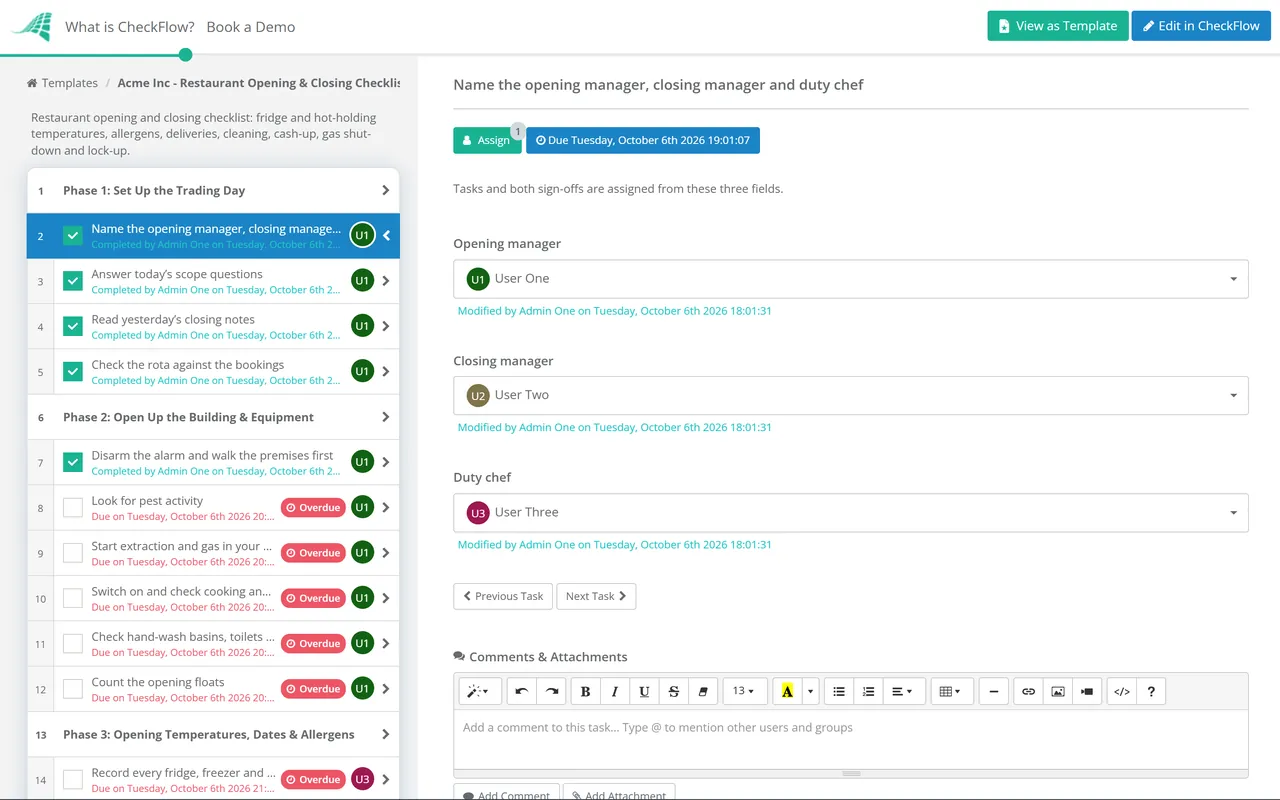
A daily schedule creates the day’s checklist before the opener arrives, with the opening manager, closing manager and duty chef assigned, and closing tasks due at your closing time.
The opening approval halts the checklist until the manager answers it, and the day is not closed until the closing manager signs it. On a day with no deliveries, the delivery tasks simply are not there.
Readings, photos of rejected deliveries and fault reports sit on the tasks that produced them, with who did what and when. Reports show which sites opened late or skipped checks, and any day exports to PDF for an inspection.
Opening checks catch failing kit, but they will not stop it failing. The Preventive Maintenance Checklist keeps fridges, dishwashers and cooking equipment on a service schedule, and the HVAC Maintenance Checklist covers the ventilation behind the canopy. The Fire Risk Assessment Checklist deals with the fryers, gas and escape routes your closing walk-round relies on.
Running several sites? The Franchise Brand Standards Audit Checklist is the area manager’s visit, while this checklist is the daily routine it checks. Stock that runs short at close feeds the Supply Ordering & Inventory Restock Checklist, and our guide to conditional logic shows how the delivery and deep-clean questions work.
Retail Store Opening & Closing Checklist
Bar Opening & Closing Checklist
Commercial Kitchen Cleaning Checklist
End-of-Day Cash-Up Checklist

HACCP Food Safety Checklist
Describe the process in a sentence and the AI checklist generator drafts the phases and tasks for you.
A walk of the building for break-ins, leaks and pests; equipment switched on and checked; every fridge, freezer and chilled display temperature recorded; date labels checked; hand-wash basins stocked; staff confirmed fit to work; an allergen briefing for the day’s menu; and floats counted.
Food covered, labelled and dated or thrown away, surfaces cleaned and sanitised to the cleaning schedule, cooking equipment off and gas isolated, waste out and bins secured, a final fridge reading, the cash-up and safe count, a walk of the building and the alarm set.
Neither the FDA Food Code nor UK hygiene law sets one frequency for every kitchen. Your food safety plan does. SFBB builds fridge checks into the opening and closing checks, and many kitchens add a reading during service for chilled displays and prep fridges that are opened constantly.
In the UK, food businesses must have food safety management procedures based on HACCP principles, and records are how you show an environmental health officer they work; SFBB’s signed daily diary is the most common way small kitchens do it. In the US, record-keeping rules come from your state or local code and from any HACCP plan or variance you operate under, so check with your health department.
A named manager for each, who signs the record. Under the FDA Food Code a person in charge must be present during all hours of operation, so the opener and closer are usually that person for their shift. Cash should be counted by two people, and many operators avoid having one person lock up alone late at night.
14-day free trial, no card required. The Business plan is $10 per user per month after the trial. Full details at checkflow.io/pricing.
14-day free trial, no credit cardFull refund in your first 30 daysUS hosting, EU on request