Run by the location manager and team
Examples: opening checks, cleaning schedules, temperature logs, cash-up, delivery checks.
Cadence: every shift, day or week.
Output: completed logs, kept as evidence for the next audit.
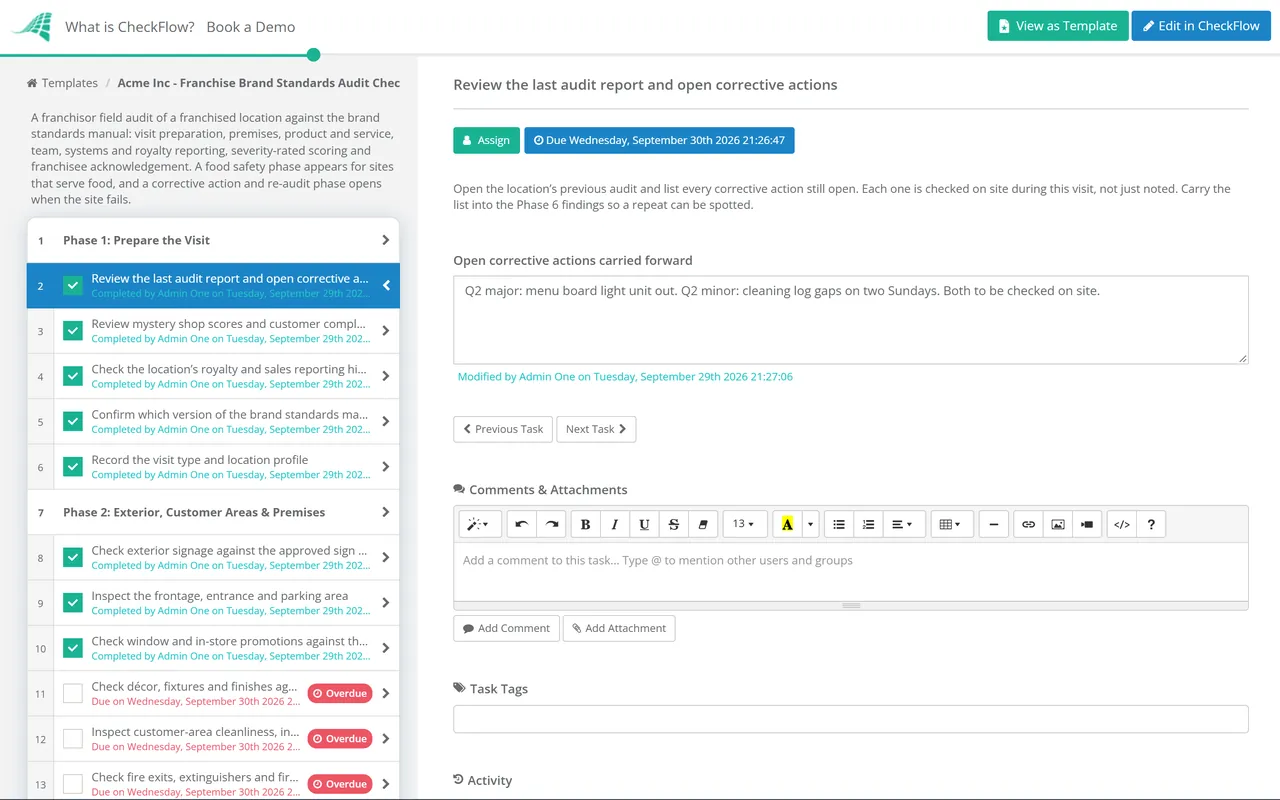
A brand standards audit is the franchisor’s field visit to a franchised location, measured against the operations manual. This free franchise audit checklist is for field managers and franchise business consultants in restaurant, retail and service franchises. It covers visit preparation, the premises, product and service, food safety where the site serves food, systems and royalty reporting, and a scored result. Every finding carries a severity, every visit ends with the franchisee’s acknowledgement, and a failed audit opens a corrective action plan that stays open until the re-audit closes it.
Brand standards are contractual, not statutory. The franchise agreement gives the franchisor the right to set standards through the operations manual and to inspect the location against them. A health inspector checks the premises against food law. A field auditor checks them against the manual: the sign package, the recipe card, the uniform, the supplier list and sales reporting. A location can pass its health inspection and still fail a brand audit because it sells an unapproved product or has changed the shopfit without permission.
Most franchise systems run two layers of checking. The franchisee’s team runs daily and weekly checks. The field manager audits the location every quarter or so, uses those logs as evidence, and scores the site. When both use the same standards, a franchisee who runs the self-check properly is never surprised by the audit.
Examples: opening checks, cleaning schedules, temperature logs, cash-up, delivery checks.
Cadence: every shift, day or week.
Output: completed logs, kept as evidence for the next audit.
Examples: signage and décor, product specification, service sequence, approved suppliers, royalty reporting.
Cadence: quarterly or twice a year, plus unannounced visits where the agreement allows.
Output: a scored report, severity-rated findings and, where needed, a corrective action plan.
Seven phases take the visit from preparation to a scored, acknowledged report. The food safety phase appears only for sites that serve food, and the corrective action phase opens only when the site fails.
Owned by the field manager before arriving on site. An auditor who knows the location’s history audits the right things.
Its tasks appear only when Phase 1 records that the site serves food. A retail or service location skips it.
The acknowledgement task is assigned to the franchisee by name. Acknowledging the report is not the same as agreeing with every finding: disagreements are recorded, not argued away.
Its tasks appear when Phase 6 records a score below the pass mark or a critical finding. Critical findings are contained on the day; the plan needs the area manager’s approval.
A percentage score on its own hides the finding that matters. A site can score well with a blocked fire exit, or lose most of its points to scuffed paintwork. Rating every finding by severity, and letting a critical finding fail the audit whatever the score, fixes that. Treat the model below as a starting point: set the definitions, deadlines and pass mark in your own manual, publish them, and apply them the same way everywhere.
| Severity | What it means | Examples | Typical correction deadline | Effect on the result |
|---|---|---|---|---|
| Critical | A risk to customer or staff safety, a breach of law, or a direct threat to the brand or the franchisor’s revenue | Food held out of temperature, blocked fire exit, unapproved supplier for a core product, sales left out of royalty reports | Contained before the auditor leaves; closed within days | Automatic fail whatever the score; re-audit required |
| Major | A brand standard clearly not met in a way customers would notice, or a system not being followed | Damaged or unlit sign, unapproved menu item, staff out of uniform, training records missing | Two to four weeks | Weighted points deducted; a major repeated from the last audit is raised to critical |
| Minor | An isolated or cosmetic lapse with little effect on the customer | Worn floor mat, one expired poster, a gap in a single day’s cleaning log | By the next scheduled visit | Small deduction; checked at the next audit |
| Observation | Good practice, or a risk worth watching that does not yet breach a standard | A local idea worth sharing, stock levels running low | None | No deduction; recorded for the next visit |
How the audit relates to the franchise agreement. The agreement, not the checklist, decides what happens when standards are not met. Most treat a persistent failure to meet the manual as a default, with a period to cure it. In the US, the FTC Franchise Rule requires the disclosure document to describe the operations manual (Item 11) and list any audit fees (Item 6), and several states have relationship laws that limit termination. California, for example, generally requires at least 60 days’ notice and a chance to cure before a franchise is terminated for failing to comply. The UK has no franchise-specific statute, so the contract governs, and members of the British Franchise Association also follow its Code of Ethics. The checklist gives you the record: dated, scored, acknowledged visits with evidence attached. Take legal advice before any audit result becomes a notice.
A recurring schedule creates each location’s audit every quarter and assigns it to the field manager who covers that territory. A missed visit shows up as an overdue checklist, not a gap found during a dispute.
Photos, temperature readings and invoice samples are attached to the task they support. The franchisee acknowledges the report by name, and the area manager’s approval of the corrective action plan is recorded with a timestamp, so nobody has to reconstruct what was agreed.
Conditional logic shows the food safety phase only where food is served, and opens the corrective action phase only when the site fails. One template covers a restaurant, a shop and a service outlet, and each site’s audit history can be exported.
A franchisor enforcing brand standards through a tool that carries someone else’s logo sends a mixed message. With CheckFlow’s white label checklist software, franchisees open the audit on your domain, under your brand. Our white label guide covers how franchisors use it for daily checks and new-site openings too.
CheckFlow is a checklist and workflow tool. It is not a franchise management platform, a POS or royalty billing system, or a learning management system, and it does not replace them. It runs the audit and follow-up around them. For head office audits, the Operational Audit Checklist covers process and control reviews, and CheckFlow’s compliance checklist software shows how recurring audits, evidence and approvals fit into one calendar.
Describe the process in a sentence and the AI checklist generator drafts the phases and tasks for you.
It is a scheduled visit by the franchisor, usually a field or area manager, to check a franchised location against the operations manual. The auditor looks at the premises, the product or service, the team, and how the location buys stock and reports sales. Findings are rated by severity, the visit is scored and the franchisee acknowledges the report. A shortfall leads to a corrective action plan and a re-audit.
At minimum: preparation from the last audit and open actions, the exterior and customer areas, the core product or service, staff presentation and training records, approved suppliers, and a check of reported sales against the till. Food businesses add temperature, labelling, allergen and hygiene checks. The checklist should end with a severity-rated score, the franchisee’s acknowledgement and, where needed, a corrective action plan with owners and deadlines.
Check what the franchise agreement allows, then set the frequency by risk. Many systems audit each location quarterly or twice a year, visit new locations more often in their first months, and add unannounced visits where the agreement permits. A site that failed should be re-audited on a fixed date, not left until the next scheduled visit.
A health inspection is carried out by a public authority against food law: in England, Wales and Northern Ireland it produces a Food Hygiene Rating Scheme rating, in Scotland a Food Hygiene Information Scheme result of Pass or Improvement Required, and in the US state and local health departments inspect against codes widely based on the FDA’s model Food Code. A brand standards audit is the franchisor checking the site against the franchise agreement and manual, which covers far more than food safety. The audit records the latest official result but does not replace it.
That depends on the franchise agreement and local law, so take legal advice on any specific case. Agreements commonly treat a persistent failure to meet standards as a default, with a notice and a period to cure, and some US states, such as California, restrict termination further. Whatever the rules, a consistent record of scored, acknowledged audits and missed corrective actions is what shows the failure was real and repeated.
Yes. The standards are already in the manual the franchisee signed up to, so there is nothing to gain by hiding how they are checked. Publishing the checklist, severity definitions and pass mark makes scores easier to accept. It also lets franchisees run the same checklist as a self-audit between visits.
14-day free trial, no card required. The Business plan is $10 per user per month after the trial. Full details at checkflow.io/pricing.
14-day free trial, no credit cardFull refund in your first 30 daysUS hosting, EU on request