End-of-Day Cash-Up Checklist Template

A till that is short at ten at night is a question nobody can answer the next morning. Counted by two people, checked against the Z report and signed off before the bag is sealed, it usually has a simple explanation.

Last reviewed: October 2026

This free end-of-day cash-up checklist is the daily cashing up routine for cafés, bars, restaurants and shops, for the closing supervisor, the second counter, the manager and finance. In the US the same job is called closing the till or cash drawer reconciliation. One run is one site’s close of one trading day. It prints the Z report and closes each till, counts each drawer by denomination with two people away from the shop floor, counts out the float, closes the card terminals and checks every other tender. Then it works out over or short for each till and in total, and adds a recount and an explanation for any till over the site’s tolerance. The manager signs off before the banking is sealed with two signatures, the floats and safe are locked, the sheet goes to finance and the bank credit is confirmed. Answers on the first task hide the cash steps for a card-only site, the card steps for a cash-only one, and add tips and the right banking task.

The Full Cash-Up, Not One Line on a Closing Checklist

Most opening and closing checklists give the cash one or two lines: cash up each till, bag the takings, lock the safe. The Restaurant Opening & Closing Checklist, the Bar Opening & Closing Checklist and the Retail Store Opening & Closing Checklist all do this, because their job is the whole trading day. This checklist is the full cash-up procedure behind those lines, for the person closing the tills, the second counter, the manager who signs it off and finance.

It follows the money from the Z report to the bank: two people count each drawer away from the shop floor, the float is counted out separately, the card terminals are closed and checked, every other tender is accounted for and the difference is measured against the site’s own tolerance. Run it alongside the closing checklist, or on its own where the cash-up is done by a different person.

This checklist

The full end-of-day cash-up

Covers: Z reports, the count by denomination, floats, card batch totals, vouchers, refunds, petty cash, tips, over or short against tolerance, the manager’s sign-off, banking and the bank credit.

When: every trading day, at close.

Output: a signed cash-up sheet, a sealed banking bag and a confirmed deposit.
The whole trading day

Opening and closing checklists

Covers: the building, safety checks, food or bar set-up, service, cleaning and lock-up, with the cash-up as one or two steps.

Use them: for the rest of the day. Restaurant, bar or retail store opening and closing.

Month end

The Bank Reconciliation Checklist

Covers: matching every bank transaction to the ledger, clearing reconciling items and an independent review.

Use it: each month; the confirmed deposits from each cash-up are the receipts it matches. Bank Reconciliation Checklist.

What the End-of-Day Cash-Up Checklist Covers

Eight phases follow one site’s close from the last sale to the bank credit. The answers on the first task decide the rest: a card-only site skips the counting and banking, a cash-only site skips the card terminals, and tips, a difference over tolerance, the way the cash is banked and a bank credit that does not match each add their own tasks. The manager’s sign-off is the gate: the banking, safe and finance tasks wait until it is done.

  1. Phase 1

    Phase 1: Set Up the Cash-Up

    3 tasks

    The person cashing up starts the run once the last customer has gone. The answers on the first task assign every task, set each due date from the close of trade and show only the steps this site needs.

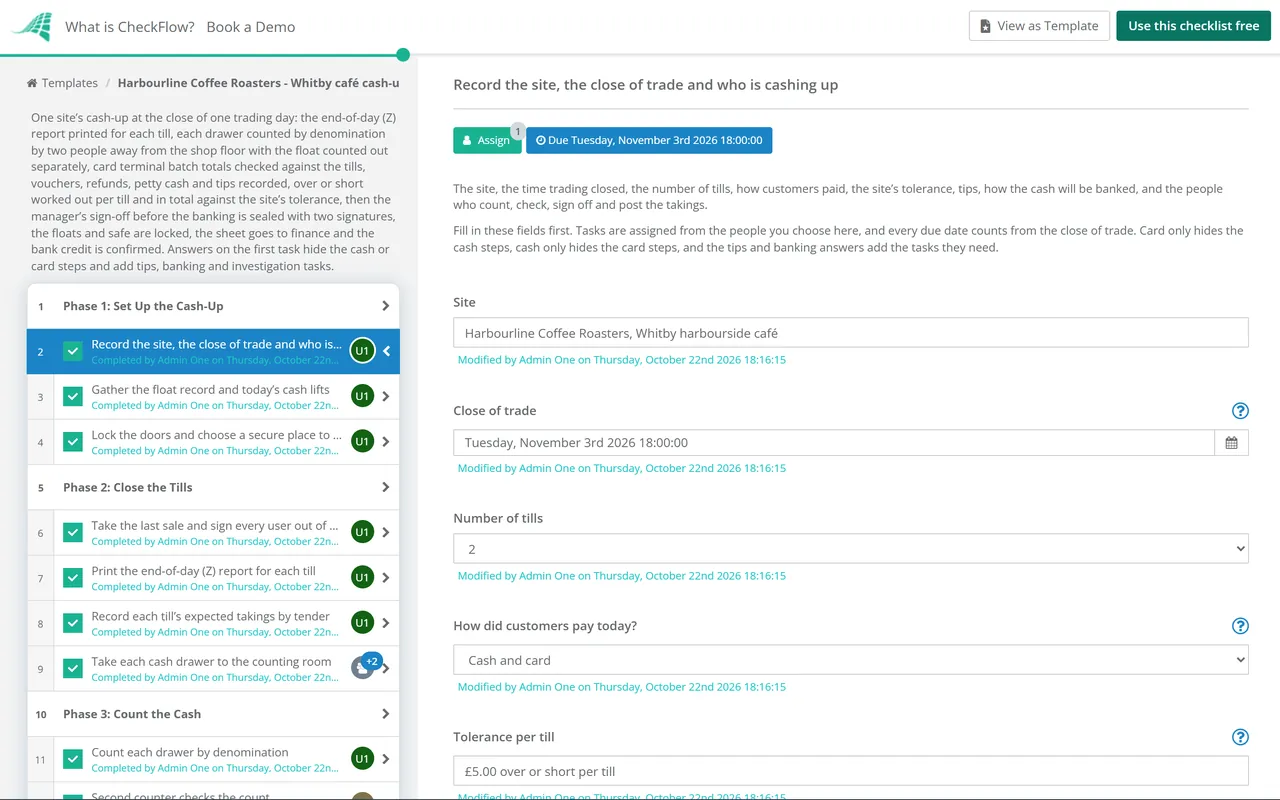
    • Record the site, the close of trade and who is cashing up — the site, the time trading closed, the number of tills, how customers paid, the site’s tolerance, tips, how the cash will be banked, and the people who count, check, sign off and post the takings
    • Gather the float record and today’s cash lifts — the float issued to each till this morning and every cash lift taken from a till into the safe during the day, with its slip, so the cash expected from each till is complete
    • Lock the doors and choose a secure place to count — the doors locked and the blinds down, and a back office or safe room away from the shop floor and the windows, where the count cannot be interrupted or seen from outside
  2. Phase 2

    Phase 2: Close the Tills

    4 tasks

    Close each till before anything is counted. The end-of-day (Z) report is the till’s own record of what it took, by tender, and every count is checked against it.

    • Take the last sale and sign every user out of each till — no sale left open or parked, every user signed out, and no till reopened for a late sale once the cash-up has started
    • Print the end-of-day (Z) report for each till — one Z report per till, which on most tills closes the day and resets its totals; an X report only reads the totals, so it does not close the day
    • Record each till’s expected takings by tender — the cash, card, voucher and gift card totals from each Z report, with refunds and voids, entered once on the cash-up sheet as the figures the count must meet
    • Take each cash drawer to the counting room — each drawer carried to the counting room by two people, with the empty till left open so anyone looking in can see there is no cash in it
  3. Phase 3

    Phase 3: Count the Cash

    5 tasks

    Two people count each drawer away from the shop floor, by denomination, and the float is counted out before the takings. The count table follows the country chosen on the first task. This phase is hidden when the site took no cash.

    • Count each drawer by denomination — every note and coin counted and entered by denomination for each till, with bagged coin counted or weighed rather than taken on trust
    • Second counter checks the count — the second person recounts each drawer or checks the totals line by line, and both initial the count; if the two counts differ, count again until they agree
    • Count out each till’s float to its set amount — the agreed float for each till counted out separately in notes and coin and set aside for tomorrow, so only the takings are left to bank
    • Set aside suspect notes and notes you no longer accept — any note that fails your checks, or is no longer legal tender, kept out of the takings and the float, recorded and dealt with under your cash policy, and never put back in a till
    • Record the cash takings for each till — the drawer count less the float, plus the cash lifts already in the safe, which is the cash each till actually took today
  4. Phase 4

    Phase 4: Card Payments & Other Tenders

    7 tasks

    Close each card terminal and check every other tender against the Z report. A refund, a voucher or a petty cash payment that is missing from the sheet shows up later as a difference.

    • Run the end-of-day batch settlement on each card terminal — each terminal’s end-of-day or banking report run so the day’s card payments are sent for settlement, with the totals printed and kept with the cash-up
    • Compare the card terminal totals with each till’s card total — the terminal total against the card figure on the Z report; a gap usually means a card payment rung up as cash, a refund on one and not the other, or a declined payment the till still recorded
    • Check vouchers, gift cards and coupons taken — each voucher or gift card redemption matched to the till, paper vouchers cancelled and kept, and gift cards sold today recorded apart from sales of goods
    • Check refunds, voids and no-sales against the till log — each refund with its receipt and the person who authorised it, each void made by someone allowed to make it, and no more no-sales than the day needed
    • Record petty cash paid out of the tills — every payment taken from a till, such as a delivery paid in cash, with its receipt and who approved it, because it lowers the cash the till should hold
    • Tips: record the day’s tips and service charge — card tips from the terminal or till report, any service charge on the Z report and any cash tips collected, each recorded apart from the takings
    • Tips: keep tips apart from the takings for your tips policy — cash tips bagged and labelled away from the banking, and the day’s figures added to the tips record so they are shared and paid under your written tips policy
  5. Phase 5

    Phase 5: Over or Short

    5 tasks

    Compare what each till took with what it should have taken. A difference over the site’s tolerance adds two tasks: recount and check the till log, then record the explanation for the manager.

    • Calculate over or short for each till — the counted cash, card and other tenders against the Z report for each till, after petty cash paid out; over means more than expected, short means less
    • Calculate the total over or short for the site — the tills added together, with each till’s figure kept as well, because a till that is over and one that is short can cancel out and still both need checking
    • Check each difference against the site’s tolerance — each till’s difference, over or short, compared with the tolerance on the first task; any till over it is investigated before the manager signs off
    • Over tolerance: recount and check the till log — the drawer recounted, then the till log checked for refunds, voids, no-sales, a card payment rung up as cash, a missing lift slip or a float that was wrong this morning, until the difference is found or every likely cause is ruled out
    • Over tolerance: record the explanation and any action — the till, the amount, who used the till, the likely cause and what happens next, such as a reminder to the team or a change to the float, recorded as fact; nobody is accused without evidence
  6. Phase 6

    Phase 6: Manager Review & Sign-Off

    3 tasks

    The manager checks the sheet against the counts and reports, then signs off the cash-up and any difference. The sign-off is the gate: the banking, safe and finance tasks cannot be completed until it is done.

    • Complete the cash-up sheet — the Z totals, counts, card and other tenders, petty cash, tips, over or short and the amount to bank for every till on one sheet, signed by both counters
    • Manager checks the sheet against the counts and reports — the totals traced to the Z reports, the count, the terminal reports and the slips for lifts and petty cash, with any figure that does not add up sent back to be put right
    • Manager signs off the cash-up and any difference — the cash-up signed and dated by the manager, with any difference over tolerance explained and accepted; if it is not ready, leave this task open, because the banking and finance tasks cannot be completed until it is done
  7. Phase 7

    Phase 7: Banking & the Safe

    8 tasks

    Prepare the banking, seal it with two signatures and lock the takings and floats in the safe. How the cash leaves the site follows the answer on the first task. This phase is hidden when the site took no cash.

    • Prepare the paying-in slip or deposit slip — the amount to bank, by notes and coin, on the bank’s paying-in slip or the deposit slip your bank or cash collection company uses, matching the cash takings on the sheet
    • Seal the banking bag and record the bag number with two signatures — the cash and the slip sealed in a tamper-evident bag in front of both people, the bag number written on the sheet, and both people signing for the amount
    • Collection: hand the sealed bag to the cash collection service — the collector’s identity checked against the company’s details before the safe is opened, the bag number and amount signed for, and the receipt kept with the cash-up
    • Staff drop: take the bag to the bank or deposit point — the bag taken to the bank, a deposit point or a night safe as your cash policy says, by two people where you can and at varied times and routes, with the receipt kept
    • Held: record the bag in the safe log until the next banking — the bag number, amount and date in the safe log with the date it will be banked, and each held bag checked at every safe count until it leaves
    • Lock the floats in the safe for tomorrow — each counted float bagged and labelled by till and locked in the safe, so the opener starts from a known amount
    • Check there is enough change for tomorrow — the coin and small notes in the floats and the change float checked, and change ordered from the bank or collection company if it will run short
    • Lock the safe and record the safe count — everything in the safe counted and recorded, including floats, banking waiting to leave, change and tips held, then the safe locked and the keys or code kept as your policy says
  8. Phase 8

    Phase 8: Records & Bank Confirmation

    7 tasks

    Send the signed cash-up to finance, then check the money arrived. The bank credit should match the paying-in slip, and the card settlements should match the terminal totals less fees. A banking difference adds a follow-up task.

    • Send the cash-up sheet to finance — the signed sheet, Z reports, terminal reports and slips sent or uploaded to finance the same night, so the takings can be posted
    • Note anything the next opener or manager needs to know — a terminal fault, a float that was wrong, change running low or a difference still open, written where the opener will read it
    • Finance posts the day’s takings — sales by tender, the over or short to its own account, petty cash to its expense codes and tips kept apart from sales, all from the signed sheet
    • Confirm the bank credit matches the banking — the amount the bank or the cash collection company credited checked against the paying-in slip and the bag number, on the day it is due to arrive
    • Confirm the card settlements reached the bank — each terminal’s settlement checked against its end-of-day total, with the card provider’s fees shown separately, and any missing settlement raised with the card provider
    • Banking difference: follow it up with the bank or collection company — the bag number, amount, slip and receipt sent to the bank or collection company, the reply recorded, and the cash-up reopened only if the count turns out to be wrong
    • File the cash-up with the business records — the sheet, Z reports, terminal reports, slips and receipts for the day kept together, for as long as your tax rules require

Where the Figures Come From, and the Rules Behind Them

Where each figure comes from

Each tender on the Z report has its own evidence. Checking them one at a time is what turns a difference into an explanation.

Figure Expected from Checked against Common causes of a difference
CashThe cash total on the Z report, plus the float and less petty cash paid outThe count by denomination, less the float, plus cash lifts in the safeWrong change, a card payment rung up as cash, a missing lift slip, a wrong float this morning
CardThe card total on the Z reportThe card terminal’s end-of-day totalA payment keyed on the terminal but not the till, a refund on one only, a declined payment the till recorded
Vouchers and gift cardsThe voucher and gift card totals on the Z reportThe vouchers and redemption slips in the drawerA voucher accepted but not rung up, a gift card sale recorded as a sale of goods
Refunds and voidsThe refund and void lines on the Z reportRefund receipts and the till logA refund without a receipt, a void after the customer left
Petty cash paid outPayments taken from a till during the dayReceipts with the approver’s nameA payout with no receipt, or a receipt never put in the drawer
Tips and service chargeThe tip and service charge lines on the till or terminal reportThe tips recordCash tips mixed with the takings, card tips counted as sales

The rules behind the cash-up, UK and US

Most of a cash-up is house practice. A few points come from law or from the tax authority, and the notes on each task follow the country chosen on the first task. This is not legal or tax advice.

Point United Kingdom United States
Who gets the tipsIn England, Wales and Scotland the employer must allocate all qualifying tips, gratuities and service charges fairly between workers at the place of business (Employment Rights Act 1996 s27D, added by the Employment (Allocation of Tips) Act 2023)Under the FLSA an employer may not keep any part of employees’ tips, and managers and supervisors may not receive tips from a tip pool (DOL Fact Sheet #15); check your state too
When tips are paidNo later than the end of the month after the customer paid (s27G)Card tips may not be held while the employer waits for the card company (DOL Fact Sheet #15)
Tips recordsA written tips policy, and a record of how every qualifying tip was dealt with kept for three years (ss27I and 27J)Check your state’s rules and your payroll provider’s advice
Suspect notesContact the police; the Bank of England cannot reimburse counterfeit notes, and knowingly passing one on is an offenceHand suspect notes to the local police; businesses can also report them on Secret Service Form SSF 1604
Old notesPaper £20 and £50 notes stopped being legal tender on 30 September 2022; some banks and the Post Office still accept old notes as depositsNot applicable
Keeping the recordsLimited company: 6 years from the end of the financial year; sole trader: at least 5 years after the 31 January deadline; VAT retail schemes need a daily gross takings recordUntil the period of limitations runs out, 3 years in most cases; cash register tapes and deposit records support gross receipts (IRS)

Sources. Employment Rights Act 1996, Part 2B as added by the Employment (Allocation of Tips) Act 2023 (in force from 1 October 2024; it covers England, Wales and Scotland, not Northern Ireland) and the statutory code of practice on distributing tips fairly; the Bank of England on counterfeit banknotes, withdrawn banknotes and exchanging old banknotes; HMRC on company records, self-employed records and retail schemes (VAT Notice 727); the Department of Labor’s Fact Sheet #15 on tipped employees; the US Secret Service on counterfeit currency and the U.S. Currency Education Program; the IRS on what records to keep and how long to keep them.

Why Run the Daily Cash-Up in CheckFlow?

1

Every close, the same way

A daily recurring schedule starts each site’s cash-up before the doors close. Enter the close of trade and every task gets a due date from it: the count and the sign-off that evening, the bank credit check two business days later. Each site’s cash-ups sit on the Reports Grid, so one still open stands out.

2

Nothing banked before it is signed off

The manager’s sign-off is a gate: the banking, safe and finance tasks cannot be ticked off until it is done. A difference over tolerance adds the recount and explanation tasks first, so the manager signs off with the reason in front of them. See how approval steps work.

3

The evidence stays with the day

Z reports, terminal reports and the cash-up sheet are uploaded to the tasks they belong to, the count and floats are recorded in tables, and the activity log shows who counted, who checked and who signed. The Reports Grid lists every day’s cash-up with the answers given, so you can filter for tills over tolerance across days and sites.

CheckFlow does not run your tills, count cash or take card payments; your point-of-sale system and card terminals do that. CheckFlow runs the process around them: who counts, who checks, what was found, who signed off and when the money reached the bank.

Run the rest of the day with the Restaurant Opening & Closing Checklist, the Bar Opening & Closing Checklist or the Retail Store Opening & Closing Checklist. Match the confirmed deposits each month with the Bank Reconciliation Checklist as part of the Month-End Close Checklist, review petty cash and other spending with the Expense Audit Checklist, and keep card terminals and card data in line with the PCI DSS Compliance Checklist.

AI generator

Didn’t find what you need? Describe it.

Describe the process in a sentence and the AI checklist generator drafts the phases and tasks for you.

Frequently Asked Questions

What is a cash-up?

A cash-up is the end-of-day check that the money in the tills matches what the tills say they took. In the US it is often called closing the till or cash drawer reconciliation. You print each till’s end-of-day (Z) report, count each drawer, count out tomorrow’s float, check the card terminal totals and the other tenders, and record any difference before the takings are banked. A daily cashing up checklist makes sure it is done the same way every night, by two people, with a manager’s sign-off.

What is the difference between an X report and a Z report?

On most tills an X report reads the totals so far without changing them, so it can be run during the day, for example at a shift change. A Z report is the end-of-day report: it records the day’s totals by tender and resets the till for the next day. Run one Z report per till at close and count against it. Check your own till’s manual, because the names and what each report resets vary by system.

What is an acceptable till variance?

There is no single figure. Each business sets its own tolerance in its cash policy, per till, and many treat a till that is over the same way as one that is short, because both mean something was rung up or handed out wrongly. This checklist asks for your tolerance on the first task and adds a recount and an explanation for any till outside it. Watch the pattern too: small differences that repeat on the same till are worth a look.

What should you do if the till is short or over?

Count the drawer again with the second person, then check the till log: refunds, voids, no-sales, a card payment rung up as cash, a cash lift without a slip, or a float that was wrong this morning. Record what you found, the amount and what happens next, and let the manager sign off with the explanation in front of them. Record it as fact and do not accuse anyone without evidence.

Should the card terminal total match the till?

Yes. Run the end-of-day or batch settlement on each card terminal at close and compare its total with the card figure on the Z report. A gap usually means a payment was keyed on the terminal but rung up as cash, a refund went through on one and not the other, or a declined payment was recorded on the till. When the settlement reaches the bank, check it against the terminal total, with the card provider’s fees shown separately.

What are the rules on tips at cash-up?

In England, Wales and Scotland the Employment (Allocation of Tips) Act 2023 requires employers to allocate all qualifying tips, gratuities and service charges fairly between workers, pay them by the end of the month after the customer paid, have a written tips policy and keep tips records for three years. In the US, the Department of Labor says the FLSA does not allow an employer to keep any part of employees’ tips. Keep tips apart from the takings at cash-up and add them to your tips record. Sources are in the table above.

What should you do with a counterfeit or old banknote?

Keep it out of the takings and the float, record it and do not pass it on. In the UK, the Bank of England says to contact the police and that it cannot reimburse counterfeit notes; old paper £20 and £50 notes stopped being legal tender on 30 September 2022, though some banks and the Post Office still accept them as deposits. In the US, the Secret Service asks for suspect notes to be given to the local police.

How long should cash-up records be kept?

As long as your tax rules require. In the UK, HMRC says a limited company keeps records of money received, such as till rolls, for 6 years from the end of the financial year, and a sole trader keeps sales records for at least 5 years after the 31 January deadline. In the US, the IRS says to keep records that support income until the period of limitations runs out, 3 years in most cases.

Is CheckFlow free for this template?

14-day free trial, no card required. The Business plan is $10 per user per month after the trial. Full details at checkflow.io/pricing.

Cash Up Every Till the Same Way, Every Night

Free trial — no credit card required.

14-day free trial, no credit cardFull refund in your first 30 daysUS hosting, EU on request