Bar Opening & Closing Checklist Template

A bar’s riskiest hours are the first and the last: a gas cylinder nobody checked, a refusal nobody wrote down, a till that is short with nobody sure who counted it.

Last reviewed: October 2026

Pubs and bars run the same routine every day, and the gaps show when a new supervisor opens for the first time. This free bar opening and closing checklist is for bar managers, duty managers, designated premises supervisors and the bartenders who open and close. One run is one trading day behind the bar, built to start each morning on a daily recurring schedule. It sets up the day and the duty team, walks the building, fire exits and cellar, then sets up the glass washer, ice, taps, garnishes, stock to par and till floats. The licence summary and notices are checked, the team is briefed on the age verification policy, and the duty manager approves the bar to open. Service keeps the refusals log, incident log and waste sheet. The close runs from last orders through cleaning, stock count, cash-up and banking to lock-up and sign-off. A line-clean task appears only on line-cleaning days.

One Record for the Whole Trading Day

A bar works to two sets of rules at once. One is the premises licence: the hours alcohol may be sold, who authorises each sale, the age verification policy and the notices on the wall. The other is the cellar and the back bar: gas cylinders, kegs, beer lines, the glass washer and the ice. A day goes wrong when either is left to memory, and the evidence that it went right, a refusals log, an incident log and a cash-up that adds up, is usually scattered across three notebooks.

This checklist keeps the whole trading day in one record, from the opener’s walk-round to the closer’s alarm. It is built for the bar. Kitchens, fridge temperatures and allergens are covered by the Restaurant Opening & Closing Checklist, and a food-led pub can run both side by side.

Opening

Before the doors open

Asks: is the building safe, the cellar and gas sound, the bar stocked to par and the licence on show?

When: every trading day, finished before the doors open.

Output: the duty manager’s approval to open, with every fault written down.
During service

While alcohol is on sale

Asks: is every serve within the licence, with ID checked and refusals and incidents recorded as they happen?

When: from the doors opening to the end of sales.

Output: the day’s refusals log, incident log and waste sheet.

Closing

After the last sale

Asks: are customers out, the bar clean, stock and cash counted and the building secure?

When: from last orders to lock-up.

Output: the cash-up and banking bags, tomorrow’s handover note and the duty manager’s sign-off.

What the Bar Opening & Closing Checklist Covers

Seven phases follow one trading day behind the bar. Phases 1 to 4 are the opening, Phase 5 runs through service, and Phases 6 and 7 are the close. The line-clean task appears only on line-cleaning days, the incident follow-up only when an incident is logged, and nothing after the duty manager’s approval to open can be completed until it is given.

  1. Phase 1

    Phase 1: Set Up the Trading Day

    4 tasks

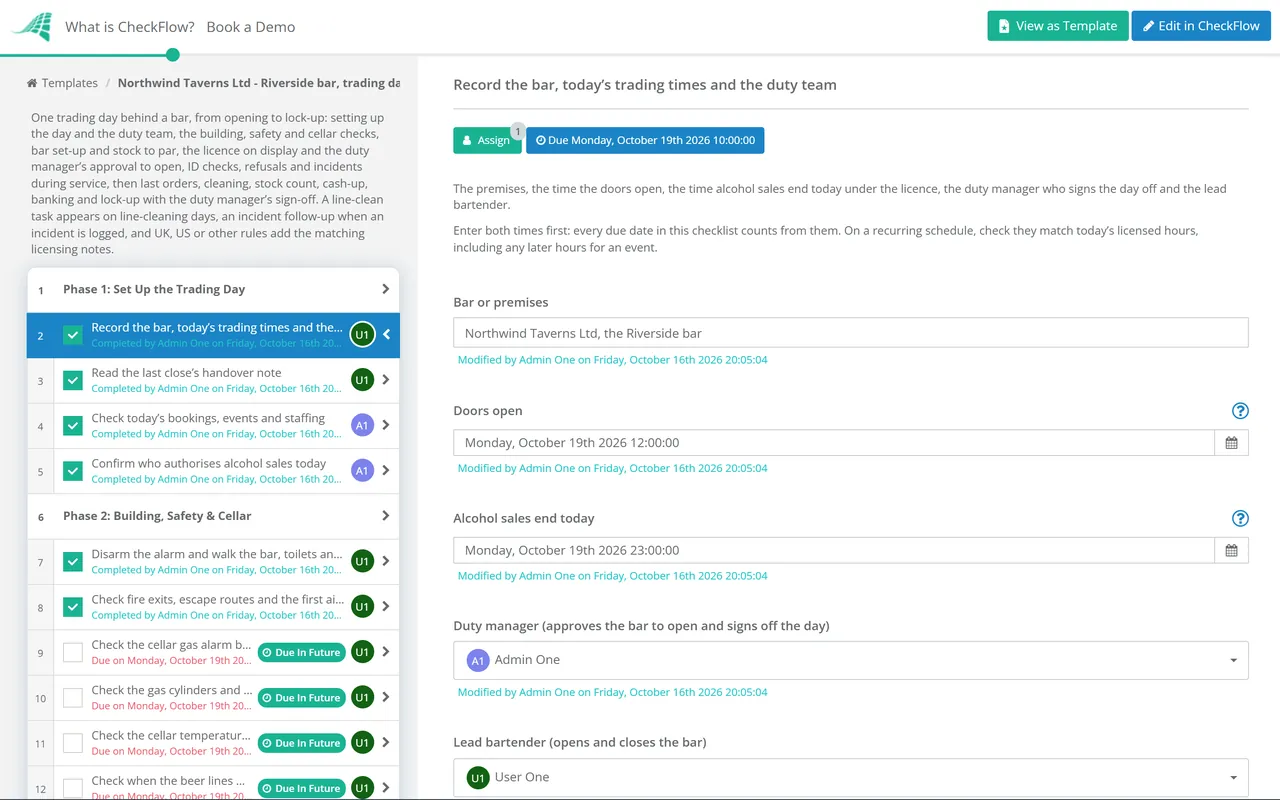
    Answer which rules apply first; it adds the matching licensing notes to the tasks. Opening tasks count back from the time the doors open, and closing tasks count on from the time alcohol sales end today.

    • Record the bar, today’s trading times and the duty team — the premises, the time the doors open, the time alcohol sales end today under the licence, the duty manager who signs the day off and the lead bartender
    • Read the last close’s handover note — faults, items running short, kegs or gas to change, and any refusals or incidents the team should watch for tonight
    • Check today’s bookings, events and staffing — private hire, live sport or music, door staff if booked, and enough staff on each shift who know the age verification policy
    • Confirm who authorises alcohol sales today — the personal licence holder or manager responsible, how to reach them, and that everyone serving alcohol has been authorised to do so
  2. Phase 2 — Opening

    Phase 2: Building, Safety & Cellar

    7 tasks

    Walk the building before anyone else arrives, then the cellar. The line-clean task appears only on days a clean is due.

    • Disarm the alarm and walk the bar, toilets and outside areas — signs of a break-in, leaks, broken glass, power or cooling failures, and anything left out from last night
    • Check fire exits, escape routes and the first aid kit — every exit unlocked and clear before customers arrive, extinguishers in place and the first aid kit stocked
    • Check the cellar gas alarm before going down — where the cellar has one, it is on and showing normal; if it is sounding, stay out and follow your gas procedure
    • Check the gas cylinders and connections — cylinders upright and secured, regulators and pipes undamaged with no hissing, enough gas for the day and spares in stock
    • Check the cellar temperature and the kegs and casks on the line — cellar cooling running and the reading recorded, nothing leaking, and the next keg or cask ready for each line
    • Check when the beer lines were last cleaned — from the line-cleaning record; if a clean is due today, the line-clean task appears
    • Clean the beer lines — following the line cleaner’s instructions, with the lines flushed with water until clear of cleaner before any beer is pulled; shown only on line-cleaning days
  3. Phase 3 — Opening

    Phase 3: Bar Set-Up & Stock

    7 tasks

    Set the bar up for the day’s trade: glasses, ice, taps, garnishes and stock to par, then the till floats.

    • Start and check the glass washer — detergent and rinse aid topped up, filter and arms clean, and the wash and rinse temperatures shown on the machine as its maker sets out
    • Check the ice machine and the ice well — the machine clean and making ice, the well clean and filled, and the scoop kept in its holder, never a glass
    • Pull through and check every tap — each beer and cider clear, cold and tasting right after standing overnight, with what was pulled off recorded as waste
    • Prepare garnishes, mixers and juices — fruit washed, cut, covered and dated, chilled mixers and juices in date, and anything left from yesterday checked or thrown away
    • Check stock against par levels — spirits, bottled drinks, wine and mixers counted against the par sheet, gaps filled from the store and shortfalls ordered
    • Check optics, measures and pourers — measures and thimbles clean and in place, pourers fitted, and no spirit bottle refilled or topped up
    • Count the till floats and test the card terminals — each float counted with a second person and recorded per till, and each terminal checked for tampering and a test payment run
  4. Phase 4 — Opening

    Phase 4: Licence, Briefing & Open the Doors

    6 tasks

    The licence on show, the team briefed and the duty manager’s approval before the doors open. Nothing after the approval can be completed until it is given.

    • Check the licence summary and notices are on display — the premises licence summary and the notice naming who keeps the licence, plus any notices your licence conditions require
    • Check the price list shows the measures you sell — menus and price lists up to date, including the small measures where your rules require them, and prices for any promotions
    • Brief the team on the age verification policy and refusals — the age the policy checks to, which ID is accepted, how to refuse politely and when to call the duty manager
    • Brief the team on today’s events, promotions and free water — what is on, any drinks promotion checked against your rules, and drinking water free on request
    • Duty manager approves the bar to open — every opening check done or its corrective action written down; nothing after this can be completed until it is given
    • Open the doors and record the time — a late opening is noted with its reason so the pattern shows over time
  5. Phase 5 — Service

    Phase 5: During Service

    7 tasks

    Kept open all session and completed when alcohol sales end. The refusals table and the incident follow-up appear only when there is something to record.

    • Apply the age verification policy at every serve — ID asked for from anyone who looks under the policy age, only accepted ID taken, and no drink handed over until the check is done
    • Record every refusal in the refusals log — the time, the reason, a short description of the customer and who refused, whether for age, no ID or drunkenness
    • Refuse service to anyone who is drunk — stop serving, offer water, tell the duty manager and make sure the customer leaves safely
    • Collect glasses and check the floor and toilets on a set round — broken glass cleared at once, spills dried and signed, and toilets checked and recorded at each round
    • Log every incident as it happens — fights, injuries, ejections, police called, lost property and complaints, with the time, what happened and who saw it
    • Follow up injuries and serious incidents — the accident book filled in, any CCTV kept, and the duty manager decides who else must be told; shown only when an incident is logged
    • Record waste and breakages as they happen — pull-throughs, spillages, returned drinks and broken bottles on the waste sheet, so the closing count adds up
  6. Phase 6 — Closing

    Phase 6: Last Orders, Clearing & Cleaning

    7 tasks

    From last orders to an empty, clean bar. No alcohol is sold after the time the licence allows.

    • Call last orders before the licensed end of sales — early enough that every drink is served before the time on the licence, and announced the same way every night
    • Stop serving at the end of sales and clear drinks by closing — no alcohol sold after the licensed time, drinking-up only as the licence allows, and glasses collected from every table
    • Check the premises are clear of customers — toilets, smoking area, beer garden and quiet corners, with customers asked to leave quietly
    • Clean the bar, taps and drip trays — drip trays emptied and washed, tap nozzles soaked, surfaces and bar mats cleaned and sanitised
    • Drain the glass washer and empty the ice well — the washer drained, its filter cleaned and the door left open, and the ice well emptied, cleaned and dried
    • Store garnishes and perishables or throw them away — cut fruit covered and dated or discarded, milk, cream and juices back in the fridge, and the discards on the waste sheet
    • Take out the empties, glass and waste — bottles to recycling, glass bins emptied quietly where neighbours are close, bins lidded and the bin store locked
  7. Phase 7 — Closing

    Phase 7: Stock, Cash-Up & Lock-Up

    7 tasks

    Stock, cash and the building, then the handover and the duty manager’s sign-off of the day’s record.

    • Count closing stock and total the waste — spirits and bottles against par, the waste sheet totalled, and shortfalls added to the next order
    • Cash up each till against the point-of-sale report — two people count, and the variance, voids, refunds and card totals are recorded per till
    • Bag the takings for banking and lock them in the safe — bag numbers and amounts recorded with two signatures, floats set aside for tomorrow, and the bags ready for the banking handoff
    • Shut down the cellar for the night — gas turned off at the cylinders where your procedure says so, cooling left running, and the cellar door locked
    • Write the handover note for tomorrow’s opener — faults, low stock, kegs or gas to change, refusals and incidents to watch for, and anything booked
    • Walk the building, lock up and set the alarm — toilets, stores and fire exits checked, lights off, and the last two staff leaving together
    • Duty manager signs off the trading day — every check done or its action written down, refusals and incidents reviewed, and the cash-up checked

Licensing Rules Behind the Bar Checks, UK and US

Most of a bar’s opening and closing routine is house practice, but several checks come straight from the licence. In England and Wales they are set by the Licensing Act 2003 and the mandatory conditions that apply to every licence that allows alcohol to be sold for drinking on the premises. In the US, alcohol rules are mostly state and local, so the US column stays general. The table shows where each check comes from; it is not legal advice, and your own licence and its conditions come first.

Topic England and Wales (Licensing Act 2003) United States
Who is responsibleThe premises licence holder and the designated premises supervisor (DPS) named on the licence. No alcohol may be supplied without a DPS who holds a personal licence, and every supply must be made or authorised by a personal licence holder (section 19)The licence holder, under state law and often city or county rules too
Licence on displayThe licence summary, or a certified copy, and a notice of the position of the person who keeps the licence, prominently displayed; the licence or a certified copy and a list of the mandatory conditions kept at the premises (section 57)The licences and signs your state or city requires
HoursThe times for the sale of alcohol and any other opening hours are set in the licence (section 17(4)); selling outside its terms is an offence (section 136)Closing hours set by state and local law and your licence
Age checksSelling to anyone under 18 is an offence (section 146). A mandatory condition requires an age verification policy: ID with a photograph, date of birth and a holographic mark or ultraviolet feature from anyone who appears under 18 or the policy’s older age. Digital ID only through a registered digital verification service (since 15 September 2026)Federal law withholds highway funds from a state where people under 21 can lawfully buy or publicly possess alcohol (23 U.S.C. 158). Accepted ID and server training are set by the state
Drunk customersKnowingly selling to a person who is drunk, or allowing it, is an offence for staff with authority to sell, the licence holder and the DPS (section 141)Set by state law
Measures and price listsBeer or cider in ½ pints, gin, rum, vodka or whisky in 25 ml or 35 ml, and still wine by the glass in 125 ml available and shown on printed material, and customers told they are available (mandatory condition)Set by state and local law
Promotions, water and pricesNo irresponsible promotions or dispensing directly into the mouth; free tap water on request where reasonably available; nothing sold below duty plus VAT on that duty (mandatory conditions)Promotion rules such as happy hours set by the state
Spirit bottlesNot covered in this tableNo refilling a liquor bottle or adding anything to its original contents (26 U.S.C. 5301(c))

Scotland and Northern Ireland. The Licensing Act 2003 extends to England and Wales only (section 201). Scotland has the Licensing (Scotland) Act 2005 and Northern Ireland the Licensing (Northern Ireland) Order 1996; choose Other in the checklist and work from your own licence.

Refusals and incident logs. The Act does not set a form for either, but your licence conditions may require one, and a written refusal is the clearest way to show the age verification policy is being applied. Keep both even when nothing happened: a blank session is a record too.

Why Run Bar Opening and Closing in CheckFlow?

1

A fresh day waiting every morning

A daily recurring schedule starts each bar’s trading day before the opener arrives, with tasks assigned to the duty manager and lead bartender. Opening tasks fall due before the doors open and closing tasks after the end of sales, so a late close still reads in order.

2

No doors open on a skipped check

The duty manager’s approval to open holds every later task until it is given, and only the duty manager can complete it or the closing sign-off. Nothing after that approval step can be ticked off while it is waiting.

3

Refusals, incidents and cash in one place

The refusals log, incident log, waste sheet and cash-up sit on the day that produced them, with who recorded each one and when. The Reports Grid lists every bar’s days, so one still open stands out, and analytics report on the answers across sites.

CheckFlow does not decide whether to serve a customer or whether a cellar is safe to enter. Those calls belong to the bar team, the duty manager and the licence holder. It makes sure the same checks happen every day, that a refusal or an incident is written down while it is fresh, and that the day is not closed until someone signs it off.

Serving food as well? Run the Restaurant Opening & Closing Checklist for the kitchen and keep the food safety plan in the HACCP Food Safety Checklist. Train new bar staff on the age verification policy with the Restaurant Employee Training Checklist, and keep fire exits and escape routes under review with the Fire Risk Assessment Checklist.

AI generator

Didn’t find what you need? Describe it.

Describe the process in a sentence and the AI checklist generator drafts the phases and tasks for you.

Frequently Asked Questions

What should be on a bar opening checklist?

Start with the building: alarm off, a walk-round for damage and leaks, fire exits unlocked and clear. Then the cellar: the gas alarm before you go down, cylinders secured, kegs on and the cellar cooling running, and whether a line clean is due. Set up the bar with the glass washer, ice, taps, garnishes and stock to par, count the floats, check the licence summary is on display and brief the team on the age verification policy before the duty manager approves the doors to open.

What should a bar closing checklist include?

Last orders called early enough that every drink is served within the licensed hours, then the premises cleared of customers. Clean the bar, taps and drip trays, drain the glass washer, empty the ice well, and store or throw away garnishes. Count closing stock against par and total the waste, cash up each till with two people, bag the takings for banking, shut down the cellar, write tomorrow’s handover note, lock up and set the alarm. The duty manager then signs off the day.

What licence documents must a bar display in England and Wales?

Section 57 of the Licensing Act 2003 requires the summary of the premises licence, or a certified copy of it, to be prominently displayed, with a notice of the position held by the person who keeps the licence. The full licence, or a certified copy, and a list of the mandatory conditions must be kept at the premises so a police officer or licensing officer can ask to see them. Failing to do either without reasonable excuse is an offence. Your licence conditions may require other notices too.

What ID can a bar accept as proof of age?

In England and Wales the mandatory age verification condition requires ID bearing the person’s photograph, date of birth and either a holographic mark or an ultraviolet feature. The Home Office encourages cards with the PASS hologram as the preferred proof of age, while accepting that many other documents meet the condition. Since 15 September 2026 a policy may allow digital ID, but only when it is checked through a registered digital verification service, and age estimation technology does not count. In the US, accepted ID is set by state law.

Does a bar need a refusals log?

The Licensing Act 2003 does not set a form for one, but your premises licence conditions may require it, and if they do, keeping it is a legal duty. Even when it is not required, a refusals log is the clearest evidence that the age verification policy is being applied, which the DPS must make sure happens. Record the time, the reason, a short description of the customer and who refused. This checklist keeps the log on each trading day.

Can staff without a personal licence sell alcohol?

Yes, in England and Wales. Every sale must be made or authorised by a personal licence holder, but the section 182 guidance says the holder does not have to be on the premises or oversee each sale. It strongly recommends giving each authorised member of staff a written authorisation, and one authorisation can cover any number of sales. The personal licence holder and the DPS remain responsible for the sales they authorise, so check authorisations are in place for everyone on the rota.

Is there a legal drinking-up time?

The Licensing Act 2003 works from the hours in each premises licence: the times alcohol may be sold and any other times the premises are open to the public. Time to finish drinks after the last sale has to fit inside those opening hours, so read your licence for both. The section 182 guidance says the ban on drinking games does not stop a bar requiring drinks to be finished or abandoned at closing time. In the US, closing hours are set by state and local law.

Is CheckFlow free for this template?

14-day free trial, no card required. The Business plan is $10 per user per month after the trial. Full details at checkflow.io/pricing.

Open and Close the Bar the Same Way Every Day

Free trial — no credit card required.

14-day free trial, no credit cardFull refund in your first 30 daysUS or EU hosting