Commercial Kitchen Cleaning Checklist Template

Most kitchen cleaning schedules are a laminated sheet on the wall. The canopy filters, the fridge door seals and the mop that does both the floor and the prep bench only get noticed when the inspector notices them.

Last reviewed: October 2026

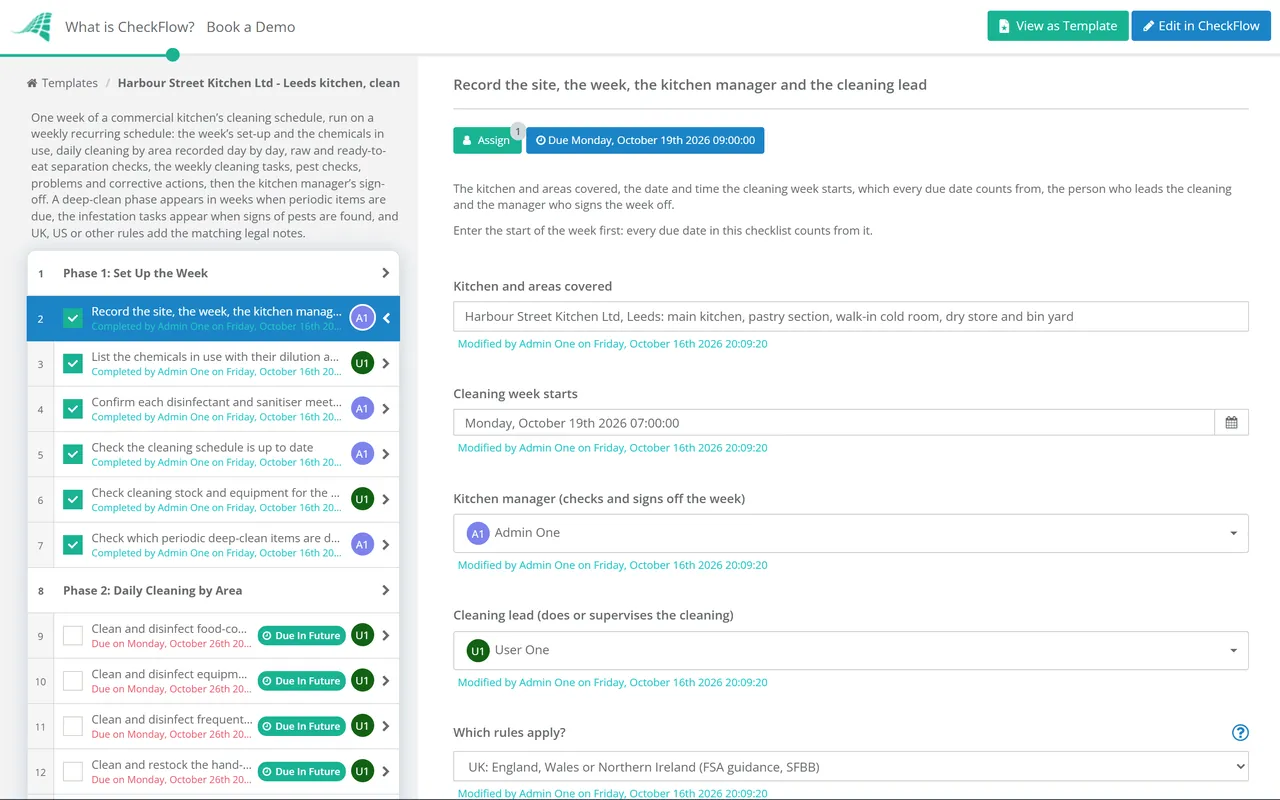
This free commercial kitchen cleaning checklist is for kitchen managers, head chefs and cleaning leads in restaurants, hotels, cafés and contract catering. One run is one week of the kitchen’s cleaning schedule, and it is built to run on a weekly recurring schedule. It starts by setting up the week: the site, who leads the cleaning and who signs it off, and every chemical in use with its dilution and contact time from the label. Each day’s cleaning of food-contact surfaces, equipment, touch points, hand-wash basins, bins, floors and cloths is recorded in a table, area by area. The kitchen manager then checks raw and ready-to-eat separation, and the weekly jobs cover fridges, canopy filters, ovens, dry stores and the dishwasher. A deep-clean phase appears in weeks when periodic items are due, and the infestation tasks appear when signs of pests are found. The week closes with problems put right and the kitchen manager’s sign-off.

Daily, Weekly and Deep: Three Cleaning Cadences in One Rota

A kitchen that looks clean at the end of service can still have a greasy canopy, a fridge nobody has emptied for a month and a mop that does the floor and the prep bench. UK government guidance for food businesses says you must be able to prove you clean effectively, with a cleaning schedule that covers what is cleaned or disinfected, how often and with which products. In the US, the FDA Food Code, a model code that states and local health departments adopt as their own rules, sets how often food-contact surfaces are cleaned and how they are sanitized.

This checklist is that schedule for one week, run on a weekly recurring schedule. The nightly shut-down clean that closes each trading day sits in the Restaurant Opening & Closing Checklist. This one is the full rota: every area day by day, the weekly jobs a day cannot fit and the deep clean when it is due. The HACCP Food Safety Checklist decides which hazards your cleaning has to control.

Daily

Every area, every day

Covers: food-contact surfaces and boards, equipment, touch points, hand-wash basins, bins, floors, disinfectant and cloths.

Who: the cleaning lead and the shift team.

Output: a table on each task showing who cleaned it and when, day by day.
Weekly

The jobs a day cannot fit

Covers: fridges and freezers, canopy filters, ovens and fryers, dry stores, the dishwasher, walls and shelving, plus the raw and ready-to-eat checks and the pest checks.

Who: the cleaning lead, checked by the kitchen manager.

Output: dated records and the kitchen manager’s sign-off.

Periodic

The deep clean, when it is due

Covers: behind and under heavy equipment, high-level surfaces, the cold room, the ice machine, drains and the grease trap, and the specialist ductwork clean.

When: monthly, or at the interval in your deep-clean plan.

Output: before and after photos and contractor reports.

What the Commercial Kitchen Cleaning Checklist Covers

Eight phases follow one week of a commercial kitchen’s cleaning. Phase 2 is recorded day by day in a table on each task. Phase 5 appears only in weeks when deep-clean items are due. The infestation tasks in Phase 6 appear only when signs of pests are found, and the corrective actions in Phase 7 only when something was missed or failed.

  1. Phase 1 — Weekly

    Phase 1: Set Up the Week

    6 tasks

    Answer which rules apply first; it adds the matching legal notes to the tasks. Every due date counts from the date and time the cleaning week starts.

    • Record the site, the week, the kitchen manager and the cleaning lead — the kitchen and areas covered, the date and time the cleaning week starts, which every due date counts from, the person who leads the cleaning and the manager who signs the week off
    • List the chemicals in use with their dilution and contact time — every detergent, disinfectant and sanitiser, where it is used, how it is diluted and how long it stays on the surface, taken from the product label
    • Confirm each disinfectant and sanitiser meets the right standard — the standard on the label or the supplier’s confirmation, and a product that still works in the cold for fridges and freezers
    • Check the cleaning schedule is up to date — what is cleaned, how often, how and with which product, with new equipment and menu changes added
    • Check cleaning stock and equipment for the week — enough chemicals and disposable cloths, separate cloths, mops and buckets for raw and ready-to-eat areas, and the gloves or goggles the labels ask for
    • Check which periodic deep-clean items are due this week — from the deep-clean plan and last month’s record; the answer decides whether Phase 5 appears
  2. Phase 2 — Daily

    Phase 2: Daily Cleaning by Area

    8 tasks

    Record each day in the table on the task: who did it, when, and anything not done. Clean and disinfect in two stages: clean off dirt and grease first, then apply the disinfectant and leave it for the contact time on the label.

    • Clean and disinfect food-contact surfaces and chopping boards — in two stages, after raw food, before ready-to-eat food and at the end of each day
    • Clean and disinfect equipment and utensils — slicers, mixers, probe thermometers, microwaves and small wares, by a full dishwasher cycle or a two-stage clean
    • Clean and disinfect frequently touched points — door and fridge handles, taps, switches, tills, phones, scales and can openers
    • Clean and restock the hand-wash basins — soap, paper towels and hot water at every basin, and nothing in them but hands
    • Empty, clean and disinfect the kitchen bins — food waste out of the kitchen as soon as possible, lids closed and the bin area clean
    • Clean the floors after service — once food is put away, with mops and buckets kept for floors only, then left to air-dry
    • Make up fresh disinfectant at the right dilution — each day, in bottles labelled with the product, the dilution and the contact time
    • Wash or replace cloths every day — disposable cloths thrown away after each task; re-usable cloths washed on a hot cycle, never only steeped in bleach
  3. Phase 3 — Weekly check

    Phase 3: Separate Raw & Ready-to-Eat

    5 tasks

    The kitchen manager checks these on the floor once a week. Separate areas, equipment and cloths come first; anything that has to be shared is cleaned and disinfected between raw and ready-to-eat use.

    • Check boards, knives and containers are kept for raw or ready-to-eat use — colour-coded or labelled, or put through heat disinfection or a full dishwasher cycle between uses, with deeply scored boards replaced
    • Check cloths and cleaning equipment for raw areas are kept separate — cloths used on raw food areas never used on ready-to-eat areas unless washed in between, and floor mops and brushes kept apart from those for worktops
    • Check complex equipment is not shared between raw and ready-to-eat food — vacuum packers, slicers and mincers kept for one use, or fully dismantled, cleaned and disinfected before the change
    • Check sinks used for raw and ready-to-eat equipment — separate sinks, or a shared sink with its taps and fittings cleaned and disinfected between uses
    • Check chemicals are stored away from food — in their own store or cupboard, never above food or clean equipment, with every working bottle labelled
  4. Phase 4 — Weekly

    Phase 4: Weekly Cleaning Tasks

    6 tasks

    Spread these across the quieter days of the week. Each task records when it was done.

    • Empty, clean and disinfect each fridge and freezer in turn — food moved to another fridge or a cold area, shelves washed and disinfected, then the seals, handles and outside
    • Clean the extraction canopy and its filters — filters taken down and degreased, or put through the dishwasher where the maker allows, the canopy wiped and grease trays emptied
    • Deep clean the ovens, grills and fryers — racks, cavities, grill trays and door seals, and fryers drained and cleaned at an oil change once the oil has cooled
    • Clean the dry stores — shelves cleared and wiped, the floor under the racking swept, spills cleaned up and open packs moved into lidded containers
    • Strip and clean the dishwasher and glasswasher — filters, spray arms and curtains cleaned, scale removed, and the detergent and rinse-aid dosing checked
    • Wash walls, doors and shelving in food rooms — splash areas behind benches and sinks, door push plates and the shelving food and equipment sit on
  5. Phase 5 — If due

    Phase 5: Monthly & Periodic Deep Clean

    7 tasks

    Shown only when deep-clean items are due this week. Do the work when the kitchen is closed or quiet, and mark items not due this time as not applicable.

    • Pull out and clean behind and under heavy equipment — ranges, fryers, fridges and freezers on wheels, with gas and power isolated as your site procedure says
    • Clean high-level surfaces — walls above head height, ceilings, light diffusers, vents and fly screens
    • Strip clean the walk-in cold room — shelving emptied and washed, then the floor, walls, door seals and strip curtain, with the food kept cold elsewhere
    • Clean and sanitise the ice machine — following the maker’s instructions, with the ice thrown away and the bin and scoop cleaned
    • Clean the drains, gullies and grease trap — drain covers lifted and channels cleaned, and the grease trap emptied by your contractor on its schedule
    • Book the specialist clean of the extract ductwork when it is due — with a contractor, keeping their report and the date of the next clean
    • Record the deep clean with photos — before and after photos, the items done and any carried over to next month
  6. Phase 6 — Weekly

    Phase 6: Pest Checks

    6 tasks

    Food left out and dirty corners draw pests in. The infestation tasks appear only when signs of pests are found, and the checklist cannot go further until the kitchen manager confirms the area is safe to use.

    • Check the kitchen, stores and bin area for signs of pests — droppings, gnawed packaging, smear marks, live or dead insects, webbing and nests
    • Check bait points, fly killers and proofing — the contractor’s bait boxes and traps in place, insect killers working, and door brushes, screens and gaps around pipes sealed
    • Keep the outside areas and bin store tidy — no rubbish or weeds, bin lids closed and spills cleaned up
    • Call the pest contractor the same day — with what was found and where, and record their visit and advice
    • Throw away food pests may have touched and clean the area — then wash, disinfect and dry every surface, piece of equipment and utensil they may have touched
    • Kitchen manager confirms the area is safe to use — the contractor’s treatment done, the area cleaned and no fresh signs before food is prepared there again
  7. Phase 7

    Phase 7: Problems & Corrective Actions

    5 tasks

    Use the daily tables and the checks above to find what was missed or not done well. The corrective action tasks appear only when there were problems.

    • Record every cleaning task missed or failed this week — from the daily tables and the checks above: what, where, which day and why
    • Put each failure right before the area is used again — re-clean, disinfect and dry the item, and throw away any food that may have been contaminated
    • Find out why it happened and fix the cause — the schedule, staffing, the products and equipment, or training and supervision
    • Retrain or supervise staff where needed — show the method again, watch it done and record who was trained
    • Replace worn boards, cloths and cleaning equipment — deeply scored chopping boards, worn mops and brushes, and broken dispensers, so nothing is too worn to clean
  8. Phase 8 — Week end

    Phase 8: Weekly Review & Sign-Off

    5 tasks

    The kitchen manager reviews the whole week on the record and on the floor before signing it off.

    • Check every daily record is complete — no blank days, and every gap explained
    • Spot-check cleaning standards on the floor — look at and touch at least three surfaces, a fridge and the canopy, and compare them with the schedule
    • Update the cleaning schedule for next week — changes from this week’s problems, new equipment and the deep-clean items now due
    • Note repeat problems for your monthly review — an item missed or failed three times or more needs its cause found, not another reminder
    • Kitchen manager signs off the week’s cleaning record — every daily table complete, every problem put right and every deep-clean item due done or carried over

Kitchen Cleaning Rules in the UK and US

Both systems ask for the same things: a planned schedule, clean first and then disinfect or sanitize, chemicals used as the label says, and raw food kept away from ready-to-eat food. The UK puts most of the detail in guidance from the Food Standards Agency (England, Wales and Northern Ireland) and Food Standards Scotland. The US puts it in the FDA Food Code, which each state or local health department adopts. Use the table to set your own kitchen rules; it is not legal advice.

Topic UK (FSA and FSS guidance, Regulation 852/2004) US (FDA Food Code 2026, a model code)
Cleaning scheduleA cleaning schedule and record covering what is cleaned or disinfected, how often and with which products. SFBB in England, Wales and Northern Ireland and CookSafe in Scotland include oneNo set form. Physical facilities are cleaned as often as necessary to keep them clean, and when the least food is exposed, such as after closing (6-501.12)
How surfaces are cleanedTwo stages: clean off dirt and grease, then disinfect for the contact time on the label. A sanitiser is used twice, once for each stageWashed (Part 4-6), rinsed, then sanitized before use (4-702.11, 4-703.11)
Disinfectant standardDisinfectants and sanitisers should meet BS EN 1276 or BS EN 13697, or an equivalent standardChemical sanitizers used to their EPA-registered label (4-501.114), with a test kit to measure the concentration (4-302.14)
Contact timeAs the manufacturer’s label says, at the right dilutionConsistent with the label: at least 10 seconds for most chlorine solutions and 30 seconds for other chemical sanitizers (4-703.11)
Food-contact surfacesCleaned and, where necessary, disinfected often enough to avoid any risk of contamination (Annex II, Chapter V), and always after contact with raw foodCleaned at each change from raw to ready-to-eat food, between different raw animal foods and at least every 4 hours in use with TCS food (4-602.11); cooking equipment and microwave cavities at least every 24 hours (4-602.12)
ClothsDisposable cloths recommended; re-usable cloths washed on a 90°C cycle (FSA); cloths from raw areas not used on ready-to-eat areas unless washed in betweenWet wiping cloths held in sanitizer between uses and laundered daily; cloths for raw animal food kept separate (3-304.14)
Raw and ready-to-eatSeparate areas, equipment, utensils and cleaning materials, or cleaning and disinfection between uses; complex equipment such as slicers and vacuum packers not shared during the working daySurfaces cleaned and sanitized at each change from raw to ready-to-eat food (4-602.11), and separate wiping cloths for raw animal food (3-304.14)
Chemical storageCleaning agents and disinfectants not stored in areas where food is handled (Annex II, Chapter I)Stored apart from food and clean equipment, never above them (7-201.11); working containers labelled with the common name (7-102.11)
PestsAdequate procedures to control pests (Annex II, Chapter IX)Premises routinely inspected and kept free of pests (6-501.111); dead or trapped pests removed (6-501.112)
VentilationFilters and other parts needing cleaning readily accessible (Annex II, Chapter I)Ducts cleaned and filters changed so they are not a source of contamination (6-501.14)

Check which Food Code edition applies. The FDA’s 2026 Food Code is its most recent full edition, but each state and local agency adopts the code on its own timetable and may amend it. Your health department can tell you which version its inspectors work to.

The BS EN standards. BS EN 1276 and BS EN 13697 are the published test standards a disinfectant or sanitiser is checked against. UK guidance asks you to check that the product label names one of them, or to ask the supplier or manufacturer when it does not.

Why Run Kitchen Cleaning in CheckFlow?

1

A cleaning week waiting every Monday

A weekly recurring schedule starts each kitchen’s week on time, assigned to its cleaning lead and kitchen manager, with every due date counted from the start of the week. A week that has not been finished shows as an open checklist on the Reports Grid.

2

Every day on one record

Each daily task carries a table for the seven days, so a blank day stands out. The deep-clean phase appears only in weeks when it is due, and the corrective action tasks only when something was missed, through rules set by a single answer.

3

No pest problem left open

When signs of pests are found, the kitchen manager confirms the area is safe to use again, and nothing after that approval step can be completed until they record a decision. Every entry, photo and decision is kept with who made it and when.

CheckFlow does not clean the kitchen or choose your chemicals. That belongs to the kitchen manager, your chemical supplier and your food safety management system. It makes sure every job on the rota has a name and a date, that a missed clean reaches someone who puts it right, and that each week is reviewed and signed off. Our guide to recurring checklists shows how weekly routines like this one run.

Keep the trading day’s checks in the Restaurant Opening & Closing Checklist, build or review the food safety plan with the HACCP Food Safety Checklist, and train new starters on your cleaning methods with the Restaurant Employee Training Checklist. Dishwashers, fridges and extraction need servicing as well as cleaning: the Preventive Maintenance Checklist keeps them on a schedule.

AI generator

Didn’t find what you need? Describe it.

Describe the process in a sentence and the AI checklist generator drafts the phases and tasks for you.

Frequently Asked Questions

What should be on a commercial kitchen cleaning checklist?

Everything in the kitchen that needs cleaning, how often, how and with which product. Daily items usually cover food-contact surfaces and chopping boards, equipment and utensils, handles and other touch points, hand-wash basins, bins, floors and cloths. Weekly items cover fridges and freezers, canopy filters, ovens, dry stores and the dishwasher. Periodic items cover the deep clean: behind heavy equipment, high-level surfaces, the cold room, drains and the extract ductwork. Add pest checks, a record of anything missed and a manager’s sign-off.

How often should a commercial kitchen be deep cleaned?

There is no single legal interval. UK guidance asks for a cleaning schedule that says how often each item is cleaned, and Annex II of Regulation 852/2004 asks for cleaning often enough to avoid any risk of contamination. The FDA Food Code asks for physical facilities to be cleaned as often as necessary to keep them clean. Set the interval by how fast grease and dirt build up: items that cannot wait go on the weekly list, the rest on a monthly or longer deep-clean plan.

What is two-stage cleaning?

Cleaning and disinfecting as two separate steps. First you clean: remove visible dirt, grease and food with hot soapy water or a cleaning product, then wipe or rinse. Then you disinfect: apply a disinfectant or sanitiser all over the surface and leave it for the contact time on the label. FSA guidance explains that disinfectants only work on surfaces that have been cleaned first. A sanitiser is a two-in-one product, so it is used twice, once for each stage.

What standard should a kitchen disinfectant meet?

In the UK, FSA and Food Standards Scotland guidance says disinfectants and sanitisers should meet BS EN 1276 or BS EN 13697, or an equivalent standard, used at the dilution and contact time on the label. Check the label, and ask the supplier if it does not say. In the US, the FDA Food Code asks for a chemical sanitizer used according to its EPA-registered label, at a concentration you can check with a test kit.

How often should food contact surfaces be cleaned and sanitized?

In the US, the FDA Food Code asks for food-contact surfaces and utensils to be cleaned at each change from raw to ready-to-eat food, before use with a different type of raw animal food, whenever they may have been contaminated, and at least every four hours while in use with TCS food. They are sanitized before use after cleaning. UK guidance says to clean and disinfect food areas and equipment after contact with raw food and before preparing ready-to-eat food.

How should cleaning cloths be used in a commercial kitchen?

Use disposable cloths where you can and throw them away after each task. FSA guidance says re-usable cloths should be washed, disinfected and dried between tasks, ideally on a 90°C washing machine cycle, and that steeping dirty cloths in bleach is not effective. Cloths used on raw food areas must not be used on ready-to-eat areas unless washed in between. In the US, wet wiping cloths are held in sanitizer between uses and laundered daily.

Do I need to keep kitchen cleaning records?

In the UK, government guidance says you must be able to prove you clean effectively, and to set up a cleaning schedule and record. SFBB in England, Wales and Northern Ireland, and CookSafe in Scotland, include a cleaning schedule. In the US, what you must record depends on your health department and any HACCP plan. Either way, a dated record of who cleaned what is the simplest proof for an inspector. Daily opening and closing checks belong in the Restaurant Opening & Closing Checklist.

Is CheckFlow free for this template?

14-day free trial, no card required. The Business plan is $10 per user per month after the trial. Full details at checkflow.io/pricing.

Keep Every Area of the Kitchen on Its Cleaning Schedule

Free trial — no credit card required.

14-day free trial, no credit cardFull refund in your first 30 daysUS or EU hosting