
Job Offer Approval Checklist

Most offer problems start with a phone call made too early: a figure promised before anyone signed it off, a condition nobody mentioned, or a letter that says something different from the call.

This free job offer approval checklist runs the final hiring gate for one named candidate, after the last interview and before anything is said or sent. It confirms the role is still approved, tests the proposed pay against the band and internal equity, and puts the package in front of a compensation approver. If the offer sits above the band or carries non-standard terms, a second approver signs it off as well. Then it sets the conditions, drafts the letter, makes the verbal and written offers, and hands the accepted candidate over to preboarding.

Use This Template Free See Live Example
No Credit Card Required

The Offer Gate Comes After the Headcount Gate

Two approvals, two different questions. A requisition asks whether the organisation should fill a role at all, and within what budget. That decision is made before any recruiting starts, and the Job Requisition Approval Checklist handles it. This checklist answers a later and narrower question: should we offer this person this package, on these terms? By this point there is a name, an interview record and a number, and the number is where most of the risk sits.

Where offers go wrong. A hiring manager keen to close calls the candidate with a figure above the range. A sign-on bonus is agreed with no repayment terms. A relocation promise lives only in an email thread. The letter leaves the conditions out, so the checks that follow have nothing to hang on. Each of these is cheap to prevent before the offer and costly to unpick after it.

Approval should not mean delay. Every task here carries a due date counted from the day the checklist starts, and both approvers are named on the first task, so they know a decision is on its way. The HR Recruitment Process Checklist covers the whole hiring cycle; run this one alongside it when the offer stage needs its own sign-off and record.

United Kingdom

An accepted offer can be a contract

Conditions: Acas advises stating any conditions, such as satisfactory references or a health check, in the offer itself. A conditional offer can be withdrawn if a condition is not met; withdrawing an unconditional one could be unlawful.

Day one: employees and workers must receive a written statement of their main terms, including pay, hours, holiday, probation and benefits, on or before their first day (section 1 of the Employment Rights Act 1996). A few items, such as pension details, can follow within two months.

Checks: questions about health should generally wait until an offer has been made (section 60 of the Equality Act 2010), and the Home Office right to work check must be completed before work starts.

Moving: from 1 January 2027 the qualifying period for unfair dismissal falls from two years to six months, for dismissals taking effect on or after that date. Review the probation wording in your offer letters with that in mind.


United States

At will, with state rules on pay

At-will: in most states, employment can be ended by either side for any lawful reason, so the letter should not read as a promise of a job for a set period. Montana is the exception, requiring good cause for dismissal once probation ends.

Pay history: California and New York bar employers from asking about an applicant’s pay history and from relying on it to set an offer. Both let the employer consider pay history that the applicant volunteers without being asked.

Pay ranges: California and Washington require employers with 15 or more employees to put a pay range in job postings, so an offer outside the posted range needs a recorded reason. Other states have their own versions, and the details vary.

Verification: Form I-9 Section 1 is due by the first day of employment and Section 2 within three business days of the first day of work for pay.

This template turns those rules into process steps; it is not legal advice. Rules differ from state to state and change often, so for a senior hire with a negotiated contract, an unusual package or a withdrawal you are unsure about, get advice from an employment lawyer before the offer goes out.

What the Job Offer Approval Checklist Covers

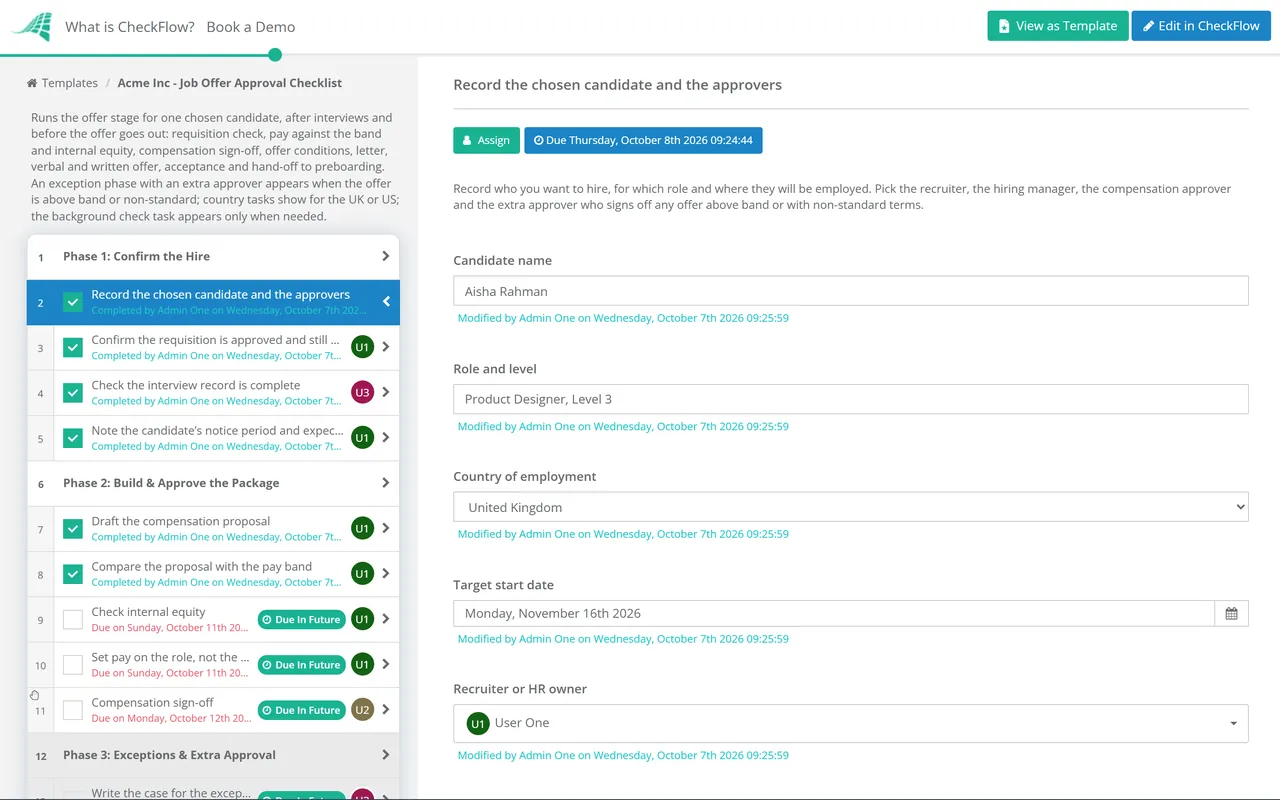
Six phases, from the chosen candidate to the hand-off. The exception phase appears only when the offer is above band or carries non-standard terms. Country tasks show for the United Kingdom or the United States, and the background check task only when the role needs one.

Phase 1

Phase 1: Confirm the Hire

  • Record the chosen candidate and the approvers — role, country of employment, target start date and who signs off
  • Confirm the requisition is approved and still open — same title, level and budget as approved
  • Check the interview record is complete — scores and reasons for every finalist
  • Note the candidate’s notice period and expectations — earliest start date and what they are looking for
Phase 2

Phase 2: Build & Approve the Package

  • Draft the compensation proposal — base pay, bonus, equity, benefits and start date
  • Compare the proposal with the pay band — and answer “Above band or non-standard terms?”
  • Check internal equity — against people in the same role and level, with reasons for any gap
  • Set pay on the role, not the candidate’s pay history — and never ask where state law bans it
  • Compensation sign-off — the approver accepts or rejects the package before anyone calls the candidate
Phase 3 — If Above Band

Phase 3: Exceptions & Extra Approval

Shown when the answer to “Above band or non-standard terms?” is Yes.

  • Write the case for the exception — market evidence, scarcity and the effect on peers
  • Set the sign-on bonus terms — amount, payment date and any repayment if the hire leaves early
  • Agree the relocation support — package, cap and repayment terms
  • List any other non-standard terms — title, extra leave, guaranteed bonus, notice or working pattern
  • Extra approver signs off the exception — a second, more senior decision on the whole package
Phase 4

Phase 4: Conditions of the Offer

The right to work and Form I-9 tasks follow the country chosen on the first task. The background check task appears only when the role needs one.

  • List the conditions the offer depends on — references, checks, qualifications and right to work
  • Request references with the candidate’s agreement — at the offer stage, not before
  • Start the background check — consent first, and only checks the role justifies
  • Plan the UK right to work check — completed before the first day of work
  • Plan the Form I-9 (US) — Section 1 by day one, Section 2 within three business days
Phase 5

Phase 5: Offer Letter & Verbal Offer

The written statement task shows for the United Kingdom, the at-will task for the United States.

  • Draft the offer letter — title, pay, hours, benefits, start date, probation, conditions and a reply date
  • Cover the day-one written statement (UK) — in the letter, the contract or both
  • Add at-will wording and state notices (US) — no promise of a fixed term
  • Check the letter against the approved terms — every figure matches the sign-off
  • Make the verbal offer — approved terms only, with the conditions explained
  • Send the written offer — the same day where possible
Phase 6

Phase 6: Acceptance & Hand-Off

  • Record the candidate’s response — accepted, declined or negotiating, with the date
  • Re-approve any change to the agreed terms — a counter-offer goes back to the approver
  • File the signed acceptance — and the final version of the letter
  • Tell the other finalists — once acceptance is in writing
  • Hand off to preboarding — open conditions, start date and owners

Who Signs Off What, and What to Attach

The matrix below is a starting point. The names will differ: the compensation approver is often an HR or reward lead, and the extra approver a department head, finance director or chief executive. What matters is that every element of the package has a route and that the evidence travels with it.

Element of the offer Standard route Extra approval when Attach
Base payCompensation approverAbove the band maximum, or above the range in the job postingPosition in the band, peer comparison, market data
Bonus or commissionCompensation approver, on plan termsAny guaranteed amount or a target outside the planPlan rules and the amount promised
Sign-on bonusExtra approverAlways, as it sits outside the bandAmount, payment date, repayment terms
Relocation supportExtra approverAlways; follow your relocation policyPackage, cap and repayment agreement
Title or levelBack to the requisition ownerAny change from the approved requisitionThe updated requisition
Other termsExtra approverExtra leave, longer notice, a fixed working pattern or a delayed startWhat was agreed and why

When a candidate asks for more, do not improvise. Note the request, say when they will hear back, and send it through the same route. Once relocation support is agreed, the Employee Relocation Checklist covers the move itself.

On the call

What to say in the verbal offer

  • The role, the start date and the approved pay
  • Any bonus, equity or sign-on payment, exactly as approved
  • Every condition, and roughly how long the checks take
  • That the written offer follows, and when
  • The date by which you need an answer
  • Who to call with questions
  • Nothing that has not been signed off
In the letter

What the written offer should state

  • Job title, reporting line and place of work
  • Pay, how often it is paid, and any bonus terms
  • Hours, holiday and main benefits
  • Start date and any probation period
  • Whether the offer is conditional, and on what
  • How to accept, by when, and who to contact
  • US: an at-will statement; UK: the day-one particulars, here or in the contract

Each condition has its own process. The Pre-Employment Background Check Checklist covers consent, timing and what to do with a result. For proof of the right to work, use the Right to Work Check Checklist (UK) or the Form I-9 & E-Verify Compliance Checklist for US hires.

Why Run Offer Approvals in CheckFlow?

1

An exception route only when needed

Answer “Above band or non-standard terms?” with Yes and the exception phase appears, with the extra approver’s task at the end. Answer No and it stays hidden. A country dropdown shows the UK or US tasks, so recruiters work from one template.

2

Nothing is said before it is signed

Compensation sign-off is an approval task assigned to the approver picked on the first task. The checklist halts until it is approved, and the verbal offer sits after it, so no figure reaches the candidate before the decision does.

3

One record of every offer

The proposal, the business case, the letter and the signed acceptance are each uploaded to their own task. Every sign-off is time-stamped against the approver’s name, and reports show how long the offer stage takes and where it stalls.

An offer is one of many decisions that need a named approver. CheckFlow’s approval software turns any step into an approval assigned to the right person, holds the process until they decide, and keeps the decision with the task.

Hiring does not end at acceptance. CheckFlow’s HR checklist software runs requisitions, offers, checks and onboarding from templates shared by HR, recruiters and hiring managers. Once the offer is accepted, the New Hire Preboarding Checklist takes over until the first day.

Frequently Asked Questions

What is job offer approval?

+

It is the sign-off an organisation requires before it offers a job to a specific candidate. Someone with authority over pay checks the proposed package against the approved budget, the pay band and what current staff in the same role earn, and confirms the terms and conditions of the offer. Only then does the hiring manager call the candidate. Without it, offers drift upwards one negotiation at a time and nobody can later explain why two people in the same job are paid differently.

How is this different from requisition approval?

+

Requisition approval happens before recruiting begins and decides whether a post should be filled, at what level and within what budget. Offer approval happens at the end, once interviews have produced a preferred candidate, and decides the exact package for that person. A role can pass the first gate and still need the second, for example when the best candidate asks for more than the budgeted band. Keeping the two separate means a change to the role goes back to the requisition owner rather than slipping through in an offer.

Should a job offer be made verbally or in writing?

+

Usually both, in that order. A call from the hiring manager is quicker and more personal, and it lets you hear the candidate’s questions. But Acas notes that an offer made verbally is better put in writing to avoid misunderstandings, and in the UK an accepted offer can form a contract whichever way it was made. So only say what has been approved, and send a written offer with the same terms straight afterwards. Ask the candidate to confirm their acceptance in writing.

Can an employer withdraw a job offer?

+

In the UK, a conditional offer can be withdrawn if a stated condition is not met, such as an unsatisfactory reference or a failed right to work check. Withdrawing an offer once every condition has been met, or an unconditional offer, may be a breach of contract. That is why the conditions belong in the letter. In the US, the answer depends on state law and on what the letter promised, and a withdrawal based on a background check report has its own notice steps. Take advice before withdrawing an accepted offer anywhere.

Can we ask a candidate what they currently earn?

+

In several US states, no. California and New York, for example, ban asking about pay history and using it to decide whether to offer a job or what to pay. A candidate can still volunteer the figure without being prompted. Elsewhere it is allowed but risky, because past pay can carry earlier inequalities into your own payroll. Asking what the candidate expects to earn, and pricing the offer on the role, the band and internal equity, works everywhere.

Is CheckFlow free for this template?

+

14-day free trial, no card required. The Business plan is $10 per user per month after the trial. Full details at checkflow.io/pricing.

Get Every Offer Signed Off Before It Goes Out

Free trial — no credit card required.