Between a signed offer and the first morning, the contract, the checks, the payroll forms and the laptop all have deadlines. Meanwhile a new hire who hears nothing for three weeks may quietly accept another offer.
Preboarding is the stretch from offer acceptance to the moment the new hire walks in, or logs in, on day one. A notice period can run for a month or more, and several legal steps have to be finished inside it. This free preboarding checklist is for HR teams, recruiters and hiring managers who want that stretch run as a process rather than a string of reminders. It sets every due date from the confirmed start date, shows only the compliance tasks for the country of employment, adds a screening phase when the offer is conditional, and ends with a sign-off that the new hire is cleared to start. Once they arrive, hand over to the Employee Onboarding Checklist, which covers day one through the 90-day review.
Most onboarding checklists squeeze preboarding into a few lines at the top: send the paperwork, order the laptop, say hello. That works when the start date is next Monday. It breaks down when the gap is six weeks, the offer depends on a criminal record check, the hire is remote, or the person is joining in another country. Each adds tasks with their own owners and deadlines, most counted backwards from a date that can still move.
So this template keeps preboarding as a separate checklist with a hard boundary at each end. It opens when the candidate says yes and the start date is agreed. It closes when HR has approved that every condition is met and the new hire has arrived. Anything after that, from the welcome on the first morning to the probation review, belongs to the onboarding checklist. HR owns the first, the hiring manager owns the second.
Preboarding (this template)
Getting the hire legally and practically ready
Runs: from offer acceptance to the first morning.
Led by: HR or the recruiter, with IT and the hiring manager.
Main risks: a missed right to work check, unsigned terms, no laptop, a no-show.
Ends with: a recorded “cleared to start” approval.
Onboarding (the next template)
Turning a new starter into a productive team member
Runs: from day one to the 90-day review.
Led by: the hiring manager, with HR and a buddy.
Main risks: unclear goals, a weak first week, no check-ins.
Ends with: a confirmed probation outcome and a development plan.
What the Preboarding Checklist Covers
Seven phases, all dated from the start date. The screening, US and UK phases appear only when the answers in Phase 1 call for them.
Phase 1
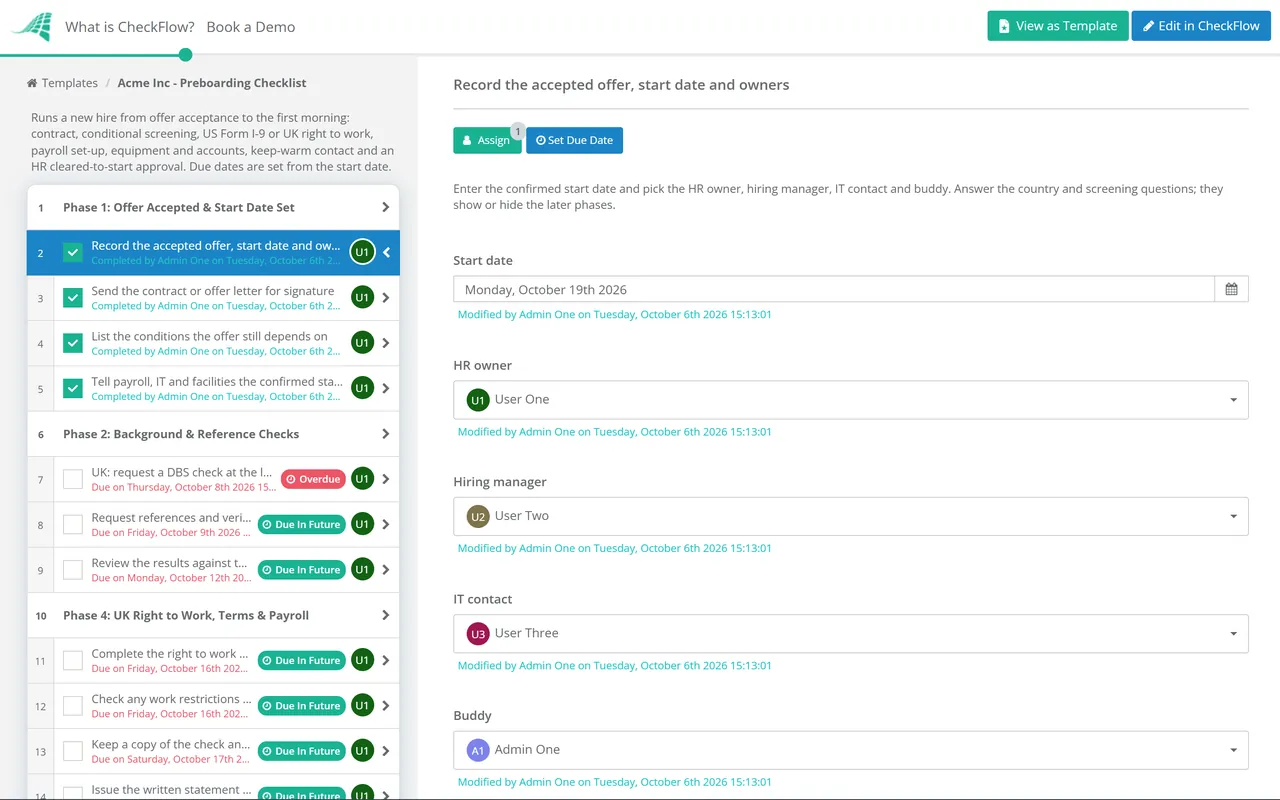
Phase 1: Offer Accepted & Start Date Set
Record the accepted offer, start date and owners — HR owner, hiring manager, IT contact and buddy, plus the country of employment and whether screening is needed
Send the contract or offer letter for signature
List the conditions the offer still depends on — and tell the candidate in writing what is outstanding and who will be in touch
Tell payroll, IT and facilities the confirmed start date
Elsewhere: confirm local hiring paperwork with an adviser — or with an employer of record, when the country is neither the US nor the UK
Phase 2 — If Screening Is Required
Phase 2: Background & Reference Checks
Shown only when the offer is conditional on screening. A process step, not legal advice: what you may check, and when, depends on the role and the jurisdiction.
US: give the FCRA disclosure and get written authorisation — the disclosure in its own document, never inside the application form
UK: request a DBS check at the level the role is eligible for
Request references and verify required qualifications or licences
Review the results against the role and record the decision — then confirm to the new hire in writing that the conditions are cleared
Before withdrawing an offer on a US report, send pre-adverse notice — with a copy of the report and the FCRA summary of rights, then wait before any final adverse action notice
Phase 3 — If United States
Phase 3: US Forms, Payroll & Reporting
Shown when the country is the United States. Two tasks fall due just after day one, so they are scheduled here and tracked to completion.
Send Form I-9 Section 1 to complete by the first day of work — it can be done any time after the offer is accepted
Plan how the Section 2 documents will be examined — in person, by an authorised representative or by the remote alternative for E-Verify employers; due within three business days of the first day of work for pay
Collect Form W-4 and any state withholding form
Set up the payroll record and direct deposit
Send benefits enrolment details and the election deadline
Schedule the state new-hire report by the state deadline — no later than 20 days after hire, and sooner where the state says so
Phase 4 — If United Kingdom
Phase 4: UK Right to Work, Terms & Payroll
Shown when the country is the United Kingdom. The right to work check must be finished before employment starts, not on the first morning.
Complete the right to work check before the start date — a manual document check, a Home Office online check with a share code, or a registered digital verification service
Check any work restrictions match the role and hours offered
Keep a copy of the check and diary any follow-up check — for the length of employment plus two years; time-limited permission needs a repeat check before it expires
Issue the written statement of particulars on or before day one
Collect the P45 or starter checklist, NI number and bank details
Phase 5
Phase 5: Equipment, Accounts & Workspace
Raise the equipment request with a delivery date before the start — allow courier time for remote hires
Request role-based accounts, set to switch on from day one
Prepare the desk, pass and parking, or confirm the home set-up
Agree how first-day sign-in details will reach the new hire securely
Test every login and device two working days before the start
Phase 6
Phase 6: Welcome & Keep-Warm Contact
The longer the notice period, the more these tasks matter. Each one is assigned to a person, not to “the team”.
Send a personal welcome from the hiring manager — once the contract is signed
Schedule keep-warm check-ins until the start date — short calls or messages about the role and the team, not reminders about forms
Introduce the buddy and arrange an informal pre-start chat
Share a short pre-start pack — the first week’s outline, who they will meet and any reading, kept optional
Escalate silence or delays to the hiring manager the same week — unanswered messages, missed forms and vague answers about the start date are early warnings
Phase 7
Phase 7: Cleared to Start & the First Morning
The checklist ends when the new hire arrives. The approval halts the checklist until HR signs it off.
Send first-morning logistics three working days before the start — arrival time, address or video link, who will meet them and which identity documents to bring
HR confirms the new hire is cleared to start — contract signed, conditions met, right to work or Form I-9 Section 1 in hand, payroll ready
Confirm who greets the new hire and the plan for the first hour
Record the arrival and launch the Employee Onboarding Checklist
The biggest difference is timing: a US employer can finish Form I-9 in the first few days of work, while a UK employer who checks right to work after the start date has no statutory excuse if the person turns out not to be allowed to work. The table summarises what the conditional phases ask for and where each rule comes from. It is a process guide, not legal advice; state, sector and role rules can add to it.
Step
United States
United Kingdom
Right to work
Form I-9: the employee signs Section 1 by the first day of employment; the employer completes Section 2 within three business days of the first day of work for pay
A right to work check by the employer, completed before employment starts
How documents are checked
Physical examination, or the remote alternative for employers enrolled in E-Verify in good standing: copies of the documents plus a live video call
Original documents in person; a Home Office online check with a share code, the only route for eVisa holders; or a registered digital verification service for British and Irish passports
Records to keep
Form I-9 for three years after hire or one year after employment ends, whichever is later
A copy of the check for the length of employment and two years after
Tax and payroll
Form W-4, plus a state withholding form where the state has one
A P45 from the last employer, or the HMRC starter checklist if there is none
Reporting the hire
A new-hire report to the state, within 20 days at most; Maine, for example, asks for seven
No separate report; HMRC learns of the starter through payroll
Criminal record checks
Under the FCRA: a standalone disclosure, written authorisation and the adverse action steps; state and local laws can add more
DBS checks: a basic check for any role; standard and enhanced checks only where the role is eligible in law
Written terms
Set by state law; California, for example, requires a written pay notice at the time of hire
A principal written statement on or before day one; the rest within two months
Three things have moved recently. The Home Office’s employer guide dated 1 October 2026 extends right to work checks beyond employees to people engaged on a worker’s contract, individual sub-contractors and some online matching services, and lets a registered verification service check a British or Irish passport up to six months after it expires. The UK government plans to require a statement of the right to join a trade union, given alongside the written statement, from January 2027. In the US, the current Form I-9 is the 01/20/25 edition. Check the sources before relying on any of this: USCIS I-9 Central, the FTC’s guide to consumer reports and the Home Office employer’s guide.
Why Run Preboarding in CheckFlow?
1
One date sets every deadline
Each task is due a set number of days before the start date recorded in Phase 1: the contract two weeks out, the equipment request ten days out, the login test two days out. If the start date moves, change it once and every due date follows.
2
Only the paperwork that applies
Two answers in Phase 1, the country of employment and whether screening is needed, decide which phases appear. A UK hire never sees Form I-9, a US hire never sees a share code, and an unconditional offer skips screening entirely.
3
A sign-off before anyone starts
The cleared-to-start task is an approval assigned to the HR owner, and the checklist stops there until it is approved. The signed contract, check results and right to work evidence sit on the same record, with names and timestamps.
CheckFlow’s onboarding software runs preboarding and onboarding as separate templates, so each stage has its own owner and its own record.
Everything that has to be true before the first morning: a signed contract or offer letter, any conditional checks cleared, the legal right to work established, tax and payroll details collected, equipment delivered and accounts tested, a welcome and regular contact from the hiring manager, and clear first-day logistics. It should also name an owner for each step and end with a recorded decision that the person is cleared to start.
How far ahead of the start date should preboarding begin?
+
As soon as the offer is accepted and a start date is agreed. The tasks with long lead times, such as screening, equipment orders and account requests, need the most notice, so start them first. When the gap is short, the same checklist still works: every due date comes from the start date, so it shows straight away which tasks are at risk.
Can a new hire fill in Form I-9 before their first day?
+
Yes. USCIS says employees may complete Section 1 any time after accepting the job offer, and must complete it no later than their first day of employment. The employer can examine documents and complete Section 2 any time from offer acceptance until three business days after the first day of work for pay. E-Verify employers create the case no later than the third business day after the employee starts work for pay.
When does a UK right to work check have to be done?
+
Before the person starts work. The Home Office guidance says employers must complete the check before employment commences to have a statutory excuse against a civil penalty. Check everyone the same way, whatever their nationality. People with an eVisa prove their right to work through the Home Office online service and a share code.
What if a background check raises a concern?
+
In the US, if the result comes from a consumer report and you may withdraw the offer because of it, the FTC says you must first send a pre-adverse action notice with a copy of the report and the summary of rights, so the person can point out errors. Only then send an adverse action notice. In the UK, discuss the result with the candidate and judge its relevance to the role. Record the reasons either way, and take advice on anything borderline.
How can we stop new hires dropping out before day one?
+
Keep in touch about the job, not only the forms. A personal welcome, a buddy introduction and short scheduled check-ins keep the new hire committed through a long notice period. Watch for warning signs, such as unanswered messages or paperwork that keeps slipping, and have the hiring manager call the same week. A checklist cannot stop a counter-offer, but it makes sure nobody goes quiet for a month by accident.
Is CheckFlow free for this template?
+
14-day free trial, no card required. The Business plan is $10 per user per month after the trial. Full details at checkflow.io/pricing.
Every New Hire Arrives Cleared, Equipped and Expected
Free trial — no credit card required.
Do you like cookies? 🍪 We use cookies to ensure you get the best experience on our website. Learn more