Pre-Employment Background Check Checklist

Most background check problems are not about what the report says. They come from the order things were done in: a consent form buried in the application, a criminal record question asked too early, or an offer withdrawn before the candidate saw the report.

Background checks protect customers, colleagues and the organisation, but the rules on how you run them are strict and differ between countries, states and cities. This free pre-employment background check checklist puts the steps in a fixed order for hires in the United States and the United Kingdom. It starts with a risk-based choice of checks for the role, then covers notice and consent, running the checks, reviewing the results, a fair process when something comes back that concerns you, and the decision and record-keeping at the end. Once a candidate is cleared, the Employee Onboarding Checklist takes over.

Use This Template Free See Live Example
No Credit Card Required

Last reviewed: October 2026

Background Checks in the US and the UK

The checks should match the job. A blanket policy of running every check on every hire is expensive, slow and, in parts of both countries, unlawful. The UK Information Commissioner’s Office says employers should vet only where the law requires it or where the role carries a significant and particular risk. US regulators take a similar line on criminal records: a check should be relevant to the duties of the job.

The order of steps matters as much as the checks. In the US, the Fair Credit Reporting Act (FCRA) controls any check bought from a background screening company, and many states and cities add fair-chance rules on when you may ask about criminal history. In the UK, criminal record checks are made through the Disclosure and Barring Service (DBS) in England and Wales, and the level of check you may request depends on the role. Scotland and Northern Ireland have their own services, Disclosure Scotland and AccessNI.

Process is not the same as advice. This template makes sure each step is done and recorded. Where a result is borderline or a candidate challenges a decision, take advice from an employment lawyer on the specific case.

United States

Consent, then a fair chance to respond

Main rules: the FCRA, plus state and local fair-chance and credit-check laws.

Before the check: a standalone written disclosure and the candidate’s written authorisation.

Before rejecting: a pre-adverse action notice with a copy of the report and the FCRA summary of rights.

Also required: Form I-9 employment eligibility verification, which is part of onboarding.

United Kingdom

Eligibility, then proportionate checks

Main rules: the Rehabilitation of Offenders Act 1974, DBS eligibility rules, UK GDPR and the Data Protection Act 2018.

Before the check: confirm the role is eligible for the DBS level and tell the candidate what will be checked.

Before the start date: a prescribed right-to-work check, which gives you a statutory excuse.

Afterwards: keep criminal record information only as long as you need it.

What the Background Check Checklist Covers

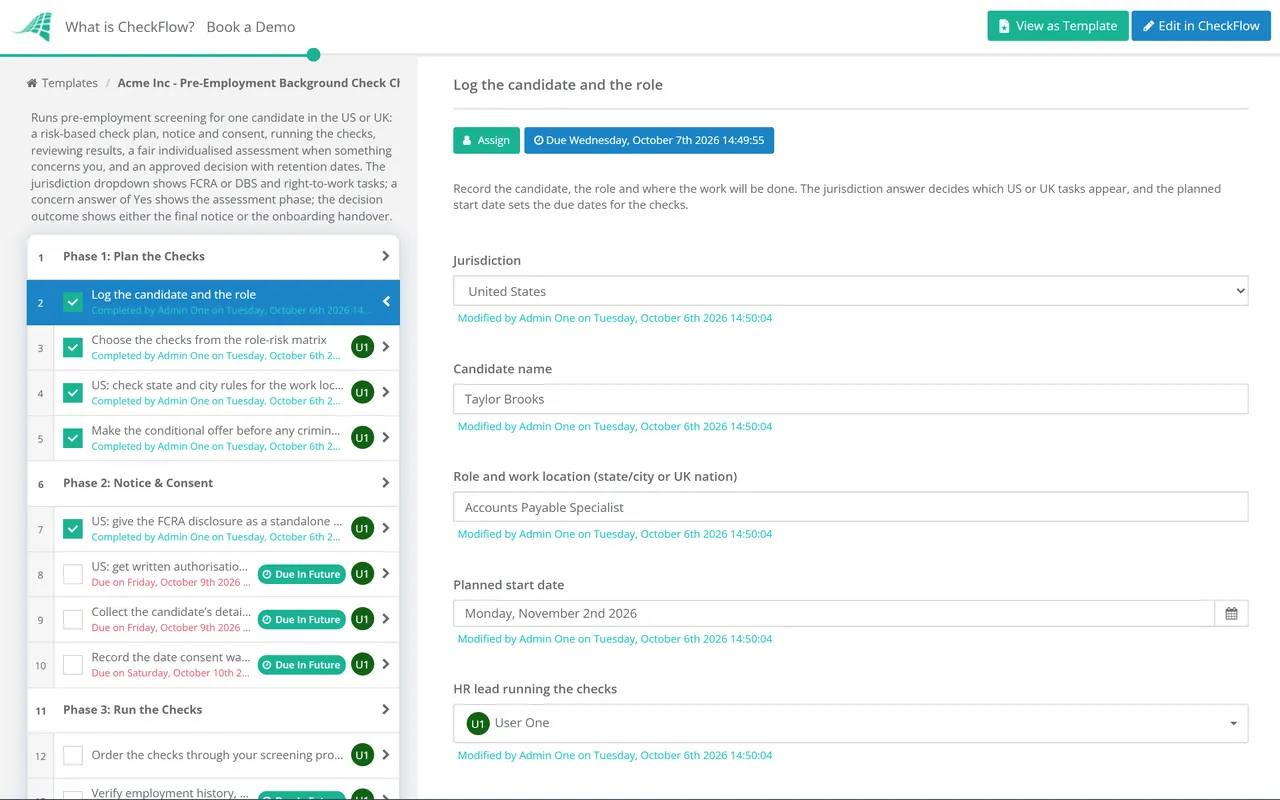
Six phases run from the check plan to the final record. US and UK tasks appear according to the jurisdiction chosen at the start, and Phase 5 appears only when a result raises a concern.

Phase 1

Phase 1: Plan the Checks

  • Log the candidate and the role — role, work location, planned start date, hiring manager and jurisdiction
  • Choose the checks from the role-risk matrix — only the checks the duties of the role justify
  • UK: confirm the role is eligible for the DBS level requested — standard and enhanced checks need an eligible role
  • US: check state and city rules for the work location — fair-chance timing and limits on credit checks
  • Make the conditional offer before any criminal record check — required by many fair-chance laws and good practice everywhere
Phase 2

Phase 2: Notice & Consent

  • US: give the FCRA disclosure as a standalone document — not inside the application form or offer letter
  • US: get written authorisation before ordering the report
  • UK: tell the candidate what will be checked — which checks, why, who sees the results and how long they are kept
  • Collect the candidate’s details for each check — identity documents, address history and referee contacts
  • Record the date consent was given and file the signed forms
Phase 3

Phase 3: Run the Checks

  • Order the checks through your screening provider or DBS umbrella body
  • UK: complete the right-to-work check before the start date — a manual check, a Home Office online check for eVisa holders or a registered digital provider
  • Verify employment history, qualifications and professional licences that the role depends on
  • Take up references — with the candidate’s agreement, and using the same questions for every referee
  • Chase anything outstanding a week before the planned start date
Phase 4

Phase 4: Review the Results

  • Compare each result with what the role actually requires
  • Set aside information you may not use — UK spent convictions for non-exempt roles, and records excluded by state or city law
  • Check the report is about the right person — name, date of birth and address history
  • Record whether any result raises a concern
  • Keep results out of the general personnel file — with access limited to the people deciding
Phase 5 — If There Is a Concern

Phase 5: Individualised Assessment

Shown only when a result raises a concern. No decision is final until the candidate has had a chance to respond.

  • Assess the result against the job — the nature and gravity of the offence, the time since it happened and the duties of the role
  • US: send the pre-adverse action notice — with a copy of the report and “A Summary of Your Rights Under the Fair Credit Reporting Act”
  • Add any notice your state or city requires — such as the California or New York City fair-chance notices
  • UK: discuss the result with the candidate before deciding
  • Give the candidate time to respond and keep the position open — at least five business days where state or city law requires it
  • Record the candidate’s response and any evidence of rehabilitation
Phase 6

Phase 6: Decision & Records

  • Approve the hiring decision — the named decision-maker signs off clearance or withdrawal of the offer
  • If the offer is withdrawn, send the final notice — in the US, the FCRA adverse action notice with the required content
  • If cleared, confirm the start date and hand over to onboarding
  • Record the outcome, not the detail — checks run, dates and whether the result was satisfactory
  • Set the deletion date for reports and certificates — then dispose of them securely when it arrives

Which Checks for Which Role: A Risk-Based Matrix

Start from the duties of the role, not from a list of everything a screening company sells. The matrix below is a starting point for Phase 1. Write down why each check is needed for the role, because that reason is what you will rely on if the check, or a decision based on it, is ever questioned.

Role profile United States United Kingdom Why
Every hireIdentity, Form I-9, referencesIdentity, right-to-work check, referencesLegal duty to confirm the person can work, and that they are who they say they are
Office and customer-facing rolesEmployment and education verification; criminal record only if job-relatedBasic DBS only if a clear reason existsLow risk: verify claims on the CV, not the person’s past
Cash, payments or financial authorityCriminal record; credit report only where state and city law allow itBasic DBS; financial checks where the role justifies themOpportunity for fraud or theft
Driving for workMotor vehicle record from the stateDVLA licence check with a check code from the candidateRoad safety and insurance cover
Children, patients or vulnerable adultsState-mandated checks for the sector, licence verificationEnhanced DBS, with barred list checks for regulated activitySafeguarding duties set by law
Privileged systems or sensitive dataCriminal record, employment and education verificationBasic DBS, employment history, qualificationsAccess to systems, data or money that could cause serious harm

The waiting period. The FCRA says a candidate must get the pre-adverse action notice before you act, but neither the statute nor the Federal Trade Commission sets a number of days. The point is to give the candidate a real chance to correct a wrong report. Five business days is a common working minimum, and it is the legal minimum under the California and New York City fair-chance laws. Wait longer if the candidate says they are disputing the report.

The EEOC guidance. The Equal Employment Opportunity Commission’s 2012 guidance on arrest and conviction records is still published and has not been formally rescinded, though federal enforcement of disparate-impact claims has been deprioritised since an April 2025 executive order. Its three factors, the nature of the offence, the time elapsed and the nature of the job, are the same ones many state and city fair-chance laws write into their individualised assessments, so the assessment in Phase 5 is worth doing either way.

UK filtering. Standard and enhanced DBS certificates do not show every old conviction. Some older convictions and cautions are filtered out after a set period, unless the offence is on the list that is never filtered or led to a custodial sentence. A basic check shows only unspent convictions and conditional cautions. The rules are in the DBS filtering guidance.

Why Run Background Checks in CheckFlow?

1

The right steps for the right country

Choose the jurisdiction on the first task and conditional logic shows the FCRA steps for a US hire or the DBS and right-to-work steps for a UK hire. Recruiters stop working from a generic list and skipping the parts that seem not to apply.

2

No shortcut past the candidate

Answer “Does any result raise a concern?” with Yes and the individualised assessment phase appears, with the notices and the response period, before the decision task. The decision is an approval assigned to a named person, so it cannot be ticked off by whoever happens to be in the hiring channel.

3

A record of who did what, and when

Signed consent forms are uploaded to the task, due dates run back from the planned start date, and the audit trail shows who completed each step. If a candidate later challenges the process, the dates and the order of events are already written down.

Background checks sit between the offer and the first day. CheckFlow’s HR checklist software runs the whole hiring lifecycle from templates, from the HR Recruitment Process Checklist to onboarding, with assignments and handoffs between HR, recruiters and hiring managers.

The clearance decision is a formal sign-off. CheckFlow’s approval software shows how approvals hold a checklist until the named approver decides, and our employee onboarding checklist guide covers what happens once a candidate is cleared.

Frequently Asked Questions

What does a pre-employment background check include?

+

It depends on the role. Every hire needs identity and right-to-work checks, and most employers take up references and verify employment history. Criminal record, credit, driving and professional licence checks should be added only where the duties of the role justify them. In the UK, the level of DBS check you may request is set by law according to the role, so the choice is not entirely yours.

What does the FCRA require from employers?

+

When you use a background screening company, the FCRA requires a clear written disclosure in a document that consists only of the disclosure, and the candidate’s written authorisation before you order the report. Before rejecting someone because of the report, you must give them a copy of it and the FCRA summary of rights. After the decision, the adverse action notice must name the screening company, say it did not make the decision, and explain the candidate’s right to a free copy within 60 days and to dispute the report. The FTC’s guidance for employers sets out each step.

When can I ask about criminal history in the US?

+

It depends on where the job is. By the National Employment Law Project’s count, 37 states and more than 150 cities and counties have some form of ban-the-box or fair-chance policy, though many apply only to public employers. California’s Fair Chance Act covers employers with five or more employees and New York City’s covers employers with four or more; both bar criminal history questions until after a conditional offer. The federal Fair Chance to Compete for Jobs Act applies the same timing to federal agencies and to federal contractors for work under the contract. Asking after the conditional offer is the safest default everywhere.

Which DBS check do I need in the UK?

+

A basic check shows unspent convictions and conditional cautions, and any employer can request one. A standard check adds spent convictions and cautions that have not been filtered, and is available only for roles listed in the Rehabilitation of Offenders Act 1974 (Exceptions) Order 1975. An enhanced check adds relevant information held by local police, and an enhanced check with barred lists also shows whether the person is barred from working with children or adults. DBS guidance says that knowingly asking for a higher level than the role allows is unlawful.

What is the penalty for skipping a UK right-to-work check?

+

Up to £60,000 for each illegal worker, according to the Home Office. A correct check carried out before the person starts work gives you a statutory excuse against the penalty. Use the Home Office online service for anyone with an eVisa. From 1 October 2026 the scheme also reaches some workers and individual subcontractors, not only employees, and any digital provider you use must be registered. Keep a copy of the check for the length of employment and for two years afterwards.

How long should background check results be kept?

+

As briefly as the purpose allows. In the UK, the ICO says vetting information should be destroyed once recruitment is over, and the DBS code of practice says certificate information should usually be kept for no more than six months after the decision. Record only that the check was done and whether it was satisfactory. In the US, EEOC rules require hiring records to be kept for one year, or longer if a charge is filed, and the FCRA requires secure disposal of reports when you no longer need them. State laws can set longer periods.

Is CheckFlow free for this template?

+

14-day free trial, no card required. The Business plan is $10 per user per month after the trial. Full details at checkflow.io/pricing.

Check Candidates Fairly, in the Right Order

Free trial — no credit card required.