
HR Recruitment Process Checklist Template

A structured recruitment process that attracts the right candidates, evaluates them consistently, and gets the right person from application to accepted offer — without losing them to a competitor in the gap.

The average time to fill an open role exceeds 40 days. For every day a role is unfilled, there is an operational cost — work not done, colleagues stretched, and hiring managers distracted from their primary responsibilities. But speed without structure produces poor hires, and poor hires cost more than the vacancy did. The most common recruitment failures are not capability failures — they are process failures: job descriptions that attracted the wrong candidates, inconsistent screening that let the wrong people through, interview processes that evaluated different things for different candidates, and offer timelines so slow that the first-choice candidate had already accepted elsewhere. A structured recruitment process eliminates all of these — by running the same defined sequence for every role, with every stakeholder briefed, every step timed, and every candidate evaluated consistently. This free checklist gives HR managers and hiring managers a complete framework for the full recruitment cycle.

Use This Template Free See Live Example
No Credit Card Required

The Five Points Where Recruitment Processes Most Commonly Break Down

Vague or discriminatory job descriptions

Job descriptions that describe the ideal candidate instead of the required role — with subjective criteria like “culture fit” or requirements that inadvertently exclude protected groups — reduce the quality of the candidate pool and create legal exposure.

Reactive sourcing

Waiting until the role is vacant to start sourcing. The organisations with the shortest time-to-fill maintain talent pipelines and employer brand presence between hires — so there are candidates who already know and want to join the organisation.

Inconsistent screening

Different screeners apply different criteria to the same application stack. Candidates are filtered out or through based on personal preferences rather than defined criteria. The shortlist that reaches the interview stage does not reflect the requirements of the role.

Slow offer process

The first-choice candidate is identified. The hiring manager wants to “think about it” for a week. The approval process for the compensation takes another week. The offer letter takes three days. The candidate has accepted elsewhere.

No pre-boarding

The offer is accepted. Nothing happens until day one. The candidate receives no communication, no paperwork, and no excitement-building during the notice period — and disengages from the new role before they have started.

What the HR Recruitment Process Checklist Covers

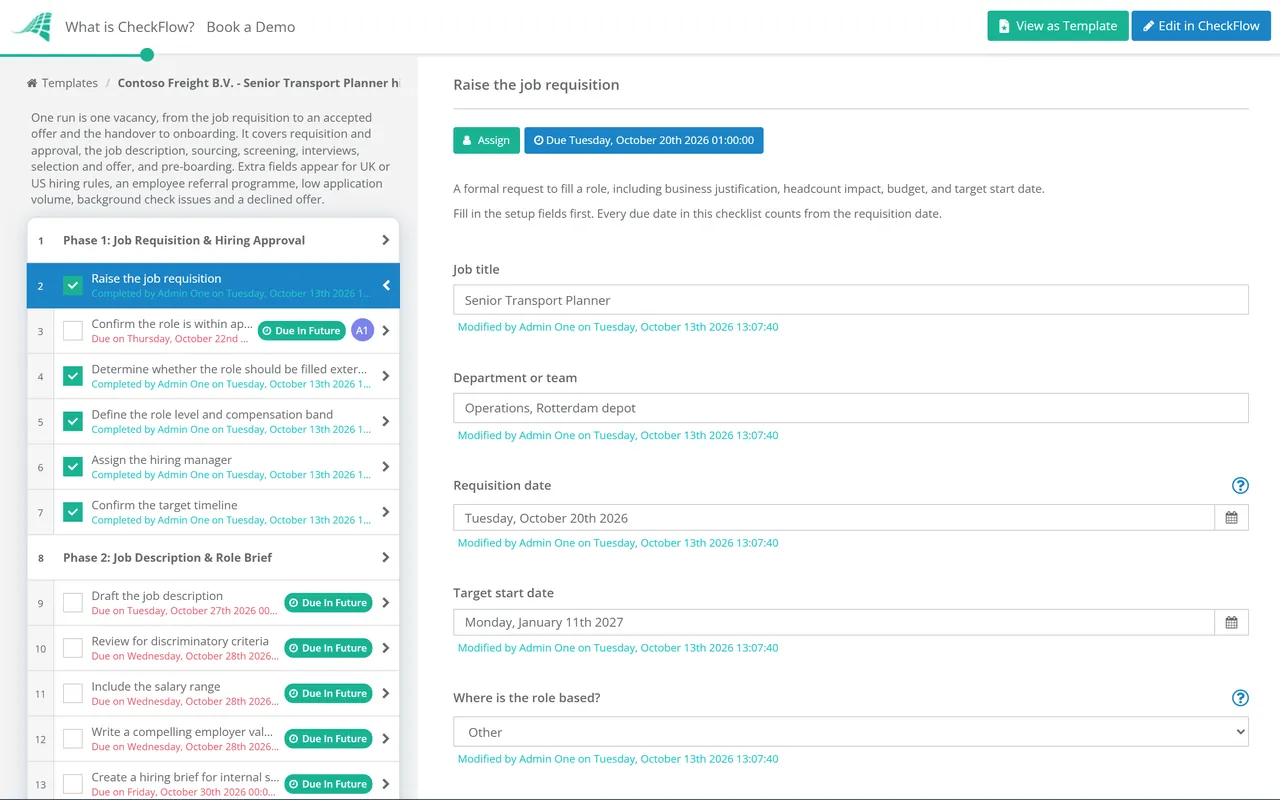
This checklist covers the full recruitment cycle in seven phases — from the initial job requisition through to the candidate’s first day pre-boarding. Run it as the standard process for every hire.

Phase 1

Phase 1: Job Requisition & Hiring Approval

  • Raise the job requisition — a formal request to fill a role, including business justification, headcount impact, budget, and target start date
  • Confirm the role is within approved headcount — and within budget; obtain finance or leadership approval before beginning the search
  • Determine whether the role should be filled externally — or whether internal mobility, restructuring, or upskilling is the right solution first
  • Define the role level and compensation band — grade, salary range, and benefits; confirmed before the job is posted to avoid late-process compensation surprises
  • Assign the hiring manager — the person with operational accountability for the role; brief them on their responsibilities in the recruitment process
  • Confirm the target timeline — desired start date, application deadline, interview dates, and offer target
Phase 2

Phase 2: Job Description & Role Brief

The job description is the first impression your organisation makes on candidates. A generic, inflated, or discriminatory job description filters out the people you want and attracts the people you do not.

  • Draft the job description — role purpose, key responsibilities, required qualifications, and desired attributes; avoid inflated requirements that deter strong candidates unnecessarily
  • Review for discriminatory criteria — requirements must be genuinely necessary for the role; experience or qualification requirements that could disproportionately exclude protected groups must be justified
  • Include the salary range — where organisational policy permits (increasingly required in UK and many US states); transparent salary posting increases application quality
  • Write a compelling employer value proposition — why is this a good place to work? Culture, development, flexibility, and benefits described honestly
  • Create a hiring brief for internal stakeholders — the scoring criteria and weighting that will be used to evaluate candidates; shared with all interviewers before the process begins
Phase 3

Phase 3: Sourcing & Job Advertising

  • Post to the appropriate job boards — general boards (Indeed, LinkedIn), specialist boards for the role type, and the company careers page
  • Share internally — internal job board or company communication; internal candidates should have the opportunity to apply
  • Brief the employee referral programme — if one exists; referred candidates are a high-quality, lower-cost source of applicants
  • Proactive sourcing via LinkedIn — identify and approach passive candidates who match the role brief; particularly for specialist or senior roles
  • Confirm diversity sourcing strategy — are channels reaching a diverse candidate pool? Specialist job boards, community organisations, and blind screening can improve diversity
  • Track application volume against target — if volume is insufficient, adjust sourcing channels or revisit the job description
Phase 4

Phase 4: Application Screening & Longlisting

  • Apply the defined screening criteria — the criteria from the hiring brief, applied consistently to every application; avoid subjective or unrelated disqualifiers
  • Confirm unconscious bias mitigations — where blind screening is used, confirm it is applied; where it is not, confirm screeners are trained
  • Create a longlist — all applications meeting the minimum criteria; share with the hiring manager for review
  • Shortlist to the interview stage — with a defined number of candidates; rationale documented for any application that is rejected at this stage
  • Send acknowledgement to all applicants — confirming receipt; commit to a communication timeline
  • Communicate rejections promptly — for candidates not progressing; a personalised rejection is better than a generic one; silence is worst of all
Phase 5

Phase 5: Interview Process Coordination

  • Confirm the interview format — number of stages, format (phone, video, in-person), and who participates at each stage
  • Brief all interviewers — on the role brief, the candidate, the questions assigned to them, and the evaluation criteria
  • Schedule interviews promptly — within five working days of shortlisting; delays at this stage lose candidates to other processes
  • Coordinate candidate logistics — confirmation, location or video link, agenda, and any assessment or test details
  • Collect structured evaluation scores — from every interviewer, after every interview; before interviewers discuss with each other
  • See the HR Interview Process Checklist for the full structured interview framework: HR Interview Process Checklist →
Phase 6

Phase 6: Candidate Selection & Offer Management

Offer process speed is the single most controllable variable in candidate conversion. The organisations that lose first-choice candidates do so overwhelmingly because the offer process was slow — not because the offer was wrong.

  • Make the selection decision — based on aggregated interview scores and evidence; documented rationale for the selected and rejected candidates
  • Obtain compensation approval — confirm the offer is within the approved compensation band; obtain any required approval before making the offer
  • Make a verbal offer — within 24–48 hours of the decision; confirm the candidate is still interested; discuss any questions
  • Issue the written offer letter — within 24 hours of verbal offer acceptance; all agreed terms in writing
  • Conduct background checks — as per the organisation’s policy; at the correct point in the process per applicable law (including ban-the-box requirements where applicable)
  • Manage the acceptance — confirm signed offer letter returned; start date confirmed
  • Communicate rejections to unsuccessful final-stage candidates — promptly and personally; offer brief feedback where possible
Phase 7

Phase 7: Pre-Boarding & Handover to Onboarding

  • Initiate pre-boarding communications — a personal welcome message from the hiring manager within 48 hours of acceptance
  • Collect pre-employment documentation — right-to-work verification, contract, tax forms; see the Employee Onboarding Checklist for the full pre-boarding framework
  • Keep the candidate engaged during notice — introduce to team members, share company news, and confirm day-one logistics
  • Withdraw the vacancy from job boards — once the offer is accepted
  • Inform unsuccessful final candidates — promptly after the accepted offer is confirmed
  • Conduct a recruitment process debrief — what worked, what took too long, and what should be improved for the next hire

This checklist is available as a free, runnable template in CheckFlow — with tasks assigned to the hiring manager and HR, interview coordination automated, and offer approval routing built in.

Use This Template Free

The Metrics That Reveal How Well Your Recruitment Process Is Working

These six metrics, tracked consistently, show where the process is performing and where it is losing time, quality, or candidates.

Efficiency

Time to fill

What: Days from job requisition approval to offer accepted.

Why it matters: Direct indicator of process efficiency and operational cost of vacancy.

Benchmark: 40–60 days average; under 30 days for high-performing processes.

Outcome quality

Quality of hire

What: New hire performance ratings at 6 and 12 months.

Why it matters: The ultimate measure of whether the recruitment process is selecting the right people.

How to measure: Average performance rating at first review vs pre-hire cost and time-to-productivity.

Cost

Cost per hire

What: Total recruitment spend (advertising, agency, internal time) divided by number of hires.

Why it matters: Direct cost control and ROI of recruitment investment.

Benchmark: Varies significantly by seniority and function.

Conversion

Offer acceptance rate

What: Percentage of offers accepted vs offers made.

Why it matters: Low acceptance rates indicate offers are below market, the process damaged candidate experience, or expectations were mismanaged.

Benchmark: 85%+ is considered strong.

Candidate experience

Candidate drop-off rate

What: Percentage of candidates who disengage or withdraw at each stage.

Why it matters: High drop-off at any stage indicates a friction point — slow response, poor communication, or a poor candidate experience.

Equity

Diversity of shortlist

What: Representation of different groups at longlisting, shortlisting, and offer stage.

Why it matters: Identifies whether sourcing or screening steps are inadvertently filtering out candidates from underrepresented groups.

Why Use CheckFlow for Recruitment?

1

A consistent, structured process for every hire

Recruitment quality should not vary with how busy the HR team is or which hiring manager is involved. CheckFlow runs the same structured process for every hire — the same requisition approval, the same job description review, the same screening criteria, the same offer timeline standard — ensuring every candidate experiences a consistent, professional process.


2

Faster offer process through clear approval routing

The bottleneck in most recruitment processes is approval — compensation approval, headcount approval, or the hiring manager’s decision. CheckFlow assigns approval tasks to named individuals with due dates, sends reminders before deadlines, and escalates automatically when approvals are overdue. The offer that should take two days does not take two weeks.

3

A complete recruitment record for compliance and improvement

Equal opportunities legislation requires consistent, evidenced selection decisions. Background check compliance requires documentation of when checks were conducted relative to the offer. Every completed task in CheckFlow is timestamped — the complete recruitment record for every hire is archived, and the data across multiple hires feeds the metric tracking that drives process improvement.

The interview stage within recruitment has its own detailed structured process. CheckFlow’s HR Interview Process Checklist covers structured interview design, briefing, scoring, and debrief. See the HR Interview Process Checklist →

Once the offer is accepted, onboarding begins. CheckFlow’s Employee Onboarding Checklist covers the full 30-60-90 day onboarding cycle that follows the recruitment process. See the Employee Onboarding Checklist →

Frequently Asked Questions

What should an HR recruitment process checklist include?

+

A recruitment process checklist covers seven phases: job requisition and approval (business justification, headcount confirmation, and timeline); job description creation (role requirements, non-discriminatory criteria, salary range); sourcing and advertising (job boards, internal posting, referrals, and proactive sourcing); application screening (consistent criteria application, longlist creation, and prompt candidate communication); interview process (format, briefing interviewers, scheduling, and evaluation collection); selection and offer management (decision documentation, verbal and written offer, background checks, and acceptance); and pre-boarding (communications during notice period and handover to onboarding). The process should produce documented selection rationale for every hire and every rejection.

What legal requirements apply to the recruitment process?

+

In the UK, the Equality Act 2010 requires that all protected characteristics (age, sex, race, disability, religion, sexual orientation, pregnancy) do not unlawfully influence selection decisions. Job descriptions must not include requirements that indirectly discriminate without justification. Right to work checks must be conducted before or on the first day of employment. In the US, federal law (Title VII, ADEA, ADA) prohibits discrimination on protected grounds. Many states have ban-the-box laws that restrict when criminal background checks can be conducted in the hiring process. All selection decisions should be documented to demonstrate they were based on merit rather than protected characteristics.

How can we reduce time-to-fill without compromising hire quality?

+

The primary time reductions come from process efficiency rather than evaluation shortcuts. Pre-approving the compensation band before posting eliminates approval delays after offer. Scheduling interview capacity in advance (blocking interview slots in the hiring panel’s calendars) eliminates scheduling bottlenecks. Setting a defined timeline standard at the start and tracking it creates accountability for speed. Making the verbal offer within 48 hours of the decision converts first-choice candidates before they accept elsewhere. None of these steps reduce the quality of evaluation — they reduce the administrative delays between evaluation steps.

What is an employer value proposition and should it be in the job description?

+

An employer value proposition (EVP) is what the organisation offers employees in exchange for their skills and time — the combination of compensation, benefits, culture, development opportunity, flexibility, and mission that makes the organisation an attractive place to work. Including a genuine, honest EVP statement in a job description improves application quality by self-selecting for candidates who are genuinely attracted to what the organisation offers — reducing post-hire attrition from candidates who joined with inaccurate expectations.

Is CheckFlow free to use for this template?

+

You can start a free 14-day trial with no credit card required, giving you full access to all features including this template. The Business plan is $10 per user per month after the trial. Full details at checkflow.io/pricing.

Hire Faster, Hire Better, Hire Consistently — Every Time

Free trial — no credit card required.