
Pay Transparency Compliance Checklist

Employ people in the EU or hire in US states with pay range laws? Check which laws apply, set a range for every job, put it in your adverts, answer pay information requests on time and, where it is due, submit the EU pay gap report.

Last reviewed: November 2026

Printed from checkflow.io/templates/human-resources/pay-transparency-compliance-checklist

This free pay transparency checklist is for HR and reward teams at employers in the EU, the US or both. One run covers one year of pay transparency duties, counted forward from a start date you choose. In the EU it follows Directive (EU) 2023/970 as each member state has brought it into its own law, and says plainly that not every country had done so by November 2026. In the US it follows the state and city pay range laws where you hire. It checks which laws apply, groups jobs into categories of equal value, sets a range for every job and writes down how pay is set. It checks that workers can ask for pay information and discuss pay, takes pay history questions out of hiring and puts the ranges in job adverts. A named approver signs off before anything is used. When an EU pay gap report is due, it works out the figures, consults workers’ representatives, submits them and, six months later, checks whether a joint pay assessment is needed. The UK has no pay transparency law like the Directive, though the government consulted in 2026 on pay information in job adverts; its gender pay gap report has its own checklist.

Pay Transparency, Gender Pay Gap Reporting or a Pay Review?

The UK report on the gap between men’s and women’s average pay has its own checklist, the Gender Pay Gap Reporting Checklist. The yearly pay review, with market data, budgets and the analysis of pay by sex and other characteristics, runs in the Annual Compensation Review Checklist. This checklist covers the transparency duties around them: what applicants and workers must be told, what goes in job adverts, and the EU report and joint pay assessment.

This checklist

One pay transparency cycle (EU & US)

Covers: which laws apply, job categories and pay ranges, pay information requests and pay secrecy terms, ranges in job adverts and the pay history ban, the yearly notice to workers, the EU report and joint pay assessment, and records.

Planned around: a cycle start date you choose, with the EU report deadline in your national law.

UK report

Gender pay gap reporting

Covers: the six figures employers in Great Britain with 250 or more employees publish each year, the written statement and the government service.

Planned around: the snapshot date and the deadline a year later.

Pay review

Annual compensation review

Covers: the budget, market data and pay bands, the pay equity work, recommendations, approval, letters and payroll.

Planned around: the date pay changes take effect.

What the Pay Transparency Compliance Checklist Covers

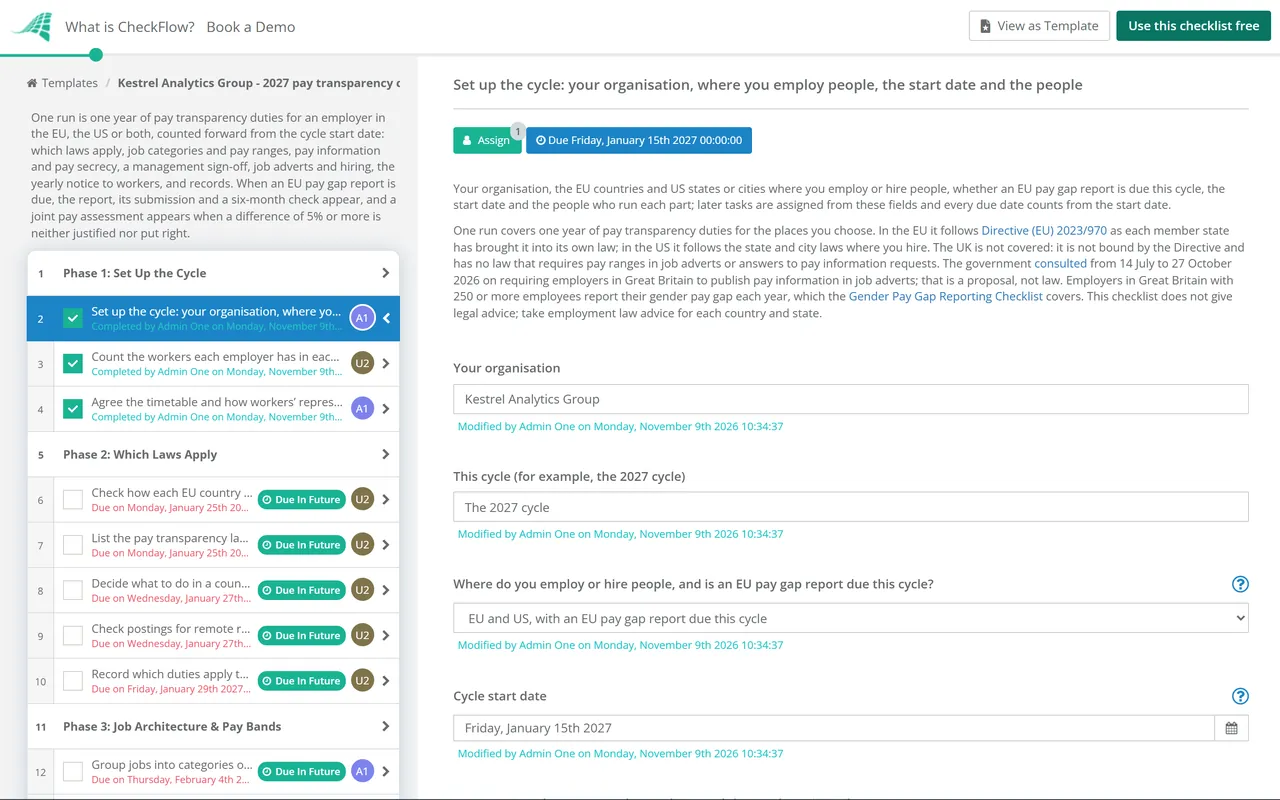
Nine phases take one year of pay transparency duties from the first check of the law to the start of the next cycle. The first task records the cycle start date, which sets every due date, and where you employ or hire people, which adds the EU tasks, the US tasks or both. When an EU pay gap report is due, the report phase, its submission and a six-month check counted from the submission date appear, and a joint pay assessment appears if a difference of 5% or more is neither justified nor put right. The sign-off in Phase 6 is assigned to one person, and nothing after it can be completed until they approve.

  1. Phase 1

    Phase 1: Set Up the Cycle

    3 tasks

    Owned by the pay transparency lead. Enter the cycle start date on the first task: every due date counts forward from it in working days. Choose where you employ or hire people and whether an EU pay gap report is due this cycle, and the tasks for those places appear.

    • Set up the cycle: your organisation, where you employ people, the start date and the people — your organisation, the EU countries and US states or cities where you employ or hire people, whether an EU pay gap report is due this cycle, the start date and the people who run each part; later tasks are assigned from these fields and every due date counts from the start date
    • Count the workers each employer has in each country and state — the number of workers each employing entity has in each EU country and each US state, and the date you counted, because the report thresholds and the state posting rules depend on headcount
    • Agree the timetable and how workers’ representatives take part — the dates for each phase, who owns each part and, where you have workers’ representatives, how they take part in the job evaluation criteria, the report and any joint pay assessment
  2. Phase 2

    Phase 2: Which Laws Apply

    5 tasks

    Check the law for every place in the first task before you change anything. EU countries had until 7 June 2026 to bring the Directive into their own law, and on 9 November 2026 EUR-Lex listed no measures from ten of them. US states and cities each have their own rules.

    • Check how each EU country has brought the Directive into its law — for each EU country in the first task, the national law that brings in the Directive, whether it is in force, and its own thresholds, dates, reporting authority and penalties
    • List the pay transparency law for each US state and city where you hire — for each state and city in the first task, whether its law covers you at your headcount and what it requires: pay ranges in postings, a ban on asking about pay history, pay information on request, internal opportunities and records
    • Decide what to do in a country whose law is not yet in force — where a country’s law is still a bill or not yet published, what you will prepare now, who is watching for the final text and when you will check again
    • Check postings for remote roles that someone in a covered state could fill — remote and hybrid roles advertised to people who could work from a state with a posting law, and which state rules you will follow for them
    • Record which duties apply this cycle and the sources — a short list, by country or state, of the duties that apply to you this cycle, with a link to each source and the date you read it; the later tasks follow this list
  3. Phase 3

    Phase 3: Job Architecture & Pay Bands

    6 tasks

    Group jobs into categories of workers doing the same work or work of equal value, set a range for every job and write down how pay is set. Ranges in adverts, answers to pay requests and the report all come from this phase.

    • Group jobs into categories of workers doing the same work or work of equal value — every job in each employer, grouped so that jobs of equal value sit together, judged on skills, effort, responsibility and working conditions; the report’s category figures and any joint pay assessment use these groups
    • Check the job evaluation method is gender-neutral — the method used to compare the value of jobs, checked so that no criterion is based directly or indirectly on sex and relevant soft skills are not undervalued
    • Set or confirm a pay range for every job — a range for every job, from the lowest to the highest pay you expect to offer, based on objective, gender-neutral criteria; job adverts and answers to pay requests use these ranges
    • Write down how pay, pay levels and pay progression are set — the objective, gender-neutral criteria used to decide each worker’s pay, pay level and pay progression, in a form you can share with workers
    • List the variable and complementary pay in each category — bonuses, commissions, allowances, benefits in kind and any other pay on top of basic pay, by category, because the report and several US posting laws ask about them
    • Check the pay and job data for every worker — each worker’s employer, country, category, sex as recorded, basic pay and variable pay, with gaps and errors fixed before any figures are worked out
  4. Phase 4

    Phase 4: Pay Information, Pay Secrecy & Pay History

    5 tasks

    Make sure people can get the pay information the law gives them, can talk about pay and are not asked about past pay. These rights run all year, so they are checked before the sign-off rather than after it.

    • Check workers can ask for pay information and get it in writing within two months — a way for workers, or their representatives, to ask for their own pay level and the average pay levels by sex for their category, a log of requests, and replies in writing within two months
    • Check people can get the pay range on request where state law gives that right — who can ask for a pay range in each state and how you answer, for example applicants and current employees in California, and employees offered a transfer or promotion in Washington
    • Remove terms and policies that stop people discussing pay — contract templates, offer letters, handbooks and policies checked for any term that stops workers disclosing or discussing their pay, and changed where the law requires
    • Remove pay history questions from forms, scripts and interviews — application forms, screening scripts, agency briefs and interview guides checked so that no one asks about current or past pay
    • Decide how answers protect the pay of an identifiable worker — where an answer to a request, the report or a joint pay assessment would reveal the pay of one identifiable worker, how you will handle it under each country’s law
  5. Phase 5

    Phase 5: The Pay Gap Report (EU)

    4 tasks

    Applies only when an EU pay gap report is due this cycle. Work out the figures for the previous calendar year, look for differences of 5% or more in any category and consult workers’ representatives before the sign-off.

    • Confirm who reports, for which year and to which authority — each employer that must report under its national law, the calendar year the figures cover, the authority that receives them and its deadline
    • Work out the report figures for the previous calendar year — the seven figures the Directive lists, for each employer that reports, using the categories from Phase 3
    • Look for any difference of 5% or more in a category, and its reasons — each category where average pay for women and men differs by 5% or more, and whether objective, gender-neutral criteria justify the difference
    • Consult workers’ representatives on the figures and the methods — the figures and the methods shared with workers’ representatives, and their comments recorded and answered, before management confirms the figures
  6. Phase 6

    Phase 6: Management Sign-Off

    3 tasks

    One person signs off the ranges, criteria, notices and any report figures before they are used. The checklist halts at the sign-off: nothing after it can be completed until it is done.

    • Prepare the sign-off pack — the pay ranges, the pay-setting and progression criteria, the advert and notice wording, the way requests are handled and, on a report run, the figures and the representatives’ comments
    • Put right what the sign-off turned down, then ask again — the changes the approver asked for, made and sent back; the approver then changes the decision to Approved and completes the sign-off
    • Sign off the ranges, criteria, notices and any report figures — the approver’s decision that the ranges, criteria and wording can be used and, on a report run, that the figures are accurate after consulting workers’ representatives
  7. Phase 7

    Phase 7: Job Adverts & Hiring

    6 tasks

    Put the approved ranges into every advert and brief everyone who recruits. Until the new ranges are approved, keep the current ones in every advert: the duty applies all year.

    • Give applicants the starting pay or its range — the initial pay or its range for each role, and any collective agreement terms that apply to it, in the job advert, before the interview or otherwise, so they can negotiate on pay
    • Put the pay range in every job posting where state law requires it — the approved range in every internal and external posting in each covered state, with benefits, other pay and how to apply where the state requires them
    • Give agencies and job boards the range for every role they advertise — each agency, job board and recruiter that advertises for you, given the approved range and asked to show it
    • Check job adverts and job titles are gender-neutral — advert templates, job titles and the recruitment process checked for wording or steps that could undermine equal pay
    • Post internal opportunities, promotions and transfers as state law requires — how internal vacancies, promotions and transfers are announced and what each announcement must include, state by state
    • Brief managers and recruiters on the rules — what they may and may not ask, where the ranges come from, how to answer a question about pay and where to send a request for pay information
  8. Phase 8

    Phase 8: Tell Workers & Submit the Report

    5 tasks

    Applies only when the route includes the EU. Share the pay criteria, send the yearly notice of the right to pay information and, on a report run, submit the figures and give each category’s figures to workers.

    • Make the pay-setting and progression criteria easy for workers to find — the approved criteria published where every worker can reach them, in an accessible format
    • Tell every worker of their right to pay information and how to ask — a notice to all workers of their right to ask for pay information and the steps to take, sent once a year
    • Submit the report figures to the national authority — the figures sent to the authority your national law names, by its deadline, with the confirmation kept
    • Give each category’s figures to all workers and their representatives — the gap by category of workers, figure (g), given to every worker and to workers’ representatives
    • Decide whether to publish the figures on your website — a decision on whether to publish figures (a) to (f) yourself, and where
  9. Phase 9

    Phase 9: Records, the Six-Month Check & Next Cycle

    6 tasks

    Keep the records each law asks for. On a report run, check six months after submitting that every difference of 5% or more is justified or put right; if not, a joint pay assessment with workers’ representatives follows.

    • Keep the records each law requires — the ranges, adverts, requests and answers, notices, report figures and methods, kept for as long as each law requires
    • Six months after submitting, check each difference of 5% or more — every difference of 5% or more in a category, checked to see whether it has been justified on objective, gender-neutral criteria or put right within six months of submitting the report
    • Carry out the joint pay assessment with workers’ representatives — the assessment, carried out with workers’ representatives, covering for each category the share of women and men, average and variable pay, the differences and their reasons, pay improvements after leave, the measures and how earlier measures worked
    • Agree the measures and put right the unjustified differences — the measures agreed with workers’ representatives to put right each unjustified difference, with owners and dates, including a review of the job evaluation and classification systems
    • Give the assessment to workers, their representatives and the monitoring body — the joint pay assessment made available to workers and their representatives and sent to the monitoring body your national law names
    • Review the cycle and set the next start date — what worked, what to change, changes in the law to watch and the start date for next year’s cycle

What the EU Directive and US State Laws Require

The EU Pay Transparency Directive

The Directive sets minimum requirements; each member state’s own law sets the detail and can go further. On 9 November 2026, EUR-Lex listed measures notified by 17 member states and none by Denmark, Germany, Ireland, France, Croatia, Cyprus, Luxembourg, Hungary, the Netherlands and Portugal. A notified measure does not mean the transposition is complete.

Duty What the Directive says Who it applies to Article
Pay structuresPay structures let you compare the value of work on objective, gender-neutral criteria, including skills, effort, responsibility and working conditions.All employers4
Pay before employmentApplicants get the initial pay or its range, and any collective agreement terms, in the advert, before the interview or otherwise.All employers5(1)
Pay historyEmployers do not ask applicants about their pay history. Job adverts and titles are gender-neutral.All employers5(2) and 5(3)
Pay-setting criteriaThe criteria for pay, pay levels and pay progression are easily accessible to workers.All employers; a member state may exempt those with fewer than 50 workers from the pay progression part6
Right to informationWorkers can ask for their own pay level and the average pay levels by sex for their category, and get them in writing within two months. All workers are told of this right every year.All employers7
Pay secrecyWorkers are not prevented from disclosing their pay to enforce equal pay; member states prohibit contract terms that restrict it.All employers7(5)
Pay gap reportSeven figures for the previous calendar year go to a national authority; the category figures go to all workers and their representatives.250 or more workers: by 7 June 2027, then yearly. 150 to 249: by 7 June 2027, then every three years. 100 to 149: by 7 June 2031, then every three years9
Joint pay assessmentWith workers’ representatives, where the report shows a difference of at least 5% in a category that is neither justified nor put right within six months.Employers that report10
TranspositionMember states bring their laws into force by 7 June 2026.Each member state34

US state pay transparency laws read for this page

As each state’s official page or statute reads on 9 November 2026. Check the law for every state and city where you hire.

State Ranges in postings Pay history Other duties Official source
CaliforniaEmployers with 15 or more employees include the pay scale in any job posting, and give it to a third party that posts for them.An employer may not seek salary history or rely on it, but may ask about salary expectations.Pay scale to applicants on reasonable request and to employees for their own position on request; job title and wage rate history kept for the employment plus three years.Labor Code section 432.3, as amended from 1 January 2026
ColoradoCompensation in all job postings and notices, internal and public, with benefits and how and when to apply.Employers may not ask about pay history or rely on it.Job opportunities disclosed to all employees, then who was selected; career progressions explained to eligible employees; records of wages and job descriptions kept; no ban on discussing pay.Colorado Department of Labor and Employment, Equal Pay for Equal Work Act
WashingtonEmployers with 15 or more employees include a wage scale or salary range, a general description of all benefits and of other compensation.Employers may not seek wage or salary history; they may confirm it after an offer with pay is accepted.The range on request for an employee offered an internal transfer or promotion (15 or more employees); no ban on discussing pay.Washington L&I, Equal Pay and Opportunities Act
New York StateBusinesses with four or more employees list the pay range for job, promotion and transfer opportunities, with the job description where one exists, and say if a role is commission-based.Employers may not seek or rely on wage or salary history; they may confirm it only if, after an offer with pay, the applicant gives it to support a higher offer (Labor Law section 194-a).The state labour department says jobs performed in New York City may also be covered by the city’s own law.New York State Department of Labor, Labor Law section 194-b; NY Senate, Labor Law section 194-a

Where this comes from. Directive (EU) 2023/970 on EUR-Lex and its national transposition page, read on 9 November 2026; California Labor Code section 432.3, Colorado’s Equal Pay for Equal Work Act page, Washington’s Equal Pay and Opportunities Act page New York State’s pay transparency page and Labor Law section 194-a, read on the same day. Other states and cities have their own laws; this table lists only the ones read. In Great Britain, section 77 of the Equality Act 2010 makes a term that stops someone disclosing their pay unenforceable where the disclosure is to find out whether pay is connected with a protected characteristic.

Why Run Pay Transparency in CheckFlow?

1

Only the duties for where you employ people

Choose the EU, the US or both on the first task, and say whether an EU pay gap report is due this cycle. The checklist shows the tasks for those places and hides the rest, and the joint pay assessment appears only when the six-month check calls for it.

2

A sign-off before anything is used

The ranges, criteria, notices and any report figures go to one approver, and the checklist halts there: adverts, notices and the report cannot be marked done until they approve. Not approved shows a task to put things right and keeps the sign-off open.

3

Every duty has a date and an owner

Name the lead, the recruitment, pay data and employment law contacts and the approver on the first task, and every task is assigned from those fields. Due dates count forward from the cycle start date in working days, so the report and the six-month check land on time.

CheckFlow does not give legal advice, set your pay ranges or file a report for you: those stay with your HR team and your advisers. CheckFlow makes sure every step is done in order, by the right person, with a record of what was decided. Track every cycle in the Reports Grid.

Run the UK report with the Gender Pay Gap Reporting Checklist, the pay review with the Annual Compensation Review Checklist, and each new role and offer with the Job Requisition Approval Checklist and the Job Offer Approval Checklist.

AI generator

Didn’t find what you need? Describe it.

Describe the process in a sentence and the AI checklist generator drafts the phases and tasks for you.

Frequently Asked Questions

What should a pay transparency checklist include?

Which laws apply where you employ or hire people, job categories and a pay range for every job, the criteria for setting pay, a way for workers to ask for pay information, the removal of pay secrecy terms and pay history questions, ranges in job adverts, the yearly notice to workers, any EU pay gap report and joint pay assessment, and records. This template adds a management sign-off before the ranges and figures are used.

What does the EU Pay Transparency Directive require employers to do?

Directive (EU) 2023/970 gives applicants the right to information on the starting pay or its range, for example in the advert or before the interview, and bans questions about pay history. Workers can ask for their own pay level and average pay by sex for their category, answered within two months, and must be told of that right every year. Pay-setting criteria must be accessible, and employers with 100 or more workers report pay gap figures on a timetable set by size. Each member state’s law sets the detail.

Has every EU country transposed the Pay Transparency Directive?

Not yet. The deadline was 7 June 2026. On 9 November 2026, EUR-Lex listed measures notified by 17 member states and none by Denmark, Germany, Ireland, France, Croatia, Cyprus, Luxembourg, Hungary, the Netherlands and Portugal. A notified measure does not mean the transposition is complete, and the Commission says it will assess whether national laws conform. Check each country’s own law before you rely on the Directive’s text.

Which employers have to report pay gaps under the Directive, and when?

Employers with 250 or more workers report by 7 June 2027 and every year after. Those with 150 to 249 workers report by 7 June 2027 and every three years after, and those with 100 to 149 by 7 June 2031 and every three years after. Each report covers the previous calendar year. A member state can also require smaller employers to provide pay information, so check the national law.

When is a joint pay assessment needed?

Under Article 10 of the Directive, when three things are true: the report shows a difference in average pay between women and men of at least 5% in any category of workers, the employer has not justified it on objective, gender-neutral criteria, and it has not been put right within six months of submitting the report. The assessment is carried out with workers’ representatives and shared with workers and the monitoring body.

Can employers ask job applicants about their salary history?

Not under the EU Directive, which says employers shall not ask applicants about their pay history. California, Colorado, Washington and New York State also stop employers seeking it. California still lets an employer ask about salary expectations; Washington lets an employer confirm past pay once an offer with pay is accepted, and New York State only if the applicant gives it to support a higher offer. Check the law in each place you hire.

Which US states require salary ranges in job postings?

Among the official pages read for this template on 9 November 2026: California and Washington, for employers with 15 or more employees; Colorado, in all internal and public postings; and New York State, for businesses with four or more employees, with New York City covered by its own law too. Other states and cities have similar laws, so check the official page for each place you hire.

How quickly must an employer answer a pay information request in the EU?

Within a reasonable period and in any event within two months of the request, in writing, under Article 7 of the Directive. Workers can ask directly, through their representatives or through an equality body, and can ask for clarification if the answer is inaccurate or incomplete. Each country’s law may set more detail.

Does the UK have a pay transparency law?

The UK is not bound by the EU Directive and has no law that requires pay ranges in job adverts or answers to pay information requests. The government consulted from 14 July to 27 October 2026 on requiring employers in Great Britain to publish pay information in job adverts; that is a proposal, not law. Employers in Great Britain with 250 or more employees report their gender pay gap, and section 77 of the Equality Act 2010 protects disclosing pay to check for discrimination.

Is CheckFlow free for this template?

14-day free trial, no card required. The Business plan is $10 per user per month after the trial. Full details at checkflow.io/pricing.

Run Every Pay Transparency Cycle to the Same Timetable

Free trial — no credit card required.

14-day free trial, no credit cardFull refund in your first 30 daysUS hosting, EU on request