
Most hiring problems start before the first advert: a leaver replaced without a second thought, a salary band settled after the interviews, or a new post that finance only discovers when the first payslip arrives.
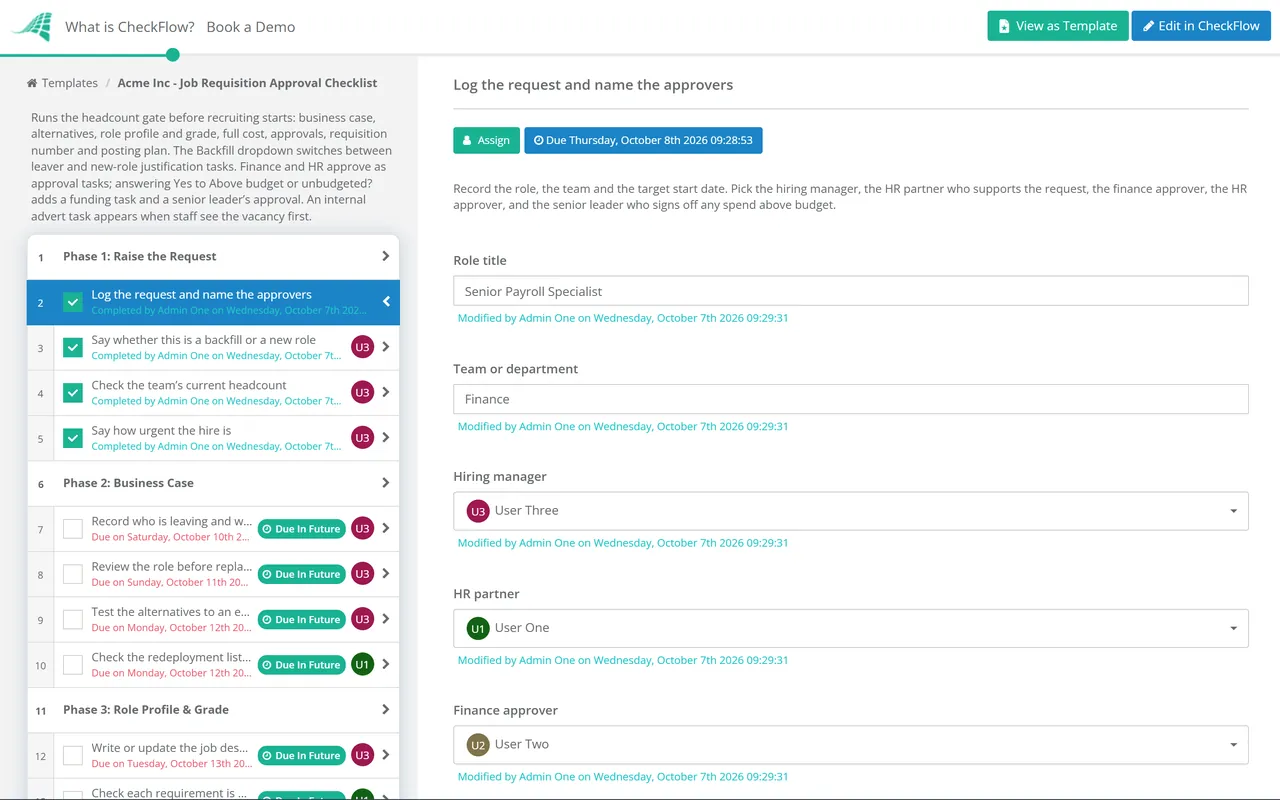
This free job requisition approval checklist is the headcount gate that comes before any recruiting starts. A manager asks for a role, and the checklist builds the case for it, fixes the grade and the band, works out what the post will really cost and tests the cheaper alternatives. Finance and HR then sign it off as approval tasks, with a senior leader added when the spend is outside the budget. Only after that does it issue a requisition number and a posting plan. One question at the start asks whether the role is a backfill, and the justification tasks change to match. It runs on CheckFlow’s approval software, so nobody starts recruiting on a verbal yes in a corridor.
A requisition is a request to add or replace a post; approving it is the decision to pay for that post. It answers four questions before anyone drafts an advert: why the work needs a person, what level the role sits at, what it will cost in full, and who has agreed to fund it. Settle those first and the grade, band and budget are not reopened halfway through the interviews.
This is the first of two gates. It approves the post, not a person. The second gate comes after interviews, when the pay and terms for the chosen candidate are checked before anything is put in writing; that step has its own template, the Job Offer Approval Checklist. Keeping the two apart stops a loose “go ahead and hire someone” being read as permission to pay any salary.
Where requisitions go wrong. A leaver is replaced like for like without asking whether the work has changed. The request shows the salary alone, so the true bill lands later and larger. An external advert goes live while a colleague at risk of redundancy could have done the job. Two managers recruit against the same budget line. The template puts a task, an owner and a due date against each of these.
What happens next. The HR Recruitment Process Checklist opens with a short requisition step and then runs the job description, sourcing, screening, interviews and offer. This template expands that opening step into a full approval, so recruitment can begin from a signed-off role with a number, a band and a budget line.
United Kingdom
On-costs and people with a prior claim
On-costs: for 2026/27, employer Class 1 National Insurance is 15% of earnings above £5,000 a year. Add the employer pension contribution, benefits and, for a pay bill over £3 million, the Apprenticeship Levy at 0.5%.
Redeployment: where a post is redundant, an employee on maternity leave is entitled to be offered a suitable available vacancy. Since 6 April 2024 that protection also covers pregnancy and a period after return, up to 18 months from the birth.
Who must hear of it: fixed-term employees have a right to be told about vacancies, and agency workers on assignment about relevant vacant posts. The Equality Act 2010 also covers how you decide who to offer work to, advert included.

United States
Payroll taxes and posting rules
On-costs: on top of salary, the employer pays its share of Social Security and Medicare, federal and state unemployment taxes and workers’ compensation premiums, plus health, retirement and other benefits. Rates and wage bases change each year, so take them from payroll.
Adverts: the EEOC says an ad must not show a preference based on a protected characteristic; asking for “recent college graduates” may discourage applicants over 40.
State law varies: Colorado expects reasonable efforts to tell all employees about each job opportunity on the same calendar day, before a selection, with the pay range, a general description of benefits and the closing date. Several other states and cities require pay ranges in postings, each with its own rules.
The checklist turns these points into process steps and names the authority behind each; it is not legal advice. If a vacancy overlaps a redundancy exercise, or a role will be open to applicants in several states, it is worth asking an employment lawyer how the rules apply to your case.
What the Job Requisition Approval Checklist Covers
Seven phases, from the first request to the hand-off to recruitment. The backfill answer chooses the justification tasks, the senior leader’s approval appears only for spend above budget, and the internal advert task appears when policy puts staff first.
Phase 1
Phase 1: Raise the Request
Log the request and name the approvers — role, team, target start date, finance, HR and senior approvers
Say whether this is a backfill or a new role
Check the team’s current headcount — approved posts, people in post and open requisitions
Say how urgent the hire is — and what slips while the seat is empty
Phase 2
Phase 2: Business Case
The first two tasks are shown for a backfill, the next two for a new role.
Record who is leaving and when (backfill)
Review the role before replacing like for like (backfill) — work that could stop, move or be automated
Set out why the new role is needed (new role) — the driver and the evidence for it
State what the new role will change (new role) — two or three outcomes you can measure
Test the alternatives to an external hire — internal move, redeployment, contractor, automation
Check the redeployment list before going external
Phase 3
Phase 3: Role Profile & Grade
Write or update the job description — purpose, main duties, essential and desirable criteria
Check each requirement is genuinely needed — degrees, years of experience and wording that signals a preference
Grade the role against your framework
Confirm hours, location and contract type
Set the salary band and check internal equity — against people already on the same grade
Phase 4
Phase 4: Full Cost & Budget
Cost the role for a full year — salary plus employer taxes, pension, benefits and bonus
Add the one-off costs of hiring — agency fees, advertising, equipment, relocation
Work out the cost in this financial year
Check the cost against the budget — and answer “Above budget or unbudgeted?”
Identify the funding for unbudgeted spend — shown only when the answer is Yes
Phase 5
Phase 5: Approval Chain
Each approval halts the checklist until it is decided. The senior leader’s approval is shown only when the role is above budget or unbudgeted.
Hiring manager submits the request — case, job description, grade and cost attached
Finance approves the cost and the budget line
Senior leader approves the spend above budget
HR approves the grade and the headcount
Tell the hiring manager the outcome — approved, approved with changes, deferred or declined
Phase 6
Phase 6: Requisition & Posting Plan
Issue the requisition number — quoted on the advert, the offer approval and the starter’s record
Agree the posting plan — channels, dates and whether staff see it first
Advertise internally first — shown when policy requires it
Check pay-range and posting rules for each location
Check the final advert against the approved role
Phase 7
Phase 7: Hand Off to Recruitment
Brief the recruiter and the interview panel — criteria, scoring and the approved band
Start the recruitment checklist — carrying over the number, band and closing date
Set a review date for the requisition — so a stale approval is re-confirmed
Close the requisition when the role is filled or cancelled
Each approver answers a different question, so each needs different evidence. Requests usually come back because someone was asked to approve something they could not see.
Approver
The question they answer
What they need to see
Usually sends it back when
Hiring manager
Is the request complete, and is the work still needed in this form?
Business case, job description, urgency, alternatives tried
Not applicable: they submit it, and own the gaps
Finance
Can we afford it, and which budget line pays?
Full-year cost, in-year cost, one-off costs, named budget line
The cost shows salary only, or two requests claim the same line
Senior leader (above budget only)
Is this worth money that is not in the plan?
The funding source or offsetting saving, and the cost of not hiring
No saving is named, or the case reads as a nice-to-have
HR
Is the grade right, and is the route to fill it fair?
Grade, band, internal equity, redeployment check, posting plan
The band is out of line with peers, or an internal or at-risk candidate was missed
Backfill
Replacing someone who is leaving
Who is leaving, the leaving date and the reason
What the leaver actually spent their time on
Duties that could stop, move to another team or be automated
Whether the grade, hours and location still fit
How the work is covered until the new person starts
Any exit interview themes that point to a design problem
New role
Adding a post to the team
The driver: growth, a new contract, a regulation or workload data
Why existing staff cannot absorb it
Two or three outcomes that would show the role worked
Whether the need is permanent or could be a fixed-term post
How it fits the workforce plan and team structure
The cost of waiting another quarter
Give the approval a shelf life. A requisition signed off in spring may no longer make sense by autumn if the budget, the structure or the business has changed. The template sets a review date once the number is issued; if the role is still open by then, the approvers re-confirm it rather than letting an old yes carry on by default.
Why Run Headcount Approvals in CheckFlow?
1
The right case for each request
One dropdown records whether the role is a backfill. A backfill shows the leaver and role-review tasks; a new post shows the need and outcome tasks instead. Managers fill in one template and only see what applies to them.
2
Sign-offs in the right order
Finance and HR approvals are approval tasks assigned to the people picked at the start, and the checklist halts until each is decided. Answer Yes to “Above budget or unbudgeted?” and a senior leader’s approval is added to the chain.
3
A record of every headcount decision
The job description, costings and comments sit on the tasks they belong to. The audit trail shows who approved what and when, and reports show how long requests wait at each step and how many are declined.
Headcount is one of many decisions that need a named person to say yes. CheckFlow’s approval software puts a sign-off inside the process it belongs to, with the evidence attached and the outcome recorded, so a decision is never lost in someone’s inbox.
A job requisition is a formal request from a manager to fill a post, whether it replaces a leaver or adds a new role. It sets out why the work is needed, the grade and salary band, the cost and the budget it comes from. Once approved, it gets a requisition number that follows the vacancy through advertising, interviews, the offer and the new starter’s first payroll, so every hire can be traced back to a decision to fund it.
Who should approve a job requisition?
+
A common chain is the hiring manager, who submits and owns the case, then finance, who confirms the cost and the budget line, then HR or leadership, who confirms the grade and the headcount. Many organisations add a more senior approver when the role is not in the budget. Keep the chain short and the same for every request; a chain that changes from role to role invites requests to be routed to whoever is most likely to say yes.
Does a backfill need the same approval as a new role?
+
It should go through the same gate, with a lighter case. A resignation is the cheapest moment to redesign a role, because nobody has to be moved out of it. The backfill tasks ask what the leaver actually did, what could stop or move, and whether the grade and hours still fit. If the answer is “the same role, the same cost, already in the budget”, finance and HR can approve it quickly.
How do you work out the full cost of a new hire?
+
Start with the salary you expect to pay, and show the top of the band as the worst case. Add the employer’s payroll taxes, which are National Insurance in the UK and the employer share of Social Security, Medicare and unemployment taxes in the US, then pension or retirement contributions, health and other benefits, and any bonus or allowances. Add one-off costs such as agency fees, advertising, equipment and relocation separately, and work out how much falls in the current financial year from the expected start date.
Do you have to advertise a job internally first?
+
Usually it is a policy choice rather than a legal rule, but there are exceptions. In the UK, an employee on maternity leave whose job is redundant is entitled to be offered a suitable available vacancy, fixed-term employees must be told about vacancies, and agency workers on assignment must be told about relevant vacant posts. In the US, Colorado requires employers to make reasonable efforts to tell all employees about job opportunities before a selection is made. Check your own policy and any collective agreement too.
How long should an approved requisition stay open?
+
Set a review date when the requisition number is issued, often at the end of the quarter or when the expected recruitment time has passed. If the role is still unfilled by then, ask the approvers to confirm the budget and the case still stand. Close the requisition as soon as an offer is accepted or the role is cancelled, so the same budget is not claimed twice.
Is CheckFlow free for this template?
+
14-day free trial, no card required. The Business plan is $10 per user per month after the trial. Full details at checkflow.io/pricing.
Approve Every New Role Before the Search Begins
Free trial — no credit card required.
Do you like cookies? 🍪 We use cookies to ensure you get the best experience on our website. Learn more