
A right to work check only protects you if it is done the prescribed way, before the first day of work. A photocopy taken on day three or a screenshot of the worker’s own status page leaves you with no defence, and checking only the people who “seem foreign” is unlawful discrimination.
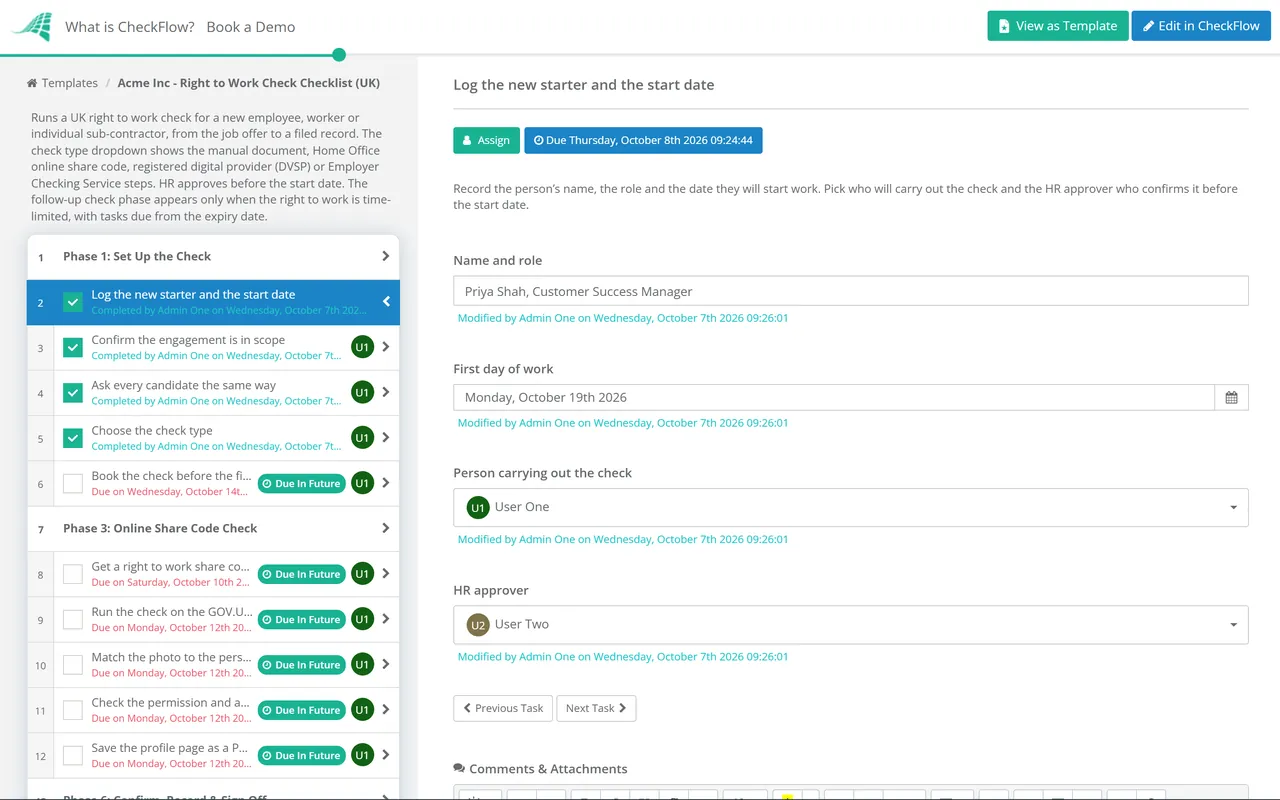
This free right to work check checklist takes each new starter from the job offer to a filed, dated record. It asks every candidate the same question, shows only the steps for the check you are using (manual documents, the Home Office online share code service, a registered digital provider or the Employer Checking Service), asks HR to confirm the check before the start date, and sets up the follow-up check for anyone whose permission runs out. It is built on the Home Office guidance in force from 1 October 2026, when the rules widened to cover workers and individual sub-contractors as well as employees. It is UK-specific by design. US employers verify employment eligibility on Form I-9 instead: see the Form I-9 & E-Verify Compliance Checklist.
The check is simple. The timing and the record are where it fails. Every employer in the UK has a duty to prevent illegal working. If you carry out a check exactly as the Home Office prescribes, before the person starts, you have a “statutory excuse”: a defence against a civil penalty if it later turns out they had no right to do the work. Miss a step, check after the start date, or fail to keep the copy, and the excuse is gone even if you saw the right document.
The documents have changed. The Home Office stopped issuing Biometric Residence Permits on 31 October 2024 and moved to eVisas, an online record of a person’s immigration status. Someone with an eVisa can only prove their right to work through the online service with a share code, and a manual look at an expired BRP is not an acceptable check. Older onboarding packs that still ask for “passport or BRP” are out of date.
Who must be checked has changed too. From 1 October 2026 the Border Security, Asylum and Immigration Act 2025 extends the scheme beyond employees. The Home Office published a rewritten Employer’s guide to right to work checks dated 1 October 2026, alongside an updated code of practice on preventing illegal working and a new code on avoiding unlawful discrimination.
From 1 October 2026
Who now needs a check
Employees, as before
People engaged under a worker’s contract, such as casual staff supplied by an employment business
Individual sub-contractors, such as couriers working through a delivery app
Service providers matched with customers by an online matching service
Not genuinely independent businesses contracting directly with their own customers
For the new groups, penalties apply only where the engagement began on or after 1 October 2026. There is no general grace period.

Unchanged
What a statutory excuse needs
One of the prescribed check types, done before work starts
A check of the person, not just the document: photo, date of birth and identity
A clear copy, with the date the check was made
Copies kept for the whole engagement and two years after
A follow-up check before any time-limited permission ends
The rules apply across England, Scotland, Wales and Northern Ireland.
The stakes are high. The Home Office guide puts the civil penalty at up to £60,000 per illegal worker, and knowingly employing someone without the right to work is a criminal offence. Discrimination is the other risk: checking only the people you assume are migrants is unlawful. This template turns the Home Office guidance into process steps; it is not legal advice. If your model involves labour supply chains, platforms or substitution clauses, where the new “extended liability” rules can apply, take advice from an employment or immigration lawyer on your specific arrangements.
What the Right to Work Check Checklist Covers
Seven phases. The check type chosen in Phase 1 shows one of Phases 2 to 5, and the follow-up phase appears only when the person’s permission is time-limited.
Phase 1
Phase 1: Set Up the Check
Log the new starter and the start date — and pick the checker and the HR approver
Confirm the engagement is in scope — employee, worker, individual sub-contractor or matched service provider
Ask every candidate the same way — British and Irish citizens included
Choose the check type — set by the person’s nationality and status
Book the check before the first day of work
Phase 2 — If Manual
Phase 2: Manual Document Check
Shown when the check type is a manual document check.
Obtain original documents from List A or List B
Check the documents with the holder present — in person or by live video, originals in your hands
Check photos, dates of birth, expiry dates and work restrictions
Explain any difference in names — marriage certificate, deed poll or similar
Copy each document and record the date of the check
Phase 3 — If Online
Phase 3: Online Share Code Check
Shown when the check type is the Home Office online check. Required for anyone with an eVisa.
Get a right to work share code — nine characters, starting with W
Run the check on the GOV.UK employer service — share code, date of birth and your full business name
Match the photo to the person — in person, by video call or by registered facial recognition
Check the permission and any work restrictions — hours, type of work and expiry date
Save the profile page as a PDF or HTML file
Phase 4 — If Digital
Phase 4: Digital Check via a Registered Provider
Shown when the check type is a digital verification service provider. For British and Irish passports and Irish passport cards.
Choose a provider on the OfDIA register — certified for right to work checks
Offer a manual check to anyone who prefers one
Get the provider’s check output — with every required field
Confirm the photo and details match the person
Store the output and any facial comparison
Phase 5 — If ECS
Phase 5: Employer Checking Service
Shown when the Home Office has to verify the right to work, for example during a pending application or appeal.
Record why the ECS is needed — pending application, appeal, ARC, paper Certificate of Application or other case
Note when the application or appeal was made
Tell the person you are checking with the Home Office
Submit the ECS request — the Home Office aims to reply within five working days
Keep the Positive Verification Notice — it gives a six-month excuse
Phase 6
Phase 6: Confirm, Record & Sign Off
Confirm the role fits any work restrictions — hours, type of work, student term dates
Record whether permission is time-limited — and the expiry date
HR confirms the check before the start date — no start without it
File the evidence securely — for the engagement plus two years, then destroy it
Report any false document to the Home Office
Phase 7 — If Time-Limited
Phase 7: Follow-Up Check
Shown when the person’s permission to work has an expiry date.
Ask for new evidence well before the expiry date
Repeat the check on or before the expiry date — any prescribed method
Use the ECS if an in-time application is pending — within the 28-day grace period
File the new check and set the next follow-up date
Stop the work if no right to work is confirmed — and take HR advice
You cannot insist on one method for everyone, but you also cannot pick freely. The person’s nationality and immigration status decide which checks are open to them, and the result decides how long your statutory excuse lasts. Use this table when choosing the check type in Phase 1.
The person has
Check to use
Statutory excuse
Follow-up
A British passport
Manual (List A, current or expired) or a registered digital provider
Continuous
None
An Irish passport or passport card
Manual (List A, current or expired) or a registered digital provider
Continuous
None
No passport, but a UK birth certificate
Manual: the birth or adoption certificate plus an official document showing their permanent National Insurance number
Continuous
None
An eVisa with settled status or indefinite leave
Online share code check only
Continuous
None
EU Settlement Scheme pre-settled status
Online share code check
Lasts without a repeat check
None required
An eVisa with time-limited permission
Online share code check only
Until the permission expires
On or before the expiry date
Only an expired BRP
Online share code check; the card itself is not acceptable
As the online result shows
A pending in-time application or appeal
Online check if they can get a share code, otherwise the ECS
Six months
Before the six months end
An Application Registration Card allowing work
ECS, for a Positive Verification Notice
Six months from the notice
Before the six months end
Common mistakes
Checks that give no excuse
Looking at a scanned copy or a document held up to a webcam you do not hold
Viewing the worker’s own status page or a printout instead of running the employer check
Accepting a share code that starts with R or S; those are for renting and other services
Using an unregistered provider, or one not certified for right to work checks
Writing a bare date on a copy instead of recording when the check was made
Letting someone start “while the check comes through”
Avoiding discrimination
What the code of practice expects
Check everyone at the same stage, British citizens included
Ask about immigration status only to learn about limits on hours or type of work
Do not treat someone worse for having time-limited permission or an eVisa
Do not insist on a digital check, except the online check for eVisa holders
Use the ECS when it applies, rather than turning the person away
Keep the job open as long as you reasonably can while they prove their status
Why Run Right to Work Checks in CheckFlow?
1
Only the steps for this check
One dropdown picks the check type and shows the manual, online, digital provider or ECS steps, nothing else. Each task carries its own instructions, so a hiring manager doing their first check follows the same route as HR.
2
A sign-off before day one
Due dates count back from the start date. The HR confirmation is an approval task assigned to the approver picked at the start, and the checklist halts until it is approved, so nobody starts on an unchecked promise.
3
Follow-ups that do not slip
When permission is time-limited, the follow-up tasks fall due from the recorded expiry date. Copies are uploaded to the task they belong to, and the audit trail shows who checked what and when, which is the evidence the Home Office asks for.
The right to work check is one step between the offer and the first day. CheckFlow’s HR checklist software runs recruitment, onboarding, reviews and departures from templates, with assignments, due dates and approvals shared between HR and line managers.
Before the person starts work. A statutory excuse is only established if the prescribed check is completed before employment begins, so a check on the first morning is cutting it fine and a check in the first week is too late. Many employers make the job offer conditional on the check and run it as soon as the offer is accepted. Whatever stage you choose, check every candidate at that stage in the same way, including British citizens, so nobody is singled out.
Can we still accept a Biometric Residence Permit?
+
No. The Home Office stopped issuing BRPs on 31 October 2024 and replaced them with eVisas. Looking at an expired BRP is not an acceptable check, and anyone with an eVisa can only prove their right to work through the Home Office online service. Ask for a right to work share code, which starts with W and lasts 90 days, then run the check yourself on the GOV.UK employer service with their date of birth. British and Irish citizens cannot get a share code, so use their passport, Irish passport card or another List A document instead.
Do gig workers, casual workers and contractors need right to work checks now?
+
Many do, from 1 October 2026. Section 48 of the Border Security, Asylum and Immigration Act 2025 extends the scheme to people engaged under a worker’s contract, individual sub-contractors and service providers found through online matching services. It also creates “extended liability” for some contractors in a supply chain, platforms and employers whose contracts allow substitution. The change is not retrospective: what counts is whether the arrangement was entered into on or after 1 October 2026. Genuinely independent businesses that contract directly with their own customers remain outside the scheme.
How long do we keep copies of right to work checks?
+
For as long as the person works for you and for two years afterwards, then destroy them securely. Keep a clear copy of each check, with a record of the date the check was made, and be able to produce it quickly if the Home Office asks. For online checks, keep the PDF or HTML profile page; for digital provider checks, keep the provider’s output and any facial comparison.
What is the penalty for employing someone without the right to work?
+
Without a statutory excuse, a civil penalty of up to £60,000 per illegal worker. Under the Home Office code of practice the starting point is £45,000 per worker for a first breach and £60,000 for a repeat breach within three years, reduced by £5,000 each for reporting the worker first and for co-operating with the investigation. Knowingly employing an illegal worker is also a criminal offence. A penalty can also affect your ability to sponsor migrant workers and to hold some licences, and penalised employers may be named on GOV.UK.
Is CheckFlow free for this template?
+
14-day free trial, no card required. The Business plan is $10 per user per month after the trial. Full details at checkflow.io/pricing.
Check Every New Starter the Same Way, Before Day One
Free trial — no credit card required.
Do you like cookies? 🍪 We use cookies to ensure you get the best experience on our website. Learn more