Structured interviews are twice as predictive of job performance as unstructured ones. A checklist that runs the right questions, in the right sequence, with independent scoring is not process overhead — it is the difference between a good hire and a lucky one.
Unstructured job interviews — where the interviewer asks whatever questions come to mind, makes holistic impressions, and then reaches a gut-feel decision — are one of the most widely used and least effective selection methods in common practice. Research consistently shows they are heavily susceptible to unconscious bias, dominated by factors like physical attractiveness, accent, and whether the interviewer likes the candidate personally, and significantly less predictive of actual job performance than structured alternatives. A structured interview process — defined questions derived from the role requirements, asked in the same order to every candidate, scored against defined criteria before interviewers discuss — produces more accurate, fairer, and more consistent assessments. It is also more legally defensible if a selection decision is challenged. This free HR interview process checklist gives HR teams and hiring managers a structured framework for designing, running, and documenting an effective interview process.
Research published in the Journal of Applied Psychology shows structured interviews have a validity coefficient of approximately 0.51 for predicting job performance — compared to 0.38 for unstructured interviews. When combined with work sample tests or cognitive assessments, structured interviews become the most predictive commonly used selection method.
More resistant to bias
Unstructured interviews allow interviewers to be influenced by irrelevant factors — physical appearance, accent, similarity to the interviewer, or interview confidence that does not correlate with job performance. Structured questions focused on specific job-relevant behaviours and scored against defined criteria reduce (though do not eliminate) the influence of these factors.
More legally defensible
Selection decisions that are challenged on discrimination grounds are defended most effectively when the organisation can demonstrate that every candidate was asked the same questions, assessed against the same criteria, and that the decision was based on documented evidence of job-relevant competencies — not subjective impressions.
What the HR Interview Process Checklist Covers
This checklist covers six phases of the interview process — from question design through to decision documentation. Use it as the standard process for every interview stage in every recruitment.
Phase 1
Phase 1: Interview Design & Question Development
Interview questions should be derived from the role requirements — not from a generic list. Each question should assess a specific competency or requirement that is directly relevant to the role.
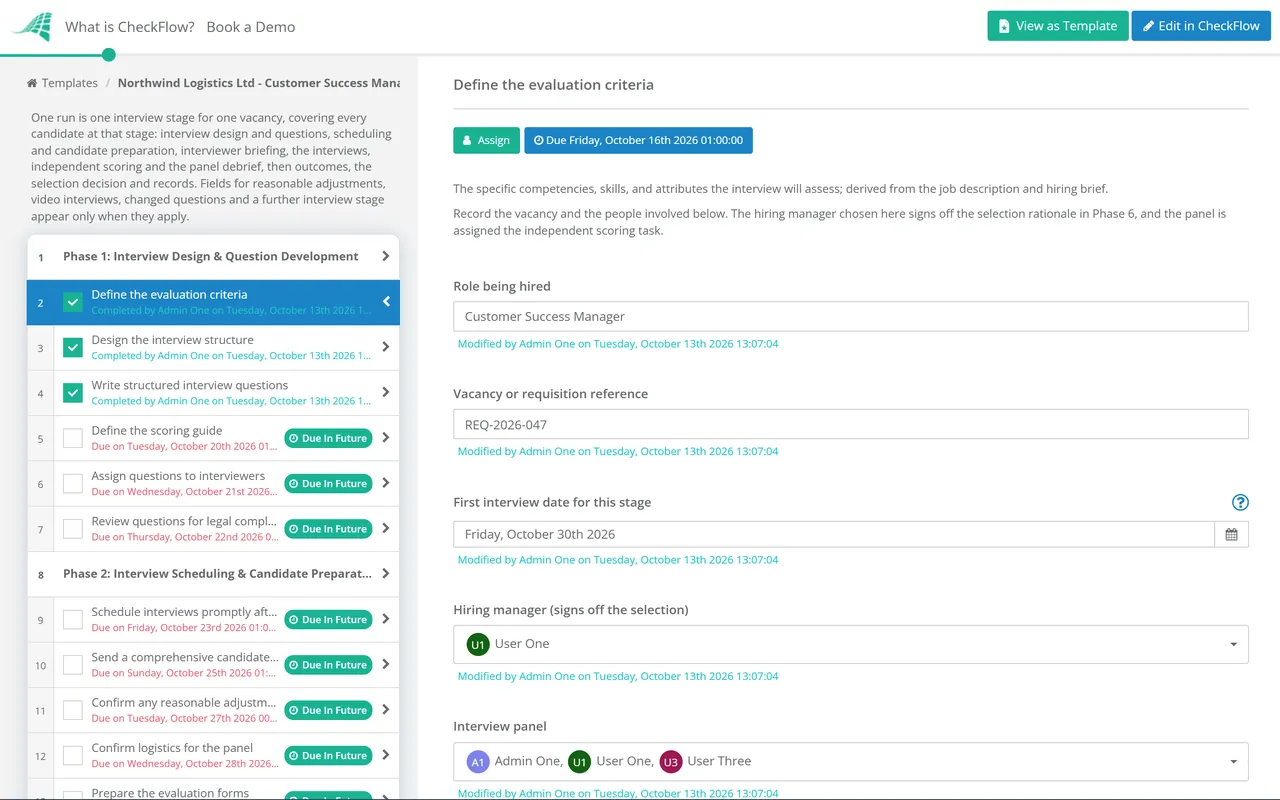
Define the evaluation criteria — the specific competencies, skills, and attributes the interview will assess; derived from the job description and hiring brief
Design the interview structure — number of stages, format (competency-based, technical, case study, presentation), and who conducts each stage
Write structured interview questions — behavioural questions (“Tell me about a time when…”) and/or situational questions (“How would you approach…”); each question assesses a defined competency
Define the scoring guide — what does a strong, acceptable, or weak response look like for each question? Anchor descriptors help interviewers score consistently
Assign questions to interviewers — in a panel, each interviewer covers different competencies; avoid all interviewers asking the same questions
Review questions for legal compliance — questions about age, family plans, health, nationality, religion, or other protected characteristics are not permitted and must be removed
Schedule interviews promptly after shortlisting — within five working days; delays lose candidates to other processes
Send a comprehensive candidate briefing — format, agenda, who they will meet, any assessments or preparation expected, dress code, and location or video link
Confirm any reasonable adjustments required — for candidates with disabilities or specific needs; accommodations arranged before the interview date
Confirm logistics for the panel — room booking, video platform, or location confirmed; each interviewer’s calendar blocked
Prepare the evaluation forms — one per interviewer per candidate; printed or digital; ready before the first interview
Phase 3
Phase 3: Interviewer Briefing
Interviewers who have not read the role brief, the candidate’s application, or their assigned questions before the interview are conducting an unstructured interview regardless of how structured the format is.
Share the role brief and hiring criteria with all interviewers — in advance of the first interview; confirm they have read it
Share the candidate’s application — CV and any application form responses; with guidance on what to look for and not look for
Brief each interviewer on their assigned questions — and the scoring guide for those questions
Confirm bias awareness — a brief reminder of common biases (halo effect, similarity bias, first impression) and the importance of focusing on evidence
Confirm the rule of independent scoring — each interviewer completes their scoring form before any panel discussion; discussion before scoring introduces anchoring bias
Phase 4
Phase 4: Conducting the Interview
Welcome the candidate warmly — introduce the panel, explain the format and agenda, and reduce anxiety; a comfortable candidate gives better evidence of their capability
Confirm note-taking approach with the candidate — clarify notes are to support fair assessment; notes should be factual and behaviour-focused
Ask the agreed questions in the agreed sequence — the same questions, in the same order, for every candidate at this stage
Use probing questions to get depth — “What was your specific role?”, “What did you personally do?”, “What was the outcome?”; STAR method (Situation, Task, Action, Result) as a framework
Allow sufficient thinking time — do not rush candidates; silence after a question is not a problem
Allow the candidate time to ask questions — at the end of the interview; their questions are also evidence of their engagement and research
Do not discuss the candidate with other panellists during or immediately after the interview — before independent scoring is complete
Close by explaining next steps — when they will hear; the candidate should not need to chase for an update
Phase 5
Phase 5: Independent Scoring & Panel Debrief
Each interviewer completes their scoring form independently — immediately after the interview; before any panel discussion
Complete notes while the interview is fresh — detailed, behaviour-focused notes that support the scores assigned; these become the legal record of the assessment
Convene the panel debrief — each interviewer shares their scores first before discussion; the first person to speak should not be the most senior person
Discuss areas of disagreement — where interviewers assessed the same competency very differently; agree on the evidence basis for the final assessment
Compile the aggregate scores — total scores and ranking across all evaluated competencies
Identify any concerns or gaps — that were not covered in this stage and need to be addressed in a subsequent stage
Phase 6
Phase 6: Communication, Decisions & Documentation
Communicate outcomes to all candidates promptly — pass or no-pass decision within 24–48 hours; radio silence is a reputational damage event
Offer feedback to unsuccessful candidates — specific, constructive, behaviour-focused; within GDPR or applicable data privacy constraints
Document the final selection rationale — why the selected candidate was selected; why unsuccessful candidates were not; based on aggregated interview scores and evidence
Retain interview notes and scoring forms — for a minimum period after the decision (typically 12 months in the UK; consult applicable data protection and employment law requirements for your jurisdiction)
Review the interview process — what worked well, what questions produced poor evidence, and what should be updated for the next hire
This checklist is available as a free, runnable template in CheckFlow — with interviewer briefing tasks, independent scoring enforcement, and documented selection rationale for every hire.
Different question types produce different kinds of evidence. A well-designed interview uses a combination of all three, weighted by role type.
Past behaviour
Behavioural questions
Format: “Tell me about a time when you [competency]…”
Why they work: Behavioural questions ask candidates to describe what they actually did in real situations — past behaviour is the best predictor of future behaviour. Candidates cannot fabricate specific examples as easily as general claims.
Example: “Tell me about a time you had to manage a difficult stakeholder relationship. What was the situation, what did you do, and what was the outcome?”
Future judgement
Situational questions
Format: “How would you approach [hypothetical situation]?”
Why they work: Situational questions assess judgement and reasoning in role-relevant scenarios — useful for roles where candidates are unlikely to have direct past experience of the specific situation.
Example: “If you joined the team and discovered a key process was not being followed by most of the team, how would you approach it?”
Demonstrated capability
Technical or work sample questions
Format: “Demonstrate your approach to [task or problem]” — via live exercise, case study, or presentation.
Why they work: Work sample tests are the single most predictive selection method for roles with specific technical requirements — assessing actual performance of relevant tasks rather than self-reported capability.
Example: A coding exercise, a written case analysis, a data model, or a short presentation.
Why Use CheckFlow for Interview Process Management?
1
A structured, consistent process for every candidate
An unstructured interview delivered by different panellists with different questions for each candidate is not an interview process — it is a conversation. CheckFlow’s interview process checklist ensures every candidate is asked the same questions, assessed against the same criteria, and evaluated by a panel that has been briefed and is scoring independently.

2
Independent scoring enforced before panel discussion
The most consequential bias in panel interviews happens when panellists hear each other’s impressions before forming their own — anchoring their score to the most senior or most confident voice. CheckFlow’s checklist makes independent scoring completion a required step before the debrief task is unlocked.
3
A legally defensible record for every interview
Every scoring form completed, every question asked, and every selection rationale documented in CheckFlow is timestamped and archived. If an unsuccessful candidate brings an employment tribunal claim, the evidence of a structured, documented, consistent process is the strongest available defence.
The interview process is one phase within the broader recruitment cycle. CheckFlow’s HR Recruitment Process Checklist covers the full hiring lifecycle from requisition to pre-boarding. See the HR Recruitment Process Checklist →
Performance reviews use a similar structured evidence-gathering framework to interviews. CheckFlow’s Employee Performance Review Checklist applies the same structured assessment principles to annual performance cycles. See the Performance Review Checklist →
Structured interviews outperform unstructured ones on three measures. They are more predictive of job performance because every question is designed to assess a specific job-relevant competency, using behavioural evidence rather than general impressions. They are more resistant to bias because the same questions are asked in the same order to every candidate, reducing the influence of irrelevant factors. They are more legally defensible because the documented record of questions, scores, and selection rationale demonstrates that every candidate was treated consistently and the decision was based on evidence. The key structural elements are: predefined questions derived from job requirements, a scoring guide anchoring what strong and weak responses look like, independent scoring before panel discussion, and documented selection rationale.
What is the STAR method and how should interviewers use it?
+
STAR stands for Situation, Task, Action, Result — a framework for eliciting complete behavioural examples from candidates. When a candidate gives an incomplete answer to a behavioural question (describing the situation but not their specific actions, or the actions but not the outcome), interviewers use STAR-based probing questions to complete the example: “What was your specific role in that situation?”, “What exactly did you do?”, “What was the result of your actions?” STAR probing produces more complete, more assessable evidence — and helps distinguish candidates who claim involvement in outcomes from those who genuinely drove them.
What interview questions are illegal or inadvisable?
+
Questions about age, family status or plans, pregnancy, religion, nationality, health or disability status, sexual orientation, or gender identity can constitute unlawful discrimination under UK, US, and EU employment law. Even asking apparently neutral questions that are clearly intended to elicit this information is potentially unlawful. All interview questions should be clearly related to the requirements of the role. If health-related information is genuinely relevant (for a role with specific physical requirements), this should be addressed through occupational health assessment after a conditional offer is made — not through interview questioning.
How long should interview notes be retained?
+
In the UK, interview notes and scoring forms should typically be retained for at least 12 months after the recruitment decision — to cover the period within which an employment tribunal claim for discrimination in recruitment can be brought (three months from the discriminatory act). Under GDPR, notes about unsuccessful candidates are personal data and should not be retained longer than necessary. A privacy notice during the application process should inform candidates of how long their data will be retained. In the US, EEOC guidelines require retention of employment records (including applications and interview notes) for one year after the position is filled.
Is CheckFlow free to use for this template?
+
You can start a free 14-day trial with no credit card required, giving you full access to all features including this template. The Business plan is $10 per user per month after the trial. Full details at checkflow.io/pricing.
Run Interviews That Select the Best Candidate — Not the Best Interviewee
Free trial — no credit card required.
Do you like cookies? 🍪 We use cookies to ensure you get the best experience on our website. Learn more