Hotel Pre-Opening Checklist Template

Open a hotel on the date you promised: licences applied for in time, systems tested, every department hired and trained, the building signed off, mock stays run and a go/no-go before the first guest arrives.

Last reviewed: November 2026

Printed from checkflow.io/templates/hospitality/hotel-pre-opening-checklist

A hotel opening has one date that every department works towards. This free hotel pre-opening checklist is for pre-opening general managers, owners’ representatives and operators opening one hotel, whether it is a new building, a converted one or an open hotel changing its brand or operator. One run is one opening, counted back from the opening date. It starts with the opening plan, the brand’s requirements or the hotel’s own standards, the pre-opening budget and the critical path, with the owner’s approval. Next come the licences, permits and insurance, then the rates, sales and hotel systems: the PMS, the POS and card payments, door locks and Wi-Fi. Department heads hire and train their teams, the hotel team takes over the building, the FF&E is checked and the OS&E received, and the lifts, water, fire precautions and accessible rooms are checked. A Food & Drink phase appears when the hotel serves food or alcohol. Mock stays test the hotel before the owner’s go/no-go, and a 30-day review closes the run.

Opening a Hotel Means Opening Every Department at Once

A new hotel opens many businesses on one date: rooms, a front desk, housekeeping, often a restaurant and bar, meeting space and the building that holds them. Each has its own licences, systems, staff and suppliers, and each has to be ready before the first guest checks in. This free hotel pre-opening checklist runs that project from the opening plan to the first 30 days, for a new hotel or for an open hotel changing its brand or operator.

One restaurant on its own, in a hotel or not, opens with the New Restaurant Opening Checklist, and a shop with the New Store Opening Checklist. The contractor proves the building’s systems with the Building Commissioning Checklist before handover, and once the hotel is open each room is cleaned and checked with the Hotel Housekeeping Room Checklist.

This checklist

A whole hotel, once

Who runs it: the pre-opening general manager, with the department heads and the owner’s representative.

Covers: the plan and budget, licences, rates and systems, hiring and training, the building handover, FF&E and OS&E, life safety, food and drink, mock stays, the go/no-go and the first 30 days.

Output: a hotel licensed, staffed, tested and open, with a review after 30 days.
One outlet

A restaurant opening

Who runs it: the owner or the restaurant’s general manager.

Covers: the kitchen design and fit-out, food registration, the menu, hiring and a soft launch for one restaurant.

Output: one restaurant open, in the New Restaurant Opening Checklist.

The building

Commissioning before handover

Who runs it: the contractor and the commissioning engineers, with the hotel’s chief engineer attending.

Covers: proving the heating, ventilation, water, electrical and fire systems work as designed.

Output: commissioned systems and their records, in the Building Commissioning Checklist.

What the Hotel Pre-Opening Checklist Covers

Nine phases take one hotel from the opening plan to the end of its first month. The first task records the opening date, which sets every due date: this template plans 24 weeks (120 working days) before opening and about 30 days after it. It also asks whether this is a new hotel or a reflag, whether it is branded or independent, whether it serves food or alcohol, and whether it has a pool or spa. Each answer adds the tasks that deal with it, and Phase 7 appears only when the hotel serves food or alcohol. The owner’s representative’s go/no-go in Phase 8 is the gate: nothing after it can be completed until the owner’s representative completes it, which they do only with Go or Go with conditions. Go with conditions adds the task to meet them, and Not yet, which is set and left open, hides the opening and shows the task to put things right.

  1. Phase 1

    Phase 1: Opening Plan, Brand & Budget

    7 tasks

    Owned by the pre-opening general manager. Enter the opening date, the day the first paying guests arrive: every due date counts from it in working days. This template plans 24 weeks (120 working days) before opening and about 30 days after it. The due dates are the latest that keep the opening on time, so start earlier where you can. Answer the questions about the type of opening, the brand, food and drink and any pool: they add the tasks this hotel needs. At a reflag, enter the changeover date as the opening date and mark tasks that do not apply Not applicable.

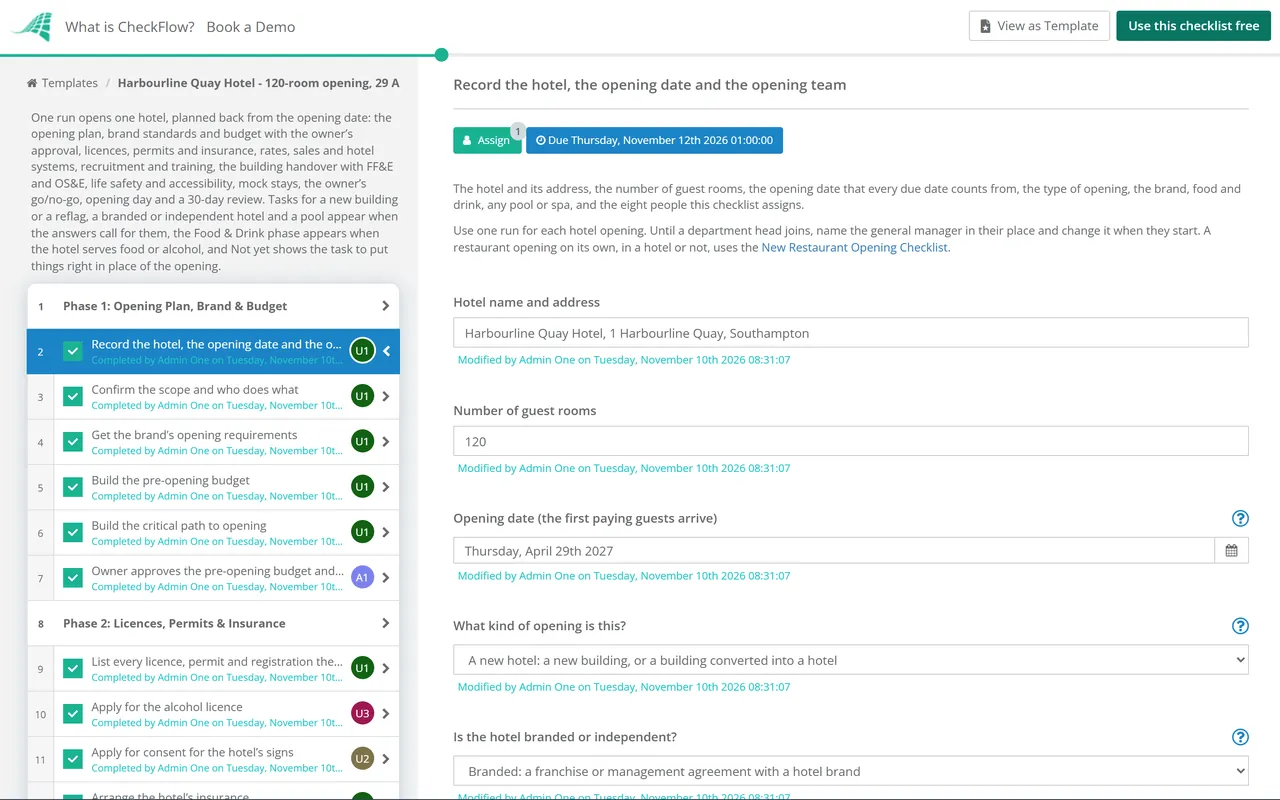
    • Record the hotel, the opening date and the opening team — the hotel and its address, the number of guest rooms, the opening date that every due date counts from, the type of opening, the brand, food and drink, any pool or spa, and the eight people this checklist assigns
    • Confirm the scope and who does what — the room types and counts, the outlets, meeting space and facilities, the guests the hotel is for, and what the owner, the brand or operator and the contractor each deliver under their agreements
    • Get the brand’s opening requirements — the brand standards that apply to this hotel, the brand’s opening timeline and approvals, the systems and suppliers it requires, any brand inspection before opening, and the dates in the franchise or management agreement
    • Set the hotel’s own standards — the room and bathroom specification, the service standards for each department, the look and tone of the hotel’s brand, and the main suppliers, written down so every department trains to the same standard
    • Build the pre-opening budget — pre-opening wages, recruitment and training, sales and marketing, OS&E, systems and licences, insurance, fees, opening events and a contingency, with how each is funded and who approves spending; this template keeps it apart from the building and FF&E budget
    • Build the critical path to opening — the dates for the licence applications, the building handover, systems, recruitment, training, OS&E deliveries, mock stays and the go/no-go, with an owner for each and the steps each one depends on
    • Owner approves the pre-opening budget and the opening date — the owner’s representative alone approves the budget and confirms the opening date before money is committed; a date that leaves too little time for the licences, the handover or training is moved now
  2. Phase 2

    Phase 2: Licences, Permits & Insurance

    5 tasks

    Each licence, permit and registration has its own lead time, so the applications go in first. Which ones apply depends on the country, state or council and on what the hotel offers; the notes give UK and US examples. Ask each authority how long it takes and plan back from the opening date.

    • List every licence, permit and registration the hotel needs — each one with the authority that issues it, how long it takes, what it needs from you, who owns it and when it must be in place, from building sign-off and fire safety to food, alcohol, lifts, any pool, signs, music, guest records and taxes
    • Apply for the alcohol licence — the licence to sell alcohol in the bar, the restaurant, the minibars and at events, applied for early with the plans, the hours and the person who will supervise sales
    • Apply for consent for the hotel’s signs — the signs on the building, at the entrance and by the road, checked against the planning rules and any brand sign standards, with any consent or permit applied for before the signs are made
    • Arrange the hotel’s insurance — cover for the building (property and contents where the agreements make it yours, business interruption and public liability) from the day the hotel team takes it over, and employers’ liability or workers’ compensation from the day the first person is employed, with the certificates filed
    • Register for the taxes the hotel will charge and pay — VAT or sales tax on rooms, food and drink, any occupancy or visitor tax where the hotel is, and business rates or property tax, with the rates set up so the PMS and POS charge them correctly
  3. Phase 3

    Phase 3: Rates, Sales & Hotel Systems

    8 tasks

    The sales and marketing manager sets the rates and opens the hotel for bookings well before opening day. The systems lead then builds and tests the systems that take those bookings, charge guests and open their doors. Test with made-up bookings, not real guests’ details, until each system is live.

    • Set the room types, rates and booking policies — room types and their descriptions, rate plans and packages, deposits, cancellation and no-show terms, check-in and check-out times, and the rules on children, pets and accessible rooms, within any brand standards
    • Set up where the hotel can be booked — the brand’s central reservations system or your own booking engine and channel manager, the online travel agencies you will use, and how room types, rates, photos and the accessible rooms’ features reach each one, with the privacy notice shown on every channel, the data protection fee paid where it applies, and online deposits taken only through a payment provider that confirms its PCI DSS status
    • Open the hotel for bookings and start pre-opening sales — the website or brand page live with the opening date, bookings open, group and corporate accounts approached, the launch publicity planned, and what guests will be told if the opening date moves
    • Build the property management system (PMS) — rooms, room types, rates, packages, taxes, guest registration fields, departments and users with their access, set up from the agreed rates and policies, with the reports the night audit and managers need
    • Set up the point of sale (POS) and card payments — outlets, menus and prices in the POS, charges posting to guest folios in the PMS, card terminals and the payment provider, deposits taken online, and who may refund or void
    • Set up the door locks, Wi-Fi, TVs and phones — key cards encoded from the PMS, master and staff keys by level, guest and staff Wi-Fi kept apart, TVs, phones and voicemail in every room, and any music or TV licences the hotel needs
    • Test every system end to end — a test booking from each channel reaching the PMS, a key card cut, a charge posted from the POS, a card payment and a refund, the night audit run and its reports produced, with each failure fixed and tested again
    • Set up guest records and data protection — the registration card or online check-in, how long guest records are kept and who can see them, and the privacy notice set up when bookings opened checked against what the systems now hold
  4. Phase 4

    Phase 4: Recruitment & Training

    6 tasks

    Department heads join first so they can hire and train their own teams. The teams are hired in waves, with time to train in the building before the mock stays. The employer registrations and the right to work checks come before anyone starts.

    • Register as an employer and set up payroll — the employer registrations, payroll, pensions or benefits, contracts and the staff handbook ready before the first hire starts; at a reflag, check the operator’s existing registrations cover this hotel
    • Hire the department heads — front office, housekeeping, food and beverage, engineering, sales and HR, each with a start date that leaves time to hire and train their team, and each person’s right to work checked before they start
    • Recruit the teams in waves — headcount by department from the staffing plan, adverts, interviews and offers, and each person’s right to work checked before they start
    • Onboard every new starter — contracts signed, uniforms, lockers, ID badges and system logins, the handbook and policies, and a first-week plan for each department
    • Train each department in the building — front office, reservations, housekeeping, food and beverage, engineering and security trained on their standards, the systems and the guest journey, in the rooms and areas they will work in
    • Train every team member in fire safety and first aid — the fire procedures and evacuation, including guests who need help to leave, first aid cover on every shift, safe use of chemicals and equipment, and the security and lost property procedures
  5. Phase 5

    Phase 5: Building Handover, FF&E & OS&E

    8 tasks

    The hotel team takes over the building from the contractor, or from the outgoing brand or operator at a reflag. FF&E (furniture, fixtures and equipment) is checked as it is installed. OS&E (operating supplies and equipment, such as linen, crockery and guest amenities) is ordered early and received into stores after handover.

    • Order the OS&E — linen and towels, guest amenities, crockery, glassware and cutlery, cleaning equipment and chemicals, uniforms and back-of-house equipment, with par levels per room or cover, lead times and delivery dates after handover
    • Agree the handover programme with the contractor — the handover date or sections, the commissioning and witness tests the hotel team attends, training on the building’s systems, and the documents due at handover
    • Agree the exit from the outgoing brand or operator — the changeover date, bookings and deposits already taken and how they move, which guest data may move and on what basis, systems access, the brand items and signs to remove, and any staff who will transfer
    • Transfer or change the licences and registrations — the alcohol licence, the food business registration, the fire risk assessment, insurance, card payments and other accounts moved to the new operator or name, timed to take effect on the changeover date
    • Check the FF&E room by room as it is installed — furniture, fittings, beds, TVs and safes in every room and public area checked against the specification or brand standard, with damage, missing items and defects listed for the contractor or supplier
    • Take handover of the signed-off building — the building signed off for occupation, the keys, the documents agreed in the handover programme, and the outstanding works listed with dates
    • Receive, check and store the OS&E — each delivery checked against the order, stored by department, set to par in rooms and outlets, and shortfalls chased
    • Snag every room and public area — every guest room, corridor, outlet and back-of-house area walked, each defect logged with a photo and an owner, fixed and checked again, and rooms that are not ready kept out of sale in the PMS until they are
  6. Phase 6

    Phase 6: Life Safety & Accessibility

    7 tasks

    Before guests sleep in the building, the lifts, water systems, fire precautions, any pool, the accessible rooms and security are checked and recorded. The rules differ by country, state and building; the notes give UK and US examples.

    • Get the lifts examined before they carry people — every passenger and goods lift thoroughly examined after installation and before it is put into service, the report filed, and the next examination booked
    • Assess and flush the water systems — a legionella risk assessment of the hot and cold water systems, outlets flushed and temperatures checked before guests arrive, and the routine checks scheduled
    • Complete the fire risk assessment for the finished hotel — every floor, guest room type, kitchen, plant room and escape route assessed, with sleeping guests and anyone who needs help to escape in mind, and every action closed before opening
    • Test the fire alarm, emergency lighting and fire doors — the fire alarm and its links to door holders and lifts, emergency lighting, fire doors and their closers, extinguishers and signs tested with certificates, and the evacuation plan and assembly points set
    • Get the pool or spa ready to open — the water treatment commissioned and tested, the pool rules, supervision and emergency procedures written, the plant room and chemical store safe, and any permit or inspection the pool needs
    • Check the accessible rooms and features — the accessible guest rooms and bathrooms, step-free routes, signs, hearing loops and alarms for deaf guests checked, and the accessible features described in every booking channel
    • Set up security, keys and guests’ valuables — CCTV and its signs, master key and key card control, the safe deposit or in-room safes, lost property, and the night security routine
  7. Phase 7

    Phase 7: Food & Drink

    4 tasks

    Applies only when the first task says the hotel serves food or alcohol. The food and beverage manager registers the food business, puts the food safety system in place and gets the alcohol licence ready to use. A hotel restaurant with its own concept can also run the New Restaurant Opening Checklist.

    • Register the food business or get the food permit — the kitchens, bars, room service and banqueting registered or permitted before any food is served to guests
    • Put the food safety system in place and commission the kitchens — written food safety procedures for every kitchen and bar, equipment commissioned and holding temperature, suppliers approved, cleaning schedules and records ready, and food hygiene training for food handlers
    • Prepare allergen information for every menu — each dish’s allergens recorded from the recipes and suppliers’ specifications, shown on menus or given on request as the law where you are requires, and staff briefed on handling requests
    • Get ready to sell alcohol — the licence granted and its conditions met, the person who supervises sales named, the licence summary displayed, and bar staff trained on age checks and refusing service
  8. Phase 8

    Phase 8: Mock Stays & the Go/No-Go

    5 tasks

    Mock stays test the hotel as a guest would, before real guests arrive. The general manager reviews readiness, and the owner’s representative alone gives the go/no-go. Nothing after the go/no-go can be completed until the owner’s representative completes it, which they do only with Go or Go with conditions; Not yet is set and left open. Not yet hides Phase 9 and shows the task to put things right.

    • Run mock stays in every room type — team members or invited guests book, check in, sleep, eat, use the facilities and check out, and report every fault, from the booking confirmation to the bill
    • Fix what the mock stays found — each fault assigned, fixed and checked, and anything that cannot be fixed before opening listed with a plan
    • Review readiness to open — licences and certificates in place, the building signed off, systems tested, every department trained, rooms ready to sell, the mock stays done and the opening-week rota set, with a recommendation to the owner’s representative
    • Put right what held up the opening and agree a new date — Not yet only: each gap the owner’s representative named fixed and checked, guests already booked told of any change, a new opening date agreed and entered on the first task, and the go/no-go asked for again
    • Owner’s representative gives the go/no-go to open — Go, Go with conditions or Not yet, with the conditions or the reasons, completed by the owner’s representative alone
  9. Phase 9

    Phase 9: Opening & the First 30 Days

    5 tasks

    Applies only when the go/no-go is Go or Go with conditions. The first paying guests arrive on the opening date. This template holds a daily debrief in the first week and a review with the owner 21 working days after opening, then closes the project.

    • Meet the owner’s conditions before opening — Go with conditions only: each condition the owner’s representative set met and recorded before the first guests arrive
    • Open to the first guests — the first arrivals checked in, every department on duty, the general manager on the floor, and any issue logged with an owner; at a reflag, the first day under the new brand or operator
    • Hold a daily debrief in the first week — each morning: guest comments and complaints, faults, staffing gaps, system errors and occupancy, with each issue owned and closed
    • Review the first 30 days with the owner — occupancy, average rate and revenue against the budget, guest reviews and complaints, open defects and warranty claims, staffing and training gaps, and the pre-opening spend against its budget, with actions agreed
    • Close the pre-opening project — the pre-opening budget closed and reconciled, the lessons recorded, the end of the defects period diarised, and the hotel handed to normal operations

Licences, Certificates and Records Before a Hotel Opens: UK and US Examples

Every country, state and council sets its own rules, so this is not a full list or legal advice. The table gives examples from the UK and the US of what to check before guests arrive, with the law or guidance each comes from, read in November 2026. Phase 2 lists the ones that apply to your hotel, with an owner and a date for each.

AreaUK exampleUS example
Building sign-offEngland and Wales: a completion certificate from building control when the work complies, usually within 8 weeks of completion (GOV.UK)A certificate of occupancy: in New York City, for example, no one may legally occupy a building until one, or a temporary one, is issued
Fire safetyEngland and Wales: the responsible person’s fire risk assessment, recorded and reviewed (Regulatory Reform (Fire Safety) Order 2005, article 9); Scotland and Northern Ireland have their own lawThe fire code the state or city has adopted; ask the local fire authority which inspections it needs before opening
LiftsGreat Britain: a thorough examination after installation and before first use, then at least every 6 months for lifts carrying people, or as an examination scheme sets (LOLER 1998, regulation 9)The state’s or city’s elevator inspections and certificates
FoodEngland, Wales and Northern Ireland: register with the local authority at least 28 days before tradingA permit from the state or local health department
AlcoholEngland and Wales: a premises licence naming a designated premises supervisor who holds a personal licence (Licensing Act 2003)A licence from the state or local alcohol beverage control board
Pool or spaHSE’s Health and safety in swimming pools (HSG179)Anti-entrapment drain covers on every public pool and spa, hotel pools included, to the standard the CPSC now applies (ANSI/APSP/ICC-16 2017, 16 CFR 1450.3), and a further device where there is a single blockable main drain (15 U.S.C. 8003)
AccessibilityReasonable adjustments for disabled guests (Equality Act 2010, section 29, England, Scotland and Wales)Accessible rooms by number for new work (2010 ADA Standards, Tables 224.2 and 224.4) and accessible booking (28 CFR 36.302(e))
Guest recordsFull name and nationality of every guest aged 16 or over, kept for at least 12 months (Immigration (Hotel Records) Order 1972)Check the state’s and city’s rules on guest registers
Guests’ propertyEngland, Wales and Scotland: the Hotel Proprietors Act 1956 notice at reception, if the hotel relies on its limitCheck the state’s law on an innkeeper’s liability
Employing staffRegister with HMRC before the first payday; employers’ liability insurance of at least £5 million; a right to work check before each person startsAn Employer Identification Number to hire employees; Form I-9 for every person hired
Card paymentsPCI DSS, from the PCI Security Standards CouncilPCI DSS, from the PCI Security Standards Council
TaxesVAT registration once taxable turnover goes over £90,000 in 12 monthsSales, property and other taxes vary by state, county and city

Check your own area. Scotland and Northern Ireland have their own rules on licensing, building and fire safety, so where the table names England and Wales, check theirs. In the US, the U.S. Small Business Administration says the licences and permits a business needs from the state, county or city depend on its activities and its location.

Why Run a Hotel Opening in CheckFlow?

1

Every deadline counts back from the opening date

The opening date on the first task sets every due date, from the budget 24 weeks out to the licence applications, the building handover, training, the mock stays and the go/no-go. If the opening moves, change the date and the whole timeline moves with it. Each task shows its owner and due date on the checklist.

2

Only the tasks this hotel needs

A new building adds the contractor handover; a reflag adds the exit from the outgoing brand and the licence transfers. A brand adds its opening requirements, food or alcohol adds the Food & Drink phase and the licence application, and a pool adds its own checks. Conditional rules do the work.

3

No opening without a go/no-go

The owner’s representative approves the budget at the start and gives the go/no-go before opening day. That approval step holds every task after it until the owner’s representative completes it, which they do only with Go or Go with conditions. Not yet is set and left open, and shows the task to put things right and set a new date.

CheckFlow does not apply for licences, test fire alarms or hire staff. The general manager, the department heads, the contractor and the authorities do that. It keeps every step of the opening on one checklist, with a named owner and a due date, so the general manager can see what is late on the Reports Grid and nothing waits on someone’s memory.

Assess the finished building with the Fire Risk Assessment Checklist and the Legionella Risk Assessment & Water Hygiene Checklist, and run the first drill with the Fire Drill & Evacuation Checklist. Branded hotels can check themselves against the brand with the Franchise Brand Standards Audit Checklist.

AI generator

Didn’t find what you need? Describe it.

Describe the process in a sentence and the AI checklist generator drafts the phases and tasks for you.

Frequently Asked Questions

What is a hotel pre-opening checklist?

It is the list of everything a hotel has to do between the decision to open and its first month of trading: the budget and critical path, licences and insurance, rates and systems, hiring and training, taking over the building, FF&E and OS&E, life safety checks, mock stays and the decision to open. This template runs those steps for one hotel, each with an owner and a due date counted back from the opening date.

When should hotel pre-opening work start?

There is no fixed rule; it depends on the size of the hotel, the building work and how long your licences take. This template plans 24 weeks (120 working days) before the opening date, with the budget and licence applications first and the mock stays and go/no-go in the last two weeks. The due dates are the latest that keep the opening on time, so a bigger hotel or a new brand should start earlier.

What licences and permits does a new hotel need?

It depends on where the hotel is and what it offers. In England and Wales, examples are building control sign-off, a recorded fire risk assessment, food business registration, a premises licence for alcohol and the employer registrations. In the US, a certificate of occupancy, fire and health department approvals, an alcohol licence from the state or local board and the federal and state tax IDs. Phase 2 lists the ones your hotel needs, each with an owner and a date.

What is the difference between FF&E and OS&E?

FF&E is furniture, fixtures and equipment: beds, wardrobes, lighting, TVs and the other items fixed or placed in rooms and public areas; this template treats it as part of the building budget, not the pre-opening budget. OS&E is operating supplies and equipment: linen, towels, crockery, glassware, guest amenities, cleaning equipment and uniforms. This template checks the FF&E as it is installed, orders the OS&E early and receives it into stores after handover.

What is a mock stay before a hotel opens?

A mock stay is a full guest stay run before real guests arrive. Team members or invited guests book, check in, sleep in the room, eat, use the facilities and check out, and report every fault along the way, from the booking confirmation to the bill. In this template the mock stays come after training and snagging, and their faults are fixed before the general manager recommends a decision to open.

Who decides whether a hotel is ready to open?

In this template, one named owner’s representative gives the go/no-go after the general manager has reviewed readiness. The choice is Go, Go with conditions or Not yet. Nothing after it can be completed until the representative completes it, which they do only with Go or Go with conditions; Not yet is left open and shows a task to put things right, tell booked guests of any change and set a new opening date. A brand may also need its own inspection before opening.

How many accessible rooms does a new hotel need?

In the US, the 2010 ADA Standards set the number for new building work and alterations by the total number of rooms: a hotel with 101 to 150 rooms needs 7 with mobility features, 2 of them with roll-in showers, and 12 with communication features. In England, Scotland and Wales, the Equality Act 2010 requires service providers to make reasonable adjustments for disabled people; the building regulations where you are may also set what new bedrooms must provide.

What changes when a hotel is reflagged?

A reflag moves an open hotel to a new brand or operator. Choosing it in this template adds two tasks: agreeing the exit from the outgoing brand or operator (bookings, guest data, systems, brand items and any staff transfer) and moving the licences, registrations and accounts so they take effect on the changeover date. In the UK, TUPE may protect the staff when the employer changes.

Is CheckFlow free for this template?

14-day free trial, no card required. The Business plan is $10 per user per month after the trial. Full details at checkflow.io/pricing.

Open Your Hotel on the Date You Planned

Free trial — no credit card required.

14-day free trial, no credit cardFull refund in your first 30 daysUS hosting, EU on request