New Store Opening Checklist Template

Most new shops open late for the same few reasons: the sign needed consent nobody applied for, the card terminals arrived after the stock, or the team first saw the tills on opening morning.

Last reviewed: October 2026

Opening a shop means dozens of suppliers, consents and hires working to one date. This free new store opening checklist is for retailers, operations and area managers and franchisees opening one new store, whether it is a first shop or the next branch of a chain. One run is one opening, counted back from the opening date. It starts with the range, the budget and the owner’s approval, then the lease, the unit’s permitted use, the sign, business rates and any registrations. The fit-out follows, with the layout, building approval and fire systems, then utilities, broadband, tills, card terminals and security, the opening stock and merchandising, and recruitment and training. A licence and age-check phase appears only when the store will sell alcohol or other age-restricted products. The fire and health and safety assessments, a pre-opening check, a soft opening and the owner’s go/no-go come before launch day, and a 30-day review closes the run.

Opening a Store Is a Project, Not a Daily Routine

A new store opens once, on a date that everything else has to fit. The shopfitter needs a signed-off layout, the card terminals and broadband need ordering weeks ahead, and stock has to land after the fit-out and before the team is trained on it. Some steps run to their own clocks: a shop sign may need consent, alcohol needs a premises licence with its own application, and in England and Wales a shop over 280 square metres can open for only 6 hours on a Sunday.

This checklist is that project, counted back from the opening date. Once the doors are open, each trading day runs on the Retail Store Opening & Closing Checklist, each new starter goes through the Retail Employee Onboarding Checklist, and replenishment moves to the Supply Ordering & Inventory Restock Checklist. Opening a café or restaurant instead? Use the New Restaurant Opening Checklist, which adds the kitchen, food registration and allergens.

Opening project

Once, before the first customer

Asks: is the store consented, fitted out, connected, stocked, staffed and safe by the opening date?

When: from 20 weeks before opening, in the default timeline, to 30 days after it.

Output: consents and any licence in place, tested tills and security, a trained team, a soft opening, the owner’s go/no-go and a 30-day review.

Daily routine

Opening and closing, every trading day

Asks: is the store safe and ready to trade today, and locked up properly tonight?

When: before the doors open and after the last customer, every day the store trades.

Output: alarm, floats, safety walk, cash-up and lock-up recorded and signed.

New starter

Onboarding, for every hire

Asks: does this person have their paperwork, training and shifts in place?

When: from the offer to the end of their first weeks, for each person who joins after opening.

Output: right to work checked, induction and till training recorded and a review with their manager.

What the New Store Opening Checklist Covers

Nine phases take one new store from the approved budget to the end of its first 30 days. Due dates count back from the opening date, starting 20 weeks out, and the review counts forward from it. Phase 6 appears only when the store will sell alcohol or other age-restricted products, a franchise adds the franchisor’s approvals, and a failed pre-opening check adds a fix task. The owner’s go/no-go in Phase 8 holds launch day until it is given.

  1. Phase 1

    Phase 1: Plan, Budget & Opening Date

    4 tasks

    Answer the setup questions on the first task: where the store is, whether it will sell alcohol or other age-restricted products, and whether it is a franchise. Every due date counts back from the opening date.

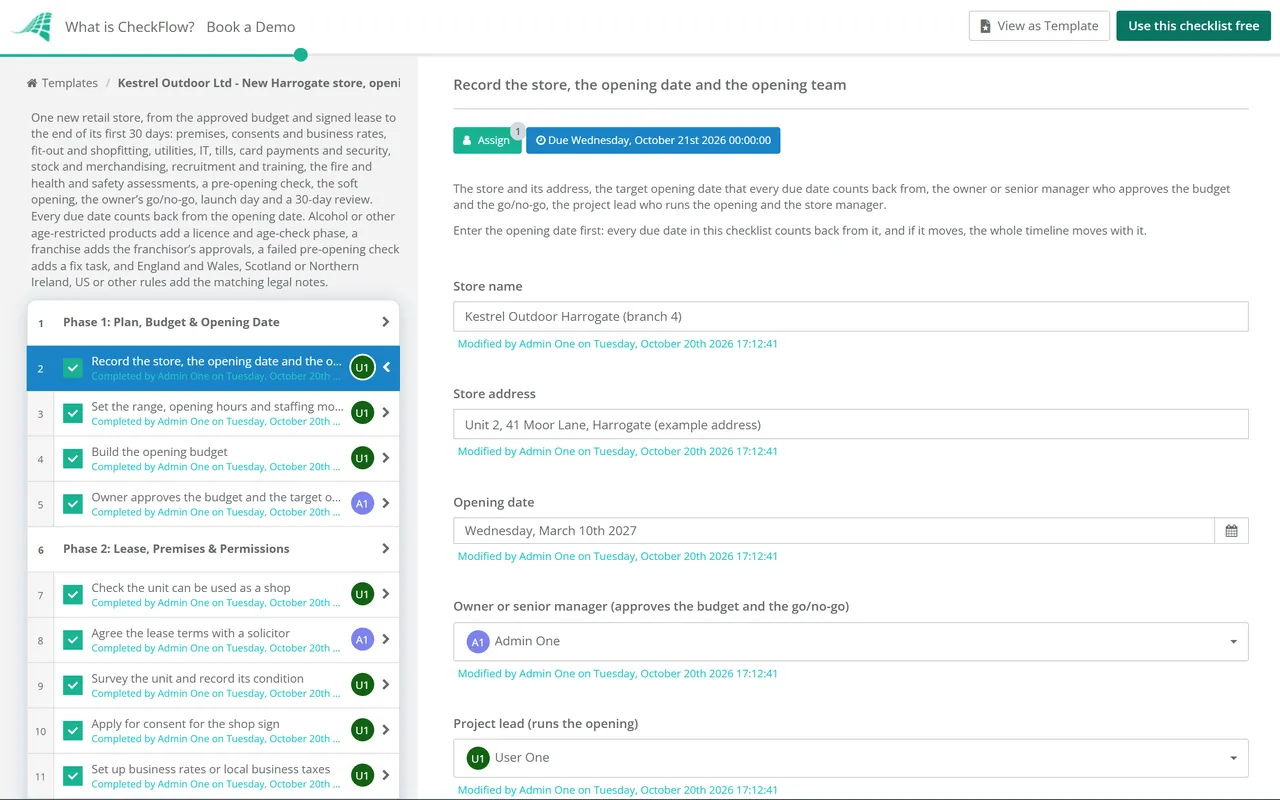
    • Record the store, the opening date and the opening team — the store and its address, the target opening date that every due date counts back from, the owner or senior manager who approves the budget and the go/no-go, the project lead who runs the opening and the store manager
    • Set the range, opening hours and staffing model — the departments and ranges, the sales floor and stockroom space, the opening days and hours, and how many people each shift needs; these drive the layout, the stock order and the rota
    • Build the opening budget — rent and deposit before opening, the fit-out, fixtures and signs, IT, tills and security, opening stock, wages before opening, launch marketing and a contingency, with how each is funded
    • Owner approves the budget and the target opening date — before the lease is signed or a shopfitter is booked; a date that leaves too little time for the fit-out, consents or recruitment is moved now, not in the last month
  2. Phase 2

    Phase 2: Lease, Premises & Permissions

    7 tasks

    Check that the unit can trade as you plan before you sign. Consents, the business rates account and any registrations have lead times of their own, so start them here.

    • Franchise: get the franchisor’s approval of the site and the store plan — the site criteria in the franchise agreement, the franchisor’s sign-off of the unit, the layout and the opening date, and the brand standards manual the fit-out must follow
    • Check the unit can be used as a shop — ask the local planning or zoning office whether a shop is allowed in the unit, and whether the sign, shopfront changes or any outside display need permission
    • Agree the lease terms with a solicitor — rent, length, break clauses, the permitted use, any limits on opening hours or signs, repairs and service charges, and who pays for the fit-out
    • Survey the unit and record its condition — a measured survey for the layout, dated photos of the condition at handover, the power, water, drainage and data connections, and the building’s asbestos information from the landlord before anyone drills or cuts
    • Apply for consent for the shop sign — the fascia and any projecting sign, their size, height and lighting checked against the rules where the store is, and consent applied for if they need it; a listed building or conservation area needs extra care
    • Set up business rates or local business taxes — the account for the property’s business taxes from the day you take it on, any relief you can claim, and the payment dates in the budget
    • Check the licences, registrations and permits the store needs — everything the products or services need before the first sale, such as a premises licence for alcohol, a food registration or the registrations for tobacco, each with its lead time and owner
  3. Phase 3

    Phase 3: Fit-Out & Shopfitting

    6 tasks

    Agree the layout before the shopfitter starts. Escape routes, the fire alarm and step-free routes are designed in, not added at the end.

    • Design the store layout — the sales floor, fixtures and displays, the till point and queue, fitting rooms, the stockroom, the staff area and toilets, with step-free routes, a checkout that wheelchair users can use and escape routes kept clear
    • Appoint the shopfitter and agree the programme — quotes against the layout, the contract, the start and handover dates and weekly progress meetings, with time left for snags before the stock arrives
    • Get building approval for the work — building regulations approval or a building permit for structural work, new walls, electrics, drainage or fire safety changes, applied for by the shopfitter or your designer, with the completion certificate kept
    • Fit out the unit — walls, floors, ceilings and lighting, shelving fixed so it cannot topple, fitting rooms and the stockroom, checked against the programme each week
    • Fit and test the fire alarm, emergency lighting, extinguishers and exit signs — a fire detection and warning system, emergency lighting, fire extinguishers and exit signs installed, tested and certified, with the store manager shown how each one works
    • Install the shop sign and window graphics — the fascia, any projecting sign and the window graphics fitted as designed or consented, with opening date posters in the window once the date is certain
  4. Phase 4

    Phase 4: Utilities, IT, Payments & Security

    6 tasks

    Order connections early: broadband and card terminals often have the longest lead times. Test every system with real transactions before the soft opening.

    • Order the broadband, phone line and store network — a connection fast enough for the tills, card terminals, CCTV and back office, a backup such as a mobile router, and staff Wi-Fi kept separate from the tills
    • Set up electricity, water, heating and waste collection — accounts in the business’s name from the day you take the unit, meter readings at handover, and a contract for commercial waste and recycling
    • Arrange insurance for the store — buildings or contents cover as the lease requires, stock, business interruption, public liability and the cover the law requires for employees, in place from the day you take the keys
    • Install the intruder alarm, CCTV and door locks — the alarm and its monitoring, keyholders and codes, CCTV covering the tills, entrances and stockroom with signs saying it is in use, and locks and shutters handed over with every key recorded
    • Install and test the EPOS tills and card terminals — products, prices and tax codes loaded, receipts, refunds and voids tested, staff logins and permissions set, a test card payment and refund on each terminal, and the end-of-day report checked
    • Set up cash handling and the safe — till floats, a safe with limited access, till limits, how cash is counted and banked or collected, and who holds the safe keys or codes
  5. Phase 5

    Phase 5: Stock, Suppliers & Merchandising

    5 tasks

    Count back from the delivery dates. Stock arrives after the shopfitter hands over and before the team is trained on it.

    • Plan the opening range and stock levels — the lines for each department, opening quantities based on sales at similar stores, enough to fill every fixture on opening day, and a reserve for the first weeks
    • Set up suppliers and delivery slots — an account with each supplier, delivery days and times the landlord allows, where deliveries are received, and who checks them in
    • Place the opening stock orders — orders timed to arrive after the shopfitter hands over and before merchandising starts, with each delivery date confirmed in writing
    • Receive and check the opening stock — each delivery counted against the order, damage and shortages reported to the supplier the same day, and the stock booked into the stock system
    • Merchandise the store and price every line — fixtures filled to the layout or planogram, shelf-edge labels and prices that match the tills, signs and promotions in place, and the stockroom tidy with nothing stored in escape routes
  6. Phase 6 — If you sell age-restricted products

    Phase 6: Alcohol & Age-Restricted Sales

    5 tasks

    Shown only when the first task says the store will sell alcohol or other age-restricted products. The licence tasks appear only when it will sell alcohol.

    • Decide the age-restricted products and the hours you will sell them — each product with a minimum age, and for alcohol the days and times you will sell it, which go on the licence application
    • Appoint the designated premises supervisor or licensee — the person named on the licence as responsible for alcohol sales day to day, with the personal licence or qualification the rules require
    • Apply for the premises licence — the application form, fee, plan of the premises and operating schedule, sent to the licensing authority and to anyone else the process requires, with any public notice displayed for as long as the rules say
    • Receive the licence and record its conditions — every condition copied into the store procedures and the staff briefing, and the licence or its summary kept at the store
    • Set up age checks and a refusals log — a written age-checking policy, the forms of ID you accept, till prompts on age-restricted lines, a refusals log and a briefing for everyone who serves at the till
  7. Phase 7

    Phase 7: Recruitment & Training

    6 tasks

    Recruit early enough to train the whole team before the soft opening. Right to work checks come before anyone starts.

    • Plan the roles, hours and wage budget — each role, how many people, their weekly hours and start dates, checked against the opening hours and the wage line in the budget
    • Recruit the team — adverts, interviews and offers, with start dates that leave time for training before the soft opening
    • Set up as an employer — payroll, the tax registrations and the insurance an employer must hold, all in place before the first person starts
    • Check every hire’s right to work — the check done before each person starts work, with copies kept as the rules require
    • Run the health and safety induction for every starter — fire procedures and exits, first aid, reporting accidents, lifting and handling stock, working alone, and what to do about violence or abuse, with the training recorded
    • Train the team on the tills, stock and service — sales, refunds and age-restricted sales on the tills, receiving deliveries, replenishment, opening and closing the store, and helping customers who need assistance
  8. Phase 8

    Phase 8: Safety Checks, Soft Opening & Go/No-Go

    7 tasks

    Assess the finished store, not the plans. A failed pre-opening check adds a fix task, and the owner’s go/no-go holds launch day until it is given.

    • Complete the fire risk assessment for the finished store — by you or a competent person, on the store as fitted out: escape routes, alarms, emergency lighting, extinguishers, how stock and packaging are stored, and the people at risk, with every action given an owner
    • Complete the health and safety risk assessment and first aid arrangements — the risks in the store, such as handling stock, slips and trips, work at height in the stockroom, deliveries and violence towards staff, the controls for each, a stocked first aid kit and a named first aider or appointed person
    • Walk the store with the shopfitter and check it is ready to open — snags, fire exits and signs, alarms and CCTV working, tills and card terminals tested, stock on the shelves with prices matching the tills, and every certificate handed over
    • Fix the snags and failed checks, then check again — each item fixed by its owner and checked again before the soft opening; anything still open goes to the owner with the go/no-go
    • Run the soft opening — a limited opening for invited customers, friends or staff, with real sales, refunds, age checks, a delivery and closing up, and a list of what went wrong
    • Franchise: complete the franchisor’s pre-opening checks — the franchisor’s pre-opening visit or checklist, the brand standards signed off and any conditions on opening recorded
    • Owner gives the go/no-go to open — consents and any licence in place, fire risk assessment actions closed, the team trained, systems tested and soft opening problems fixed
  9. Phase 9

    Phase 9: Launch Day & 30-Day Review

    4 tasks

    The first month shows what the plan got wrong. Review it while the opening is fresh, then hand the store over to its daily routines.

    • Run launch day — the store open on time with the full team, the opening and closing checks done, the cash-up recorded, and problems noted for the first-week review
    • Review the first week — sales against plan, best and worst sellers, stock gaps, queues, staffing levels and customer comments, with changes agreed for week two
    • Compare the first 30 days with the plan — sales, margin, stock, wages and opening costs against the budget, snags still open, and the daily routines handed over to the store’s opening and closing checklist
    • Owner signs off the 30-day review — the opening closed as a project, open actions given owners in the store’s normal routines, and lessons recorded for the next opening

Consents, Licences and Rules Before You Open, England and Wales and the US

Much of what slows a store opening is a consent, registration or licence with its own lead time. The table sets out the main ones in England and Wales and in the US, in the order the checklist meets them. It is a starting point for planning, not legal advice.

Step England and Wales United States
Using the unit as a shopAsk the local planning authority whether a shop is allowed in the unit and whether shopfront changes need permission, before you sign the leaseZoning is controlled locally and can restrict or ban some kinds of business; ask the city planning department (SBA)
Shop signEngland: many signs have deemed consent within limits on size, height and lighting (Control of Advertisements Regulations 2007, Schedule 3). An illuminated sign has none in a conservation area, National Park, the Broads or an Area of Outstanding Natural Beauty. Otherwise apply for express consent. Wales has its own regulationsSet locally: ask the city or county planning or permits office
Property taxesBusiness rates billed by the council on the rateable value set by the Valuation Office; the council decides on relief. In England from April 2026, lower multipliers for qualifying retail properties with a rateable value below £500,000State tax ID through the state Department of Revenue where needed; sales tax and property tax vary by state, county and city
Trading hoursUp to 280 square metres: any day or hour. Larger shops: 6 consecutive hours between 10am and 6pm on Sundays, closed on Easter Sunday and Christmas Day, with Sunday hours displayedCheck your state and city
Registrations and licencesFood or drink: register each premises with the council at least 28 days before trading. Tobacco: economic operator and facility IDs from the UK ID issuer (UK-wide)Set by local government; retail is commonly regulated locally. Federal licences for some products, such as alcohol and firearms (SBA)
AlcoholA premises licence from the council under the Licensing Act 2003, a designated premises supervisor with a personal licence, and mandatory conditions including an age verification policyA licence from the local alcohol beverage control board; the SBA also lists the federal Alcohol and Tobacco Tax and Trade Bureau
Age-restricted productsFrom 29 October 2026, vaping and nicotine products may be sold only to people aged 18 or over (UK-wide)Set by state and city: ask the licensing agency
AccessibilityReasonable steps to avoid the disadvantage a physical feature puts disabled customers at (Equality Act 2010, sections 20 and 29; England, Wales and Scotland)A new sales counter, shelving or fixtures is an alteration that must be accessible to the maximum extent feasible; at least one accessible checkout aisle (ADA, 2010 Standards)
Fire safety and exitsThe responsible person keeps a written fire risk assessment, a fire detection and warning system and fire safety training (Fire Safety Order 2005)Exit routes free and unobstructed, exit doors openable from inside without keys, “Exit” signs and an employee alarm system (29 CFR 1910.36 and 1910.37)
Hiring staffRegister with HMRC before the first payday, hold employers’ liability insurance for at least £5 million and check each hire’s right to work, keeping copies for 2 years after they leaveAn EIN to hire employees, Form I-9 for every hire, and workers’ compensation and the other insurance your state requires
Notices for staffThe health and safety law poster, or the leaflet for each worker, and the employers’ liability certificateThe OSHA notice, or the approved state plan poster (29 CFR 1903.2)
CCTVA business using CCTV for crime prevention pays the ICO’s annual data protection fee (UK-wide)Check your state’s rules

Scotland and Northern Ireland. Business rates, fire safety and alcohol licensing work differently there, and Scotland has no trading hours restrictions. Choose that answer on the first task and the checklist adds the notes for the UK-wide rules, such as employing staff, tobacco registration and CCTV.

US states and cities. Most licences, permits, sign rules and taxes for a store are set by the state, county and city. Check each one where your store is.

Why Run a Store Opening in CheckFlow?

1

Every deadline counts back from one date

The opening date on the first task sets every due date, from the budget 20 weeks out to the sign consent, the stock orders and the go/no-go. If the date moves, the whole timeline moves with it, and each task shows its owner and due date on the checklist.

2

The rules for your store, and no others

Three answers on the first task shape the run. Where the store is adds the England and Wales, Scotland or Northern Ireland, or US notes. Alcohol or other age-restricted products add Phase 6, with the licence tasks only when you sell alcohol, and a franchise adds the franchisor’s approvals. Conditional rules do the work.

3

No opening without a go/no-go

The owner approves the budget before money is committed and gives the go/no-go before launch day. That approval step holds every task after it until a decision is recorded, and a failed pre-opening check adds a task to fix it first. Plans, certificates and the licence are uploaded to the tasks that needed them.

CheckFlow does not apply for consents or licences, fit out shops or assess fire risk. The owner, the shopfitter, the solicitor and the authorities do that. It keeps every step of the opening on one checklist, with a named owner and a due date, so the project lead can see what is late on the Reports Grid and nothing waits on someone’s memory.

Once you are open, run each trading day with the Retail Store Opening & Closing Checklist and review the fire risk assessment with the Fire Risk Assessment Checklist. Work new hazards through the Health & Safety Risk Assessment Checklist, and check franchise stores against the brand with the Franchise Brand Standards Audit Checklist. Moving a head office rather than opening a shop? Use the Office Relocation Checklist.

AI generator

Didn’t find what you need? Describe it.

Describe the process in a sentence and the AI checklist generator drafts the phases and tasks for you.

Frequently Asked Questions

How long does it take to open a new store?

It depends on the unit, the fit-out and any consents or licences, so plan backwards from the opening date rather than forwards from today. A unit that needs a new shopfront, electrics and fixtures takes far longer than one that was a shop before. The latest dates are set by lead times: sign consent, a premises licence for alcohol, broadband, card terminals and recruitment. This checklist starts 20 weeks before opening by default; change any offset to suit your project.

What do you need to open a shop in the UK?

In England and Wales: a unit that can be used as a shop, a lease, any consent the sign needs and an account for business rates with the council. If you sell food or drink, register as a food business at least 28 days before trading; if you sell alcohol, get a premises licence and a designated premises supervisor; if you sell tobacco, get IDs from the UK ID issuer. As an employer you register with HMRC, hold employers’ liability insurance and check right to work, and the responsible person keeps a written fire risk assessment. Scotland and Northern Ireland have their own rules on rates, licensing and fire safety.

Do you need consent for a shop sign?

Often not in England. The Control of Advertisements Regulations 2007 give many signs on business premises deemed consent, as long as they stay within limits on size, height and lighting and sit on a wall with a shop window. An illuminated sign has no deemed consent in a conservation area, a National Park, the Broads or an Area of Outstanding Natural Beauty, and a sign outside the limits needs express consent from the local planning authority. Listed buildings can need listed building consent too. Wales has its own regulations.

Do you pay business rates on a new shop?

Usually, yes. Business rates are charged on most non-domestic properties, including shops, and the council bills them based on the rateable value set by the Valuation Office. The council decides whether you can get relief, such as small business rate relief, so contact it when you take the unit. In England, from April 2026 qualifying retail properties with a rateable value below £500,000 pay lower multipliers. Scotland and Northern Ireland handle business rates differently.

What licences do you need to open a retail store in the US?

It depends on your state, county and city. The SBA says local governments set registration, licensing and permit requirements, and that retail is commonly regulated locally, so start with your Secretary of State’s website and your city and county. You also need federal and state tax IDs, an EIN to hire staff, a zoning check before you rent, and a licence from the alcohol beverage control board if you sell alcohol. Ask the state whether you must register to collect sales tax before the first sale.

Do you need a licence to sell alcohol in a shop?

Yes. In England and Wales any business that sells alcohol on a permanent basis needs a premises licence from the council, and a designated premises supervisor who holds a personal licence. Every such licence carries mandatory conditions, including an age verification policy. Buy alcohol only from wholesalers approved under HMRC’s Alcohol Wholesaler Registration Scheme. Scotland and Northern Ireland have their own licensing law, and in the US the local alcohol beverage control board issues retail licences.

What should a store soft opening include?

Real customers on a limited opening, such as invited guests, friends and family or neighbouring businesses, with the full procedures running: sales and refunds on every till, card payments, age checks, a delivery booked in, and opening and closing the store. Ask customers and staff what went wrong, fix it and check it again before launch day. In this checklist the soft opening comes after the pre-opening check and before the owner’s go/no-go.

Is CheckFlow free for this template?

14-day free trial, no card required. The Business plan is $10 per user per month after the trial. Full details at checkflow.io/pricing.

Open the Store on the Date You Planned

Free trial — no credit card required.

14-day free trial, no credit cardFull refund in your first 30 daysUS hosting, EU on request