Legionella Risk Assessment & Water Hygiene Checklist

Assess the hot and cold water systems, write the control scheme, and keep the flushing and temperature checks on record, with a named responsible person and every figure taken from HSE or CDC.

Last reviewed: November 2026

Printed from checkflow.io/templates/operations-facilities-management/legionella-risk-assessment-checklist

This free legionella risk assessment checklist is for the responsible person who manages legionella control at one premises: a facilities or estates manager, a health and safety lead, a property manager or a care home manager. It follows HSE’s Approved Code of Practice L8 and its technical guidance HSG274 in the UK, and CDC’s water management program toolkit in the US, chosen with one country field on the first task. One run is one assessment cycle. It appoints the responsible person, chooses a competent assessor, and surveys the whole hot and cold water system with baseline temperatures, the outlets nobody uses and an up-to-date schematic. The assessor’s report gives the significant findings, and the written control scheme sets each check, its limit and what happens when it fails. Remedial works, sampling for legionella, and the checks for any cooling towers, spa pools or other risk systems appear when the answers call for them. Three months of weekly flushing, monthly temperatures and quarterly showerhead cleaning are logged, the records are checked against L8’s retention periods, and the dutyholder signs off the cycle.

Assess, Control and Check the Water Systems in One Run

HSE describes Legionnaires’ disease as a potentially fatal form of pneumonia, caught by breathing in small droplets of water that contain legionella bacteria, and CDC says about 1 in 10 people who get it die from complications. The law in Great Britain asks whoever is in control of premises to assess the risk from their water systems, control it and keep records. This checklist runs that work for one premises: the assessment, the written control scheme and the routine checks that keep the scheme working, with the dutyholder’s sign-off at the end.

It is not a building walk-round: the Facility Inspection Checklist covers the whole site and asks whether a legionella assessment is in place. It does not assess chemicals: the COSHH Assessment Checklist does that, including water treatment chemicals. And it does not service cooling plant: the HVAC Maintenance Checklist does, while this checklist sets the cooling tower’s legionella checks.

This checklist

Legionella control for one premises

Covers: the responsible person, the survey and schematic, the risk assessment, the written control scheme, remedial works, three months of routine checks, sampling where needed, records and the sign-off.

Planned around: the date of the site survey.

Output: an assessment, a scheme, a log of every check and a date for the next review.
The walk-round

Facility inspection

Covers: the whole building: structure, fire safety, electrics, plumbing, access and housekeeping.

Planned around: each inspection visit.

Output: findings and repairs, in the Facility Inspection Checklist.

The plant

HVAC and cooling tower servicing

Covers: servicing heating, ventilation, air conditioning and cooling plant.

Planned around: the maintenance schedule.

Output: serviced equipment, in the HVAC Maintenance Checklist.

What the Legionella Risk Assessment Checklist Covers

Nine phases take one assessment cycle from planning to the sign-off. The first task records the date of the site survey, which sets every due date, and the answers that add tasks: the country and type of premises, which adds the note on the law and the temperature figures that apply (and a healthcare task), whether this is a review (adding a look back at the last assessment), and any cooling towers, spa pools or other risk systems. Remedial work in the report adds Phase 5, and sampling and a result above the action level add their own tasks. The dutyholder’s sign-off is the gate: the assessment, the scheme, the routine checks and their records all come before it, and the routine checks carry on whatever it decides.

  1. Phase 1

    Phase 1: Plan the Assessment

    8 tasks

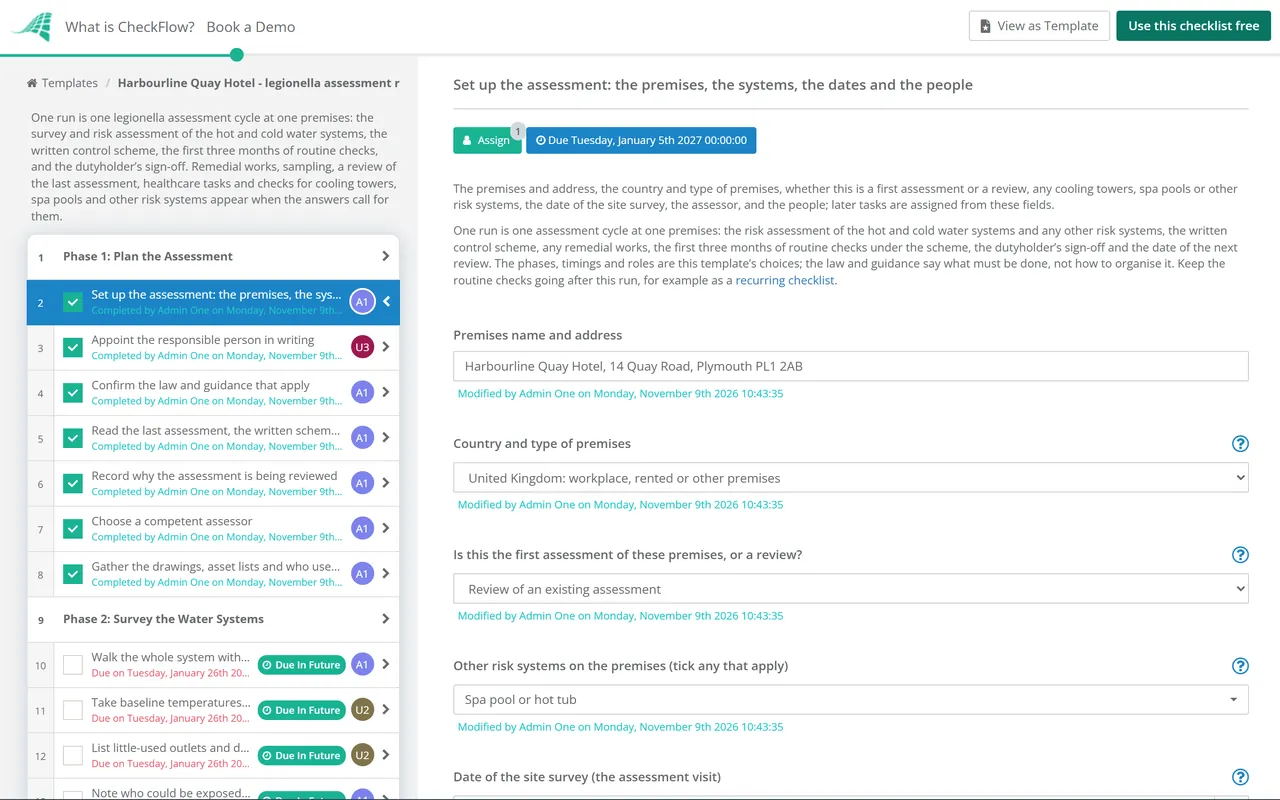
    Owned by the responsible person. Enter the date of the site survey on the first task: every due date counts from it in working days. Choose the country and type of premises, whether this is a first assessment or a review, and any other water systems, and the tasks for each answer appear.

    • Set up the assessment: the premises, the systems, the dates and the people — the premises and address, the country and type of premises, whether this is a first assessment or a review, any cooling towers, spa pools or other risk systems, the date of the site survey, the assessor, and the people; later tasks are assigned from these fields
    • Appoint the responsible person in writing — a person with sufficient authority, competence and knowledge of the installation to take day-to-day responsibility for controlling the risk, their deputy, and how they can be contacted at all times; ACOP L8 calls this person the responsible person
    • Confirm the law and guidance that apply — the law and guidance for the country and type of premises on the first task; the note below shows them
    • Read the last assessment, the written scheme and the records since — shown only for a review: the last assessment and its significant findings, the written scheme, the monitoring records since, remedial work still open and any change to the system or its use
    • Record why the assessment is being reviewed — shown only for a review: a change to the water system or its use, a change to the use of the building, new information about risks or controls, checks showing the controls are no longer effective, a change of key people, or a case of legionellosis associated with the system, as ACOP L8 lists them
    • Choose a competent assessor — you, someone in your organisation or an outside consultant with the training and experience to assess this system; check an outside assessor’s experience, qualifications and memberships before you book them
    • Gather the drawings, asset lists and who uses the building — plumbing drawings, any asset register, the last schematic, maintenance and water treatment records, the hours the building is used, and anyone using it who may be more at risk
    • Cooling towers: check the notification — shown when there is a cooling tower or evaporative condenser: in Great Britain, check the local authority has been told in writing where each one is, and tell them when one stops being used; in the US, check what your state or local health department requires
  2. Phase 2

    Phase 2: Survey the Water Systems

    6 tasks

    The survey happens on the date on the first task. Walk the whole system with the assessor, including parts out of use, take baseline temperatures, list the outlets nobody uses, and draw the schematic.

    • Walk the whole system with the assessor — the incoming supply, cold water tanks, water heaters and calorifiers, pipe runs, outlets, showers, thermostatic mixing valves and any parts temporarily out of use, with an asset register of the plant
    • Take baseline temperatures at the sentinel outlets — hot and cold temperatures at the outlets nearest to and furthest from each tank and cylinder, and at the calorifier flow and return, recorded with the time taken to reach them
    • List little-used outlets and dead legs — every outlet not used for seven days or more, and every dead leg and blind end, with where it is and whether it can be removed
    • Note who could be exposed and anyone at higher risk — employees, residents, visitors, patients or guests who use showers, taps and other outlets that make spray, and anyone more at risk because of age, illness or a weakened immune system
    • Identify where legionella could grow and spread — water between 20 and 45 °C, stored or recirculated water, sources of nutrients such as rust, sludge, scale, organic matter and biofilms, places water stagnates, and anything that makes spray that people could breathe
    • Draw or update the schematic diagram — the layout of the system, including parts temporarily out of use, easy to read without special training; it is not a formal technical drawing
  3. Phase 3

    Phase 3: Assess the Risk

    4 tasks

    The assessor’s report gives the significant findings and what to do about them. Check it covers the whole system, record the findings, and agree when the assessment will next be reviewed. The report task asks whether remedial work is recommended, which adds Phase 5.

    • Receive the risk assessment report — the significant findings, the risk at each part of the system, the controls recommended and any remedial work, with the name of the competent person and a description of the system
    • Check the report against the survey — every part of the system covered, parts not accessed listed with a plan to reach them, and each recommendation clear enough to act on
    • Record the significant findings — the significant findings, any groups identified as particularly at risk and the steps taken to prevent or control the risk; employers with five or more employees must record them
    • Agree when the assessment will next be reviewed — a review date and what to consider at it, plus the events that bring the review forward; ACOP L8 asks for an indication of when to review the assessment and what to consider to be recorded
  4. Phase 4

    Phase 4: Write the Control Scheme

    7 tasks

    Where the assessment finds a risk you cannot prevent, a written control scheme says how it is controlled. Write it, set the checks and limits, say what happens when a check fails, and brief everyone with a role. Healthcare premises add one task.

    • Write the written control scheme — an up-to-date schematic, the correct and safe operation of the system, the precautions, the checks and how often, and the remedial action if the scheme is not effective, as ACOP L8 lists them
    • Set the checks, limits and frequencies for each system — each check, where it is taken, how often and by whom, with the limit it must meet; the UK figures in this template are HSE’s, and in the US they are your program’s control limits
    • Write what to do when a check is out of limits — for each check, the action to take, who decides and who is told, so a failed reading leads to the same response every time
    • Agree what contractors do and check their competence — the water treatment or monitoring contractor’s tasks in writing, their competence checked, and the responsible person still answerable for the standard of their work
    • Brief and train everyone with a role in the scheme — the significant findings and the precautions each person must take, training for those doing checks, refresher training, and a record of all of it
    • Healthcare: brief the water safety group — shown for UK healthcare premises and care homes: the assessment and the scheme taken to the water safety group, which HSG274 Part 2 describes as a multidisciplinary group that develops the water safety plan; HTM 04-01’s addendum advises forming one, though it is not statutory under health and safety legislation
    • CMS-certified facilities: check the program meets CMS’s expectations — shown for US hospitals, critical access hospitals and nursing homes: a facility risk assessment of where Legionella and other opportunistic waterborne pathogens could grow and spread, a program that considers ASHRAE 188 and the CDC toolkit, testing protocols and acceptable ranges for control measures, and results and corrective actions documented, as CMS’s memo QSO-17-30 sets out
  5. Phase 5 — Remedial Works

    Phase 5: Remedial Works

    4 tasks

    Applies only when the assessment recommends remedial work. Give each item a priority and an owner, remove dead legs, complete the other works, and clean and disinfect where the works call for it.

    • Prioritise the remedial works and give each an owner — shown when the assessment recommends remedial work: every recommendation from the report, its priority, its owner and a target date
    • Remove dead legs and redundant pipework — shown when the assessment recommends remedial work: redundant pipework cut back as far as possible to a common supply, preferably removing the feeding tee, and the schematic updated
    • Complete the other remedial works and record each one — shown when the assessment recommends remedial work: each item done, with the date of completion and who did it, as ACOP L8 asks to be recorded
    • Clean and disinfect where the works call for it — shown when the assessment recommends remedial work: after new installation or refurbishment, new components, a long period without use or flushing, or where a tank inspection shows it is needed, as HSG274 Part 2 lists; certificates kept
  6. Phase 6

    Phase 6: Routine Checks on Hot & Cold Water

    6 tasks

    The first three months of the scheme’s routine checks, logged as they happen: weekly flushing, monthly temperatures, quarterly showerheads, and the six-monthly and annual tasks booked. Any reading out of limits is dealt with before the review.

    • Book the six-monthly and annual tasks — the cold water tank inspection, the tank temperature check, the calorifier inspection and cleaning, and the servicing of thermostatic mixing valves, each with a date and an owner
    • Flush little-used outlets every week and log it — each outlet on the list run until the temperature stabilises and is comparable to the supply, purged to drain without releasing spray, weekly or as the risk assessment says
    • Check sentinel outlet temperatures every month — hot outlets timed to reach temperature, cold outlets after running, the nearest and furthest outlets each month and a rotating selection of others; the note below gives the figures for your country and premises
    • Check calorifier flow and return temperatures every month — the flow from each calorifier or water heater and the return on each loop, logged monthly; HSE gives at least 60 °C flow and a return not below 50 °C
    • Clean and descale showerheads and hoses — showerheads, inserts and hoses dismantled, cleaned and descaled, quarterly or as the risk assessment says
    • Deal with every reading out of limits — each reading that missed its limit, the action the scheme sets, who took it and when, and a re-check showing the limit is met
  7. Phase 7

    Phase 7: Sampling & Other Risk Systems

    8 tasks

    Decide whether this cycle needs sampling for legionella and act on the results. Cooling towers, spa pools and other risk systems ticked on the first task add their own routine checks here.

    • Decide whether sampling for legionella is needed this cycle — whether the scheme or the assessor calls for sampling now, for example where there is doubt about the controls, temperatures are not consistently met, people at higher risk use the building, or the system is an open one such as a cooling tower or spa pool
    • Take the samples through an accredited laboratory — shown when sampling is needed: samples from the outlets, tanks and cylinders the scheme names, taken and analysed as the guidance for your country says
    • Record the results and compare them with the action levels — shown when sampling is needed: each result against the action level in the scheme, read by someone competent to interpret it
    • Resample and review the controls and the risk assessment — shown when a result is above the action level: resample, and review the control measures and the risk assessment to find the remedial action needed, as the guidance for your country says
    • Consider disinfecting the system, then retest — shown when a result is above the action level: disinfection decided by the competent person, and retesting a few days after it and at frequent intervals until control is shown, as HSG274 Part 2 describes for results above 1,000 cfu/l
    • Cooling towers: run the checks the scheme sets — shown when there is a cooling tower or evaporative condenser: the weekly check of the biocide regime, legionella sampling at least quarterly, and a system out of use for more than a month drained and shut down, as HSG274 Part 1 says
    • Spa pools: run the checks the scheme sets — shown when there is a spa pool or hot tub: the checks HSE’s spa pool guidance sets, with routine testing at least quarterly; in the US, the checks in your program
    • Other risk systems: run the checks the scheme sets — shown when there are other systems that make spray: humidifiers, misters, fountains, vehicle washers, dental equipment and similar, each checked as HSG274 Part 3 or the manufacturer says
  8. Phase 8

    Phase 8: Review & Sign-off

    6 tasks

    Look at the first three months as a whole, make sure the records are complete, update the assessment and scheme, and hand the routine checks on so they carry on whatever happens next. Then the dutyholder signs off the cycle. Nothing after the sign-off can be completed until it is done.

    • Review the first three months of records — every check done on time, the readings, the flushing log, the remedial works, any sampling results and the actions taken
    • Check the records are complete and kept for the right periods — the responsible people, the significant findings, the scheme and its implementation, whether each system is in use, and every check with its date; records kept while current and for at least two years after, and monitoring records for at least five years
    • Update the assessment and the scheme with what the cycle showed — any change the checks, the works or the results point to, made to the assessment and the written scheme, with the date
    • Hand the routine checks on to an ongoing schedule — weekly flushing, monthly temperatures, quarterly showerheads and the six-monthly and annual tasks carried on after this run, each with an owner, whatever the sign-off decides
    • Dutyholder signs off the assessment cycle — the assessment, the written scheme, the remedial works, the first three months of checks and the records; nothing after this task can be completed until it is signed off
    • Not approved: complete what is missing and bring it back — shown when the sign-off is not approved: finish the tasks or records the dutyholder named, keeping the weekly flushing, monthly temperature checks and the other routine checks going while you do, then change the decision on the sign-off, or un-complete it and complete it again
  9. Phase 9

    Phase 9: Close the Cycle

    3 tasks

    After the sign-off: meet any conditions, tell the people affected what they must keep doing, and file the records.

    • Meet the conditions of the sign-off — shown when the sign-off is approved with conditions: each condition met and recorded, and the dutyholder told
    • Tell the people affected what they must keep doing — staff, occupants or tenants told the controls they help keep, such as not changing the hot water temperature setting, cleaning showerheads and reporting hot water that is not hot
    • File the records and diary the next review — the report, the scheme, the logs, certificates and sign-off filed, and the next review date from Phase 3 in the diary of the responsible person and the deputy

Legionella Checks and Figures, as HSE and CDC Give Them

Routine checks and the figures HSE gives

Phase 4 sets these checks in the scheme, and Phase 6 logs the first three months. Your risk assessment may set other frequencies.

CheckHSE figureHow often (HSE)Where it comes from
Calorifier flow (stored hot water)At least 60 °CMonthlyHSE web guidance; HSG274 Part 2 Table 2.1
Calorifier returnNot below 50 °CMonthlyHSG274 Part 2 Table 2.1
Hot sentinel outletsAt least 50 °C within one minute (55 °C in healthcare premises)Monthly; other outlets and subordinate loops quarterly, ideally on a rolling monthly rota (HSG274)HSE web guidance; HSG274 Part 2 Table 2.1
Cold sentinel outletsBelow 20 °C after running for two minutesMonthly, plus a representative selection of other outlets on a rotation (HSG274)HSE web guidance; HSG274 Part 2 Table 2.1
Little-used outletsFlushed, without releasing spray (outlets unused for seven days or more)Weekly, or as the risk assessment saysHSE web guidance; HSG274 Part 2 Table 2.1
Showerheads and hosesDismantled, cleaned and descaledQuarterly, or as the risk assessment saysHSE web guidance
Cold water storage tankBelow 20 °C, tight-fitting lid, cleanTemperature every six months (HSG274: annually in summer); inspected at least annuallyHSE web guidance; HSG274 Part 2 Table 2.1
Calorifier inspectionInspected internally and cleaned by drainingAnnually, or as the rate of fouling indicatesHSG274 Part 2 Table 2.1
Cooling towersBiocide regime checked (dip slides); sampling for legionellaWeekly; sampling at least quarterlyHSG274 Part 1, paragraph 1.60
RecordsMonitoring records at least five years; others while current and two years afterKept as each check is doneACOP L8, paragraph 72

UK and US, side by side

The first task’s country field shows the note for each.

United Kingdom (Great Britain)United States
Main sourcesHealth and Safety at Work etc Act 1974, COSHH 2002, ACOP L8 and HSG274 (free)CDC’s water management program toolkit (free); ANSI/ASHRAE Standard 188 (paid)
Who it coversEmployers and those in control of premises, including landlordsBuildings and devices on CDC’s worksheet; CMS-certified hospitals, critical access hospitals and nursing homes under memo QSO-17-30
The person in chargeThe responsible person, specifically appointed by the dutyholder (ACOP L8); this template records the appointment in writingA water management program team
The planA written control schemeA water management program with control points, control limits and corrective actions
Sampling for legionellaNot usually needed for hot and cold water systems; at least quarterly for open systems such as cooling towers and spa poolsOne validation option (CDC); CMS does not require water cultures
Notification and reportingCooling towers and evaporative condensers notified to the local authority; cases of legionellosis reported under RIDDOR where HSE says they applyNot covered by this template: check with your state or local health department

Where this comes from. HSE’s ACOP L8 (fourth edition, 2013), HSG274 Parts 1 to 3 (second edition, 2024; HSE says only Part 1 was updated), and HSE’s pages on what you must do, hot and cold water checks, testing and landlords’ responsibilities; CDC’s toolkit, seven steps and worksheet (March 2024); and CMS’s memo QSO-17-30 (revised 6 July 2018). All were read on 9 November 2026. The HSE figures apply in England, Wales and Scotland; Northern Ireland has its own regulations, enforced by HSENI. ASHRAE 188 is a paid standard and is named, not quoted.

Not on this checklist. Water treatment products, disinfection methods and test kits: the competent person and the laboratory choose them. The figures above are HSE’s; in the US, use the control limits your water management program sets.

Why Run Legionella Control in CheckFlow?

1

Every check logged, every miss acted on

The weekly flushing, the monthly temperatures and the calorifier readings each have their own log, and every reading out of limits goes on one list with the action taken and a re-check. When the dutyholder signs off, the whole cycle is in one place.

2

Only the tasks these premises need

The country and type of premises show the law and the temperature figures that apply. A review adds a look back at the last assessment, remedial work adds its own phase, and cooling towers, spa pools and other risk systems add their checks. Sampling, and a result above the action level, add theirs.

3

A named owner for every task

Name the responsible person, the deputy, the site lead and the dutyholder on the first task, and every task is assigned from those fields. Due dates count from the survey date. The Reports Grid lists every premises’ cycle with its answers, while Analytics shows where tasks are waiting.

CheckFlow does not test water or decide whether a system is safe: the competent person and the laboratory do that. CheckFlow makes sure every cycle gets the same steps in the same order, with an owner and a due date for each, a sign-off at the end, and a record of who did what and when. See CheckFlow’s compliance checklist software, and keep the routine checks going between assessments with a recurring checklist.

Inspect the whole building with the Facility Inspection Checklist, assess water treatment chemicals with the COSHH Assessment Checklist, service cooling plant with the HVAC Maintenance Checklist, and commission new water systems with the Building Commissioning Checklist.

AI generator

Didn’t find what you need? Describe it.

Describe the process in a sentence and the AI checklist generator drafts the phases and tasks for you.

Frequently Asked Questions

Who is responsible for legionella control at work?

HSE says employers, and anyone in control of premises, including landlords, must identify and assess sources of legionella risk, manage and prevent or control the risk, and keep records. ACOP L8 asks the dutyholder to appoint a competent person, known as the responsible person, with the authority and knowledge of the installation to take day-to-day responsibility. It can be you, an employee or someone from outside the business. This template appoints them in Phase 1.

What should a legionella risk assessment include?

HSE lists management responsibilities, including the name of the competent person and a description of the system; the competence and training of key people; the potential sources of risk; the controls in place; monitoring, inspection and maintenance procedures; records of the results and checks; and arrangements to review the assessment. ACOP L8 adds an up-to-date schematic diagram, including parts temporarily out of use. Phases 2 and 3 of this template collect each of them.

How often should a legionella risk assessment be reviewed?

Regularly, and whenever there is reason to think it is no longer valid. ACOP L8 lists examples: changes to the water system or its use, or to the use of the building, new information about risks or controls, checks showing the controls no longer work, changes to key people, and a case of legionellosis linked to the system. HSE’s guidance for landlords says the law does not set an annual or two-yearly interval. This template records a review date in Phase 3.

What water temperatures control legionella?

HSE says to store hot water at 60 °C or more and distribute it so it reaches at least 50 °C within one minute at outlets (55 °C in healthcare premises), and to keep cold water below 20 °C where possible, with cold outlets below 20 °C after running for two minutes. Legionella can grow between 20 and 45 °C. In the US, CDC’s toolkit leaves the control limits to your water management program. Watch for scalding where vulnerable people use the water.

How often should little-used outlets be flushed?

HSE says weekly for infrequently used outlets, or as the risk assessment indicates, flushing until the temperature stabilises and purging to drain without releasing spray. HSG274 counts equipment unused for seven days or more as infrequently used, and says high risk populations such as hospitals and care homes may need more frequent flushing. Removing outlets nobody needs, and cutting back the pipework, is the alternative. Phase 6 of this template keeps the weekly flushing log.

When is sampling for legionella needed?

HSE says routine testing should be at least quarterly for open systems such as cooling towers, evaporative condensers and spa pools. For hot and cold water systems it is not usually needed, but may be where there is doubt about the controls or temperatures are not consistently met. Samples go to a UKAS-accredited laboratory. Temperature monitoring is a separate check. In the US, CDC treats sampling as one way to validate a program, and CMS does not require cultures.

How long should legionella records be kept?

ACOP L8 says records should be kept while they are current and for at least two years afterwards, and records of any monitoring inspection, test or check, with their dates, for at least five years. Employers with five or more employees must record the significant findings of the assessment. Records should cover the responsible people, the findings, the written scheme and how it was carried out, whether the system was in use, and every check. Phase 8 checks them.

Does a landlord need a legionella risk assessment?

Yes. HSE says landlords must assess the risk from legionella to keep tenants safe, but for most homes this does not need an in-depth assessment: domestic systems with regular use are generally low risk, and most landlords can assess it themselves. Simple controls such as flushing before a let, tight tank lids and stored hot water at 60 °C keep it low. HSE also says the law does not require a legionella test certificate.

What is a legionella water management program in the US?

CDC’s free toolkit describes a water management program in seven steps: establish a team, describe the building water systems, identify where Legionella could grow and spread, decide where to apply control measures and how to monitor them, set interventions when limits are not met, make sure the program runs as designed and works, and document and communicate it. The industry standard is ASHRAE 188. CMS expects certified hospitals and nursing homes to have one.

Is CheckFlow free for this template?

14-day free trial, no card required. The Business plan is $10 per user per month after the trial. Full details at checkflow.io/pricing.

Run Every Legionella Assessment Cycle the Same Way

Free trial — no credit card required.

14-day free trial, no credit cardFull refund in your first 30 daysUS hosting, EU on request