New Restaurant Opening Checklist Template

Most restaurant openings slip for the same few reasons: the extraction was designed after the kitchen, the licence went in late, or nobody counted back from opening day to see when the food business had to be registered.

Last reviewed: October 2026

Opening a restaurant means hundreds of decisions on one immovable date. This free new restaurant opening checklist is for owners, operators and general managers opening one new site, whether it is a first restaurant or the next one in a group. One run is one opening, counted back from the opening date. It starts with the concept, the budget and the owner’s approval, then the premises, lease and fit-out, with the kitchen design, extraction, sinks and fire risk assessment. Next come the food business registration or health department permit, the food safety management system and the first inspection. A licence phase appears only when you will sell alcohol or need a premises licence. Suppliers, recipes and allergen information follow, then hiring and training, the till and bookings, a soft launch and the owner’s go/no-go before opening day. A first-month review closes the run.

Opening a Restaurant Is a Project, Not a Shift

A new restaurant opens once, on a date that everything else has to fit. The kitchen has to be designed before it is built, the extraction and gas supply have to be in before the equipment is commissioned, and the legal steps run to their own clocks. In England and Wales a food business registers with its local authority at least 28 days before it starts trading. In the US, the FDA Food Code model has the health department review the plans before the kitchen is built and receive the permit application at least 30 calendar days before opening. An alcohol licence has its own application, notice period and conditions.

This checklist is that project, counted back from the opening date. Once the doors are open, the daily routine moves to the Restaurant Opening & Closing Checklist, each new starter goes through the Restaurant Employee Training Checklist, and a full food safety plan is built with the HACCP Food Safety Checklist.

Opening project

Once, before the first service

Asks: is the restaurant registered, licensed, built, stocked, staffed and tested by the opening date?

When: from 26 weeks before opening, in the default timeline, to a month after it.

Output: registration or permit and any licence in place, a trained team, a tested soft launch and a first-month review.
Daily routine

Opening and closing, every trading day

Asks: is the kitchen safe to trade today, and is it set up for tomorrow?

When: before the first shift and after the last cover, every day the restaurant is open.

Output: temperatures, allergen briefings, cleaning, cash-up and lock-up recorded and signed.

Food safety plan

The HACCP plan, built once and reviewed

Asks: which hazards does each dish carry, and how is each one controlled?

When: before the first food is prepared, then whenever the menu or process changes.

Output: a HACCP plan, or a Safer Food, Better Business pack, that the daily records follow.

What the New Restaurant Opening Checklist Covers

Eight phases take one new restaurant from concept to the end of its first month. Due dates count back from the opening date, starting 26 weeks out, and the review counts forward from it. Phase 4 appears only when you need an alcohol or premises licence. The owner’s go/no-go in Phase 7 holds opening day until it is given.

  1. Phase 1

    Phase 1: Concept, Budget & Opening Date

    4 tasks

    Answer the setup questions on the first task: which rules apply and whether you need an alcohol or premises licence. Every due date counts back from the opening date.

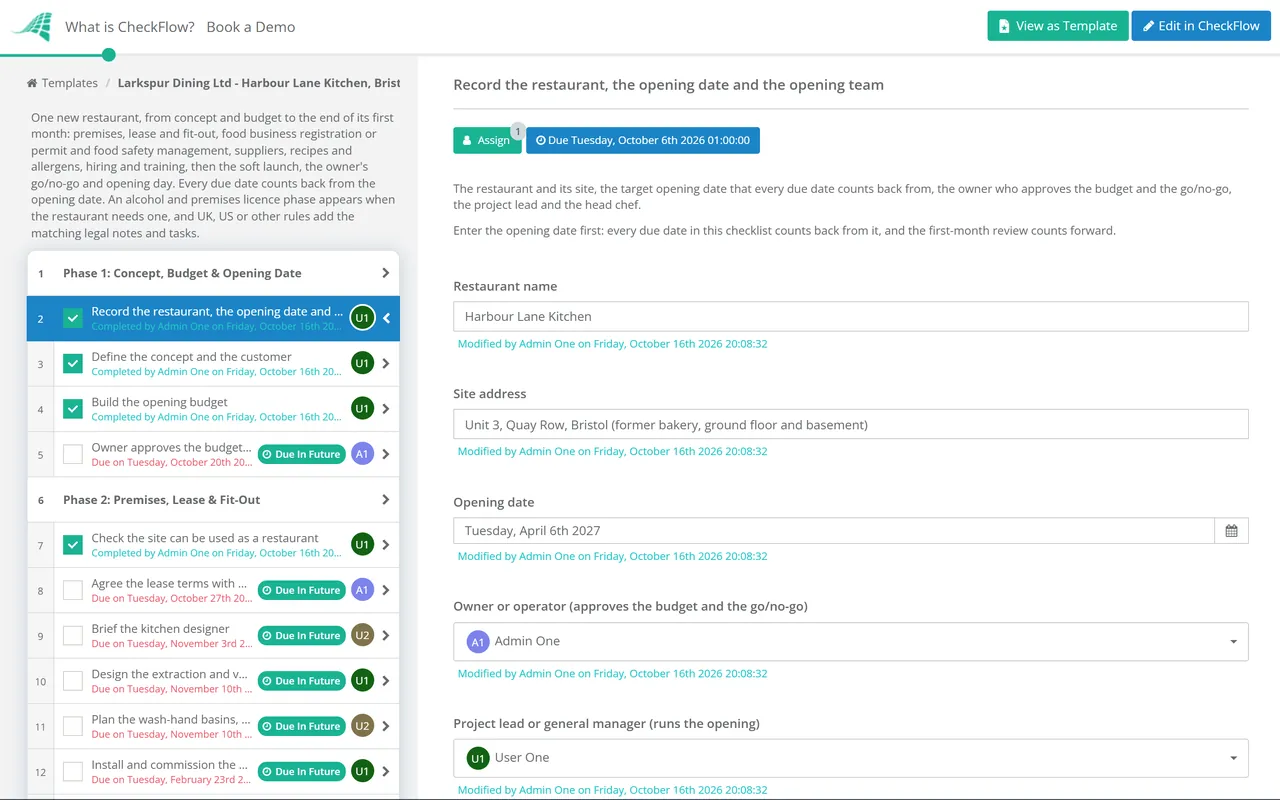
    • Record the restaurant, the opening date and the opening team — the restaurant and its site, the target opening date that every due date counts back from, the owner who approves the budget and the go/no-go, the project lead and the head chef
    • Define the concept and the customer — cuisine, service style, seats, expected covers, average spend and opening hours; these drive the kitchen design, the menu, the staffing and the hours on any licence
    • Build the opening budget — premises, fit-out and kitchen equipment, licences and fees, opening stock, wages before opening, marketing and a contingency, with how each is funded
    • Owner approves the budget and the target opening date — before the lease is signed or any contractor is booked; a date that leaves too little time for licences or the fit-out is moved now, not in the last month
  2. Phase 2

    Phase 2: Premises, Lease & Fit-Out

    7 tasks

    The kitchen layout, the extraction and the gas supply have the longest lead times and are the hardest to change later. Ask the local authority for advice before you commit to a site or change it.

    • Check the site can be used as a restaurant — ask the local planning or zoning office whether a restaurant is allowed in the unit, and whether extraction ducting, signs or outdoor seating need permission
    • Agree the lease terms with a solicitor — rent, length, break clauses, permitted use and hours, and who pays for the extraction, the gas supply and the fit-out
    • Brief the kitchen designer — the menu, covers and equipment list, and a flow from delivery to storage, preparation, cooking, service and wash-up that keeps raw and ready-to-eat food apart
    • Design the extraction and ventilation with a competent engineer — a canopy over every appliance that gives off fumes and heat, enough make-up air, a high-level discharge clear of neighbours, and ductwork and filters that can be cleaned
    • Plan the wash-hand basins, sinks and drainage — enough basins with hot and cold water for staff to wash their hands, separate sinks for food and equipment where needed, and a grease trap or grease removal unit so fat does not go down the drain
    • Install and commission the kitchen equipment — gas appliances fitted and checked by a qualified gas engineer, extraction tested, fridges and freezers holding temperature before food arrives, with certificates, manuals and the snag list kept
    • Complete the fire risk assessment for the finished premises — cooking, gas, escape routes, alarms and fire-fighting equipment, with every action closed before opening; get fire safety advice before the fit-out starts, not after
  3. Phase 3

    Phase 3: Registration, Permits & Food Safety

    7 tasks

    The deadlines here are set by law and count back from the day you start trading. Your rules answer in Phase 1 adds the notes for your country.

    • US: submit the plans for health department review — before building or converting the kitchen: the intended menu, expected volume, layout, equipment specifications and evidence of a food safety management system
    • Register the food business or apply for the permit — with the local authority in the UK, or the health department in the US, early enough to meet the deadline that applies where you are
    • Write the food safety management system — HACCP-based procedures for your dishes and processes, or a pack such as Safer Food, Better Business for caterers, finished before the first food is prepared
    • Arrange pest control and waste collection — a pest control contract and commercial waste and recycling collections in place before the first delivery, with a bin store that keeps pests out
    • Set up the daily food safety records — opening and closing checks, fridge and hot-holding temperatures, cleaning schedules and the diary, ready to use from the first training shift
    • Make sure a trained person is in charge on every shift — the people who will run each shift, the food safety training each has and any certificate the rules require
    • Prepare for the first inspection — premises clean and finished, the food safety system and records ready to show, and a named person to walk the officer round
  4. Phase 4 — If you need a licence

    Phase 4: Alcohol & Premises Licence

    6 tasks

    Shown only when the first task says you will sell alcohol, or in England and Wales sell hot food or drink after 11pm or put on entertainment. The licensee and age-check tasks appear only when you sell alcohol.

    • Decide the licensable activities and hours — alcohol for drinking on or off the premises, late-night hot food or drink, music or other entertainment, and the days and times for each
    • Appoint the designated premises supervisor or licensee — the person named on the licence as responsible for alcohol sales, with the qualification and personal licence the rules require
    • Apply for the licence — the application form, fee, plan of the premises and operating details, sent to the licensing authority and to anyone else the process requires
    • Display the application notice and deal with any representations — the notice shown where the public can read it for as long as the rules say, and any objections answered or taken to a hearing
    • Receive the licence and record its conditions — every condition on the licence copied into the opening procedures and the staff briefing, and the licence kept at the premises
    • Set up age checks and a refusals log — an age-checking policy, a refusals log and a briefing on the licence conditions for everyone who serves alcohol
  5. Phase 5

    Phase 5: Suppliers, Menu & Allergens

    7 tasks

    Allergen information is a legal duty in both countries. Record the allergens in every recipe before the menu is printed, not after.

    • Write and cost every recipe — a standard recipe for each dish with ingredients, quantities, method and portion, and a cost per portion that the menu price covers
    • Choose suppliers and set up the supplier records — reputable suppliers for each food, with delivery days, minimum orders and contacts, kept as the record of who supplies each food
    • Record the allergens in every dish — from the recipes and the supplier specifications, including sauces, garnishes, oils and anything added at the pass, in one allergen matrix
    • Decide how customers get allergen information — written on the menu, or a matrix or folder on request with a clearly visible notice saying how to ask, plus how a server passes an allergen order to the kitchen
    • US: add a consumer advisory for raw or undercooked dishes — dishes such as cooked-to-order burgers, raw oysters or raw-egg dressings marked on the menu with a disclosure and a reminder
    • Trial every dish and sign off the menu — each dish cooked at the planned portion, timing and plating, adjusted, and the menu and prices checked against the recipes and the allergen matrix before print
    • Place the opening stock orders — dry, chilled and frozen deliveries timed for after the fridges are holding temperature, checked on arrival and put away straight away
  6. Phase 6

    Phase 6: Hiring & Training

    6 tasks

    Food safety training comes before anyone handles open food. Book the training shifts early enough to run a soft launch with the full team.

    • Plan the roles, hours and wage budget — front-of-house and kitchen roles for each service, the hours each covers and what they cost against the budget
    • Recruit the team — adverts, interviews and paid trial shifts, with offers and start dates that leave time for training before the soft launch
    • Set up as an employer — payroll, the tax registrations and the insurance you need before anyone starts work
    • Check every hire’s right to work — before their first shift, with a copy of the documents and the date of the check kept on file
    • Run the food safety induction for every starter — illness reporting, handwashing, personal hygiene, cleaning and allergens, before anyone handles open food
    • Train each station and the systems — kitchen stations, the steps of service, the till, the booking system and the allergen order route, practised on training shifts
  7. Phase 7

    Phase 7: Systems, Soft Launch & Opening Day

    6 tasks

    The soft launch tests everything with real guests while mistakes are cheap. The owner’s go/no-go holds the opening day tasks until it is given.

    • Open bookings and publish the opening details — the booking system, opening hours, map and directory listings, website and social posts with the opening date
    • Set up the till and card payments — menu items and prices that match the printed menu, allergen and modifier buttons, card terminals, staff logins and the end-of-day report
    • Run the soft launch — invited guests or limited covers over one or more services, with the full food safety and allergen procedures, and feedback collected from guests and staff
    • Fix what the soft launch found and re-test it — slow tickets, equipment faults, menu or till errors and gaps in training, each put right and checked on a training service
    • Owner gives the go/no-go to open — registration or permit in place, any licence granted, fire risk assessment actions closed, staff inducted and soft launch fixes done
    • Run opening day — a pre-shift briefing on the menu, allergens and roles, the opening checks done, a manager on the floor all day and every problem written down
  8. Phase 8

    Phase 8: First-Month Review

    4 tasks

    The first month shows what the plan got wrong. Review it while the opening is fresh, and agree the changes for month two.

    • Review the first week — covers, sales, ticket times, complaints, food waste and the problems logged on opening day
    • Compare the first month’s costs with the budget — food cost, wages and the final fit-out spend against the opening budget, with the reasons for any gap
    • Review the food safety records and any inspection — gaps in the daily records, corrective actions and complaints, and the report or rating from any inspection so far
    • Owner signs off the first-month review — the changes for month two agreed: menu, rota, hours, suppliers and prices, each with an owner

Registrations and Licences Before Opening, England and Wales and the US

Most of what slows an opening is a legal step with its own lead time. The table sets out the main ones in England and Wales and under the FDA Food Code model, so you can see which deadlines count back from your opening date. It is a starting point for planning, not legal advice.

Step England and Wales United States (FDA Food Code model, 2026 edition)
Register or get a permitRegister the food business with the local authority at least 28 days before trading. Registration is free and cannot be refused, and each site is registered where it isA valid permit to operate from the regulatory authority, applied for at least 30 calendar days before the planned opening (8-301.11, 8-302.11)
Plans before buildingNo plan approval at registration; the FSA suggests asking the local authority for advice when you choose or change premisesPlans reviewed before a kitchen is built or converted, or remodelled where the regulator asks (8-201.11): menu, volume, layout, equipment and evidence of a food safety management system (8-201.12)
InspectionA food hygiene inspection by the local authority, usually unannounced and possibly several months after opening, with a rating from 0 to 5One or more preoperational inspections against the approved plans before the permit is issued (8-203.10, 8-303.10)
Food safety managementProcedures based on HACCP principles (Article 5 of the assimilated Regulation (EC) No 852/2004); Safer Food, Better Business packs for small businessesA written food safety management system within four years of the regulator adopting this edition (8-201.15); a HACCP plan only for certain activities (8-201.13)
Person in chargeStaff trained for their role; a food hygiene certificate is not compulsory, though the FSA recommends a qualification for anyone starting a food businessThe person in charge is a certified food protection manager, unless the regulator treats the business as minimal risk (2-102.12)
Allergens14 allergens declared; for non-prepacked food, in writing or verbally with a clearly visible written noticeNine major food allergens, including sesame; written notification when one is an ingredient in unpackaged food (3-602.12(C)), and a consumer advisory for raw or undercooked animal foods (3-603.11)
AlcoholA premises licence from the council under the Licensing Act 2003, naming a designated premises supervisor who holds a personal licence; the application notice is displayed for 28 daysA licence from the state or local alcohol beverage control board; the Small Business Administration also lists the federal Alcohol and Tobacco Tax and Trade Bureau for retail sales
Late-night food and entertainmentHot food or drink sold between 11pm and 5am, and some entertainment such as live or recorded music, also need a premises licenceAsk the city or county licensing office
Hiring staffRegister as an employer with HMRC before the first payday, hold employers’ liability insurance for at least £5 million and check each hire’s right to workAn Employer Identification Number to hire employees, and Form I-9 completed and kept for every hire

Scotland and Northern Ireland. The Licensing Act 2003 extends to England and Wales only. Northern Ireland registers food businesses on the same 28-day rule and uses the FSA’s Safe Catering guidance in place of Safer Food, Better Business. In Scotland, start from Food Standards Scotland’s guidance and your council.

Check your local edition. The FDA publishes the Food Code as a model. State, local, tribal and territorial regulators adopt it into their own rules on their own timetable, so your health department may enforce an earlier edition with different requirements.

Why Run a Restaurant Opening in CheckFlow?

1

Every deadline counts back from one date

The opening date on the first task sets every due date, from the budget 26 weeks out to the registration, the licence application and opening day. If the date moves, the whole timeline moves with it, and each task shows its owner and due date on the checklist.

2

The licences you need, and no others

Two answers on the first task shape the run. Which rules apply adds the UK or US notes, and in the US the plan review and menu advisory tasks. The licence answer adds Phase 4, with the licensee and age-check tasks only when you sell alcohol. Conditional rules do the work.

3

No opening without a go/no-go

The owner approves the budget before money is committed, and gives the go/no-go before opening day. That approval step holds every task after it until a decision is recorded. Plans, certificates and the licence are uploaded to the tasks that needed them.

CheckFlow does not apply for licences, design kitchens or inspect premises. The owner, the solicitor, the engineers and the authorities do that. It keeps every step of the opening on one checklist, with a named owner and a due date, so the project lead can see what is late on the Reports Grid and nothing waits on someone’s memory.

Once you are open, run each trading day with the Restaurant Opening & Closing Checklist and each new starter through the Restaurant Employee Training Checklist. Build the full food safety plan with the HACCP Food Safety Checklist, and assess the finished premises with the Fire Risk Assessment Checklist.

AI generator

Didn’t find what you need? Describe it.

Describe the process in a sentence and the AI checklist generator drafts the phases and tasks for you.

Frequently Asked Questions

How long does it take to open a restaurant?

It depends on the premises, the fit-out and the licences, so plan backwards from the opening date rather than forwards from today. A unit that needs a new kitchen and extraction takes far longer than taking over a working restaurant. The legal steps set the latest dates: in England and Wales the food business registers at least 28 days before trading, and in the US the Food Code model asks for the permit application at least 30 days before opening, after plan review. This checklist starts 26 weeks out by default; change any offset to suit your project.

What licences do you need to open a restaurant in the UK?

In England and Wales, register the food business with your local authority; registration is free and cannot be refused. If you sell alcohol, sell hot food or drink between 11pm and 5am, or put on some entertainment such as live or recorded music, you need a premises licence from the council under the Licensing Act 2003. Selling alcohol also needs a designated premises supervisor with a personal licence. As an employer you register with HMRC and hold employers’ liability insurance. Scotland and Northern Ireland have their own licensing law.

How far in advance do you have to register a food business?

In England, Wales and Northern Ireland, the Food Standards Agency says to register with your local authority at least 28 days before you start trading, and recommends waiting until about 28 days before you are ready rather than registering too early. Registration is free. If you are already trading without registering, register as soon as possible, because it is a legal requirement. In Scotland, Food Standards Scotland and your council give the guidance.

What permits do you need to open a restaurant in the US?

A permit to operate from your state or local health department, which in the FDA Food Code model follows a plan review before you build or convert the kitchen and a preoperational inspection before the permit is issued. The Food Code also expects a certified food protection manager as the person in charge. Selling alcohol needs a licence from the state or local alcohol beverage control board. You also need an EIN to hire staff, a Form I-9 for each hire and premises that meet local zoning. Check the code edition your health department has adopted.

Do you need a food hygiene certificate to open a restaurant?

In the UK, no certificate is compulsory. You must be able to show that you and your staff have the right skills and training for the work, and the Food Standards Agency recommends that anyone starting a food business takes a food hygiene qualification. In the US, the 2026 Food Code makes the person in charge a certified food protection manager unless the regulator treats the business as minimal risk. Check what your state or county has adopted, and any other training rules it sets, before you hire.

Do I need a HACCP plan or Safer Food, Better Business?

UK food businesses must have food safety procedures based on HACCP principles. Small caterers in England and Wales can meet that with the FSA’s Safer Food, Better Business pack and its daily diary; Northern Ireland uses Safe Catering. A full HACCP plan suits more complex menus and processes, and the HACCP Food Safety Checklist builds one. In the US, the Food Code model asks for a HACCP plan only for certain activities, such as reduced oxygen packaging, and the 2026 edition adds a written food safety management system.

What should a restaurant soft launch include?

Real guests on a limited menu or limited covers, with the full procedures running: allergen questions at the table, tickets to the pass, temperature checks, the till and card payments, and clearing and cleaning down. Invite friends, neighbours or local businesses, and ask guests and staff what went wrong. Then fix what you found and test it again before the opening day. In this checklist the soft launch result decides whether a fix-and-retest task appears before the owner’s go/no-go.

Is CheckFlow free for this template?

14-day free trial, no card required. The Business plan is $10 per user per month after the trial. Full details at checkflow.io/pricing.

Open on the Date You Planned

Free trial — no credit card required.

14-day free trial, no credit cardFull refund in your first 30 daysUS or EU hosting