
Good for teaching the routine
- New buildings, new staff or a changed evacuation route
- Practising assisted evacuation with consent and dignity
- Testing a single floor, shift or department
- Lower disruption, but times will look better than reality
Last reviewed: October 2026
No Credit Card Required
Printed from checkflow.io/templates/operations-facilities-management/fire-drill-evacuation-checklist
Fire drills tend to be run the same way every year: same day, same exit, same people. Then a real alarm sounds on the night shift with the main stair blocked and nobody knows who is in the building. This free fire drill checklist is for facilities managers, office and site managers, multi-site retail and restaurant operators and the fire wardens who run drills on their behalf. It covers planning the scenario and roles, preparing the alarm system and the roll call, practising assisted evacuation for people with a personal emergency evacuation plan, running and timing the drill, the debrief and a manager-approved report, and closing the loop into the fire risk assessment and training.
A drill tests the emergency plan that came out of your fire risk assessment. It does not replace the assessment, and it should not be designed in isolation from it. Before choosing a scenario, check which evacuation strategy the assessment and fire strategy assume. Most workplaces use simultaneous evacuation, where everyone leaves when the alarm sounds. Large or tall buildings may use phased evacuation, moving the floors nearest the fire first. Hospitals and care homes often move patients horizontally to a protected area rather than out of the building. Blocks of flats designed for “stay put” are a different case again. Practise the strategy you actually have.
Then decide how realistic to make it. Official UK business guidance calls it good practice not to announce drills in advance, so you see how people really respond. That has to be balanced against safety: a surprise evacuation of a busy kitchen, a lab mid-experiment or a care home at night carries its own risks. Many sites alternate between the two.
Finally, give every role a name before drill day. The coordinator decides when to start, holds the clock and gives the all-clear. Fire wardens (or marshals) each own an area and sweep it on the way out, checking toilets, meeting rooms and stores and closing doors. A roll-call keeper takes the staff rota and visitor book to the assembly point. Observers stand at stairs and exits and write down what goes wrong. In a small shop one person may hold several roles; in a large building each floor needs its own warden and a deputy for when they are on leave. OSHA’s emergency action plan rule asks US employers to designate and train employees to assist in a safe and orderly evacuation, which is the same idea.
Six phases take the drill from planning to follow-up. Phase 3 appears only when someone with a personal emergency evacuation plan is expected on site, and the alarm-monitoring tasks in Phases 2 and 4 appear only when your alarm signals a monitoring centre.
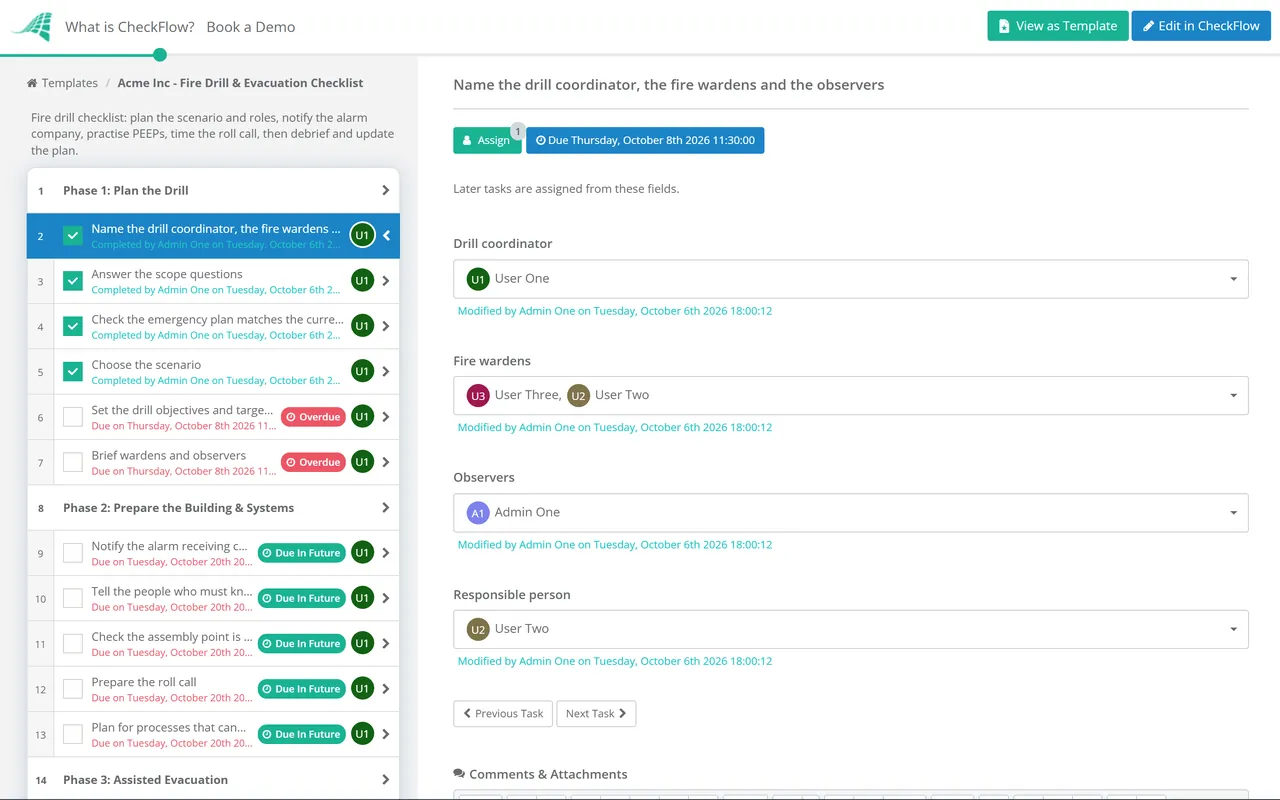
Answer the scope questions first. They decide which tasks and phases this drill shows.
Shown only when someone with a personal emergency evacuation plan is expected on site during the drill.
Drill frequency is set by guidance and by your fire risk assessment in the UK, and by the fire code your state or city has adopted in the US. The table summarises the main sources. Treat the figures as minimums, and check the edition and local amendments that apply to your building.
| Source | What it says about drills |
|---|---|
| UK government workplace guidance | Carry out at least one fire drill per year, record the results and keep them with your fire safety and evacuation plan |
| UK higher-risk premises | No single national figure; set a higher frequency in your fire risk assessment where there are shifts, high staff turnover, sleeping occupants or many visitors |
| OSHA 29 CFR 1910.38 (US employers) | No drill frequency; requires designated and trained evacuation helpers, an alarm system, and review of the plan with each employee when it is developed, when their duties change and when the plan changes |
| International Fire Code, Table 405.2 | Examples: business (Group B) annually, with employees; educational (Group E) monthly; hotels and similar (Group R-1) quarterly on each shift, with employees |
| NFPA 101 Life Safety Code | Drills where the occupancy chapter requires them, for example existing business occupancies above set occupant loads, and health care occupancies quarterly on each shift |
Keep a record an inspector would accept. The International Fire Code lists what a drill record should hold: who conducted the drill, the date and time, how occupants were notified, the staff on duty who took part, the number evacuated, special conditions simulated, problems encountered, the weather and the time taken to evacuate fully. UK guidance asks for the results to be recorded in the fire safety logbook. Phase 5 of this template captures the same fields, so the record is complete whichever side of the Atlantic you are on.
Plan for disabled people in advance. In the UK, the government’s supplementary guide on means of escape for disabled people describes personal emergency evacuation plans for employees and visitors. In England, residential buildings of 18 metres or seven storeys or more, and those over 11 metres with simultaneous evacuation, have had specific residential PEEP duties since 6 April 2026. A drill is the time to find out whether the plans work, not the fire.
Set a yearly or quarterly schedule for each site and the checklist arrives with the coordinator and wardens assigned and the notice tasks dated ahead of drill day, so nothing depends on someone remembering.
Wardens and observers tick off their areas from a phone browser, add photos of propped doors or blocked exits, and type times straight into the record. The debrief starts from facts, not memories.
The drill tests the plan; the assessment writes it. Review the plan with the Fire Risk Assessment Checklist, keep the alarm and emergency lighting serviced through the Preventive Maintenance Checklist, and check escape routes between drills with the Facility Inspection Checklist.
Running drills across a portfolio of shops, restaurants or offices? Use one template for every site, schedule each location on its own cycle with recurring checklists, and treat the drill as one part of a wider emergency programme alongside the Business Continuity Plan Testing Checklist.
Emergency Action Plan Checklist

Fire Risk Assessment Checklist
Fire Extinguisher Inspection Checklist

Facility Inspection Checklist
Safety Audit Checklist
Describe the process in a sentence and the AI checklist generator drafts the phases and tasks for you.
In the UK, government guidance says at least once a year, with more frequent drills where your fire risk assessment calls for them, for example with several shifts or high staff turnover. In the US, OSHA’s emergency action plan rule sets no frequency; the locally adopted fire code does. Under the International Fire Code, business occupancies drill annually and hotels quarterly on each shift.
UK guidance calls it good practice not to announce them, so you see how people really respond. In practice, tell the people who must know, such as security and the alarm monitoring company, and use announced or partial drills when the aim is to teach a new route or practise assisted evacuation safely.
There is no single legal time for every building. What matters is that people can reach a place of safety before escape routes become unusable, which depends on the building’s design and the fire strategy. Time each drill from the alarm to the last person out and to the completed roll call, and compare against your own previous results and the assumptions in your fire risk assessment.
The date and time, who ran it, how the alarm was raised, which staff took part, how many people evacuated, the scenario, the weather, any problems and the time to clear the building. That matches the record the International Fire Code asks for and covers what UK guidance expects in the fire safety logbook. Add the actions raised and who owns them.
In the UK, the responsible person under the Fire Safety Order, usually the employer or whoever controls the premises, though they often delegate the running of drills to a facilities manager or fire wardens. In the US, the employer must designate and train employees to help with evacuation, and the building owner or occupant answers to the local fire code.
The call that matters is to whoever receives your alarm signal. If the system is monitored by an alarm receiving centre or monitoring company, tell them before you start and again when you finish, or the fire service may be sent. Beyond that, practice varies by area, so ask your local fire and rescue service or fire department whether they want notice of drills.
14-day free trial, no card required. The Business plan is $10 per user per month after the trial. Full details at checkflow.io/pricing.
14-day free trial, no credit cardFull refund in your first 30 daysUS hosting, EU on request