Hotel Housekeeping Room Checklist Template

Most room complaints are not about the cleaning. They are about the room released before anyone inspected it, the shower fault nobody reported and the wallet in the drawer that nobody logged.

Last reviewed: October 2026

A hotel room is not ready because it looks clean. It is ready when it has been cleaned, restocked, checked for faults and inspected, and the front desk knows it can be sold. This free hotel housekeeping room checklist is for room attendants, housekeeping supervisors and executive housekeepers. One run is one room turn: a departure clean after a check-out, or a stayover service for a guest staying on, chosen when the checklist starts. It begins with the room status and assignment, then entry and safety, stripping and airing the room, the bathroom, the bedroom and bed make, restocking amenities and the minibar, and recording defects and lost property. A deep or infection-control clean phase appears when the room is flagged for one, and tasks to take the room out of order or hand in lost property appear only when they are needed. The room is released only after the supervisor’s inspection.

A Room Turn Is a Clean With a Handover at Each End

A hotel room is cleaned many times a week, and the cleaning is the part most teams already do well. What slips is everything around it: the room status that never changed from vacant dirty, the wallet in the bedside drawer that nobody logged, the dripping shower that the next guest reports, and the room that went back on sale before anyone inspected it. A room turn is a cleaning job with a handover at each end, from the front desk to housekeeping and back.

This checklist is for one room, from the moment it is assigned to the moment the supervisor releases it. It is built for hotels, with room attendants, a supervisor and a property management system. Hosts and holiday let managers turning a whole property between guests should use the Short-Term Rental Turnover Checklist instead. The condition of the building itself belongs in the Facility Inspection Checklist, and the assessment of the cleaning chemicals your team uses belongs in the COSHH Assessment Checklist.

Departure clean

The guest has checked out

Covers: a full strip of every bed, the whole room cleaned and restocked, and a search for property left behind.

Ends with: the supervisor’s inspection and the room released as vacant and inspected.

Watch for: minibar charges reaching the front desk before the guest leaves.
Stayover service

The guest is staying on

Covers: the same cleaning, with linen and towels changed as the guest and the linen policy ask, and the guest’s belongings left where they are.

Ends with: the room marked occupied and serviced.

Watch for: do not disturb signs and guests who decline service.

Deep or infection-control clean

The room is flagged

Covers: the items on the deep-clean schedule, or the hotel’s infection-control procedure after a guest was ill: protective equipment, body fluid spills, contaminated laundry, disinfection and a record.

Ends with: the same inspection, with the clean recorded.

What the Hotel Housekeeping Room Checklist Covers

Eight phases follow one room from assignment to release. The service type chosen in Phase 1 adds the departure or the stayover tasks. Phase 4 appears only when the room is flagged for a deep or infection-control clean, the out-of-order and lost property tasks in Phase 7 appear only when they are needed, and the room cannot be released until the supervisor has inspected it.

  1. Phase 1

    Phase 1: Room Status & Assignment

    4 tasks

    Start one checklist per room. The service type and the rules question here decide which tasks and notes this room shows, and every due date counts back from the time the room must be ready.

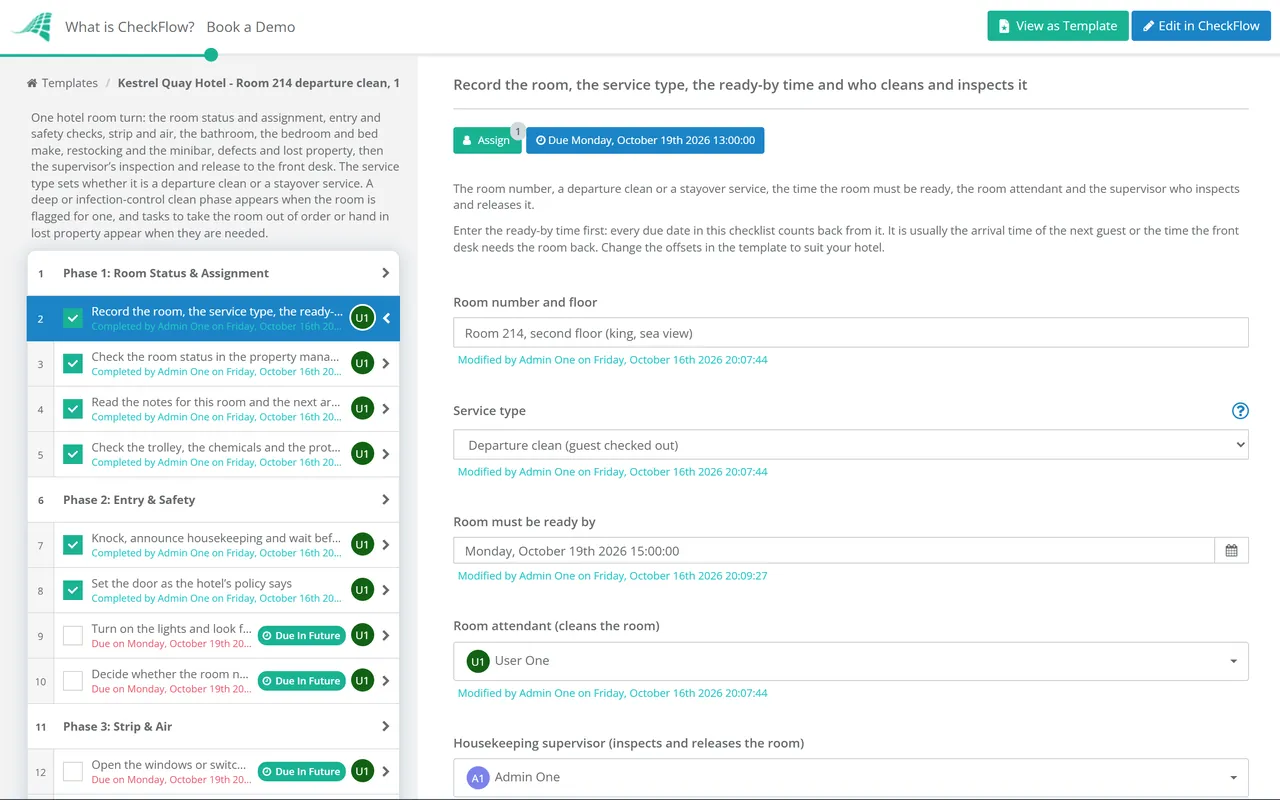
    • Record the room, the service type, the ready-by time and who cleans and inspects it — the room number, a departure clean or a stayover service, the time the room must be ready, the room attendant and the supervisor who inspects and releases it
    • Check the room status in the property management system — vacant dirty after a check-out, occupied for a stayover, or due out and not yet checked out, so nobody walks in on a guest
    • Read the notes for this room and the next arrival — a cot or extra bed, an accessible room set-up, an allergy request, an early arrival, a known maintenance issue or a guest who reported feeling unwell
    • Check the trolley, the chemicals and the protective equipment — every product in its original or a labelled container, the safety data sheets where staff know to find them, gloves without holes, eye protection for splash risks and a wet floor sign
  2. Phase 2

    Phase 2: Entry & Safety

    4 tasks

    Room attendants often work alone. Enter the way the hotel’s procedure says, look before touching anything, and decide here whether the room needs more than a standard clean.

    • Knock, announce housekeeping and wait before entering — as the hotel’s procedure says, and never enter a room showing do not disturb; follow the hotel’s policy for when to check on a guest who has not been seen
    • Set the door as the hotel’s policy says — a service sign on the handle, the trolley across the doorway, or the door closed and latched; a self-closing fire door is not wedged open unless the fire risk assessment allows it
    • Turn on the lights and look for hazards before touching anything — needles or other sharps, broken glass, body fluids, damaged electrics, aerosols or heaps of paper near heat, or anything that makes the room unsafe; stop and call the supervisor
    • Decide whether the room needs a deep or infection-control clean — a deep clean when the room is on the deep-clean schedule or the supervisor asks for one, and an infection-control clean after a guest was ill or where there is vomit, diarrhoea or blood; the answer decides whether Phase 4 appears
  3. Phase 3

    Phase 3: Strip & Air

    6 tasks

    The bed strip is a departure task. On a stayover, linen and towels are changed as the guest and the linen policy ask, and the guest’s belongings stay where they are.

    • Open the windows or switch on the ventilation — HSE’s guidance for hospitality says to use cleaning substances only in well-ventilated areas; an open window is sometimes enough
    • Empty the bins and remove the rubbish — look before reaching in and never press rubbish down by hand; sharps go to the sharps procedure and recycling is kept apart
    • Clear used trays, glasses, cups and crockery — to the service point the hotel uses, with any broken glass wrapped before it goes in the bin
    • Strip every bed and remove all used linen and towels — a departure task: every bed that was used or looks slept in, with mattress protectors and pillows checked for stains
    • Change linen and towels as the guest and the linen policy ask — a stayover task: towels left on the floor or in the bath are changed, a reuse card is respected, and the guest’s clothes, papers and valuables stay where they are
    • Check the mattress seams, headboard and bed frame for bed bugs — spots of blood or small brown spots on bedding, the mattress or furniture; if you find signs, stop, keep the linen in the room and call the supervisor
  4. Phase 4 — If flagged

    Phase 4: Deep or Infection-Control Clean

    6 tasks

    Applies only when Phase 2 flags a deep clean or an infection-control clean. Follow the hotel’s own procedure for each; these tasks make sure it was followed and recorded.

    • Put on the protective equipment the infection-control procedure sets — for example disposable gloves and an apron, and eye protection where splashes are possible, put on before entering the bathroom or touching soiled linen
    • Deal with any spill of body fluids first, using the spill kit — contain and remove it as the procedure says before the rest of the room is cleaned, and bag the waste the way the procedure sets
    • Bag linen, towels and soft items as the procedure says for contaminated laundry — kept apart from the rest of the laundry and labelled, so the laundry handles it the way the procedure sets
    • Clean, then disinfect every surface and high-touch point — with the product the procedure names, at the dilution and contact time on its label, including handles, switches, remote controls, phone, taps and the toilet flush
    • Complete the deep-clean items listed for this room — the items on the hotel’s deep-clean schedule, such as behind and under furniture, curtains, vents, mattress rotation and descaling the showerhead
    • Record the infection-control clean — the date, who cleaned, the products used and anything that was thrown away, in the hotel’s infection-control log
  5. Phase 5

    Phase 5: Bathroom Clean

    7 tasks

    Work from clean to dirty and from top to bottom, and finish at the door so you never walk back over a wet floor.

    • Apply cleaner to the toilet, bath, shower and basin so it has time to work — at the dilution on the label, and never mix products: HSE warns that bleach mixed with acidic toilet cleaners or ammonia gives off harmful gases
    • Clean the shower, bath, screen, tiles and grout — hair out of every plughole, limescale off the screen and taps, and any mould or failed sealant noted as a defect for Phase 7
    • Clean the basin, taps, mirror and vanity unit — polished dry, with any dripping tap or slow drain noted as a defect
    • Clean the toilet inside and out with its own cloth — bowl, rim, seat, hinges, flush handle, base and the floor behind it, with the cloth the hotel’s colour code keeps for toilets only
    • Flush the taps and shower if the room has stood empty — as the hotel’s legionella risk assessment says for outlets that are used infrequently, run through to drain without spraying
    • Put out clean towels, the bath mat and the bathroom amenities — folded and placed to the hotel’s standard, with soap, toiletries and toilet roll to the room’s par level
    • Mop the bathroom floor last, working back to the door — HSE notes that even a well-wrung mop leaves a film of water that can make a smooth floor slippery, so keep the wet floor sign out until it is dry
  6. Phase 6

    Phase 6: Bedroom Clean & Bed Make

    7 tasks

    The search for property left behind is a departure task. Faults found here are recorded with photos in Phase 7.

    • Make the beds with fresh linen to the hotel’s standard — the same pillows, fold and throw every time, using the bed-making method and any lifting aids the hotel’s manual handling assessment sets
    • Dust from high to low — headboard, picture frames, lamps, shelves, wardrobe, television, windowsills and skirting, ending at floor level
    • Wipe and disinfect the high-touch points — door handles, light switches, remote controls, phone, safe keypad, kettle handle, hairdryer and hangers
    • Replace cups and glasses with clean ones and clean the kettle — clean cups and glasses from the back-of-house supply, never washed in the bathroom basin, and the kettle emptied and wiped
    • Search the room for property left behind — a departure task: the wardrobe, drawers, safe, bathroom, under the bed and behind the curtains; the answer decides whether the lost property tasks in Phase 7 appear
    • Check the lights, television, heating or air conditioning, phone, curtains and safe work — switched on and tried, not just looked at; faults go into the defects table in Phase 7
    • Vacuum the carpet or mop the floor, working back to the door — under the bed and furniture edges and into the corners, finishing at the entrance
  7. Phase 7

    Phase 7: Restock, Defects & Lost Property

    8 tasks

    Every defect is recorded, even one you fixed. The answer to “Can the room be sold?” decides whether the maintenance and out-of-order tasks appear, and lost property tasks appear only when something was found.

    • Restock the room’s amenities to its par list — tea, coffee, milk, water, toiletries, tissues, stationery and the laundry bag, with anything the store room is short of noted
    • Check the minibar and record what was taken — item by item, restocked and with the dates checked, and passed to the front desk straight away on a departure so it can be charged before the guest leaves
    • Set the room for arrival — curtains, lights, temperature, the fire action notice and guest information in place, and the requests from Phase 1 such as a cot or extra bed
    • Record every maintenance defect with a photo — where it is, what is wrong and whether it was fixed on the spot; the answer to “Can the room be sold?” decides what follows
    • Raise each defect with maintenance — in the maintenance system or log, with the photos, the room number and how urgent it is
    • Set the room out of order and tell the front desk — in the property management system, with the reason and the date it is expected back, so the next arrival is moved to another room
    • Bag and label each item of lost property — with the room number, date, time, where it was found and who found it; cash, cards, passports and jewellery go to the duty manager or security straight away
    • Log the items in the lost property register and hand them in — as the hotel’s lost property policy says, so the item can be matched when the guest calls
  8. Phase 8

    Phase 8: Supervisor Inspection & Release

    5 tasks

    No room goes back on sale until the supervisor has inspected it. Nothing after the supervisor’s decision can be completed until it is recorded.

    • Tell the supervisor the room is ready for inspection — and update the room to vacant clean, or occupied and serviced, so the supervisor can see it is waiting
    • Supervisor inspects the room against the hotel’s standard — each area checked in person, including the bathroom, the beds, the floors and the minibar, with every failed item recorded for a re-clean
    • Re-clean anything that failed and show the supervisor — the room attendant puts each failed item right and the supervisor checks it again before deciding
    • Supervisor decides whether the room can be released — approved only when every area passes and any defect has been raised; required before the room status is changed
    • Update the room status and tell the front desk — vacant and inspected after a departure clean, occupied and serviced after a stayover, or left out of order with the reason, at the time it was released

Hotel Room Status Codes and Who Changes Them

The room status is how housekeeping and the front desk talk to each other. A room that is clean but still shows as dirty cannot be sold, and a room shown as inspected before anyone has looked at it is the one the next guest complains about. Property management systems use their own codes and wording, so match the table to yours and agree with the front desk who may change each one.

Room status What it means Who usually sets it Where this checklist covers it
Vacant dirty (VD)The guest has checked out and the room needs a departure cleanThe front desk at check-out, or the systemPhase 1: the checklist starts as a departure clean
Occupied (OCC)A guest is staying and the room is due its stayover serviceThe system, from the bookingPhase 1: the checklist starts as a stayover service
Do not disturb (DND)The guest has asked not to be disturbed, or has declined serviceThe guest’s sign; the room attendant records itPhase 2: the room is not entered and the hotel’s policy is followed
Vacant clean (VC)Cleaned and waiting for the supervisor’s inspectionThe room attendantPhase 8: reported ready for inspection
Vacant inspected (VI)Inspected and released, so the room can be allocated and soldThe supervisorPhase 8: set only after the supervisor’s decision
Occupied and servicedThe stayover service is doneThe room attendant or the supervisorPhase 8: after a stayover
Out of service (OOS)A short hold for a minor job; systems differ on whether the room can still be soldThe supervisor or maintenancePhase 7: defects logged for maintenance
Out of order (OOO)The room cannot be sold until a defect is fixed, with a reason and an expected return dateThe supervisor or the duty managerPhase 7: the room is set out of order and the arrival moved

Cleaning chemicals. In Great Britain, the Control of Substances Hazardous to Health Regulations 2002 (COSHH) require the employer to assess the risks from the hazardous cleaning substances staff use, to prevent or control exposure, and to give staff information, instruction and training. HSE’s guidance for the hospitality industry adds the everyday rules: keep products in their original labelled containers where possible, never put them in food or drink containers, never mix them, and use them only in well-ventilated areas. In the US, OSHA’s Hazard Communication Standard requires a written hazard communication program, labelled containers, safety data sheets readily accessible during each work shift and training for staff. It exempts consumer products only where the employer can show staff are exposed no more often or for longer than a consumer using the product as intended would be.

Fire doors. In England, the government’s fire safety guide for sleeping accommodation lists fire doors being wedged open as one way fire and smoke spread, so hold a bedroom door open while cleaning only in the way your fire risk assessment allows. This table and the notes in the template are a starting point for your own procedures, not legal advice.

Why Run Hotel Housekeeping in CheckFlow?

1

One checklist per room

Start a checklist for each room from the template, or from another system through the API. The room attendant and the supervisor are assigned from the first task, and every due date counts back from the time the room must be ready. Rooms still in progress show on the Reports Grid.

2

Nothing released without an inspection

The supervisor’s decision is an approval step: the room status cannot be changed in the checklist until the supervisor records it. The inspection table shows which areas failed and what was put right, with who did it and when.

3

Defects and lost property reach someone

Answer “Can the room be sold?” and the maintenance and out-of-order tasks appear for the supervisor. Find property left behind and the bag, label and register tasks appear. Photos are taken in a phone browser and attach to the task.

CheckFlow does not replace your property management system or set your cleaning standard. Room statuses still change there, and the standard is yours. It makes sure each room turn follows the same steps, that faults and lost property are recorded where someone will act on them, and that the supervisor’s inspection happens before the room is sold. Real-time updates let the supervisor see each room move through the phases.

Assess the cleaning chemicals behind the Phase 1 checks with the COSHH Assessment Checklist, keep the store room stocked with the Supply Ordering & Inventory Restock Checklist, and check the building itself with the Facility Inspection Checklist. If your hotel has a restaurant, run its shifts with the Restaurant Opening & Closing Checklist and train new staff with the Restaurant Employee Training Checklist.

AI generator

Didn’t find what you need? Describe it.

Describe the process in a sentence and the AI checklist generator drafts the phases and tasks for you.

Frequently Asked Questions

What should a hotel housekeeping checklist include?

One room turn from start to finish: the room status and who is assigned, entry and safety checks, stripping and airing the room, the bathroom, the bedroom and bed make, restocking amenities and the minibar, and recording defects and lost property. It should end with a supervisor’s inspection and the room released to the front desk. Add tasks that appear only when they are needed, such as an infection-control clean after a guest was ill or taking the room out of order for a repair.

What is the difference between a departure clean and a stayover service?

A departure clean follows a check-out: every bed is stripped, the whole room is cleaned and restocked, the room is searched for property left behind and the supervisor inspects it before it is sold again. A stayover service is for a guest staying on: the same areas are cleaned, linen and towels are changed as the guest and the hotel’s linen policy ask, and the guest’s belongings stay where they are. In this template the service type in Phase 1 decides which tasks appear.

What do VD, VC and VI mean in hotel housekeeping?

They are common room status codes. VD is vacant dirty: the guest has checked out and the room needs cleaning. VC is vacant clean: the room has been cleaned and is waiting for inspection. VI is vacant inspected: a supervisor has inspected it and it can be sold. Other common ones are OCC for occupied, DND for do not disturb and OOO for out of order. Property management systems use their own codes, so check what yours shows.

Who should inspect a hotel room after it is cleaned?

Someone other than the person who cleaned it, usually a housekeeping supervisor or floor supervisor. They check each area in person against the hotel’s standard, send anything that fails back for a re-clean and only then release the room to the front desk. In this template the supervisor is chosen on the first task, the inspection is recorded area by area, and the room status cannot be updated in the checklist until the supervisor has recorded a decision.

What should housekeeping do with lost property?

Record it straight away. Bag each item and label it with the room number, the date and time, where it was found and who found it, then log it in the lost property register and hand it in as the hotel’s policy says. Valuables such as cash, cards, passports and jewellery should go to the duty manager or security at once. A clear record is what lets the front desk match an item to a guest who calls days later.

What chemical safety rules apply to hotel housekeeping?

In Great Britain, COSHH requires the employer to assess the risks from hazardous cleaning substances, prevent or control exposure and train staff. HSE’s hospitality guidance says to keep products in labelled containers, never decant them into food or drink containers and never mix them, since bleach mixed with acidic toilet cleaners or ammonia gives off harmful gases. In the US, OSHA’s Hazard Communication Standard requires labelled containers, safety data sheets readily accessible during each shift, a written program and training.

How is this different from the short-term rental turnover checklist?

The Short-Term Rental Turnover Checklist is for hosts and holiday let managers turning a whole property between guests, with check-out photos for damage claims, laundry, alarm tests and a ready-for-guest sign-off. This checklist is for hotels: one room at a time, run by room attendants and a supervisor, with room statuses in a property management system, stayover services, the minibar, lost property and an inspection before the room is released.

Is CheckFlow free for this template?

14-day free trial, no card required. The Business plan is $10 per user per month after the trial. Full details at checkflow.io/pricing.

Release Every Room Cleaned, Checked and Inspected

Free trial — no credit card required.

14-day free trial, no credit cardFull refund in your first 30 daysUS or EU hosting