Crash Cart Checklist Template

Nobody finds out that the pads are out of date, the suction battery is flat or the seal was broken until the trolley is needed. This checklist finds it first, writes it down and has the nurse in charge accept the trolley as ready.

Last reviewed: October 2026

Printed from checkflow.io/templates/healthcare-medical/crash-cart-checklist

This free crash cart checklist is for nurses, nurses in charge, resuscitation officers and department managers who check the crash cart, called a resuscitation trolley in the UK, on a ward, in a department or in a clinic. One run is one check of one trolley. The first task sets the type of check: a routine check of the tamper seal, the outside of the trolley, the defibrillator, suction, oxygen and breathing equipment; a full check that also opens the seal and counts the airway, circulation and drug drawers against your contents list with every expiry date; or a restock and re-seal after the trolley was used, which adds cleaning and replacing what was used before that full count. Every check ends with the faults replaced and reported, a new seal number, a signed record and the nurse in charge or resuscitation lead accepting the trolley as ready for use. The template checks presence, expiry dates, seals and function only. What the trolley holds and how often it is checked are set by your own policy and your resuscitation committee or lead.

A Crash Cart Check Makes One Trolley Ready, Not the Whole Medicines System

A crash cart check makes sure one trolley is complete, in date, sealed and working before the next emergency. Resuscitation Council UK says a reliable system of equipment checks and replacement must be in place to ensure that equipment and drugs are always available for use in a cardiac arrest, and its statement on resuscitation trolleys asks for a documented check at least daily. In the United States, the hospital Conditions of Participation say outdated drugs must not be available for patient use, and The Joint Commission accepts a numbered breakaway tag on an emergency cart when there is a defined process to monitor it. This template is that check and its record.

It is not the same job as the other healthcare templates it sits beside. The Medication Management Audit Checklist audits how a whole service handles medicines. The Medical Equipment Sterilization Checklist takes reusable instruments through cleaning and sterilisation. The Healthcare Incident Reporting Process Checklist investigates one incident, such as a seal broken with no explanation or a defibrillator that failed when it was needed.

Crash cart check

Checks one trolley is complete and ready

Asks: is this trolley sealed, complete, in date and working, and has someone accepted it as ready?

When: at the frequency your policy sets, and every time the trolley is used or opened.

Output: a signed check record, a new seal number, faults replaced and reported, and the nurse in charge’s acceptance.

Medicines audit

Checks how a service handles medicines

Asks: are medicines ordered, stored, given, recorded and disposed of as our policy and the law require?

When: on the cycle your medicines policy sets.

Output: ratings by section, findings and an action plan with owners.

Incident investigation

Looks into one thing that went wrong

Asks: what happened, why, and what will stop it happening again?

When: each time an incident or near miss is reported, including possible tampering with a trolley.

Output: a root cause, actions and the reports to the people who must be told.

What the Crash Cart Checklist Covers

Eight phases take one crash cart check from the setup to the nurse in charge’s acceptance. Every check covers the trolley and its tamper seal, the defibrillator, suction, oxygen and breathing equipment, and ends with the faults, a new seal, the signed record and the acceptance. A full check adds the airway drawer and the circulation, drugs and fluids drawer. A restock after use adds cleaning and replacing what was used before that count. A fault found adds a task to replace and report it, and a trolley marked not ready adds a task to take it out of use and arrange cover.

  1. Phase 1

    Phase 1: Set Up the Check

    3 tasks

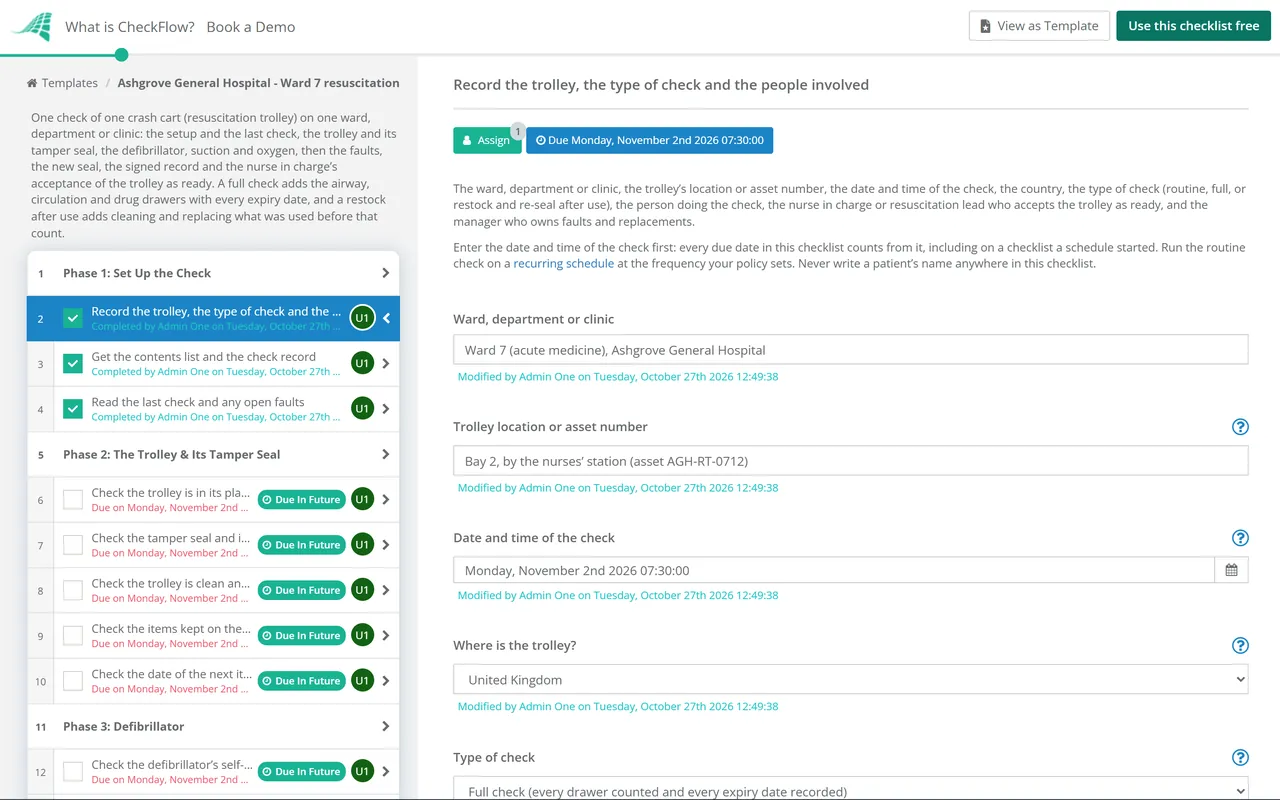
    Record which trolley you are checking and which kind of check this is, then read the last check before you start. The type of check on the first task decides which phases appear: a routine check covers Phases 2, 3, 4 and 8, a full check adds the airway and circulation drawers, and a restock after use adds cleaning and replacing what was used. Every due date counts from the time of the check.

    • Record the trolley, the type of check and the people involved — the ward, department or clinic, the trolley’s location or asset number, the date and time of the check, the country, the type of check (routine, full, or restock and re-seal after use), the person doing the check, the nurse in charge or resuscitation lead who accepts the trolley as ready, and the manager who owns faults and replacements
    • Get the contents list and the check record — the trolley’s current contents list, approved by your resuscitation committee or resuscitation lead, the check record or log kept with the trolley, and the label or log that shows the next item to expire
    • Read the last check and any open faults — the date and result of the last check, the seal number recorded then, and any item that was missing, out of date or faulty, with whether its replacement has arrived
  2. Phase 2

    Phase 2: The Trolley & Its Tamper Seal

    5 tasks

    Check the trolley from the outside before opening anything. A seal that is broken or carries a different number on a trolley nobody used is a sign of possible tampering: report it straight away and do a full check.

    • Check the trolley is in its place and easy to reach — in its marked place, not blocked, with the defibrillator sign visible and a way to call for help close by, and secured in the way your policy says for this area
    • Check the tamper seal and its number — the seal intact and its number the same as the one in the log, or, if it is broken, the reason known; a broken, missing or different seal on a trolley nobody used is treated as possible tampering
    • Check the trolley is clean and in good repair — clean surfaces, drawers that open and close, wheels and brakes that work, and nothing stored on or against the trolley that does not belong there
    • Check the items kept on the outside of the trolley — the items your list keeps on top of or beside the trolley, such as gloves, aprons and eye protection, a sharps container and clinical waste bag, the resuscitation algorithms and drug dose aids, and the record forms
    • Check the date of the next item to expire — the date on the expiry label or log of the first item on the trolley to expire; if that date has passed, or falls before the next full check, the trolley needs a full check now: reopen the first task if it is complete and change the type of check to Full check to add the drawer phases
  3. Phase 3

    Phase 3: Defibrillator

    5 tasks

    Every check includes the defibrillator. Follow the manufacturer’s instructions for your model: Resuscitation Council UK says they must be followed for the use, storage, servicing and expiry of equipment. Take a defibrillator that fails out of use and tell the nurse in charge before you go on.

    • Check the defibrillator’s self-test result — the status indicator or self-test report shows the defibrillator is ready, with no error, low battery or service message
    • Check the battery and charging — the battery charged, the defibrillator plugged in to charge where your policy says so, and a spare battery charged if your model uses one
    • Check the pads and electrodes — adhesive defibrillator pads connected or ready to connect, in sealed packaging and in date, a spare set, ECG electrodes and a razor
    • Do the user check your model needs — any daily or weekly user test the manufacturer describes, such as a manual test or a recorder paper check, done and recorded the way the instructions say
    • Check the service date — the label or record of the last planned maintenance by your clinical engineering or medical physics team, and a next service date that has not passed
  4. Phase 4

    Phase 4: Suction, Oxygen & Breathing

    4 tasks

    These are the items needed in the first minutes of a resuscitation attempt, so every check includes them. Resuscitation Council UK lists portable suction, an oxygen cylinder, a self-inflating bag with reservoir and clear face masks as items to have immediately available.

    • Check the portable suction works — the battery charged or the manual pump working, suction produced when you test it, and tubing, a Yankauer sucker and soft suction catheters ready
    • Check the oxygen cylinder — enough oxygen on the gauge for your local minimum, the cylinder secured on the trolley, a key where one is needed, and oxygen tubing
    • Check the bag-valve-mask and the oxygen masks — a self-inflating bag with reservoir, clear face masks in the sizes on your list, an oxygen mask with reservoir, and a pocket mask where your list includes one
    • Check the monitoring equipment on the trolley — waveform capnography and any other monitoring your list includes, switched on, working and with the tubing and connectors it needs
  5. Phase 5

    Phase 5: After Use: Clean & Replace

    4 tasks

    Applies only when the type of check is a restock and re-seal after use. Clean the trolley and replace what was used before the full count in Phases 6 and 7, so the trolley is ready for the next emergency.

    • Record when and why the trolley was opened — the date and time it was used or opened, the kind of emergency or reason, without patient names, and who opened it
    • Clean the trolley and the reusable equipment — single-use items thrown away, sharps in the sharps container, and the trolley and any reusable equipment decontaminated as your policy says
    • Replace the drugs used — the opened drug box or the drugs used replaced through your pharmacy’s process, with the opened box returned if your pharmacy asks for it
    • Replace used equipment and recharge the defibrillator — every used or opened item replaced from stock, new defibrillator pads fitted, any event data downloaded if your policy asks for it, and the defibrillator back on charge
  6. Phase 6

    Phase 6: Airway Drawer

    3 tasks

    Applies only when the type of check is a full check or a restock after use. Open the seal, count the airway drawer against your list and check each expiry date. Resuscitation Council UK says the choice of airway devices depends on local policy and staff training, so check what your list says, not what another hospital carries.

    • Check the airways — oropharyngeal and nasopharyngeal airways in the sizes on your list, with lubrication, and supraglottic airway devices where your list includes them, each present, sealed and in date
    • Check the intubation equipment — laryngoscope handles and blades that light, spare batteries and bulbs where needed, tracheal tubes, introducers, syringes, ties and filters, where your list includes them
    • Count the airway drawer against the list — every item on the list present in the quantity listed, each sealed pack intact and in date, and the earliest expiry date in the drawer recorded
  7. Phase 7

    Phase 7: Circulation, Drugs & Fluids

    5 tasks

    Applies only when the type of check is a full check or a restock after use. Count the circulation drawer, the fluids and the drugs against your list. This check confirms that each item is present, sealed and in date. It never decides which drug or dose a patient needs.

    • Check the circulation drawer — intravenous cannulae in a selection of sizes, skin wipes, tourniquets, dressings, syringes, needles, infusion sets and tape, counted against the list and in date
    • Check the intravenous fluids — the fluids on your list present in the quantity listed, in date, and with their outer packaging intact
    • Check the drugs are present, sealed and in date — every drug on your local list present in the quantity listed, in tamper-evident packaging or a sealed drug box, and in date
    • Check any other kits kept with the trolley — other kits kept on or beside the trolley, such as an anaphylaxis kit, an intraosseous access device or a grab bag, checked against their own lists
    • Record every item that expires before the next full check — each item due to expire before the next full check, with its expiry date, replaced now or ordered, and the earliest expiry date on the trolley written on the expiry label
  8. Phase 8

    Phase 8: Faults, Re-seal & Acceptance

    7 tasks

    Record what was wrong and what was done about it, seal the trolley and sign the record. Resuscitation Council UK’s statement asks for documentation of the findings, of any resulting action needed and of that action being completed. The nurse in charge or resuscitation lead then accepts the trolley as ready, and nothing after that can be completed until they record a decision.

    • Record what was missing, out of date or faulty — every item found missing, out of date, damaged or not working in this check, or none; a yes adds the task to replace and report
    • Replace missing items and report faults — each missing or out-of-date item replaced from stock or through the pharmacy, each faulty device taken out of use, labelled and reported to clinical engineering with a replacement found, and an incident reported where your policy asks for one
    • Re-seal the trolley and record the new seal number — a new numbered tamper-evident seal fitted whenever the trolley was opened, its number written in the log, or the same number recorded if the seal was not broken
    • Sign the check record — the trolley’s check record or log signed and dated by the person who did the check, with the type of check and its result
    • Nurse in charge accepts the trolley as ready for use — Ready for use or Not ready for use, with any conditions or reasons recorded
    • Take the trolley out of use and arrange cover — do this straight away: the trolley labelled not ready, the resuscitation team and the nearby areas told which trolley to use instead, and the problem escalated until it is fixed and the trolley passes a full check
    • Close the open items and set the next checks — anything still on order chased until it arrives, the next routine and full check dates set, and repeated faults raised with the resuscitation lead

Crash Cart Rules and Guidance: What Each Source Says and Who It Covers

These are the sources the notes in this checklist quote, what each one says and who it applies to. None of them gives one national contents list or checking frequency for every trolley, so your organisation’s policy, approved by its resuscitation committee or resuscitation lead, has the final word.

Source What it says Who it applies to
Resuscitation Council UK, Statement on keeping resuscitation drugs locked away (2016, reviewed September 2021)Resuscitation trolleys should not be locked or kept in locked rooms or cupboards. All resuscitation drugs must be stored in tamper-evident containers. The contents of every trolley must be checked systematically at least daily, with the findings, any action needed and that action being completed documented. Evidence of theft or tampering should be reported immediately and investigated.Healthcare provider organisations in the UK.
Resuscitation Council UK, Quality Standards: Acute care equipment and drug lists (last updated July 2023)Minimum equipment and drug lists for adults and children, each marked immediate or accessible. A reliable system of equipment checks and replacement must be in place, and the frequency of checks should be determined locally. The manufacturer’s instructions must be followed for use, storage, servicing and expiry. Standardised equipment and layout is recommended.Acute hospitals in the UK. Separate lists cover primary care, community hospitals and mental health inpatient care.
Resuscitation Council UK, Quality Standards: Primary care equipment and drug lists (last updated May 2020)Checks should be designated to named individuals with cover for absence, and their frequency will depend upon local circumstances but should be at least weekly.GP practices and other primary care settings in the UK.
Resuscitation Council UK, Quality Standards: Acute care (last updated July 2023)The resuscitation committee is responsible for ensuring that resuscitation equipment and drugs are available and ready for use. It recommends that the resuscitation practitioner makes sure systems keep equipment in good working order, which it says will usually mean delegating routine checking to ward staff.Acute hospitals in the UK.
42 CFR 482.25(b)(2) and (b)(3)Drugs and biologicals must be kept in a secure area, and locked when appropriate. Outdated, mislabeled, or otherwise unusable drugs and biologicals must not be available for patient use.Hospitals in the Medicare and Medicaid programmes (United States).
42 CFR 482.41(d)(2) and 482.55(c)(2)Facilities, supplies, and equipment must be maintained to ensure an acceptable level of safety and quality. Since 1 July 2025, emergency provisions, including equipment, supplies and medication, must be kept at the hospital and be readily available for treating emergency cases.Hospitals in the Medicare and Medicaid programmes (United States); 482.55 applies to hospitals that provide emergency services.
42 CFR 416.44(d)Emergency equipment must be immediately available for use during emergency situations, appropriate for the patient population and maintained by appropriate personnel, as the ASC’s policies specify for its operating room.Ambulatory surgical centres (United States).
The Joint Commission, standards FAQs “Emergency Cart - Security” and “Emergency Cart - Medication Security” (updated January 2026)A breakaway tag with a numeric identification number is acceptable when there is a defined process to monitor the integrity of the lock and the cart contents. Emergency carts containing medication in departments not staffed 24/7 must be secured in a locked location.Joint Commission accredited hospitals, critical access hospitals and ambulatory organisations (United States).

How often to check. The sources differ. Resuscitation Council UK’s 2016 statement asks for a documented check of every resuscitation trolley at least daily; its 2023 acute care lists say the frequency should be determined locally; its primary care lists say at least weekly. The US regulations quoted here set no frequency. This template runs one check per run, and your policy decides how often to run the routine and full checks.

Locked or sealed. The UK and US sources also differ on locking. Resuscitation Council UK says trolleys should not be locked; the Joint Commission says carts with medication in departments not staffed 24/7 must be locked away. The country question on the first task shows the matching note.

Contents. The template never lists drugs or doses for you. Count against the contents list your resuscitation committee or lead has approved for that area.

Why Run Crash Cart Checks in CheckFlow?

1

One template, three kinds of check

The first task sets the type of check. A routine check shows the seal, the outside of the trolley, the defibrillator, suction and oxygen. A full check adds the airway, circulation and drug drawers with every expiry date, and a restock after use adds cleaning and replacing what was used. A seal broken with no explanation shows what to do about possible tampering.

2

No trolley is ready by default

The nurse in charge or resuscitation lead is chosen on the first task. The acceptance is assigned to them, and nothing after the approval step can be completed until they record a decision. A trolley marked not ready adds a task to take it out of use and arrange cover.

3

On the schedule your policy sets

Start the routine check on a recurring schedule for each trolley. Every due date counts from the check time entered on the first task, and the Reports Grid lists every check with its seal numbers and faults, with filters and export. Analytics shows overdue and late tasks by person and step.

CheckFlow does not give clinical advice or decide what a trolley should hold. The contents list and the checking frequency come from your policy and your resuscitation committee or lead, and the manufacturer’s instructions govern each device. CheckFlow runs the check around them: who checks what, by when, what was found, and who accepted the trolley as ready. CheckFlow’s healthcare checklist software shows how the same approach handles other clinical processes.

Possible tampering or a device that failed goes through the Healthcare Incident Reporting Process Checklist. How the whole service stores and records its medicines is audited with the Medication Management Audit Checklist, US hospitals prepare their evidence with the Joint Commission Survey Readiness Checklist, and other safety equipment gets the same routine with the Fire Extinguisher Inspection Checklist.

AI generator

Didn’t find what you need? Describe it.

Describe the process in a sentence and the AI checklist generator drafts the phases and tasks for you.

Frequently Asked Questions

What is a crash cart checklist?

A crash cart checklist is the record of a check that one crash cart, or resuscitation trolley, is sealed, complete, in date and working. A routine check looks at the tamper seal, the defibrillator, suction, oxygen and the items on the outside. A full check opens the seal and counts every drawer against the contents list with each expiry date. After the trolley is used, it is cleaned, restocked, counted and re-sealed. Each check is signed, and in this template the nurse in charge accepts the trolley as ready.

Is a crash cart the same as a resuscitation trolley?

Yes. US sources such as The Joint Commission’s standards FAQs call it a crash cart or an emergency cart, and Resuscitation Council UK calls it a resuscitation trolley. Both mean the mobile trolley that holds the defibrillator, airway and breathing equipment, suction, oxygen, circulation equipment and emergency drugs a team needs in the first minutes of a resuscitation attempt. This template works for either and uses your own contents list.

How often should a crash cart be checked?

The sources differ, so your policy decides. Resuscitation Council UK’s statement on resuscitation trolleys (2016, reviewed 2021) asks for a systematic, documented check of the contents at least daily. Its 2023 acute care equipment lists say the frequency should be determined locally, and its primary care lists say at least weekly. The US regulations quoted on this page set no frequency. Always restock and re-seal after the trolley is used or opened, and run the routine check on a recurring schedule.

What should be on a crash cart?

Whatever the contents list approved by your resuscitation committee or resuscitation lead says for that area. Resuscitation Council UK publishes minimum equipment and drug lists for acute, primary, community hospital and mental health settings, grouped into airway and breathing, circulation, other items and drugs, and says organisations must use a risk assessment to decide what each area needs. This template checks each item against your list for presence, packaging and expiry. It does not choose drugs or doses.

Should a crash cart be locked?

It depends where you are. Resuscitation Council UK says resuscitation trolleys should not be locked or kept in locked rooms or cupboards, and that resuscitation drugs must be in tamper-evident containers. In the United States, the Joint Commission accepts a numbered breakaway tag on carts in areas staffed 24/7 when there is a defined process to monitor it, but says carts containing medication in departments not staffed 24/7 must be secured in a locked location. Follow your own policy.

What is a crash cart tamper seal?

It is a numbered seal or breakaway tag that closes the trolley’s drawers and breaks when someone opens them. The number is written in the check log. If the seal is intact and its number matches, the drawers have not been opened since the last full check. A broken, missing or different seal on a trolley nobody used is treated as possible tampering in this template: report it straight away and do a full check before the trolley is accepted.

What should you do after a crash cart has been used?

Record when and why it was opened, without patient names, then clean it, dispose of single-use items and decontaminate reusable equipment as your policy says. Replace the drugs used through your pharmacy, replace used equipment and defibrillator pads, and put the defibrillator back on charge. Then count every drawer against the list, check expiry dates, fit a new numbered seal, sign the record and have the nurse in charge accept it as ready. Choose “restock and re-seal after use” on the first task.

Who is responsible for checking the crash cart?

Resuscitation Council UK’s acute care standards make the resuscitation committee responsible for ensuring resuscitation equipment and drugs are available and ready for use, and say routine checking will usually be delegated to ward staff. Its primary care lists say checks should be designated to named individuals with cover for absence. In this template a named person does the check, the nurse in charge or resuscitation lead accepts the trolley, and the manager owns faults and replacements.

Is CheckFlow free for this template?

14-day free trial, no card required. The Business plan is $10 per user per month after the trial. Full details at checkflow.io/pricing.

Check Every Trolley, Then Know It Is Ready

Free trial — no credit card required.

14-day free trial, no credit cardFull refund in your first 30 daysUS hosting, EU on request