Hand Hygiene Audit Checklist Template

Most hand hygiene failures happen at moments nobody notices: after a hand on the bed rail, before a dressing, with gloves still on. An audit that does not count opportunities against the five moments cannot show which ones are being missed.

Last reviewed: October 2026

Hand hygiene only protects patients if it happens at the right moments on every shift, and an audit is how a team finds out whether it does. This free hand hygiene audit checklist is for IPC teams, link practitioners and ward, clinic and practice managers who audit one area at a time. One run is one observation audit of one ward, clinic or practice. It plans the period, the sessions and the staff groups, checks basins, soap, paper towels, handrub at the point of care and posters, then records every opportunity against WHO’s five moments, with bare below the elbows and glove use checked alongside. It works out the compliance rate overall, by staff group and by moment, gives feedback to staff, and ends with a report, an action plan and the IPC lead’s sign-off. An improvement and re-audit phase appears when compliance falls below your organisation’s own target.

A Hand Hygiene Audit Counts What Staff Do at Each Moment

NHS England’s National Infection Prevention and Control Manual (NIPCM) says hand hygiene is considered one of the most important ways to reduce the spread of the infectious agents that cause healthcare associated infections. WHO’s Hand Hygiene Technical Reference Manual sets out how to measure it: a trained observer watches routine care, counts every opportunity for hand hygiene against the “My 5 Moments for Hand Hygiene”, and records whether hand hygiene was done. Compliance is the actions performed divided by the opportunities. WHO calls direct observation the method that gives the most accurate data on compliance, while noting that being watched can change what staff do.

A hand hygiene audit is narrower and deeper than an infection control audit. The Infection Control Audit Checklist checks all ten standard infection control precautions in an area, with hand hygiene as one of them. This checklist is the focused observation audit that sits under it: enough sessions and opportunities to give a rate by staff group and by moment that you can track over time. Both feed the evidence a regulator looks for, which the CQC Inspection Readiness Checklist gathers.

Hand hygiene audit

Measures compliance at the five moments

Asks: do staff clean their hands at each moment it is needed, and are the basins, soap and handrub there for them?

When: on the cycle your organisation sets, at least once a year under WHO’s strategy, and again after a poor result.

Output: a compliance rate overall, by staff group and by moment, with feedback, an action plan and the IPC lead’s sign-off.

Infection control audit

Checks all ten standard precautions in one area

Asks: are placement, hand hygiene, PPE, equipment, the environment, linen, spills, waste and sharps safety all in place today?

When: on your IPC programme’s rolling cycle.

Output: a score for each element, findings and an action plan.

Inspection readiness

Prepares the evidence for the regulator

Asks: can we show the regulator that our systems work, including how we manage infection risk?

When: continuously, ahead of an inspection or survey.

Output: evidence organised by the regulator’s questions or standards, with your audits among it.

What the Hand Hygiene Audit Checklist Covers

Seven phases take one audit from planning to sign-off. Phases 2 to 4 happen in the area: a facilities walk-round, then observation sessions that record every opportunity against the five moments, with bare below the elbows and glove checks alongside. Phase 7 appears only when compliance falls below the target your organisation sets.

  1. Phase 1

    Phase 1: Plan the Audit

    6 tasks

    Decide what this audit measures, and how, before anyone is watched. WHO’s method gives results you can compare only when the scope, the staff groups and the sessions are set in advance and kept the same next time.

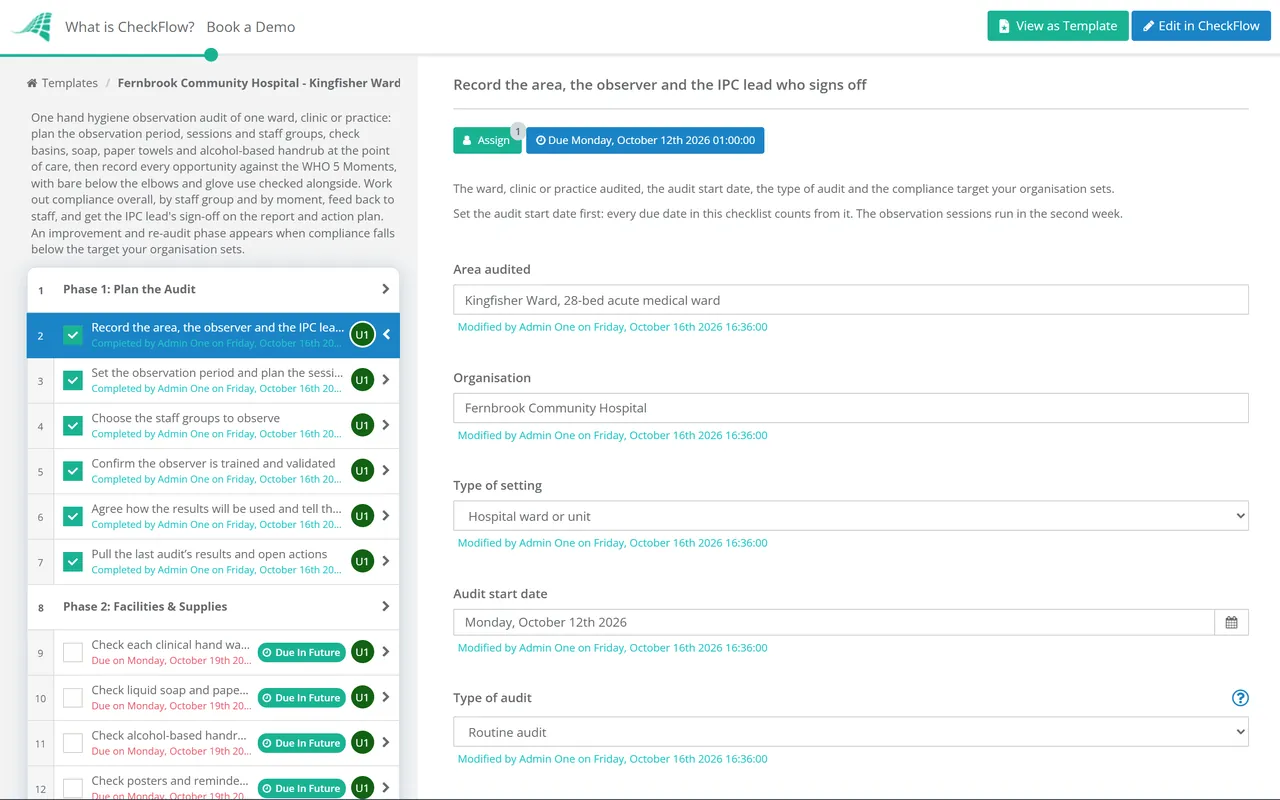
    • Record the area, the observer and the IPC lead who signs off — the ward, clinic or practice audited, the audit start date, the type of audit and the compliance target your organisation sets
    • Set the observation period and plan the sessions — the dates sessions will run, how many there will be, and times spread across shifts, days and activities so the sample is representative
    • Choose the staff groups to observe — WHO’s four professional categories, or your own subdivisions of them, observed in proportion to the area’s workforce
    • Confirm the observer is trained and validated — able to identify, tell apart and explain the five moments, with experience of patient care, and checked against the WHO method
    • Agree how the results will be used and tell the area — anonymous and confidential unless your organisation decides otherwise, not used to evaluate individual staff, and the observation period announced to the nurse in charge and the lead doctor
    • Pull the last audit’s results and open actions — overall compliance, the moments and staff groups that scored lowest, and any actions still open
  2. Phase 2

    Phase 2: Facilities & Supplies

    6 tasks

    The first component of WHO’s hand hygiene improvement strategy is system change: water, soap and towels, and alcohol-based handrub at the point of care. Walk round the area before the first session, because staff cannot comply where the means are missing.

    • Check each clinical hand wash basin — used for hand hygiene only and not for disposing of other liquids, with mixer taps, no overflow or plug, and in a good state of repair
    • Check liquid soap and paper towels at every basin — wall-mounted dispensers, filled and working, with running water at each basin
    • Check alcohol-based handrub at the point of care — within arm’s reach of where care is given, reachable without leaving the patient zone, filled and working
    • Check posters and reminders where hands are cleaned — instructional posters at hand hygiene facilities and five moments reminders in the clinical area
    • Check glove stock and hand care products — gloves in the sizes staff need, located close to the point of use, and an emollient hand cream for staff with no communal tubs
    • Report every fault found before the first session — empty dispensers refilled, and broken basins, taps or dispensers reported to estates with a reference
  3. Phase 3

    Phase 3: Observation Sessions

    6 tasks

    Watch routine care and record what you see. WHO’s rule is that the observer records only actions they can clearly see that match an indication, and never assumes that hand hygiene took place.

    • Introduce yourself before each session — to the staff and, where it applies, the patients, with a general reason for being there, then stand close to the point of care without interrupting care
    • Record each session’s details — session number, date, start and end time, duration and the staff groups observed
    • Record every opportunity against the five moments — the staff group, the moment or moments that applied, and the action seen: handrub, handwash or missed
    • Record when gloves were worn and hand hygiene was missed — noted only when the person observed is wearing gloves at an opportunity and does not clean their hands
    • Check and complete each form straight after the session — end time, duration and the observer’s initials entered, with entries changed only to correct a clear error
    • Give immediate feedback to the staff observed — the moments met and missed, given in a way that invites discussion, at a convenient time in their working day
  4. Phase 4

    Phase 4: Bare Below the Elbows & Glove Use

    4 tasks

    Hand hygiene works best on bare forearms and short, natural nails, and gloves do not replace it. Make these checks during the same sessions. The rules quoted are the NIPCM’s for England; elsewhere, check against your own dress code and glove policy.

    • Check staff are bare below the elbows — forearms exposed, no hand or wrist jewellery beyond a single plain ring, a religious bangle moved up the forearm, and disposable over-sleeves removed before hand hygiene
    • Check nails, cuts and skin — nails clean and short with no artificial nails or nail products, cuts and abrasions covered with a waterproof dressing, and staff with skin problems pointed to occupational health or their GP
    • Observe whether gloves are right for the task — worn when exposure to blood, body fluids, non-intact skin or mucous membranes is likely, and not worn for tasks with no such exposure
    • Check gloves are changed and hands cleaned around them — gloves changed after each task and each patient, never cleaned with handrub or soap, and hand hygiene before putting them on and after taking them off
  5. Phase 5

    Phase 5: Compliance Calculation

    7 tasks

    WHO’s formula is the number of hand hygiene actions performed divided by the number of opportunities, multiplied by 100. Work it out the same way at every audit so the results can be compared.

    • Check you observed enough opportunities — against the number you planned, adding sessions before you calculate if the count fell short
    • Total the opportunities and actions for each staff group — opportunities, handrub, handwash and missed, session by session, then added up
    • Work out the compliance rate — actions performed divided by opportunities, multiplied by 100, overall and for each staff group
    • Break the results down by moment — how often each moment was met, as a guide to which moments to target in training
    • Work out the share of handrub and handwash — the proportion of actions done by each method, set against the facilities you found in Phase 2
    • Compare the result with the last audit — overall, by staff group and by moment, using the same method so that a change reflects practice rather than a different sample
    • Compare the result with your target — the target set on the first task; compliance below it for the area or any staff group switches on Phase 7
  6. Phase 6

    Phase 6: Report, Sign-off & Feedback

    6 tasks

    WHO’s manual says final results should go to the staff concerned, and to management or the infection control committee, as soon as possible after the data are collected. The IPC lead signs off the report first, and nothing after the sign-off can be completed until they do.

    • Write the audit report — compliance overall, by staff group and by moment, the facilities found, the bare below the elbows and glove findings, and the comparison with last time
    • Write the action plan with owners and deadlines — one action per finding, such as moving dispensers, agreeing refill rounds or training on a moment, the most urgent first
    • IPC lead signs off the audit report — the results, findings and action plan, before they are shared, with the decision and any conditions recorded
    • Feed back the results to the area team — overall and by staff group and moment, at a team meeting or as a short written summary posted in the area and discussed
    • Send the results to management and the IPC committee — the report and the action plan, as your organisation decides, so the area’s results can be tracked over time
    • Set the next audit date — on the cycle your organisation sets, sooner after a poor result, with open actions carried into the next audit
  7. Phase 7 — If Needed

    Phase 7: Improvement & Re-audit

    7 tasks

    Shown only when compliance falls below the target your organisation sets. Work through the actions, then observe the same area again with the same method.

    • Give targeted training on the moments that were missed — the five moments and handrub and handwash technique, for the staff groups that fell short, recorded for each session
    • Fix the supply and facility gaps — dispensers moved to the point of care, refill rounds agreed, and estates jobs chased until they are done
    • Refresh reminders in the workplace — five moments posters and prompts placed where the missed moments happen
    • Track each action to its deadline — follow up each owner before the date, and escalate any action that slips to the IPC lead
    • Re-audit with the same method — the same staff groups, session length and calculation, so the new rate can be compared with this one
    • Feed back the re-audit result to the team — the new rates, what changed and anything still to do
    • IPC lead closes the improvement plan — or sets a further re-audit if compliance is still below the target

The WHO 5 Moments for Hand Hygiene: What the Observer Records

WHO’s “My 5 Moments for Hand Hygiene” is the reference approach for doing, teaching and observing hand hygiene. Two moments come before contact and protect the patient; three come after contact and protect the health-care worker and the wider care area. An observer counts an opportunity whenever one or more moments arise, and records the action against it: handrub, handwash or missed.

Moment When it applies Examples from WHO’s manual
1. Before touching a patientWhen approaching the patient, before touching their intact skin or clothing.Shaking hands, helping a patient move, wash, eat or dress, taking a pulse or blood pressure.
2. Before a clean or aseptic procedureImmediately before contact with a mucous membrane, non-intact skin or an invasive medical device. If gloves are used, hand hygiene comes before putting them on.Brushing a patient’s teeth, giving eye drops, dressing a wound, inserting a catheter or tube, preparing medicines or food.
3. After body fluid exposure riskAs soon as a task with a risk of exposure to blood or body fluids ends, and after removing gloves.After an injection or puncture, removing an invasive device, handling a sample, clearing excreta or soiled bed linen.
4. After touching a patientWhen leaving the patient’s side after touching them. If surroundings are touched after the patient, it is still moment 4.After taking a pulse or blood pressure, helping a patient back into bed, giving physiotherapy.
5. After touching patient surroundingsWhen leaving the patient zone after touching objects or furniture there, without touching the patient. Never combined with moment 4.After changing an empty bed, holding a bed rail, clearing a bedside table, adjusting an infusion rate.

Working out compliance. Compliance (%) is the number of hand hygiene actions performed divided by the number of opportunities, multiplied by 100. One action can cover two moments that arise together, such as after touching one patient and before touching the next. An action with no matching moment is not counted, and the observer never assumes an action they did not see. WHO’s manual says compliance by moment is a guide rather than an exact measure, so report the rate by staff group and overall, and use the moments to target training.

Setting a target. The WHO manual and the NIPCM’s hand hygiene section do not set a compliance target. Agree one in your own IPC policy, record it on the first task, and observe and calculate the same way at every audit. In England, the NIPCM lists the same five moments for direct patient care and adds hand hygiene before putting on and after removing gloves.

Why Run Hand Hygiene Audits in CheckFlow?

1

Every area observed on its cycle

A recurring schedule starts each area’s audit on the cycle you choose, assigned to its observer. The due dates count from the audit start date, so the walk-round, the sessions, the calculation and the sign-off land in order, and a result below your target adds the re-audit phase to that run.

2

No report goes out unsigned

The IPC lead is chosen on the first task. The sign-off is assigned to them alone, and nothing after the approval step can be completed until they record a decision. Their decision, any conditions and the report itself stay on the checklist with the date.

3

Rates you can compare

Every run keeps its session log, totals by staff group and by moment, and the action plan with names and dates. The Reports Grid lists every area’s audit with the answers given, including the overall compliance rate, and Analytics shows overdue and late tasks by person and step.

CheckFlow does not decide whether an opportunity was met. That judgement is the observer’s, recorded on the form and in the totals. It runs the audit around it: who does what, by when, with what evidence, and who signed it off. CheckFlow’s healthcare checklist software shows how the same approach handles other clinical processes.

Hand hygiene is one of ten precautions the Infection Control Audit Checklist checks in each area. Audit results feed the CQC Inspection Readiness Checklist and the Joint Commission Survey Readiness Checklist, instrument loads are recorded with the Medical Equipment Sterilization Checklist, and new staff learn the five moments through the New Nurse Onboarding Checklist.

AI generator

Didn’t find what you need? Describe it.

Describe the process in a sentence and the AI checklist generator drafts the phases and tasks for you.

Frequently Asked Questions

What is a hand hygiene audit?

A hand hygiene audit measures how often staff clean their hands when they should. A trained observer watches routine care in one area, counts each opportunity for hand hygiene against WHO’s five moments, and records whether handrub or handwashing was done or the moment was missed. Most audits also check the facilities, such as basins, soap, paper towels and handrub at the point of care, and whether staff are bare below the elbows. The result is a compliance rate overall and by staff group, feedback to staff, an action plan and a date to audit again.

How do you calculate hand hygiene compliance?

Divide the number of hand hygiene actions performed by the number of opportunities observed, then multiply by 100. That is WHO’s formula. An opportunity is counted whenever one or more of the five moments arises, and each opportunity needs one action, so two moments that coincide count once. Actions with no matching moment are left out, and the observer never assumes an action they did not see. Work the rate out overall and for each staff group. WHO’s manual says a breakdown by moment is a useful guide but not an exact measure.

What are the WHO 5 Moments for Hand Hygiene?

They are the five times WHO says hand hygiene is needed during care: before touching a patient, before a clean or aseptic procedure, after body fluid exposure risk, after touching a patient, and after touching a patient’s surroundings. The first two protect the patient; the last three protect the health-care worker and the wider care area. WHO proposes the five moments as the reference approach for doing, teaching and observing hand hygiene, which is why audits record opportunities against them. NHS England’s National IPC Manual lists the same five moments for direct patient care.

How many observations does a hand hygiene audit need?

WHO’s manual says there is no clear evidence on the ideal sample size, but that estimates indicate 200 opportunities per observation period, per ward, department or staff group, are needed to compare results reliably. It breaks observation into sessions of about 20 minutes, up to 10 minutes longer or shorter, run at different times and with different staff, and advises watching no more than three health-care workers at once. Fewer opportunities still give a rate, but a rise or fall from the last audit may then be down to chance.

What is a good hand hygiene compliance rate?

WHO’s manual and the NIPCM’s hand hygiene section do not set a target, so agree one in your own infection prevention and control policy. Record it on the first task of this checklist, and observe and calculate the same way at every audit so the rates can be compared over time. A rate is only as good as the sample behind it: report the number of opportunities with every result, and look at staff groups and moments as well as the overall figure, because a high overall rate can hide one group or one moment that is often missed.

Who should carry out a hand hygiene audit?

A trained observer who knows the five moments well enough to identify, tell apart and explain them. WHO’s manual says observers should have broad experience of patient care, and its implementation guide says they should be validated by testing before they collect data. Observers introduce themselves, stand near the point of care without interrupting care, and record only what they clearly see. They also set an example: no wristwatch on the wrist, no jewellery and short, unvarnished nails. The IPC lead signs off the results.

How often should hand hygiene audits be done?

WHO’s implementation guide says observations should be repeated regularly, at least once a year, to monitor sustained improvement and find areas that need more work, with the frequency set by the hand hygiene programme’s coordinator. You may want to observe high-risk areas more often, and to audit again sooner after a poor result or a change such as new dispensers. Set the cycle in your IPC programme and run it as a recurring schedule, so each area’s audit starts on time and no area is missed.

Is CheckFlow free for this template?

14-day free trial, no card required. The Business plan is $10 per user per month after the trial. Full details at checkflow.io/pricing.

Observe Every Moment, Then Close Every Gap

Free trial — no credit card required.

14-day free trial, no credit cardFull refund in your first 30 daysUS or EU hosting