The sales kickoff
For: the sales organisation, once a year, in person, hybrid or virtual.
Planned around: goals and one theme, enablement sessions, the comp plan and awards.
Output: reps who use what they learned, checked at 30, 60 and 90 days.
Last reviewed: November 2026
No Credit Card Required
Printed from checkflow.io/templates/event-planning/sales-kickoff-planning-checklist
This free sales kickoff checklist is for sales enablement and sales operations teams who plan the annual sales kickoff, or SKO, with a planning group of sales leaders, product marketing, events, finance and HR. One run plans one kickoff, from about sixteen weeks before the first day to a review 90 days after it. It agrees the goals and one theme with the executive sponsor, chooses the format, and gets the budget approved before the venue or platform is booked. It builds the agenda, briefs the speakers, plans the enablement sessions and pre-work, agrees what is said about compensation plans, quotas and territories with finance and HR, and checks the award winners. Registration, travel and the run of show come next, then the executive sponsor signs off the content before the rehearsals. After the days themselves come the survey, the budget, deleting attendees’ personal information and three checks on whether reps are using what they learned. The format, a certification and a comp plan reveal each add the tasks they need.
A sales kickoff, or SKO, brings the sales organisation together at the start of the sales year to set the direction, launch the year’s plan, build skills and recognise the people who did well last year. It is part event and part training programme: the venue, travel and run of show matter, but the work that decides whether it was worth it happens in the sessions, in the comp plan conversations and in the weeks after.
This checklist is built to avoid four problems. If every leader gets a slot, the agenda becomes a series of updates with no time to practise. The comp plan is shown to the room before managers can answer questions about it. The awards are announced before anyone checked the numbers. And nothing happens after the event, so the new talk track is forgotten by the end of the quarter. This checklist plans one kickoff from the goals to the 90-day review. A team retreat belongs in the Company Offsite Planning Checklist, an event for customers in the Product Launch Event Checklist or the Event Planning Checklist, and outside speakers in the Conference Speaker Coordination Checklist.
For: the sales organisation, once a year, in person, hybrid or virtual.
Planned around: goals and one theme, enablement sessions, the comp plan and awards.
Output: reps who use what they learned, checked at 30, 60 and 90 days.
For: one team or the leadership, away from the office for a day or two.
Planned around: decisions to make together, attendees’ needs and time together.
Output: decisions and actions with owners, in the Company Offsite Planning Checklist.
For: customers, prospects, press and analysts.
Planned around: the guest list, the stage demo, the embargo and the reveal.
Output: coverage, leads and pipeline, in the Product Launch Event Checklist.
Nine phases take one kickoff from about sixteen weeks before the first day to a review 90 days after it. The format chosen in Phase 2 adds the venue, travel and remote tasks it needs, a certification adds its design, judging and retest tasks, and a comp plan reveal adds the tasks to confirm, present and follow up the plans. The executive sponsor approves the budget on a task due before anything is booked, and nothing after their sign-off of the agenda and session materials can be completed until it is given.
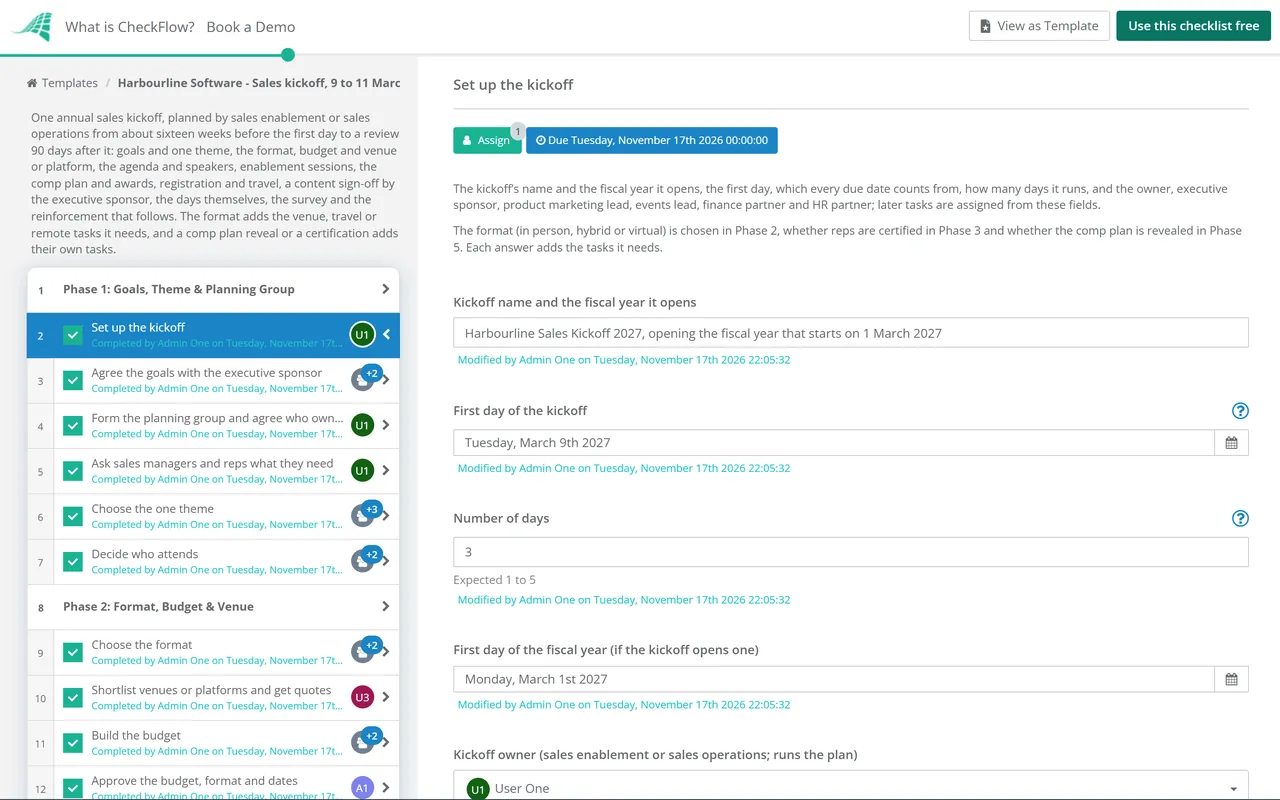
Start about sixteen weeks before the first day. Enter that date on the first task: every due date counts from it in working days. Agree what the kickoff must change with the executive sponsor before anyone books a room or writes a slide, and choose one theme the whole event points to.
Choose the format, price the kickoff and get the executive sponsor’s approval before anything is booked. The format adds the venue, travel and remote tasks it needs. If the sponsor approves a lower budget or does not approve it, a task appears to change the plan.
About eight weeks out, choose the skills and product sessions from the goals and what the field asked for, then turn them into an agenda. Mix inspiration, learning and celebration, keep sessions short, and give every session an owner and a reason to be there. If reps are certified at the kickoff, the certification tasks appear.
Give reps short pre-work so the time together at the kickoff is spent practising, and build the practice materials. If reps are certified at the kickoff, design the certification and calibrate the judges here.
Agree with finance and HR what will be said about compensation, quotas and territories at the kickoff, and keep the details private until they are final. Choose award categories from data, check the winners and keep the results quiet until the ceremony.
Open registration early enough for travel to be booked within policy and for the venue to act on attendees’ needs. Travel, rooms and arrival tasks appear for an in-person or hybrid kickoff, and the remote tasks for a hybrid or virtual one.
Ten working days before the first day, the executive sponsor signs off the agenda and every session’s materials, including any comp plan session. Nothing after that step can be completed until they do. Then rehearse every session and every handover.
The tasks for the event fall due on the first day. On a kickoff of more than one day, complete each one as it happens. Keep to time, record the certification results and capture what each rep commits to before they leave.
Send the survey while the event is fresh, close the budget and delete what you no longer need. Then hand the reinforcement to the managers and check progress against the goals at about 30, 60 and 90 days.
The first task names six people, and later tasks are assigned from them. One person can hold more than one role in a smaller company. The table is this template’s split of the work, not a rule.
| Role | Who that might be | Owns | Approves or confirms |
|---|---|---|---|
| Kickoff owner | Sales enablement or sales operations | The plan, the planning group, the agenda, the sessions, the pre-work and the follow-up | That every session’s materials are in by the deadline |
| Executive sponsor | The chief revenue officer or head of sales | The goals and the theme, with the owner | The budget, format and dates, then the agenda and session materials |
| Product marketing lead | Product marketing | Messaging, product sessions and the practice materials | That product content matches what is being sold this year |
| Events lead | An events team, an office manager or an agency | Venue or platform, registration, travel, rooms, production, the run of show and deleting personal information afterwards | Final numbers and the run of show |
| Finance partner | Finance or sales finance | The budget, quotas and the data behind the awards | The plans and quotas, the winners’ figures and the final spend |
| HR partner | HR or people team | How the comp plans are communicated, attendee welfare and award checks | The plan documents, the award winners and who handles a concern on the day |
| Sales managers | Every first-line manager (not named in the first task; the owner works through them) | Briefing their team, the private plan conversations and the reinforcement afterwards | That reps are using what they learned at 30, 60 and 90 days |
Where this order comes from. The phases follow the public planning checklists that sales enablement vendors publish. Brainshark’s SKO Planning Checklist (2021) runs from forming a planning committee and setting objectives, outcomes and metrics, through content themes, logistics, the agenda and pre-work, to reviewing and rehearsing, getting feedback and keeping the momentum going with post-work. Highspot’s 2027 sales kickoff guide (updated 23 September 2026) builds the agenda around inspiration, education and celebration, and says “Pre-work shifts SKO from lecture to practice.” The Brooks Group publishes an 18-item Sales Kickoff Planning Checklist as a download behind a form, which was not drawn on here. The offsets, roles and the sign-off are this template’s choices.
Duty of care, access needs and alcohol. A kickoff is a work event, and the employer’s responsibilities for the people attending are the same as at any other. The Company Offsite Planning Checklist covers them: what to ask attendees, first aid and emergency contacts, travel abroad and alcohol at social events. Use its guidance for the social time and registration tasks here.
Enter the first day of the kickoff and every task falls due a set number of working days before or after it, from the goals about sixteen weeks out to the 90-day review. If the date moves, change it once and the whole plan follows. Tasks are assigned from the six people named in the first task, and the Tasks Grid shows each of them what is due. Run it on a recurring schedule so next year’s kickoff starts on time.
In person adds the venue, travel, rooms and arrival. Hybrid adds those and the platform and remote set-up, and virtual adds the platform and remote set-up only. A certification adds its design, the judges’ calibration, the results and a second attempt, and a comp plan reveal adds the tasks to confirm, present and follow up the plans. Change an answer and the tasks follow.
The executive sponsor approves the budget on a task due before the venue or platform is booked, and signs off the agenda and every session’s materials ten working days before the first day. That sign-off halts the checklist, so rehearsals and the event tasks wait until the sponsor completes the sign-off. See how approvals that halt a checklist work.
CheckFlow does not book venues or travel, send surveys, run certifications or calculate commission. It keeps the kickoff plan in one place: who does what and by when, the approvals, the decisions on the tasks they came from, and a record of what was done, so next year’s planning group starts from this one. The checklist view shows the whole plan to everyone involved.
Launching a new product or a pricing change? Prepare the team in full with the Sales Readiness Checklist and use the kickoff to practise it. Set pay with the Annual Compensation Review Checklist, set the year’s direction with the Annual Strategic Planning Checklist, and keep the coaching going after the event with the Sales Coaching Checklist.
Describe the process in a sentence and the AI checklist generator drafts the phases and tasks for you.
Goals agreed with the executive sponsor and one theme; the planning group and who owns what; the format, a budget the sponsor approves and the venue or platform; the agenda, speakers and enablement sessions with pre-work; what is said about compensation plans, quotas and territories, agreed with finance and HR; awards with checked winners; registration, travel and the run of show; a sign-off of the content and rehearsals; the days themselves; and a survey, the budget and reinforcement over the next 90 days.
This checklist starts about sixteen weeks, or eighty working days, before the first day, with the budget approved and the venue or platform booked in the first five weeks. A large in-person kickoff may need its venue earlier: if it was booked before the run starts, record the booking on the venue task and complete it. The due dates are fixed offsets from the first day, so if you start later, the early tasks show as overdue.
This template gives the plan to one owner from sales enablement or sales operations, with a planning group of sales leaders, product marketing, events, finance and HR. Brainshark’s SKO Planning Checklist (2021) starts by forming a planning committee and getting executive leadership’s buy-in. An executive sponsor, such as the chief revenue officer, agrees the goals, approves the budget and signs off the content, so one person can settle disagreements about the agenda.
Start from the goals rather than a slogan. Ask what reps must do differently this year, from the sales plan and from what managers and reps say they need, then choose one theme that every keynote, session and award can tie back to. Several themes make for an agenda that tries to cover everything. Highspot’s 2027 guide (updated September 2026) lists ten theme ideas, including a coaching culture and accelerating deals from day one.
You can, once the plans are final; this checklist treats it as a choice in Phase 5. If the plans are revealed there, finance and HR confirm the plans, quotas and territories first, managers see their own team’s plans before the reveal, the room sees the design and worked examples, and each rep gets their own plan privately. Check with HR or your legal adviser what each plan document must contain where you employ people.
Decide what reps must show, such as a pitch, a demo or a discovery role-play, write a scoring guide with a pass mark, and brief the judges so they score a sample the same way. Run it during the practice sessions, give every rep feedback they can use, and offer anyone not yet certified a second attempt within a few weeks. For a new product launch, the Sales Readiness Checklist covers certification in more depth.
It depends on the goals, where people are based and the budget. Practice and role-play work best in a room together, and so does the social time; a virtual kickoff saves travel but needs shorter sessions, more breaks and a host for remote attendees. In this checklist the format is chosen in Phase 2, and each answer adds the venue, travel or remote tasks it needs.
Plan the follow-up before the event. Collect each rep’s commitments on the last day, share the recordings and talk tracks, and give managers a short coaching guide for their one-to-ones. This checklist then checks progress with the managers at about 30 and 60 days and reviews each goal with the executive sponsor at 90 days. Highspot’s guide says: “Don’t treat the SKO as a one-and-done event”.
14-day free trial, no card required. The Business plan is $10 per user per month after the trial. Full details at checkflow.io/pricing.
14-day free trial, no credit cardFull refund in your first 30 daysUS hosting, EU on request