
Where are we going?
- Three to five years ahead
- Mission, vision and strategic priorities
- Where to compete and how to win
- Reviewed every year, rewritten rarely
- Owned by the CEO and the board
Last reviewed: October 2026
No Credit Card Required
Printed from checkflow.io/templates/project-management/annual-strategic-planning-checklist
Strategic planning is a process that happens once a year, which is exactly why nobody remembers how it went last time. This free annual strategic planning checklist gives founders, leadership teams, chiefs of staff and strategy or operations leads in small and mid-size firms a repeatable cycle: set the calendar, review the year just ending, scan the market, revisit the strategy, agree three to five objectives with measurable results, turn them into departmental plans and a budget, get the plan approved, then run it through quarterly reviews. Two questions at the start show the board approval phase when your plan goes to a board, and an OKR grading task when you set goals as OKRs.
These three documents are often produced by the same people in the same month, which is why they get confused. They answer different questions, and a planning cycle that produces only one of them leaves a gap.
The strategic plan looks three to five years ahead and says where the business is going and what it will prioritise to get there. It changes slowly; in most years the annual cycle confirms it and adjusts it. The annual operating plan is this year’s share of that strategy: a handful of objectives, the measures that show progress, the initiatives that deliver them and the person who owns each. The budget is the operating plan expressed in money and headcount.
This checklist runs the annual cycle that refreshes the strategic plan and produces the operating plan. The budget is built alongside it, so finance runs the Annual Budget Planning Checklist in parallel, with Phase 5 below connecting the two. If you need to plan one function, the HR Strategy Process Checklist works from the strategy this cycle produces.
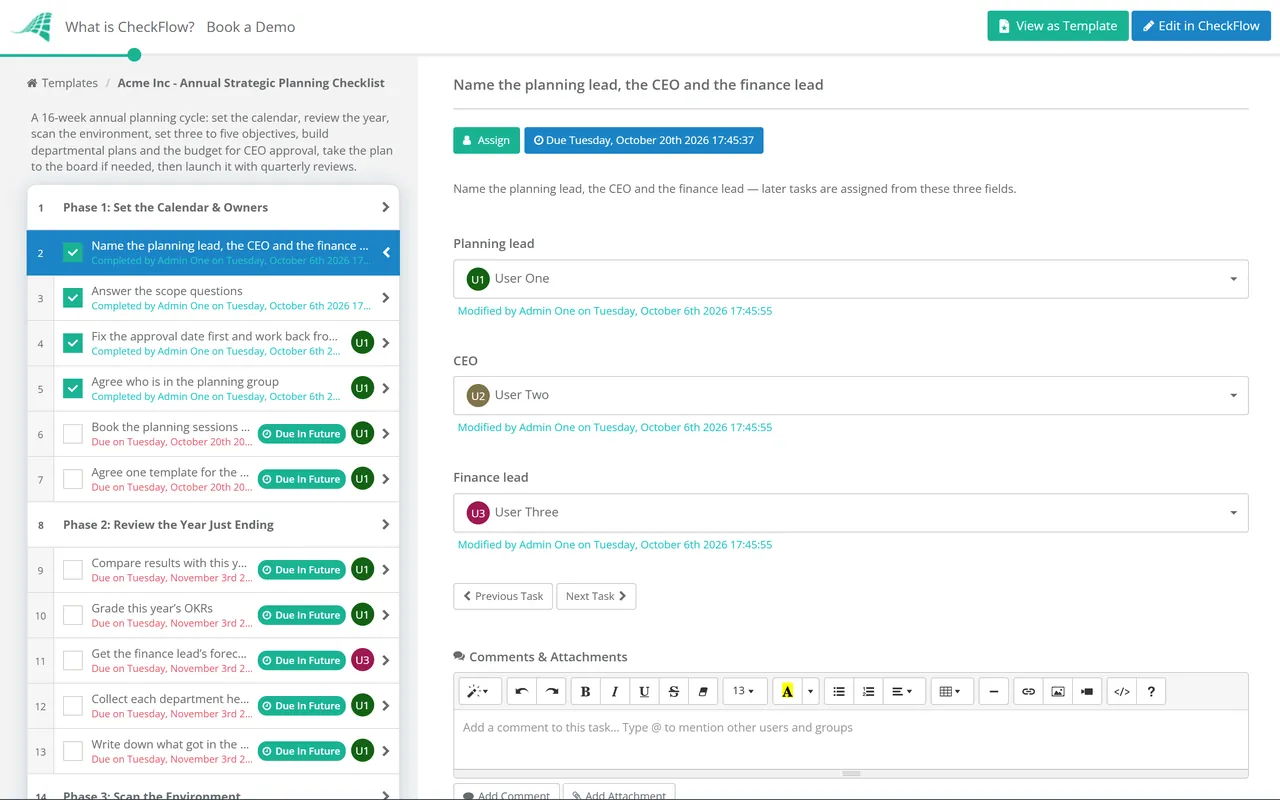
Seven phases run from setting the planning calendar to the first quarterly review. Phase 6 appears only when the plan needs board approval, and the OKR grading task in Phase 2 appears only when you set goals as OKRs.
Answer the two scope questions first. They decide whether the board phase and the OKR grading task appear.
The OKR grading task appears only when you set goals as OKRs.
Shown only when the scope answer is that the plan needs board approval.
This is a typical schedule for a small or mid-size company, not a rule. For a year starting on 1 January, week 16 falls in early to mid September, which is why planning cycles for a calendar year usually start in the third quarter. A smaller firm without a board can compress it to ten or twelve weeks; a group with several divisions may need longer. Fix the approval meeting first and move every block back from it.
The planning lead confirms the calendar, the planning group and the templates. Finance agrees how the budget timetable fits alongside.
Results against this year’s objectives, the full-year forecast, department reviews, and the customer, competitor and regulatory scan.
The leadership team revisits priorities, works through the SWOT and drafts the three to five objectives with their measures.
Departments write their plans against the objectives while finance builds the budget and headcount plan from them.
The leadership team tests the plans against capacity and the budget, cuts what does not fit, and the CEO approves the final draft.
The board pack goes out and the board approves the plan and budget, often at its last meeting before the year starts.
The plan is published and presented to staff, reporting is set up and the first quarterly review is in the diary.
The quarterly review is where the plan lives or dies. Each review asks the same questions: where each objective stands against its measures, what has changed in the market, what to stop, and whether any objective needs to change. Keep it short, keep the measures the same as the plan’s, and record decisions so next year’s review starts from them.
Keep the budget on the same clock. The most common failure is a budget that is finished before the objectives are agreed, so the money follows last year’s spending rather than this year’s plan. Let finance prepare the baseline and the assumptions during weeks 16 to 10, but hold departmental budget submissions until the objectives are drafted. If your budget calendar already runs to fixed dates, move the strategy workshop earlier rather than asking finance to wait.
Decide in the room what will stop. New objectives need people and time that are already committed to something. Before the workshop ends, list the projects and routine work that will pause or end to make room, and give each one an owner who tells the teams affected.
Every task has a due date offset from the start date, so starting the checklist in September produces the whole 16-week timetable. A recurring schedule starts next year’s cycle on the same date without anyone remembering to.
The plan and budget stop at an approval step until the CEO signs off, and the board phase and OKR grading appear only when they apply. Comments, attachments and history keep the review, the scan and the decisions together.
Run each quarterly review as its own recurring checklist assigned to the objective owners. Reports show which reviews are overdue and which actions from the last one are still open.
Annual planning connects to several other processes. Finance builds the numbers with the Annual Budget Planning Checklist, people leaders turn the strategy into a workforce plan with the HR Strategy Process Checklist, and any large investment the plan calls for should go through the Business Case Checklist before it is funded.
Strategic planning is one of the processes an operations team owns. Read what operations management covers, and see how CheckFlow for business process management runs planning, reviews and the work in between from one set of templates.
Describe the process in a sentence and the AI checklist generator drafts the phases and tasks for you.
About 16 weeks before the new year starts, so early to mid September for a company whose year begins on 1 January. That leaves time to review the year, scan the market, agree objectives, build departmental plans and a budget, and get approval before the year begins. Fix the date of the approval meeting first and count back from it. Smaller firms without a board can usually run the cycle in ten to twelve weeks.
A strategic plan sets direction for three to five years; an annual operating plan sets out what the business will do in the next twelve months to move along it. The strategic plan holds the mission, vision and strategic priorities and changes slowly. The operating plan holds a few objectives, their measures, the initiatives and the owners, and is reviewed every quarter. The budget then puts the operating plan into money and headcount.
Three to five is a sensible limit for the whole company. With more than that, objectives start competing for the same people and money, and nobody can say which comes first when they collide. Each objective should have one owner and a small number of measurable results. If a department needs more detail, it goes in the departmental plan, not in the company objectives. Writing down what you will not do this year helps keep the list short.
You can, but OKRs work best when the annual objectives are paired with key results that are set and graded each quarter. Andy Grove developed OKRs at Intel, and John Doerr, who learned them there in the 1970s, introduced them to Google in 1999. Google grades key results from 0.0 to 1.0, expects committed OKRs to reach 1.0, and treats an average of around 0.7 as success for aspirational ones. If you prefer KPIs with targets, the checklist works the same way.
The leadership team owns it, with a planning lead, often a chief of staff or operations lead, running the process. Finance builds the budget alongside it, department heads write their departmental plans, and the CEO approves the final draft. Where there is a board, it approves the plan and budget. Asking customer-facing staff for input during the review and scan usually improves the plan more than adding people to the strategy workshop.
14-day free trial, no card required. The Business plan is $10 per user per month after the trial. Full details at checkflow.io/pricing.
14-day free trial, no credit cardFull refund in your first 30 daysUS hosting, EU on request