A comprehensive event planning framework — from first objectives meeting to post-event debrief — with every moving part coordinated and nothing left to chance.
Successful events are not the product of inspired improvisation. They are the product of structured preparation that began months before the first attendee arrived — where venue contracts were signed before marketing launched, where AV was briefed with enough lead time to plan properly, where the speaker slides were received and reviewed before the event day, and where every vendor knew their call time and contact number. The event that looks effortless is the one that was most thoroughly planned. This free event planning checklist gives event planners, corporate event managers, and marketing teams a comprehensive framework for planning and executing any event — from a small internal workshop to a multi-day industry conference.
Why the Best Events Are the Most Thoroughly Planned
Events fail at the details. A speaker confirmed but not briefed on the AV setup. A venue contract signed without reading the service charge clause. A registration system live but not tested on mobile. A catering delivery window that conflicts with the venue access time. None of these are unforeseeable — they are the predictable consequences of planning processes that handle each workstream separately without a master framework that connects them.
The value of an event planning checklist is not that it reminds experienced planners of things they have forgotten. It is that it makes the dependencies visible — the decisions that cannot be made until other decisions are made, the tasks that cannot be started until other tasks are complete. Venue must be confirmed before marketing launches. Budget must be approved before deposits are paid. Speaker contracts must be signed before speakers are announced. A structured checklist with enforced phase sequencing prevents the cascade of problems that occur when these dependencies are violated under timeline pressure.
What the Event Planning Checklist Covers
This checklist covers eight phases of the event planning lifecycle — applicable to any event type, scaled for the size and complexity of your event.
Phase 1
Strategy, Objectives & Event Brief
Everything in event planning flows from the brief. A clear brief saves weeks of rework later. An unclear brief guarantees it.
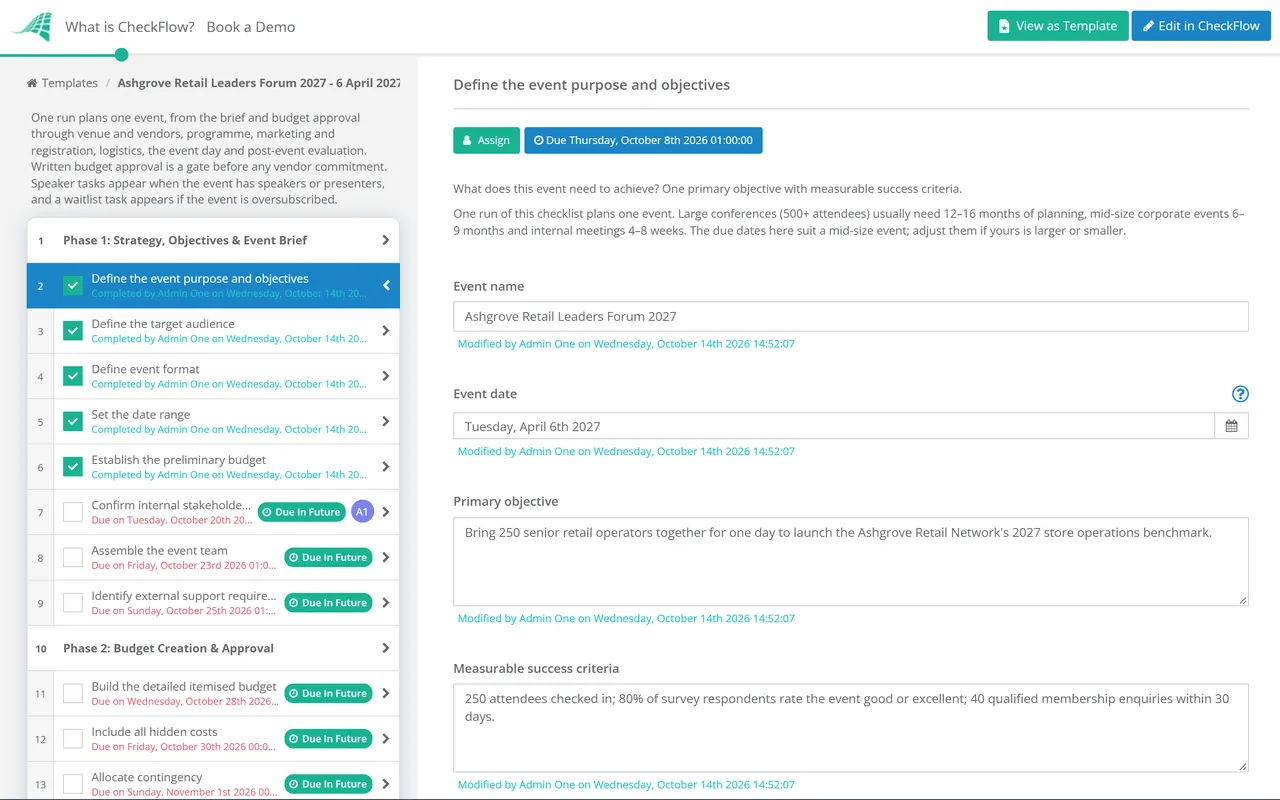
Define the event purpose and objectives — what does this event need to achieve? One primary objective with measurable success criteria
Define the target audience — who is this event for? A confirmed audience profile guides every subsequent decision
Define event format — in-person, virtual, hybrid; single or multi-day; conference, workshop, gala, product launch, or other
Set the date range — confirm against competitor events, holidays, and key stakeholder availability
Establish the preliminary budget — a realistic order of magnitude before detailed planning begins
Confirm internal stakeholder sign-off on the brief — all key decision-makers aligned before work begins
Assemble the event team — assign ownership for each workstream; confirm roles and escalation paths
Identify external support requirements — event agency, AV company, PR support, or other specialist partners
Phase 2
Budget Creation & Approval
Build the detailed itemised budget — all categories, fully costed with three quotes for major items
Include all hidden costs — service charges, Wi-Fi infrastructure, overtime provisions, insurance, permits, and post-event costs
Allocate contingency — 10–15% standard; confirm with the approving stakeholder
Submit for budget approval — through the appropriate multi-level approval process; with supporting documentation and ROI justification
Obtain written budget approval before any vendor commitments are made
Set up post-approval budget tracking — approved versus committed versus actual spend by category
Phase 3
Venue & Vendor Selection and Contracting
Venue must be confirmed and contracted before marketing launches. Nothing erodes trust faster than promoting an event date that subsequently changes because the venue was not secured.
Define venue requirements — capacity, location, AV capability, catering, accessibility, parking, and accommodation requirements
Issue the venue RFP — to a minimum of five venues; evaluate responses on defined criteria
Conduct site visits — at the same time of day as the event; with the AV and production teams
Negotiate and sign the venue contract — confirm all costs, cancellation terms, and vendor access conditions before signing
Secure all other key vendors — AV and production, catering, photography/videography, entertainment, printing, and any other required suppliers; contracts signed for all
Confirm all required permits and licences — music licence, alcohol licence, outdoor event permit as applicable
Phase 4
Programme Design & Speaker Coordination
Design the event programme — session structure, timing, breaks, and flow
Confirm and contract all speakers — signed agreements before public announcement
Collect speaker bios and headshots — minimum four weeks before the event
Set slide submission deadline — minimum five working days before the event
Confirm AV requirements for each session — briefed to the AV team with adequate lead time
Confirm session chairs and Q&A formats — briefed on their responsibilities
Phase 5
Marketing, Promotion & Registration
Build the event website or landing page
Open registrations — after venue and date are confirmed; test the registration journey end-to-end before launch
Launch the marketing campaign — email, social, paid, and PR channels; confirm UTM parameters on all links
Manage waitlist if the event is oversubscribed — a structured process for waitlist management
Send pre-event communications to registered attendees — confirmation email, logistical information, agenda, and reminder sequence
Confirm final attendance numbers for catering and seating — typically 7–10 days before the event
Phase 6
Logistics, Staffing & Pre-Event Preparation
Produce the event run-of-show — minute-by-minute schedule for event day, shared with all team members and vendors
Brief all event staff and volunteers — roles, responsibilities, arrival times, contact numbers, and escalation paths
Confirm all vendor arrival and setup times — coordinated with the venue access schedule
Confirm all AV and technical rehearsals — scheduled and completed before doors open
Prepare all event materials — name badges, programmes, signage, and any printed materials
Conduct venue walk-through — final check of all spaces, AV, catering setup, and signage the day before
Phase 7
Event Day Execution
Briefing call or meeting with the full team before doors open
Manage registration and check-in — staffed, tested, and with a contingency for system failure
Manage speakers on arrival — greeted, briefed, and AV tested before their session
Monitor event flow against the run-of-show — flag and address any deviations in real time
Manage attendee experience — queries, issues, and any unexpected situations
End-of-day wrap and team debrief — immediate observations documented while fresh; vendor departure confirmed
Phase 8
Post-Event Follow-Up & Evaluation
Send attendee thank-you and survey within 48 hours
Follow up with leads and VIP attendees
Distribute event content — recordings, slides, and highlights
Process speaker payments and final vendor invoices
Produce budget actuals report — actual versus approved spend
Calculate event ROI against defined KPIs
Run structured team debrief within one week
Archive all event documentation for future planning
Event planning involves venue, vendors, speakers, marketing, registration, logistics, and post-event — all running in parallel, all interdependent. CheckFlow’s grid dashboard shows every workstream’s status simultaneously. The event manager knows exactly what is complete, what is outstanding, and where the team needs to focus without convening a status meeting.

2
Enforce the planning sequence that prevents downstream problems
Venue confirmation must precede marketing launch. Budget approval must precede vendor commitments. Speaker contracts must be signed before speakers are announced. CheckFlow’s enforced task sequence prevents these dependencies from being violated under timeline pressure — protecting the event from the downstream problems that flow from premature commitments.
3
Build an event archive that improves every future event
Every completed task is timestamped. The full event record — objectives, budget, vendor decisions, planning timeline, and post-event evaluation — is archived in CheckFlow. The team planning next year’s event starts from evidence, not memory.
For events with recurring formats — annual conferences, quarterly briefings, monthly webinars — CheckFlow’s recurring checklist feature schedules each event cycle automatically, starting the same structured planning process for every instance. Learn more →
Large events involving multiple simultaneous workstreams and vendors benefit from the same multi-process visibility CheckFlow provides for teams managing complex multi-workstream operations. See multi-process visibility →
Eight phases: strategy and objectives, budget and approvals, venue and vendor selection, programme design and speaker coordination, marketing and registration, logistics and pre-event preparation, event day execution, and post-event follow-up and evaluation. The depth of each phase should be proportionate to event size: large conferences (500+ attendees) benefit from 12–16 months of structured planning; smaller workshops can execute the same framework in 4–6 weeks.
How far in advance should event planning begin?
+
Large industry conferences: 12–16 months. Mid-size corporate events (100–500 attendees): 6–9 months. Internal meetings and workshops: 4–8 weeks. The most time-sensitive early decisions are venue (popular dates fill 12 months out), keynote speakers (6–12 months), and sponsors (6–9 months). Marketing can begin once venue and date are confirmed — but not before.
What is a run-of-show and why is it essential?
+
A run-of-show (ROS) is the minute-by-minute schedule for the event day, shared with all team members, vendors, and staff. It specifies when each element starts and ends, who is responsible for each transition, what the AV cue is for each moment, and what the contingency is if anything runs late. It is essential because it replaces the need for constant real-time communication between team members on the day — everyone knows what is supposed to happen and when, without needing to ask.
What is the biggest risk in event planning?
+
The biggest single risk in event planning is premature commitment — making a vendor payment or marketing announcement before the dependencies that support it are in place. Announcing a date before the venue is confirmed, signing a catering contract before the budget is approved, or launching registrations before the event platform is tested. A structured checklist with phase-gated progression prevents premature commitments by making every dependency visible before the next phase can begin.
Is CheckFlow free for this template?
+
Yes — 14-day free trial, no card required. The Business plan is $10 per user per month after the trial. Full details at checkflow.io/pricing.
Plan Every Event From the Same Structured Framework
Free trial — no credit card required.
Do you like cookies? 🍪 We use cookies to ensure you get the best experience on our website. Learn more