Company Offsite Planning Checklist Template

Nobody agreed what the two days were for, the venue had no step-free access, and the decisions made over dinner were forgotten by Monday. A good offsite is planned like any other piece of work, with goals, owners and a follow-up.

Last reviewed: October 2026

This free company offsite planning checklist is for team leads, chiefs of staff, office managers and people teams who organise a team offsite or retreat. One run plans one internal offsite, from setup about twelve weeks before to the follow-up a few weeks after. It agrees the goals with the sponsor, the attendees and the dates, then shortlists venues and builds a budget that the sponsor approves before anything is booked, with finance approval when the budget is above their limit. It books the venue and catering, asks attendees what they need to take part without asking why, covers first aid and emergency contacts, and plans travel, the agenda, pre-reads and social time. After the day come the decisions and actions, a feedback survey, the budget reconciliation and deleting the personal information you collected. A hybrid format, an overnight stay, travel abroad, an external facilitator and alcohol at social events each add the tasks they need.

A Company Offsite Is Internal Work, Not a Client Event

A company offsite, or team retreat, takes a team away from its usual place of work for a day or two to do work that is hard to do apart: set a direction, solve a problem together or rebuild how people work with each other. It is an internal event. There are no tickets, sponsors or press, but the people attending are colleagues who have to travel, eat, sleep and take part, and the company is responsible for them while they do.

Offsites that disappoint usually fail in the same places. Nobody agreed what the time was for, so the agenda fills with updates. The venue looked good in photos but had no step-free access or Wi-Fi that worked. The social evening was built around a free bar. The decisions were never written down, so nothing changed on Monday. This checklist plans one offsite from the goals to the follow-up. A client or public event, with registration, marketing and sponsors, belongs in the Event Planning Checklist.

This checklist

The team offsite

For: one team or the leadership, away from the office for a day or two.

Planned around: goals the sponsor owns, the attendees’ needs, travel and the agenda.

Output: decisions and actions with owners, feedback and a reconciled budget.

External event

A client or public event

For: customers, prospects or the public, often hundreds of people.

Planned around: registration, marketing, speakers, sponsors and suppliers.

Output: attendance, leads and return on the spend, in the Event Planning Checklist.

Every week

The team’s usual rhythm

For: the same team, every week or month, in person or remotely.

Planned around: meetings, one-to-ones, recognition and social time.

Output: a team that stays connected between offsites, in the Remote Team Engagement Activities Checklist.

What the Company Offsite Planning Checklist Covers

Nine phases take one offsite from setup about twelve weeks before to the follow-up a few weeks after. The first task records whether it is hybrid, overnight or abroad, whether an external facilitator runs sessions, whether alcohol is served and whether the budget is above the sponsor’s limit, and each answer adds the tasks it needs. Nothing after the sponsor’s approval of the goals, budget and venue shortlist can be completed until it is given.

  1. Phase 1

    Phase 1: Goals, Attendees & Dates

    5 tasks

    Start about twelve weeks before the offsite. Answer the questions in the first task before anything else: they decide which travel, accommodation, facilitator, hybrid and alcohol tasks appear, and every due date counts from the day the offsite starts.

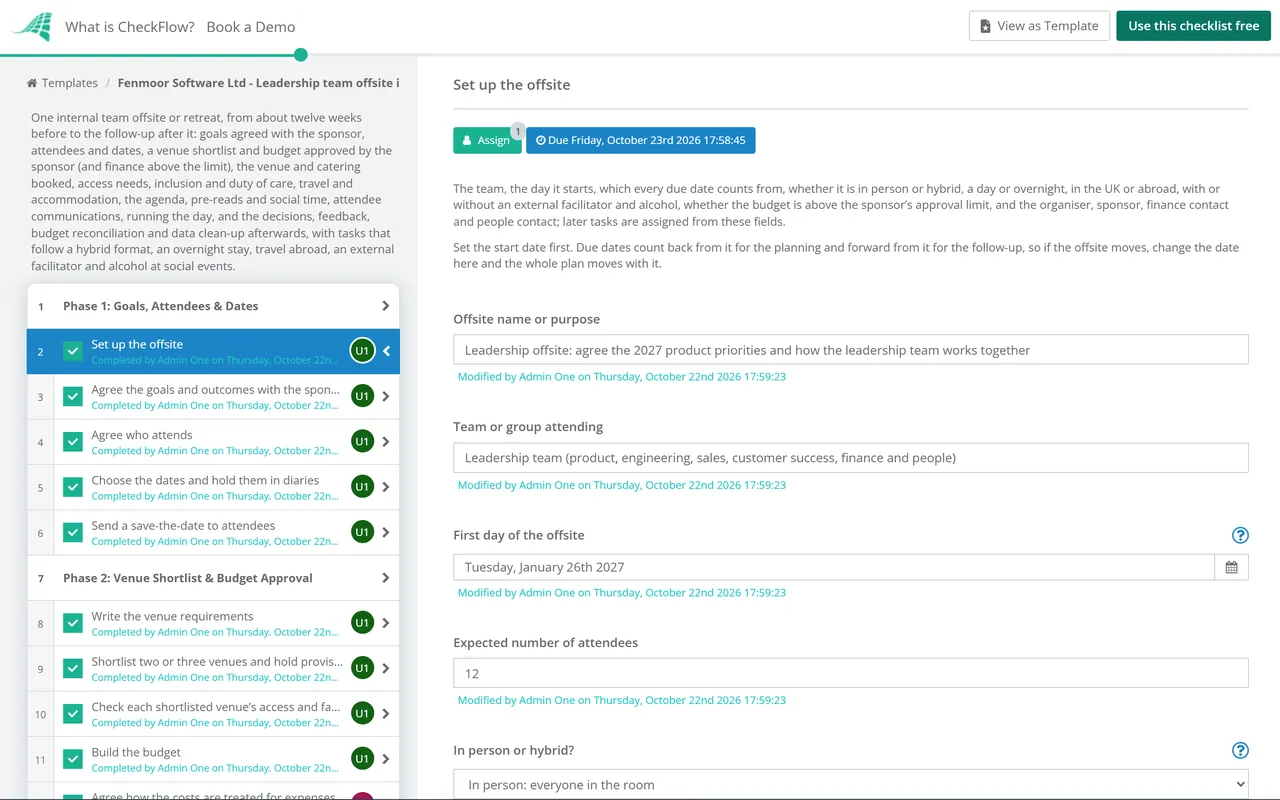
    • Set up the offsite — the team, the day it starts, which every due date counts from, whether it is in person or hybrid, a day or overnight, in the UK or abroad, with or without an external facilitator and alcohol, whether the budget is above the sponsor’s approval limit, and the organiser, sponsor, finance contact and people contact; later tasks are assigned from these fields
    • Agree the goals and outcomes with the sponsor — the two or three things the offsite must produce, such as a decision, a plan or a stronger working relationship, and how the sponsor will judge whether it worked
    • Agree who attends — the attendee list agreed with the sponsor, with each person’s role and where they will travel from, and anyone who joins for part of it only
    • Choose the dates and hold them in diaries — dates checked against public and school holidays, religious festivals, busy periods and the key people’s diaries, then held as a calendar invitation
    • Send a save-the-date to attendees — the dates, the area, the purpose and whether it is overnight, so people can arrange childcare, cover and travel early
  2. Phase 2

    Phase 2: Venue Shortlist & Budget Approval

    7 tasks

    Shortlist venues and price the offsite before anything is booked. The sponsor approves the goals, the budget and the shortlist, and nothing after that step can be completed until they do. A budget above the sponsor’s limit adds a finance approval first.

    • Write the venue requirements — a main room for the whole group, breakout rooms, step-free access, Wi-Fi that copes with everyone at once, catering for every dietary need, a reasonable journey for attendees and, if overnight, enough bedrooms on site or close by
    • Shortlist two or three venues and hold provisional dates — venues that meet the requirements, each holding the dates provisionally without a deposit, with the date the hold expires
    • Check each shortlisted venue’s access and facilities — by a visit or a video tour: step-free routes, lifts, accessible toilets and bedrooms, a hearing loop, a quiet room, natural light, the Wi-Fi speed in the main room and where people can go outside
    • Build the budget — venue hire, catering, accommodation, travel, the facilitator, activities, materials and a contingency, from the venues’ quotes rather than guesses
    • Agree how the costs are treated for expenses and tax — which costs the company pays directly, what attendees claim back under the expenses policy, and how any social event, dinner or activity is treated for tax
    • Get finance approval for the budget — shown when the budget is above the sponsor’s approval limit: finance approves the total and the contingency before the sponsor signs off the plan
    • Sponsor approves the goals, budget and venue shortlist — Approved, Approved with changes or Not approved, based on the goals, the attendee list, the budget and the shortlist; nothing is booked until it is recorded
  3. Phase 3

    Phase 3: Book the Venue & Facilitator

    7 tasks

    Book the venue the sponsor approved and settle the details while there is still time to change them. An external facilitator adds two tasks, and a hybrid offsite adds the set-up for people joining remotely.

    • Book the venue and check the contract — the rooms, timings, catering, equipment and Wi-Fi in writing, the deposit, the minimum numbers, the date final numbers are due and the cancellation terms, then release the other venues’ holds
    • Agree the facilitator’s scope and fee — shown when an external facilitator runs sessions: the sessions they run, the preparation calls, the fee and expenses, the cancellation terms and who owns the materials afterwards
    • Brief the external facilitator — shown when an external facilitator runs sessions: the goals, who is attending and what is going on in the team, topics to handle with care, and the outputs the sponsor expects
    • Confirm the room layouts and equipment — how the main room is set out, the breakout rooms, screens and connectors, microphones, flip charts and pens, and when you can get in to set up
    • Agree the catering and how dietary needs are handled — meal and break times, the menus, how each special meal is labelled or served to the right person, and allergen information for every dish
    • Confirm the venue’s first aid and emergency arrangements — a first aider on site during your hours, the fire alarm test times and assembly point, how people with access needs are helped out in an emergency, the nearest hospital, and the duty manager’s number
    • Set up the connection for people joining remotely — shown for a hybrid offsite: a camera and microphones that cover the room, a screen showing the remote attendees, a host in the room who speaks for them, and a test call over the venue’s Wi-Fi
  4. Phase 4

    Phase 4: Accessibility, Inclusion & Duty of Care

    6 tasks

    Ask every attendee what they need to take part, early enough for the venue and the agenda to change. The people contact keeps the answers private and shares only what others must act on, and names who to call if something goes wrong.

    • Ask attendees what they need to take part — access needs, dietary needs and allergies, caring responsibilities, faith or prayer times, travel limits and, if overnight, room needs, asked the same way of everyone
    • Pass on access and dietary needs to the venue — only what the venue must act on, such as an accessible bedroom or a nut-free meal, without names where a room or table number will do, and a check that each need can be met
    • Check activities are open to everyone and run safely — social and team activities that everyone can join or a real alternative for those who cannot, and for physical or outdoor activities the provider’s risk assessment and insurance
    • Check the agenda works for everyone — start and finish times that suit people travelling or with caring responsibilities, regular breaks, quiet time, prayer times and social time that is not all built around a bar
    • Name the emergency contact and collect attendees’ emergency contacts — one person reachable throughout the offsite, including overnight, and each attendee’s own emergency contact, held by the people contact only
    • Share the safety arrangements with attendees — the emergency contact’s number, the venue’s first aid and fire arrangements, how to raise a concern during the offsite, and a reminder that the usual conduct policies apply
  5. Phase 5

    Phase 5: Travel & Accommodation

    6 tasks

    Plan how everyone gets there and back within the travel policy. Overnight stays add the bedroom booking, and travel abroad adds entry requirements and travel insurance.

    • Plan how everyone gets there — the journey from each place people travel from, public transport, car shares, parking and accessible transport, and a start time that lets people travel on the day if they need to
    • Check passports, visas and entry requirements — shown when anyone travels abroad: the FCDO travel advice for the country, passports valid for the whole trip, any visa or electronic travel authorisation, and anyone who needs more time to get one
    • Book travel — through the company’s travel process and within the travel policy, with tickets and times sent to each traveller
    • Book bedrooms and send the rooming list — shown for an overnight offsite: a room for each person who needs one, accessible rooms where asked, check-in and check-out times, and which extras the company pays for
    • Arrange travel insurance for everyone travelling abroad — shown when anyone travels abroad: the company’s business travel policy checked to cover every traveller, the activities planned and any pre-existing condition, and the policy number and emergency line sent to each traveller
    • Put every itinerary in one place — each person’s travel and accommodation, so the organiser and the emergency contact can see who is arriving when and from where
  6. Phase 6

    Phase 6: Agenda, Pre-Reads & Social Time

    6 tasks

    Build the agenda from the goals. Every session needs an owner and a reason to be in the room, and the social time is part of the plan, not what is left over. Alcohol at social events adds a task to agree sensible limits.

    • Draft the agenda against the goals — each session tied to a goal, with its time, its format (discussion, workshop, decision or briefing) and the output it should produce
    • Give each session an owner — one person who prepares it, runs it or briefs the facilitator, and records what it decided
    • Plan the social time and free time — a shared meal or activity everyone can join, some unplanned time, and time to rest or catch up with work and home
    • Agree sensible limits for alcohol at social events — shown when alcohol is served: good soft drinks and food alongside it, a set limit or finish time for any bar tab, no drinking games or pressure to drink, and a safe way back to the hotel or home
    • Sponsor reviews the agenda — the sessions, owners and timings checked against the goals, and anything to add, cut or move agreed
    • Send the pre-reads — short papers sent at least a week ahead, each with the question attendees should come ready to answer
  7. Phase 7

    Phase 7: Communications to Attendees

    4 tasks

    Tell attendees what they need to know once, clearly and in good time. Confirm final numbers by the venue’s deadline, and make sure everyone who runs a session knows the plan.

    • Send the joining instructions — the venue address and how to get there, start and finish times, what to wear and bring, the Wi-Fi, accessibility information and who to contact
    • Confirm final numbers with the venue — attendees, the dietary list and any room changes, by the deadline in the venue contract
    • Send the final agenda — the agenda with times, rooms and session owners, and a reminder of the pre-reads
    • Brief the session owners — a short call with everyone running a session, the facilitator if there is one and the venue contact, to walk through the running order and who does what
  8. Phase 8

    Phase 8: Running the Offsite

    6 tasks

    On the day the plan is in place, so the organiser’s job is to keep it on time, look after people and capture what is decided. A hybrid offsite adds a task to look after people joining remotely.

    • Arrive early and check the rooms, equipment and Wi-Fi — the room layout, screens, microphones, the remote connection if there is one, signage, name badges and refreshments, before the first attendee arrives
    • Welcome attendees and run through the day — the goals, the agenda, the fire exits and first aid, the emergency contact and how people can raise a concern or step out
    • Look after the people joining remotely — shown for a hybrid offsite: the host in the room brings remote attendees in to every discussion, checks they can hear and see, and shares the boards and notes with them
    • Keep sessions to time and record decisions and actions — each decision and each action with an owner and a date, recorded as it is agreed, not reconstructed afterwards
    • Check in with the venue at each break — catering, room temperature, timings and anything an attendee has asked for
    • Close with the agreed outcomes and next steps — the sponsor sums up what was decided against the goals, who owns each action and when people will hear more
  9. Phase 9

    Phase 9: Follow-Up & Budget Reconciliation

    6 tasks

    The offsite only pays off if the decisions turn into work. Share them while they are fresh, ask attendees what to change next time, reconcile the budget and delete the personal information you collected.

    • Share the decisions and actions within two working days — to every attendee and to anyone who needs to know, with owners and dates, and the actions added to the team’s usual tracker
    • Send the feedback survey — a few questions on whether the goals were met, the sessions, the venue, travel, food, access and the social time, with room for comments
    • Review the outcomes and feedback with the sponsor — whether each goal was met, the feedback themes, progress on the actions and whether to hold another offsite
    • Record the lessons for the next offsite — what to keep and change: the venue, the timing, the agenda format, the communications and this checklist
    • Reconcile the budget — every invoice and expense claim against the approved budget, with the reason for each difference, and any refunds or credits from the venue
    • Delete the personal information you no longer need — access and dietary needs, emergency contacts, passport and travel details and the rooming list, deleted from inboxes, spreadsheets and shared folders, and from the venue and travel agent where you can ask

What to Ask Attendees Before an Offsite

Phase 4 asks every attendee what they need to take part. Ask everyone the same questions in the same way, early enough for the venue and the agenda to change, and make it clear that nobody has to explain a need or name a condition. The table is a starting point.

Topic What to ask Who needs to know What not to do
AccessAnything you need to get to, into and around the venue and the sessions, such as step-free routes, a hearing loop, seating or extra breaksThe venue, for the rooms and routes; the organiser, for the agendaAsk for a diagnosis or proof
Food and allergiesDietary needs and allergies, and how severe an allergy is if the kitchen needs to knowThe venue’s catering team, by table or place rather than by name where possibleRely on people telling the waiter on the day
Caring and travelTimes you cannot travel or must leave by, and whether an overnight stay is a problemThe organiser, for start and finish times and the travel planAssume everyone can stay late or arrive the night before
Faith and culturePrayer times, fasting or festivals that fall on the dates, and food that meets your needsThe organiser and the venueSchedule the social time only around a bar
Rooms (overnight)An accessible room, a room near the lift, or anything else about the roomThe venue, through the rooming listAsk people to share a room without asking first
Emergency contactWho to call if something happens to you during the offsiteThe people contact onlyLeave the list in a shared folder after the event
Anything elseAnything else that would help you take part fullyWhoever must act on it, and nobody elseShare an answer more widely than it needs to go

Keep the answers private. The ICO, the UK data protection regulator, says health data covers any information that reveals something about a person’s health, including injury and disability, and it is special category data under UK data protection law. An allergy or an access need can be health data. Collect only what the venue and the organisers must act on, share it only with them, and delete it after the offsite. Phase 9 has a task for that.

Duty of care. An offsite is work. In Great Britain, section 2 of the Health and Safety at Work etc. Act 1974 puts a duty on every employer to ensure, so far as is reasonably practicable, the health, safety and welfare at work of all its employees. In practice that means knowing the venue’s first aid and emergency arrangements, naming an emergency contact who can be reached throughout, checking that outdoor or physical activities are run safely, and, for travel abroad, following the Foreign, Commonwealth & Development Office’s travel advice and making sure everyone has appropriate travel insurance. Outside Great Britain, check the rules that apply to your employees with your HR or legal adviser.

Why Plan Offsites in CheckFlow?

1

A plan that moves with the date

Enter the first day of the offsite and every task falls due a set number of working days before or after it, from the goals about twelve weeks out to the budget reconciliation three weeks after. If the date moves, change it once and the whole plan follows. Tasks are assigned from the four people named in the first task, and the Tasks Grid shows each of them what is due. Run it on a recurring schedule for an annual leadership offsite.

2

Only the tasks this offsite needs

Hybrid adds the remote set-up and a host for people joining online. Overnight adds the bedrooms and rooming list, travel abroad adds entry requirements and travel insurance, an external facilitator adds the contract and briefing, and alcohol at social events adds a task to agree sensible limits. Change an answer and the tasks follow.

3

Nothing booked before it is approved

The sponsor approves the goals, the budget and the venue shortlist, with a finance approval first when the budget is above their limit. That step halts the checklist, so no venue, travel or facilitator is booked until the decision is recorded. See how approvals that halt a checklist work.

CheckFlow does not book venues, travel or hotels, and it does not send surveys or hold attendees’ answers for you. It keeps the offsite plan in one place: who does what and by when, the approvals, the decisions and actions on the tasks they came from, and a record of what was done, so the next offsite starts from this one. The checklist view shows the whole plan to everyone involved.

Planning a client or public event? Use the Event Planning Checklist, with the Venue Booking Process Checklist for the contract and the Event Budget Approval Checklist for a larger budget. Set the year’s direction before a leadership offsite with the Annual Strategic Planning Checklist, and keep a remote team connected between offsites with the Remote Team Engagement Activities Checklist and the Virtual Meeting Best Practices Checklist.

AI generator

Didn’t find what you need? Describe it.

Describe the process in a sentence and the AI checklist generator drafts the phases and tasks for you.

Frequently Asked Questions

What should a company offsite checklist include?

Goals agreed with the sponsor and how they will be judged; the attendee list and dates; venue requirements, a shortlist and a budget approved before anything is booked; the venue contract, room layouts and catering; what attendees need to take part, asked privately; first aid, emergency contacts and, for travel abroad, entry requirements and travel insurance; travel and accommodation; an agenda with an owner for every session, pre-reads and social time; joining instructions and final numbers; running the day and recording decisions; and the follow-up: decisions shared, a feedback survey, the budget reconciled and personal information deleted.

How far in advance should you plan a team offsite?

This checklist starts about twelve weeks, or sixty working days, before the first day. That leaves time to agree goals, hold venues, get the budget approved, book travel and give attendees time to arrange childcare and cover. A small day offsite near the office can be planned in less; a large overnight offsite abroad may need longer, especially if anyone needs a visa. The due dates count back from the start date you enter, so you can see at once whether the time is realistic.

How do you set goals for a company offsite or team retreat?

Agree two or three outcomes with the sponsor before anything else, such as a decision on next year’s priorities, a plan for a problem the team keeps meeting, or better working relationships after a reorganisation. For each, agree how you will know it worked. Then build every session from a goal. If a goal could be met by an ordinary meeting or a video call, it probably does not need the offsite. The goals also make the follow-up easy: the sponsor reviews each one afterwards.

How do you make an offsite accessible and inclusive?

Ask every attendee the same questions early: access needs, dietary needs and allergies, caring responsibilities and travel limits, faith or prayer times and, if overnight, room needs. Ask what people need, not why, and never ask for a diagnosis. Check the venue in person or by video for step-free routes, accessible toilets and bedrooms and a quiet room. Set start and finish times people can manage, plan social time that everyone can join without a drink in hand, and keep the answers private.

What duty of care does an employer have at a company offsite?

An offsite is work. In Great Britain, section 2 of the Health and Safety at Work etc. Act 1974 puts a duty on every employer to ensure, so far as is reasonably practicable, the health, safety and welfare at work of its employees. In practice: know the venue’s first aid and emergency arrangements, name an emergency contact reachable throughout, check activity providers’ safety arrangements, and remind people that the usual conduct policies apply. For travel abroad, the FCDO advises appropriate travel insurance before travel. Elsewhere, check with your HR or legal adviser.

Does the £150 annual party exemption cover a team offsite?

Usually not for one team. HMRC’s exemption covers an annual party or similar annual function that is available to employees generally, or to all employees at one location, costing no more than £150 a head in the tax year, including VAT and any transport or accommodation provided to attend. HMRC’s own example says a party open only to directors is not covered. A dinner for one team or for the leadership is therefore outside it. Ask your finance team how the social parts of your offsite are treated. This applies to UK employers only.

Should you serve alcohol at a team offsite?

That is your company’s choice, and the first task asks the question so the plan can follow it. If you do, agree sensible limits in advance: good soft drinks and food alongside it, a set limit or finish time for any bar tab, no drinking games or pressure to drink, and a safe way back to the hotel or home. Make sure the social time does not depend on drinking, and remind everyone that conduct and harassment policies still apply at dinner and in the bar.

How is a company offsite different from other events?

An offsite is internal: colleagues, a small number of people and goals that belong to the team, with no registration, marketing or sponsors. Most of the planning goes on the goals, the attendees’ needs, travel and the agenda. A client or public event is planned around registration, promotion, speakers and return on the spend; use the Event Planning Checklist for that. Many teams use “offsite” and “retreat” for the same thing, and this checklist works for both.

Is CheckFlow free for this template?

14-day free trial, no card required. The Business plan is $10 per user per month after the trial. Full details at checkflow.io/pricing.

Plan Every Offsite From Goals to Follow-Up

Free trial — no credit card required.

14-day free trial, no credit cardFull refund in your first 30 daysUS hosting, EU on request