
Conference Speaker Coordination Checklist Template

A structured speaker management process — from first outreach to post-event thank you — with nothing left to email threads and memory.

Speaker coordination is one of the highest-risk elements of any conference. A speaker who receives their AV requirements form two days before the event, whose travel has not been booked, who never received a final schedule, or who does not know where to go when they arrive is a speaker whose experience will affect their performance — and whose audience will notice. With multiple speakers across multiple sessions, the complexity multiplies. A structured speaker coordination process assigns every task to a named owner, ensures every speaker receives every communication at the right time, and gives the conference team visibility across the entire speaker roster simultaneously. This free checklist covers the full speaker coordination lifecycle for conferences and events of any size.

Use This Template Free See Live Example
No Credit Card Required

Why Speaker Coordination Fails Without a Structured Process

Speaker coordination failure is almost always a process failure, not a people failure. Event teams are managing venues, sponsors, catering, registration, and marketing simultaneously — and speaker coordination gets handled by email threads that are easy to miss, spreadsheets that go out of date, and informal reminders that depend on individual memory. A speaker who does not receive their briefing pack, whose dietary requirement was not passed to catering, or whose slide deadline was never confirmed is the product of this environment.

A checklist-driven speaker coordination process gives each speaker the same quality of management regardless of who is handling them, makes the status of every speaker visible in one place, and ensures the right information travels in both directions — from the organiser to the speaker, and from the speaker to the AV, logistics, and content teams.

What the Conference Speaker Coordination Checklist Covers

This checklist covers seven phases of speaker coordination — from identification and outreach through to post-event follow-up — for each speaker at the conference.

Phase 1

Speaker Identification & Programme Planning

Programme planning and speaker selection must happen before outreach begins. A speaker approached without a clear brief about the session, audience, and format will deliver unclear commitments that cause problems later.

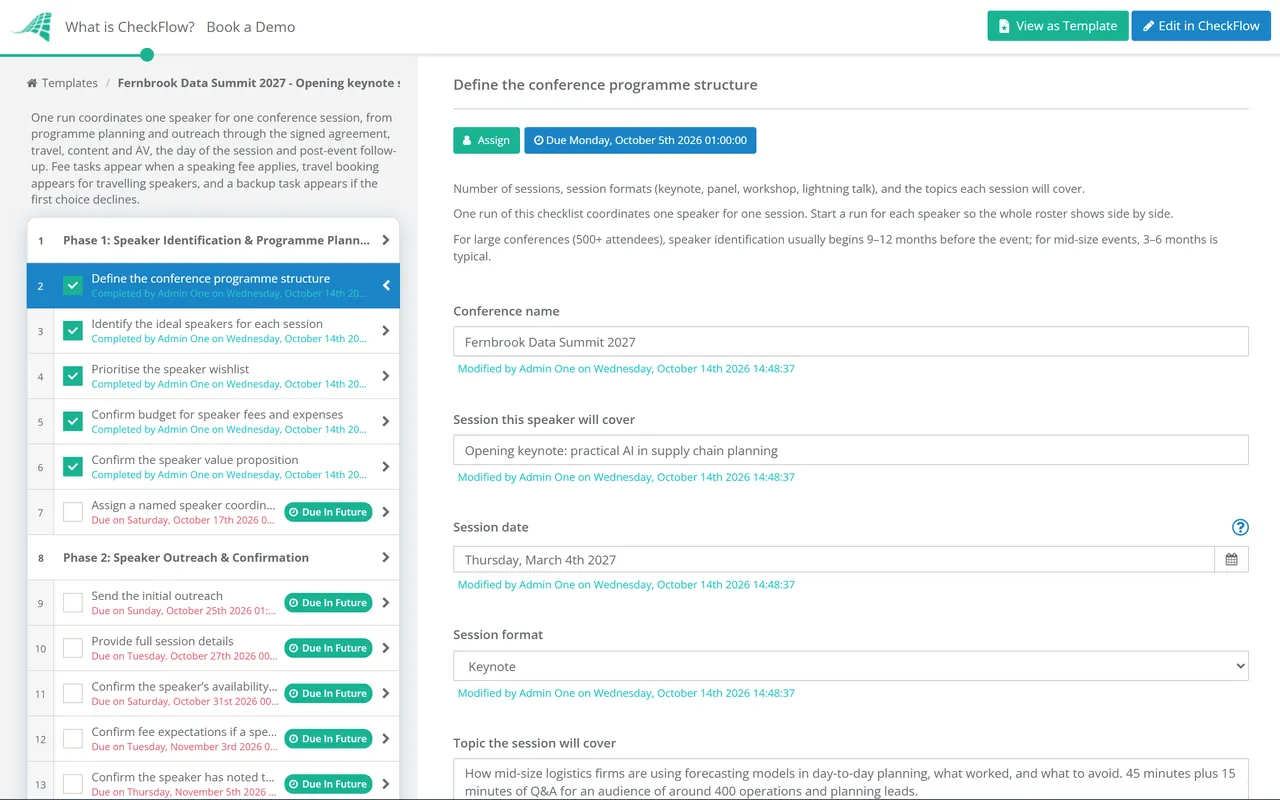
  • Define the conference programme structure — number of sessions, session formats (keynote, panel, workshop, lightning talk), and the topics each session will cover
  • Identify the ideal speakers for each session — subject matter expertise, audience fit, profile, and ability to present effectively to the conference audience
  • Prioritise the speaker wishlist — first choice and backup options for each session; popular speakers book up quickly for peak conference seasons
  • Confirm budget for speaker fees and expenses — speaking fees (where applicable), travel, accommodation, and any other expenses covered by the organiser
  • Confirm the speaker value proposition — what does the speaker gain from participating? Exposure, network access, fee, or portfolio building? Be clear about this in the outreach
  • Assign a named speaker coordinator for each speaker — a single point of contact from the organising team for each speaker
Phase 2

Speaker Outreach & Confirmation

  • Send the initial outreach — a personalised, specific invitation explaining the event, the session, the audience, and what is being asked of the speaker
  • Provide full session details — topic, format, duration, date, time, audience profile, and any specific requirements or constraints for the session
  • Confirm the speaker’s availability and interest — receive a clear yes or no before progressing to agreement stage
  • Confirm fee expectations if a speaking fee applies — agree the rate and payment terms before drafting the agreement
  • Move to backup speaker promptly if first choice declines — do not leave sessions unconfirmed while waiting for a slow response
  • Confirm the speaker has noted the date and added it to their calendar
  • Record confirmed speakers in the speaker tracker — name, session, status, and coordinator assigned
Phase 3

Speaker Agreement & Legal Documentation

  • Issue a speaker agreement or contract — covering session title, date, time, duration, format, fee (if applicable), expenses covered, cancellation terms, and any content rights
  • Confirm IP and recording rights — will the session be recorded? Will it be published or shared after the event? Confirm the speaker has agreed in writing
  • Obtain signed agreement before announcing the speaker publicly — announcing before confirmation creates reputational risk if the speaker withdraws
  • Collect invoicing details for fee-bearing speakers — company name, address, and payment information; confirm payment timeline
  • Confirm the speaker has received and acknowledged all key terms
Phase 4

Logistics, Travel & Accommodation

  • Confirm whether the speaker requires travel and accommodation — local versus travelling speakers have different needs
  • Collect travel preferences — preferred airline, class of travel, loyalty programme numbers, and any travel constraints
  • Book travel and accommodation — within the agreed budget; send itinerary to the speaker with sufficient lead time
  • Collect dietary requirements and accessibility needs — pass to catering and venue teams promptly
  • Confirm arrival logistics — where to go on arrival, who to ask for, green room or speaker preparation area location, and a named contact
  • Confirm speaker fee payment timeline — invoice raised, approval obtained, and payment scheduled for the agreed date
  • Confirm any specific requirements beyond standard — childcare, personal assistant support, medical needs, or any other request
Phase 5

Content Preparation & AV Requirements

Content and AV requirements collected too close to the event create last-minute scrambles. Set deadlines with enough lead time to review, request changes, and test.

  • Send the speaker briefing pack — session overview, audience profile, format guidance, AV specifications, presentation template (if provided), and key dates
  • Collect bio and headshot for marketing and programme materials — set a clear deadline at least four weeks before the event
  • Confirm presentation format and AV requirements — slide format, video or audio assets, demos, or special equipment needed
  • Set and chase the slide submission deadline — minimum five working days before the event to allow AV team review and testing
  • Review submitted slides for content and format compliance — branding, timing, and any sensitive content that requires review
  • Confirm the Q&A format and any panel introductions — who introduces each speaker, how Q&A will be managed, and time allocations
Phase 6

Day-of Speaker Management

  • Send a detailed day-of briefing 24 hours before — exact schedule, room location, green room details, AV contact, and any changes since the last communication
  • Confirm speaker has arrived or is on track to arrive — proactive check-in on the morning of the session, not when they are due on stage
  • Welcome and brief each speaker on arrival — introduce to the AV team, confirm the schedule and any final changes, and address any questions
  • Conduct a technical run-through — slide load test, microphone check, and any demo or video confirmation
  • Assign a named minder or liaison for each speaker on the day — someone who is responsible for the speaker’s experience throughout the event
  • Manage time on stage — a session chair or timer ensures speakers stay within allocated time; brief chairs on the cut-off protocol
  • Manage any day-of issues — no-shows, technical failures, or last-minute changes; confirm the contingency plan is documented and known to the team
Phase 7

Post-Event Speaker Follow-Up

  • Send a personalised thank-you to every speaker — within 48 hours of the event; specific to their contribution, not a generic template
  • Process speaker fee payment if not already paid — confirm payment has been made and the speaker has been notified
  • Share any session recordings, photos, or materials as agreed — provide links to recordings, edited photos, and any post-event content featuring the speaker
  • Collect speaker feedback on the experience — a brief survey or personal message asking about their experience as a speaker
  • Add outstanding speakers to the future speaker pipeline — speakers who performed well are valuable for future events
  • Update the speaker database — contact details, session performance notes, and willingness to participate in future events

Available as a free, runnable template in CheckFlow — with tasks assigned per speaker across coordinator, AV, logistics, and content teams, every speaker’s status visible from a single dashboard, and a documented record of every coordination step.

Use This Template Free

The Five Most Common Speaker Coordination Failures — All Preventable

Missing bio and headshot deadline

Programme materials go to print without the speaker’s photo, or marketing is delayed while the team chases assets.

Prevention: A fixed deadline in the speaker briefing pack, with a systematic chase process that starts before the deadline is missed.

Slides received on event day

No time for AV review, no time to fix formatting errors, no time to load and test. The session starts with a technical delay.

Prevention: A firm slide submission deadline of at least five working days before the event, enforced.

Travel not booked for travelling speakers

The coordinator assumed the speaker had booked their own travel; the speaker assumed it was being arranged. Neither happened.

Prevention: Explicit confirmation in the speaker agreement of who books travel, with a tracking task in the coordination checklist.

Speaker arrives to an empty green room with no contact

No greeter, no AV check, no briefing on the day’s schedule. The speaker’s confidence is dented before they go on stage.

Prevention: A named day-of liaison for every speaker, briefed and in position before the first speaker arrives.

No post-event follow-up

A strong speaker who had a positive experience hears nothing for weeks. When asked to speak again, their first instinct is hesitation.

Prevention: A 48-hour thank-you task in the coordination checklist that cannot be skipped.

Why Run Speaker Coordination in CheckFlow?

1

See every speaker’s status at once

Conference coordinators managing eight speakers across fifteen sessions need a single view showing exactly which speakers have signed agreements, submitted bios, confirmed travel, and sent slides — and which have not. CheckFlow’s grid shows every speaker’s coordination status simultaneously, so the team knows exactly where to focus attention without opening twelve email chains.


2

Run the same process for every speaker regardless of profile

Keynote speakers and breakout session presenters receive different levels of attention in most events. Both deserve the same quality of coordination. CheckFlow runs the same structured process for every speaker — ensuring every speaker receives every communication and every task is completed, regardless of who is managing the relationship.

3

A complete speaker record for post-event and future events

Every coordination task completed is logged with a timestamp. The full speaker record — agreement terms, content submissions, logistics arranged, and post-event feedback — is archived in CheckFlow. When planning next year’s conference, the record of which speakers were outstanding and which caused coordination challenges is already there.

Speaker coordination is one workstream within a broader event planning process. CheckFlow’s Event Planning Checklist covers the full conference lifecycle — with speaker coordination as one structured phase within the master planning framework. See the Event Planning Checklist →

For events running a recurring speaker series — monthly webinars, quarterly briefings, or annual conferences — CheckFlow’s recurring checklist feature starts a fresh speaker coordination process automatically for each event cycle. Learn more about recurring checklists →

Frequently Asked Questions

What does speaker coordination involve?

+

Speaker coordination covers the full lifecycle of managing a conference speaker: identifying and confirming the right speakers for each session, issuing and collecting signed speaker agreements, arranging travel and accommodation for travelling speakers, collecting bios and headshots for marketing materials, managing slide and content submission deadlines, briefing the AV team on technical requirements, managing the speaker’s experience on the event day, and following up with personalised thank-yous and fee payment after the event. For events with multiple speakers, all of these workstreams run simultaneously across a roster of individuals — making structured coordination essential rather than aspirational.

How far in advance should speaker coordination begin?

+

For large conferences (500+ attendees), speaker identification should begin 9–12 months before the event, with outreach at least 6 months out. For mid-size events, 3–6 months is typical. Keynote speakers for major industry conferences are often booked 12 months in advance. Marketing assets (bio, headshot) should be requested at least 8 weeks before the event. Slides should be due at least 5 working days before the event. Travel and accommodation should be arranged at least 4–6 weeks out for international speakers, and 2–4 weeks for domestic.

What should a speaker agreement cover?

+

A speaker agreement should cover: session details (title, date, time, duration, format), speaker fee and payment terms (if applicable), expenses covered by the organiser and the process for claiming them, cancellation terms for both parties, recording and intellectual property rights (will the session be recorded and where will it be published), content review rights (does the organiser have any right to review or approve the content), and any exclusivity provisions (restrictions on speaking at competing events around the same period). Both parties should sign before the speaker is announced publicly.

How do you manage a speaker who cancels close to the event?

+

Cancellation risk is managed through three practices: maintaining a waitlist of backup speakers for each session type, building cancellation terms into the speaker agreement (which may include partial fee retention or replacement obligations), and confirming the event programme has contingency formats (panel discussions can be expanded to replace a cancelled solo session, for example). When a late cancellation occurs, communicate to the attendees transparently and promptly — a well-managed cancellation communicated clearly is far less damaging than a gap on the day that surprises attendees.

Is CheckFlow free for this template?

+

Yes — 14-day free trial, no card required. The Business plan is $10 per user per month after the trial. Full details at checkflow.io/pricing.

Manage Every Speaker With the Same Quality of Coordination

Free trial — no credit card required.