Two sign-offs nobody can skip
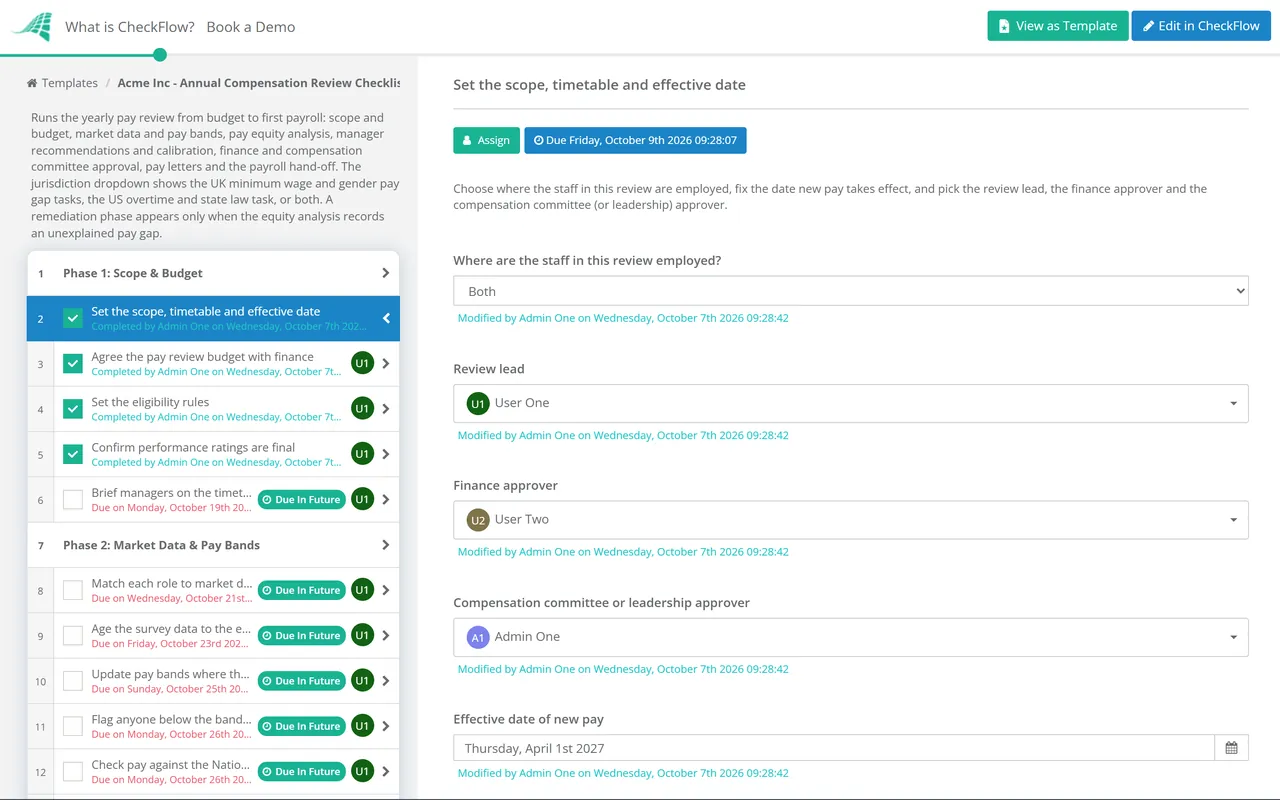
Finance and the compensation committee each get an approval task assigned to the person picked at the start. The checklist halts until they decide, so no letter goes out on figures that were never approved.
This free annual compensation review checklist runs the yearly pay review from setting the budget to the first payslip at the new rates. It covers market data, pay bands, a pay equity analysis, manager recommendations, calibration, sign-off by finance and the compensation committee, pay letters and the hand-off to payroll. A jurisdiction question at the start adds the UK minimum wage and gender pay gap checks, the US overtime and state pay checks, or both. If the equity analysis finds a gap nobody can explain, a remediation phase appears.
An annual compensation review is the once-a-year decision on everyone’s pay. Finance sets how much the organisation can afford, HR checks where pay sits against the market and against each other, managers propose increases, and leadership approves the result. Each step depends on the one before it, and the review usually runs to a fixed date when the new pay must start.
The common failures are about order, not effort. Managers are asked for recommendations before the bands are updated, so they anchor on last year’s numbers. Exceptions are agreed in side conversations and never appear in the totals. The equity check is run on current pay but not on the proposed increases, so the review itself opens a new gap. And payroll hears about the final figures after its cut-off has passed.
Set the budget before anything else. The pay review budget is normally a line in the annual plan, so agree it alongside the Annual Budget Planning Checklist, and split it into merit increases, promotions and a separate amount for equity adjustments.
Equal pay: under the Equality Act 2010, a woman and a man doing like work, work rated as equivalent or work of equal value are entitled to equal terms, unless the employer can show the difference is due to a material factor that is not sex discrimination.
Minimum wage: from 1 April 2026 the National Living Wage is £12.71 an hour for workers aged 21 and over. Check the hourly equivalent of every salaried role, not just hourly pay.
Gender pay gap: employers with 250 or more employees on the snapshot date report each year. Gender equality action plans are voluntary for now and due to become mandatory in 2027.

Equal pay: the Equal Pay Act requires equal pay for men and women in substantially equal jobs in the same establishment. Title VII, the ADEA and the ADA also bar pay discrimination, without needing the jobs to be equal.
Overtime: the salary level for the executive, administrative and professional exemptions is $684 a week. A 2024 rule that raised it was vacated in November 2024.
States: many states have their own equal pay and pay transparency laws, and the duties vary. Colorado, California, New York and Washington, for example, require pay ranges in job postings.
If you employ staff in the EU, the Pay Transparency Directive (EU) 2023/970 was due to be transposed by 7 June 2026, and not every member state has finished. Check the national law in each country before your next review. This checklist turns the review into process steps and points to the authority behind each one; it is not legal advice. Where the equity analysis turns up a gap, an employment lawyer can help you decide how to analyse and fix it.
Seven phases, from the budget to the first payroll at the new rates. The remediation phase appears only when the pay equity analysis finds a gap that cannot be explained.
Shown when the pay equity analysis finds a gap it cannot explain.
The equity analysis in Phase 3 is only as good as the explanations behind each gap. In the UK, a difference between a man and a woman doing equal work needs a material factor that is not sex discrimination, and if the factor puts one sex at a particular disadvantage, the employer must also show it is a proportionate means of achieving a legitimate aim. In the US, the Equal Pay Act allows differences based on seniority, merit, quantity or quality of production, or a factor other than sex, and the employer must prove it. Use the table when testing each gap.
| Reason given for a gap | Usually holds up when | Weak when |
|---|---|---|
| Length of service or seniority | A written system applies to everyone and the gap tracks it | Service only matters for some people, or the gap is far bigger than the extra service explains |
| Performance | Ratings come from a calibrated review with recorded evidence | Ratings were never calibrated, or one group is rated lower across the board |
| Location | A published location factor is applied to every role in that place | It is applied case by case, or remote staff are treated inconsistently |
| Market pressure for a skill | Recent market data shows the premium and it applies to everyone with that skill | It was true at hiring years ago and no longer is |
| Starting salary negotiation | Rarely on its own | It carries forward a gap from pay history or from who negotiated harder |
| Different job title | The work itself is different in skill, effort or responsibility | The titles differ but the work is the same; content counts, not the title |
Finance confirms the budget, the effective date is fixed and managers get the timetable. Work back from the payroll cut-off for the effective date, not forward from today.
Bands are updated before managers see a worksheet. The equity analysis runs on current pay, and any remediation is costed so it can be funded separately.
Managers propose increases within the guidelines, calibration evens out the differences between teams, and the equity check runs again on the proposed figures.
Finance signs off the cost and the compensation committee approves the final review. After this, the figures are locked.
Payroll has the data before its cut-off, letters reach staff before or soon after the new pay starts, and someone checks the first payslips. The Payroll Processing SOP Checklist covers the pay run itself.
Finance and the compensation committee each get an approval task assigned to the person picked at the start. The checklist halts until they decide, so no letter goes out on figures that were never approved.
The jurisdiction dropdown shows the UK minimum wage and pay gap reporting tasks, the US overtime and state law tasks, or both. The remediation phase appears only when the equity analysis records an unexplained gap.
Due dates are set relative to the effective date, so a slipping step shows as overdue while there is still time. Run the template on a yearly schedule and the next review starts itself.
Pay reviews draw on performance ratings, budgets and payroll, and they leave a record you may need to defend later. CheckFlow’s HR checklist software keeps the worksheets, comments and approvals on the tasks they belong to, with an audit trail of who changed what, and when.
Ratings feed the merit guidelines, so finish the Employee Performance Review Checklist before managers make recommendations. For pay decisions on new hires during the year, the Job Offer Approval Checklist uses the same bands.
It is the yearly cycle in which an organisation decides pay increases for its staff. It normally starts with a budget, checks pay against the market and against internal bands, asks managers for recommendations based on performance and position in band, calibrates them across teams, and ends with approval, letters and a payroll change on a set effective date. Many organisations review bonuses in the same cycle.
Employers with 250 or more employees on the snapshot date: 31 March for public authorities and 5 April for everyone else. The data must be published within one year of that date. Since April 2026, those employers can publish a voluntary action plan alongside their figures, with at least one action on the gender pay gap and one on supporting employees through the menopause; plans are due to become mandatory in 2027. The government has also said it will require ethnicity and disability pay gap reporting from employers with 250 or more staff, but has not set a start date.
Raise the pay of the lower-paid person; do not cut the pay of the higher-paid one. The EEOC says that under the US Equal Pay Act no employee’s pay may be reduced to correct a differential. Fund the adjustment from its own budget so it does not eat into merit increases, decide whether it applies from the effective date or earlier, and fix the cause, such as starting salaries or band placement, so the gap does not return next year.
For the executive, administrative and professional exemptions it is $684 a week, or $35,568 a year, and the highly compensated employee level is $107,432. A 2024 Department of Labor rule that would have raised both was vacated by a federal court in Texas on 15 November 2024, and in May 2026 the Department restored the 2019 regulations in the Code of Federal Regulations. Salary alone does not make a job exempt; the duties tests still apply, and some states set stricter rules.
It does if you employ people in an EU member state. Countries had until 7 June 2026 to bring it into national law. Under the Directive, employers with 250 or more workers report pay gap data by 7 June 2027 and every year after, and a joint pay assessment is needed where a gap of at least 5% in a category of workers is neither justified nor fixed within six months. The detail depends on each country’s own law, so check it before you rely on the Directive’s text.
14-day free trial, no card required. The Business plan is $10 per user per month after the trial. Full details at checkflow.io/pricing.