Sales Coaching Checklist Template

Most sales coaching is a pipeline review with a few tips at the end. The rep hears five things to fix, nobody listens to the next calls, and a month later the same habits are still there.

Last reviewed: October 2026

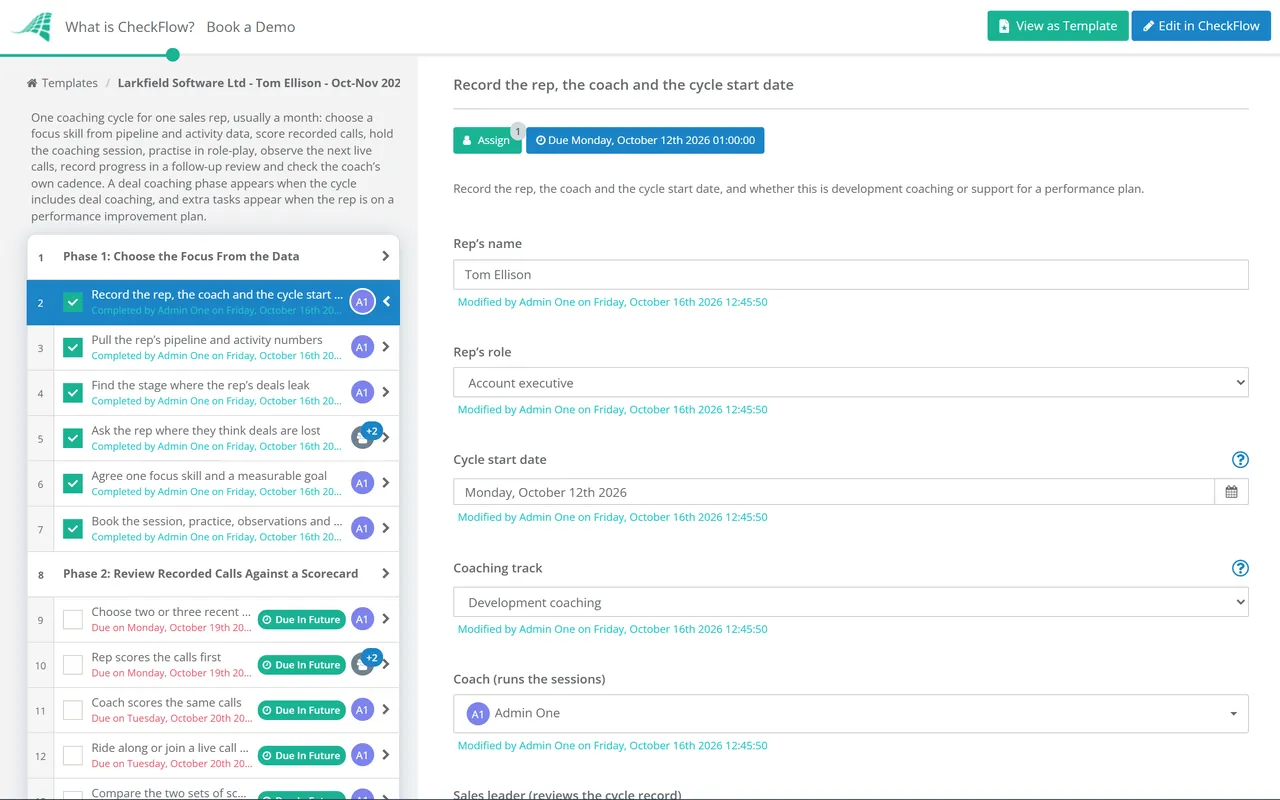
This free sales coaching checklist is for sales managers, team leads and enablement leads who coach account executives, SDRs or account managers. One run is one coaching cycle for one rep, usually a month. It starts with the rep’s pipeline and activity numbers, so the focus skill is chosen from evidence rather than a hunch. The coach and the rep score recorded calls against the same scorecard, then hold a session where the rep assesses themselves first and leaves with one or two behaviours to change. Practice and role-play come next, then the coach observes the next live calls and a follow-up review records the progress. The last phase checks the coach’s own cadence. Choosing deal coaching adds a phase on named opportunities, and a rep on a performance improvement plan gets tasks that tie the cycle to the plan. New hires start with the Sales Rep Onboarding Checklist.

Sales Coaching Changes One Behaviour at a Time

Sales coaching is the ongoing work of helping a rep who already sells to sell better. It is not onboarding, which takes a new hire from their first day to a ramp decision and is covered by the Sales Rep Onboarding Checklist. It is not call quality assurance either. A call center QA programme scores many calls for compliance and consistency, while a coaching cycle studies a few calls closely to change one habit.

Coaching usually fails in the same ways. The focus comes from the last call the manager happened to hear, the rep leaves with a long list of fixes, and nobody listens to the next calls to see whether anything changed. This checklist keeps each cycle short and closed: evidence first, one or two behaviours, practice, observation and a written record of progress. A cycle takes one of three shapes.

Skill coaching

One behaviour across many calls

Covers: one skill, such as discovery, demos or handling objections, scored on recorded calls.

Best for: a rep whose deals stall at the same stage again and again.

Output: before and after scores on the focus behaviour.
Deal coaching

Named opportunities this month

Covers: one or two live deals at the stage the rep finds hardest, reviewed against your qualification criteria.

Best for: deals that stall, slip or rest on a single contact.

Output: an agreed buyer action and a planned call for each deal. Choosing it adds Phase 4.

On a performance plan

Coaching that supports a PIP

Covers: the same cycle, with the goal taken from the plan’s objectives and the progress record shared with HR.

Best for: a rep already on a formal performance improvement plan.

Output: dated evidence for the plan’s check-ins. The plan itself runs in the PIP Process Checklist.

What the Sales Coaching Checklist Covers

Eight phases run one coaching cycle for one rep, usually over a month. Phase 4 appears only when the cycle includes deal coaching, and the tasks marked performance plan only appear when the rep is on a PIP.

  1. Phase 1 — Week 1

    Phase 1: Choose the Focus From the Data

    7 tasks

    Done in the first days of the cycle. The numbers say where to look; the recorded calls in Phase 2 say why.

    • Record the rep, the coach and the cycle start date — and whether this is development coaching or support for a performance plan
    • Pull the rep’s pipeline and activity numbers — stage conversion, win rate, deal size, cycle length and activity, beside the team’s figures for the same period
    • Find the stage where the rep’s deals leak — usually the one with the biggest gap against the team, which is where to start listening to calls
    • Ask the rep where they think deals are lost — before showing them the numbers, and what they want to get better at
    • Agree one focus skill and a measurable goal — one behaviour for the cycle, with a measure you can see on the next calls and one you can see in the pipeline
    • Link the goal to the performance plan objectives — performance plan only: the goal comes from the plan, and the coaching dates line up with its check-ins
    • Book the session, practice, observations and follow-up review — in both calendars now, so the cycle survives a busy month
  2. Phase 2 — Week 2

    Phase 2: Review Recorded Calls Against a Scorecard

    6 tasks

    Use calls recorded under your company’s call-recording policy. Field reps without recordings can use a ride-along instead.

    • Choose two or three recent calls at the focus stage — one the rep picks and at least one the coach picks
    • Rep scores the calls first — against the same scorecard the coach will use, with notes on what they would change
    • Coach scores the same calls — with a timestamp for every score below standard
    • Ride along or join a live call where there is no recording — the coach watches and takes notes, and says nothing in front of the buyer
    • Compare the two sets of scores — where the rep and the coach agree, and where they see the call differently
    • Pick the moments to discuss in the session — two or three clear examples of the focus behaviour, good and poor
  3. Phase 3 — Week 2

    Phase 3: Hold the Coaching Session

    6 tasks

    The rep talks first. The session ends with actions the rep has written down, not a list of things the coach said.

    • Open with the rep’s self-assessment — what went well on the calls, and what they would do differently
    • Play the chosen moments and ask before telling — what was the buyer thinking at that point, and what else could the rep have asked?
    • Agree one or two behaviours to change — described as what the rep will do on the next call, not what they should stop doing
    • Show what good looks like — a clip from a strong call in the call library, or the coach models it
    • Write down the actions, owners and dates — the rep writes them and the coach checks that each one is specific
    • Share the session notes the same day — so the rep and the coach work from the same record
  4. Phase 4 — If Needed

    Phase 4: Coach the Live Deals

    5 tasks

    Shown when the cycle includes deal coaching. Skill coaching works on a behaviour; deal coaching works on a named opportunity.

    • Pick one or two live opportunities at the focus stage — deals that matter this quarter and have a buyer meeting coming up
    • Review each deal against your qualification criteria — BANT, MEDDICC or your own; the rep answers and the coach asks questions
    • Find the gap that is holding the deal back — a missing decision-maker, no agreed timeline or a problem nobody has put a cost on
    • Plan the next buyer call together — the objective, the questions to ask and the objections to expect
    • Agree the buyer action that moves the deal on — a specific step with a date, recorded in the CRM
  5. Phase 5 — Weeks 2–3

    Phase 5: Practise and Role-Play

    5 tasks

    A behaviour changes through repetition, not through being told about it once.

    • Write a role-play scenario from a real call — the buyer, the moment and what the buyer actually said
    • Run short role-play rounds with the coach or a peer — the rep practises the new behaviour, then the roles swap once
    • Give feedback after every round — one thing to keep and one thing to change
    • Repeat until the rep can do it without notes — then try a harder version of the same moment
    • Add a short practice drill to the rep’s week — a few minutes a day until the observed calls in Phase 6
  6. Phase 6 — Week 3

    Phase 6: Observe the Next Live Calls

    4 tasks
    • Listen to the rep’s next two or three calls at the focus stage — live or recorded, within a week of the practice
    • Score them on the same scorecard — so the scores can be compared with the ones from Phase 2
    • Note whether the new behaviour appeared — and how the buyer responded when it did
    • Give short feedback within a day of each call — on the focus behaviour only
  7. Phase 7 — Week 4

    Phase 7: Follow-Up Review & Progress Record

    6 tasks
    • Hold the follow-up review — the rep goes first: what changed, and what was hard
    • Compare the scores from the start and end of the cycle — on the focus behaviour, call by call
    • Check the goal measures — the call measure should move first; the pipeline measure may take longer
    • Record the outcome and the next focus — goal met, partly met or not met, and whether to keep the behaviour, move on or change the approach
    • Share the progress record with HR and the plan owner — performance plan only: dated evidence for the plan’s next check-in
    • Sales leader reviews the cycle record — a sign-off that the cycle ran as planned and the record is complete
  8. Phase 8 — Week 4

    Phase 8: Check the Coach’s Own Cadence

    5 tasks

    Assigned to the coach. A coaching programme slips when the coach’s own sessions do.

    • Check every booked session happened — and note why any were moved or cancelled
    • Ask the rep how useful the coaching was — specific enough, enough practice and the right focus
    • Compare coaching time across your reps — every rep gets a cycle, not only the strongest or the weakest
    • Note one thing to change in your own coaching — before the next cycle starts
    • Book the rep’s next cycle — or set a recurring schedule so each cycle starts on its own

Choosing the Focus Skill From the Rep’s Numbers

Phase 1 compares the rep’s numbers with the team’s for the same period. The stage with the biggest gap is where to start listening to calls. The numbers point to a stage; only the calls show the behaviour behind it, so treat each row below as a place to look rather than a diagnosis. Compare reps who sell to similar customers, because a gap can come from the territory or the lead source rather than the rep.

What the numbers show Skill to look at first What to listen for on calls How to practise
Plenty of first meetings, few become opportunitiesDiscoveryThe rep talks more than the buyer, asks little about the impact of the problem and ends without an agreed next stepOpen a discovery call on a real account and ask three follow-up questions before mentioning the product
Opportunities stall after the demoA demo built on discoveryA product tour that never refers back to the problems the buyer named, and no next meeting booked before the call endsRebuild one demo around the three problems a buyer named in discovery
Deals are lost late, often on priceValue and negotiationA discount offered before the buyer asks for one, and value never put in the buyer’s own termsAnswer “it’s too expensive” three different ways without offering a discount
Close dates keep movingQualification and next stepsNo named decision-maker, no agreed decision process, and next steps set by the rep aloneReview two live deals against your qualification criteria every week
Many dials and emails, few meetings (SDRs)Openings and early objectionsThe first 30 seconds, and what happens after a brush-off such as “just send me an email”Short daily drills on the three brush-offs the rep hears most
Small deals with one contact per accountMulti-threadingEvery call is with the same person, and nobody asks who else is affected or who signs offMap the people involved in two live deals and plan one new contact for each

Score the focus behaviour, not the whole call. A scorecard with twenty criteria spreads attention across twenty things. For a coaching cycle, score the two or three behaviours that make up the focus skill on a simple 1–5 scale, with a timestamp for every low score. Use the same scorecard for the calls in Phase 2 and Phase 6, so the before and after scores mean the same thing. If your team already scores calls for QA, keep that scorecard for QA and use a short one for coaching.

Why Run Sales Coaching in CheckFlow?

1

Every due date counts from the cycle start

The first task asks for the cycle start date, and every task falls due a set number of days after it, so the session, the practice and the observed calls land in the right weeks. A recurring schedule can start a new cycle for each rep every month, and a missed session shows as overdue on the Reports Grid instead of quietly not happening.

2

One answer adds deal coaching or the plan tasks

Choosing deal coaching shows the phase on live opportunities. Marking the rep as on a performance plan adds the tasks that tie the goal to the plan and send the record to HR. The coach, the sales leader and, if they use CheckFlow, the rep are chosen on the first task, so each task goes to the right person.

3

A progress record you can show

Before and after scores sit in tables beside the session notes and the agreed actions, and the sales leader signs the record off at the end. Each task shows who completed it and when. When a promotion is discussed or a plan reaches its review, the evidence is already written down.

Coaching works when it is a routine. CheckFlow’s recurring checklist software starts each rep’s cycle on a fixed date, and analytics and reporting show which cycles are on track and which tasks are overdue across the team.

Coaching sits beside other sales routines. New reps start with the Sales Rep Onboarding Checklist, and the sales onboarding guide explains the 30-60-90 day plan. The Call Center Sales QA Checklist scores calls for compliance and consistency, the Sales Call Tracker Checklist keeps the CRM data that Phase 1 relies on, and a rep who needs a formal plan goes through the Performance Improvement Plan (PIP) Process Checklist.

AI generator

Didn’t find what you need? Describe it.

Describe the process in a sentence and the AI checklist generator drafts the phases and tasks for you.

Frequently Asked Questions

What should a sales coaching checklist include?

One full coaching cycle for one rep. Start with the rep’s pipeline and activity numbers to choose a focus skill, then score a few recorded calls against a short scorecard, with the rep scoring them first. Hold a session that agrees one or two behaviours and written actions, practise them in role-play, observe the next live calls and compare the scores in a follow-up review. Add deal reviews when you coach on live opportunities, and a check on the coach’s own cadence so sessions are not quietly dropped.

How do you write a sales coaching plan?

Write it for one rep and a short period, such as a month. A workable plan names one focus skill, the evidence it was chosen from, a measure you can see on calls and one you can see in the pipeline, the dates of the session, practice, observed calls and review, and who coaches. Keep it to one or two behaviours. At the end of the cycle, record whether the goal was met and choose the next focus. This template is that plan in checklist form, with the dates worked out from the cycle start.

What is the difference between deal coaching and skill coaching?

Skill coaching works on a behaviour the rep repeats across many calls, such as discovery questions or handling a price objection, and is measured on recorded calls over several weeks. Deal coaching works on a named opportunity: what is missing against your qualification criteria, who else needs to be involved and what the next call should achieve. Deal coaching helps this quarter’s number; skill coaching changes how the rep sells every deal. Many managers do both, so the template lets you choose either or both.

How often should a sales manager coach each rep?

Often enough that the next calls are observed while the session is still fresh. One workable rhythm is a short weekly one-to-one plus a focused coaching cycle each month, but the right amount depends on the size of the team and how experienced the reps are. Two things matter more than the exact frequency: sessions happen when they are booked, and every rep gets a cycle, not only the strongest or the weakest. Phase 8 of this checklist checks both.

How do I build a coaching plan for a new AE’s first 90 days?

Use onboarding for the first month and coaching after that. The Sales Rep Onboarding Checklist covers tools, training, certification and the 30-day sign-off for solo selling. Once the AE runs calls alone, start monthly coaching cycles: discovery is a sensible first focus, then demos and next steps, then qualification as their pipeline grows. The 60- and 90-day reviews can use each cycle’s progress record as evidence. The 30-60-90 day sales onboarding guide covers the ramp itself.

Can sales coaching be part of a performance improvement plan?

Yes, but keep the two records clear. A PIP is a formal HR process with objectives, support, check-ins and stated outcomes, run with HR. Coaching is one kind of support the plan can promise. When a rep is on a plan, take the cycle’s goal from the plan’s objectives, observe calls before each check-in and share the progress record with HR. The plan itself runs in the Performance Improvement Plan (PIP) Process Checklist.

Is CheckFlow free for this template?

14-day free trial, no card required. The Business plan is $10 per user per month after the trial. Full details at checkflow.io/pricing.

Coach Every Rep on One Behaviour at a Time

Free trial — no credit card required.

14-day free trial, no credit cardFull refund in your first 30 daysUS or EU hosting