Venue Booking Process Checklist for Event Planners
A structured venue selection and booking process — from requirements brief to signed contract — without discovering the surprises after the deposit is paid.
The venue contract you sign in month one defines the conditions you will operate under on event day. A minimum spend commitment you did not understand. An exclusivity clause on alcohol that increases your bar budget by 40%. A cancellation policy that retains your entire deposit if the event moves by three months. A Wi-Fi infrastructure upgrade that the initial quote did not include. Every one of these is in the contract — and every one of them is visible on a careful read. The event planner who runs a structured venue selection and contracting process reviews all of them before the deposit lands. This free venue booking checklist gives professional event planners and corporate event managers a structured process for selecting, evaluating, and contracting the right venue for any event.
Why Venue Decisions Go Wrong — and Where in the Process It Happens
Most venue selection mistakes happen at two points. The first is before the site visit: committing to a venue based on brochure photos and a phone conversation, without physically testing the sightlines, the acoustics, the Wi-Fi performance, the load-in access, or whether the adjacent events space generates noise that will travel. The second is before the contract review: signing a venue agreement without reading the service charge clause, the minimum spend commitment, the attrition clause on guest room blocks, or the exclusivity provisions on food and beverage. Both mistakes are made under time pressure and enthusiasm.
A structured venue booking process eliminates both. The site visit phase ensures the physical reality of the venue is verified before any commitment is made. The contract review phase ensures every clause is read and understood before the deposit is paid. An event planner who completes both phases before signing is an event planner who does not discover surprises on event day.
What the Venue Booking Process Checklist Covers
Phase 1
Venue Requirements Brief
The requirements brief is produced before a single venue is contacted. Venues evaluated without defined criteria are evaluated on emotion — which produces inconsistent decisions and missed requirements.
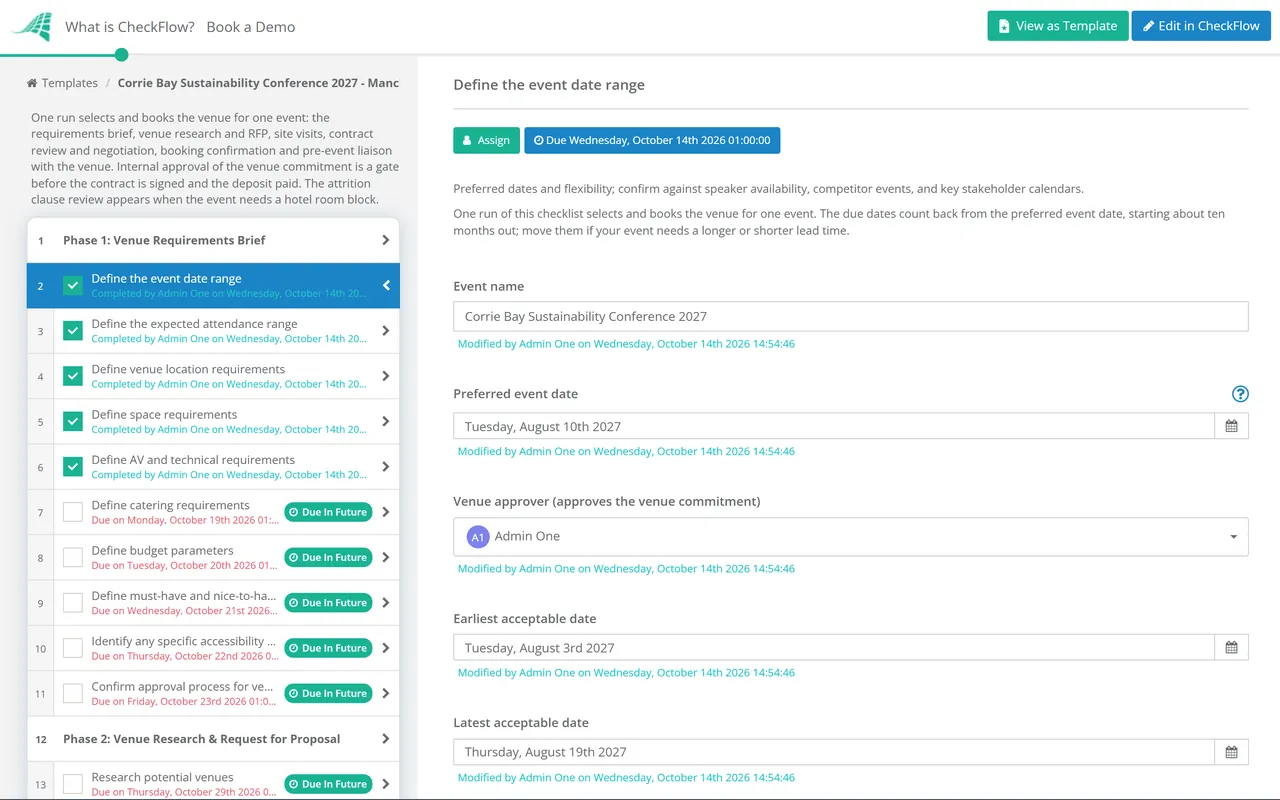
Define the event date range — preferred dates and flexibility; confirm against speaker availability, competitor events, and key stakeholder calendars
Define the expected attendance range — minimum and maximum; the venue must comfortably accommodate the maximum
Define venue location requirements — city, proximity to transport, airport access, and whether accommodation on-site or nearby is required
Define space requirements — plenary capacity, breakout rooms, exhibition space, registration area, green room, and any other specific space requirements
Define AV and technical requirements — stage, screens, sound, lighting, streaming capability, and internet bandwidth requirements
Define catering requirements — meals provided, dietary requirement management, licensing requirements (alcohol), and any preferred supplier arrangements
Define budget parameters — venue hire budget range; maximum acceptable food and beverage minimum spend
Define must-have and nice-to-have criteria — prioritised criteria against which all venues will be evaluated consistently
Identify any specific accessibility requirements — step-free access, hearing loops, accessible toilets, and any attendee-specific requirements
Confirm approval process for venue selection — who approves the final venue choice before contracting?
Phase 2
Venue Research & Request for Proposal
Research potential venues — a longlist of at least eight to ten venues meeting the basic requirements; using venue directories, DMCs, past event knowledge, and peer recommendations
Issue the RFP — to a minimum of five shortlisted venues; the RFP should specify all key requirements, evaluation criteria, and the response deadline
Confirm the RFP response deadline — realistic for venues to respond comprehensively; typically five to seven working days
Evaluate all RFP responses against the defined criteria — a consistent scoring matrix; not a first-impression judgement
Shortlist to two or three venues for site visits — the shortlist decision is based solely on the RFP response against criteria
Request provisional holds at shortlisted venues — confirm the dates are provisionally reserved while site visits are conducted
Phase 3
Site Visits & Physical Inspection
Visit the venue at the same time of day as your event. A venue that feels calm at 10am on a Tuesday may be noisy and crowded at 7pm on a Thursday when adjacent events are running.
Schedule the site visit at the same time of day as the event — to assess actual lighting, ambient noise, and venue activity at that time
Bring the right team — AV specialist or production manager; the client (if the venue is for a client event); and the lead event planner
Test the Wi-Fi performance — not just whether it exists; actual bandwidth available for multiple concurrent connections
Check sightlines and acoustics — from the back of the room, from the sides, and from any pillar-obstructed seats
Inspect the load-in access — loading dock location, lift size if applicable, distance from parking to event space, and any restrictions on delivery times
Confirm adjacency risks — what events are booked adjacent to the space on the event day? Will there be noise, shared facilities, or competing signage?
Inspect catering facilities and capabilities — kitchen quality, service layout, and catering team experience with events of the required size
Review signage opportunities — where branded signage can be displayed; any restrictions on fixtures, floor coverings, or walls
Take comprehensive notes and photos — for comparison against other shortlisted venues and to brief absent stakeholders on site characteristics
Phase 4
Contract Review & Negotiation
The venue contract is not a standard document. Every clause is negotiable before signing. Nothing is negotiable after.
Review all costs in full — venue hire fee, food and beverage minimum spend, service charges (confirm exact percentage), Wi-Fi infrastructure, parking, security, and any other mandatory charges
Review the cancellation policy — what percentage of the contract value is retained at each cancellation trigger date? Confirm this is acceptable before signing
Review the attrition clause (for events with hotel room blocks) — what is the minimum room pickup commitment? What is the financial penalty for falling short?
Review exclusivity provisions — on food and beverage, AV suppliers, security, and any other exclusive vendor arrangements; confirm whether approved alternatives are available
Review vendor access provisions — when can external vendors (AV, production, decoration) access the space? Any restrictions on approved supplier lists?
Review force majeure provisions — what events trigger force majeure? Who bears financial risk if the event is cancelled due to circumstances beyond control?
Negotiate key terms before signing — areas for negotiation include room hire fee, minimum spend, complimentary upgrade rooms, Wi-Fi inclusion, and setup time
Confirm the contract is reviewed by legal counsel for major events — or by the procurement team for corporate events above the procurement policy threshold
Confirm all agreed terms are reflected in the final contract before signing — verbal negotiations that are not in the written contract are not binding
Obtain internal approval for the venue commitment before signing
Phase 5
Booking Confirmation & Initial Coordination
Sign the contract and pay the deposit — within the venue’s required timeframe to secure the booking
Confirm your named venue contact — the specific person responsible for your event; confirm contact details and their availability in the run-up to the event
Set a schedule for regular liaison meetings — at key planning milestones: 12 weeks, 6 weeks, 4 weeks, and 1 week before
Confirm the detailed planning timeline with the venue — when final numbers are due, when catering menus must be confirmed, when AV briefing happens, and venue access times
Notify other shortlisted venues that they have not been selected — promptly and professionally; they may be candidates for future events
Update the event budget with confirmed venue costs — replacing estimates with the actual contracted figures
Phase 6
Pre-Event Venue Liaison & Final Confirmation
Provide the final confirmed attendance numbers — within the venue’s required timeframe (typically 7–10 days before)
Confirm catering menu and dietary requirements — final menu signed off; dietary data provided to catering
Confirm AV setup and supplier access — when the AV team arrives, setup schedule, and any specific venue requirements
Conduct the pre-event walk-through — one to two days before; with the AV team and key event staff; confirm all spaces, signage positions, and logistics
Confirm day-of contacts at the venue — who is the duty manager on the event day, and what is their direct contact number?
Provide the run-of-show to the venue — so they understand the event timeline and can anticipate and support key moments
The Site Visit Items That Are Never in the Brochure
Acoustics and sound bleed
What to check
Walk to the back of the room and listen. Walk to the adjacent spaces and listen through the walls. Is there an adjacent event space? What sound insulation exists between them?
Wi-Fi under load
What to check
Connect multiple devices simultaneously and test actual download and upload speeds. A venue that claims “strong Wi-Fi” for 10 people may not support 300 devices in the same room.
Load-in and setup access
What to check
Walk the route from the delivery point to the event space. Note lift sizes, corridor widths, step access, and any union or security requirements for external vendors entering the building.
Adjacent event activity
What to check
Ask what other events are booked on the same day. Walk through the shared spaces (lobby, catering areas, toilets) and assess whether two simultaneous events will create crowding or brand conflicts.
Lighting control
What to check
Test the blackout capability for presentation screens. Assess natural light. Check whether the room can be lit warmly for a dinner versus brightly for a conference.
Catering service flow
What to check
Walk the service route from the kitchen to the event space. For networking drinks, assess whether catering can circulate comfortably. For plated dinners, assess whether the kitchen can produce 300 covers simultaneously.
Why Run Venue Booking in CheckFlow?
1
Manage multiple venue evaluations simultaneously
Professional event planners often manage venue selection for multiple concurrent events. CheckFlow’s grid dashboard shows every venue booking process at every stage — which events are in the RFP phase, which are in site visit, and which have contracts pending — without confusion between them.

2
Enforce contract review before the deposit is paid
CheckFlow’s enforced task sequence prevents the booking confirmation from advancing until the contract review phase is marked complete. The enthusiasm of finding a great venue does not bypass the financial protection of reading what you are signing.
3
A venue database that builds with every booking
Every venue assessment — RFP response scores, site visit notes, contract terms, and event day performance — is archived in CheckFlow. The event planner managing next year’s conference starts with a complete record of what every shortlisted venue cost, what they delivered, and what their contract terms were.
Venue selection is Phase 3 in the broader event planning process. CheckFlow’s Event Planning Checklist coordinates venue booking as a gated phase — venue must be confirmed before marketing launch can begin. See the Event Planning Checklist →
Venue costs are the largest single budget line in most event budgets. CheckFlow’s Event Budget Approval Checklist covers the full budget preparation process — including identifying hidden venue costs before the budget is submitted. See the Event Budget Approval Checklist →
A venue Request for Proposal (RFP) is a structured document sent to multiple venues inviting them to submit a detailed proposal for hosting your event. An effective venue RFP includes: event overview (type, date, duration, expected attendance); space requirements (plenary capacity, breakout rooms, exhibition space); AV and technical requirements; catering requirements (meals, licensing, dietary management); accommodation requirements (room block size and preferred rate); budget parameters; evaluation criteria; and the proposal deadline and submission format. Sending a consistent RFP to a minimum of five venues allows proper comparison and demonstrates professional purchasing process to all vendors.
What should you look for in a venue contract?
+
Five areas require careful review. Costs: confirm the venue hire fee, food and beverage minimum spend, service charge percentage, Wi-Fi infrastructure costs, and any other mandatory charges not included in the initial quote. Cancellation policy: what percentage is retained at each cancellation trigger date. Attrition clause: if a hotel room block is included, what is the minimum pickup commitment and the financial penalty for falling short. Exclusivity provisions: any restrictions on external catering, AV suppliers, or alcohol suppliers. Force majeure: who bears financial risk if the event cannot proceed due to circumstances beyond either party’s control.
How many venues should you visit before booking?
+
A minimum of two to three venues, and never fewer than two. Visiting only one venue before booking removes all negotiating leverage and the ability to make a genuine comparative assessment. For large, high-investment events, visit three to five shortlisted venues. The site visit investment is small relative to the event budget and the risk of committing to the wrong venue. Schedule visits at the same time of day as the event to assess lighting, noise, and activity levels accurately.
What hidden costs do event venue contracts typically contain?
+
The most common are: service charges on food and beverage (typically 22–28%, added on top of per-head catering quotes); Wi-Fi infrastructure charges ($5,000–$20,000 for dedicated event-grade bandwidth at major venues); minimum spend commitments on food and beverage that apply regardless of actual consumption; attrition clauses on hotel room blocks (financial penalties if fewer rooms are used than contracted); union labour premiums on AV and setup in certain venues; and overtime charges if the event runs beyond contracted hours.
Is CheckFlow free for this template?
+
Yes — 14-day free trial, no card required. The Business plan is $10 per user per month after the trial. Full details at checkflow.io/pricing.
Find and Book the Right Venue — Before You Sign Anything You’ll Regret
Free trial — no credit card required.
Do you like cookies? 🍪 We use cookies to ensure you get the best experience on our website. Learn more