Banquet Event Order (BEO) Checklist Template

A function goes wrong on paper first: a change agreed by email that never reached the kitchen, a dietary list that arrived after the food order, or a room set from an old version of the BEO.

Last reviewed: November 2026

Printed from checkflow.io/templates/hospitality/banquet-event-order-checklist

This free banquet event order (BEO) checklist is for the events, catering or conference manager at a hotel or venue running one function, from a private dinner to a wedding or an awards night. One run is one function, counted back from the function date. It starts with the enquiry and a provisional hold, then the proposal, the contract and the deposit. Next the BEO is drafted: the timings, the menu and drinks, the allergens in every dish, the room set, AV, outside suppliers, staffing and billing. The client signs it, every later change is logged and reissued, and the final numbers and dietary list come in. The approver releases the final BEO before the BEO meeting with the kitchen, banqueting and front of house. The day itself, the final bill and a debrief close the run. A phase for off-site catering appears when the function is held away from the venue.

The BEO Is the Venue’s Own Order, Not the Planner’s

A banquet event order (BEO), also called a function sheet or event order, is the document a hotel or venue writes for each function so that every department works from the same instructions: what happens when, what is served to whom, how the room is set and what is charged. The client signs it, and every change after that is a new version. There is no legal form for it; each venue designs its own.

This checklist is the venue’s side of one function. An event planner choosing and booking a venue uses the Venue Booking Process Checklist, and the organiser’s whole event, from the budget to the follow-up, sits in the Event Planning Checklist. The kitchen’s standing allergen controls, which every function relies on, are in the Food Allergen Management Checklist.

The venue’s order

One function, from enquiry to final bill

Asks: is every department working from the same signed, current BEO?

When: from the enquiry, about 12 weeks out in the default timeline, to five weeks after the function.

Output: a signed BEO and change log, a released final version, a function run to it and a final bill.

The planner’s side

Choosing and booking the venue

Asks: which venue meets the brief, and is its contract safe to sign?

When: before the booking, from the requirements brief to the signed contract and the liaison that follows.

Output: a booked venue, in the Venue Booking Process Checklist.

Standing controls

Allergen management for every service

Asks: does the kitchen know what is in every dish, and can staff answer any guest’s question?

When: all the time, and whenever a recipe or supplier changes.

Output: the allergen records, training and procedures each BEO draws on, in the Food Allergen Management Checklist.

What the Banquet Event Order Checklist Covers

Eight phases take one function from the first enquiry to the final bill. Due dates count back from the function date in working days, starting about 12 weeks out, and the final bill and debrief count forward from it. Phase 2 appears only when the function is held off-site. The approver’s release of the final BEO in Phase 5 holds the BEO meeting, the orders and the day until it is given.

  1. Phase 1

    Phase 1: Enquiry & Provisional Hold

    4 tasks

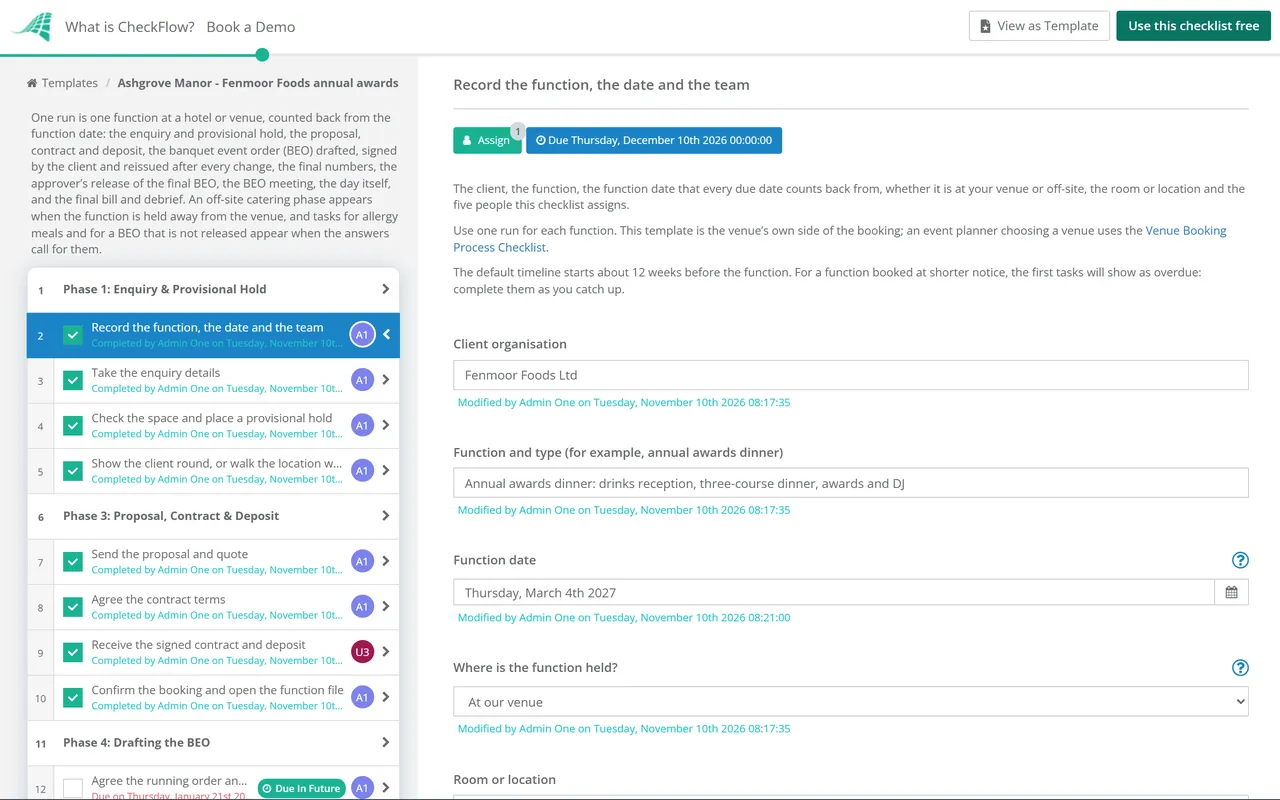
    Record the function on the first task: the client, the function date that every due date counts from, where it is held and the people who run it. A function held away from the venue adds the off-site phase.

    • Record the function, the date and the team — the client, the function, the function date that every due date counts back from, whether it is at your venue or off-site, the room or location and the five people this checklist assigns
    • Take the enquiry details — the organiser’s name and contact details, the type of function, the date and times, guest numbers, budget, the room or style asked for, and any access or dietary needs mentioned at this stage
    • Check the space and place a provisional hold — the room or team is free on the date, what else is booked that day (shared areas, noise, the kitchen’s load), and a provisional hold in the diary with an option date by which the client confirms or releases it
    • Show the client round, or walk the location with them — the room as it would be set, the arrival route, step-free access, toilets, the bar and how far the kitchen is from the room; for an off-site function, the location itself
  2. Phase 2 — If the function is off-site

    Phase 2: Off-Site Location & Catering Plan

    6 tasks

    Applies only when the first task says the function is off-site. The food is cooked in your kitchen or on site and served somewhere you do not run, so plan the facilities, the transport and any licence before you quote.

    • Visit the location and check its facilities — space for a temporary kitchen or finishing area, the power supply and what it can carry, drinking water, drainage, handwashing, toilets for guests and staff, vehicle access and loading, the distance from the kitchen area to the tables, and shelter for anything outdoors
    • Check your registration or permit covers catering there — UK: your kitchen is registered as a food business with its local authority, and you ask the authority where the location is whether it needs anything more; US: ask the health department that issued your permit whether it covers catering at another location, or whether the event needs a temporary permit where it is held
    • Plan the transport and temperature control — how chilled and hot food travels (insulated or heated boxes, a refrigerated vehicle), how long it will be out of your kitchen, probe checks at loading and on arrival, and how food is kept cold or hot until it is served, as your food safety plan sets out
    • Plan the kitchen equipment and hire for the location — ovens or regeneration equipment, hot cupboards, fridges, a handwash station, tables, crockery, cutlery, glassware, linen and bins, what comes from your own stock and what is hired, and a load list to check against on the day
    • Confirm the licence for any alcohol at the location — a copy of the location’s own licence and its conditions if it covers the alcohol, or the notice or permit the law needs where it does not; if no alcohol is sold or supplied, mark this task not applicable
    • Agree access, waste and clear-down with the site owner — access and load-in times, parking, where waste and used oil go, who cleans what, the time the location must be clear, and the site’s own rules on power, open flames and noise
  3. Phase 3

    Phase 3: Proposal, Contract & Deposit

    4 tasks

    The contract sets the prices, the minimum numbers and the deadline for final numbers. The hold becomes a confirmed booking only when the signed contract and the deposit arrive.

    • Send the proposal and quote — the menus and packages offered, room hire or minimum spend, drinks options, what is included (tables, linen, AV), the deposit and payment terms, and how long the quote and the hold stand
    • Agree the contract terms — date, room, times, minimum numbers, prices, the deposit and payment schedule, the deadline for final numbers and what is charged if fewer guests come, cancellation charges, outside suppliers, damage and insurance
    • Receive the signed contract and deposit — the contract signed by the client and the deposit paid, checked against the agreed terms, before the hold becomes a confirmed booking
    • Confirm the booking and open the function file — the booking marked definite in the diary or events system, any other holds on the space released, and a confirmation to the client of what you need from them and when: menu choice, dietary needs and final numbers
  4. Phase 4

    Phase 4: Drafting the BEO

    10 tasks

    The banquet event order (BEO) is the one document every department works from. Each task here fills one part of it, and the last one puts it together for the client.

    • Agree the running order and timings — access for set-up, suppliers’ arrival, guest arrival, the drinks reception, the call to dinner, each course, speeches and awards, entertainment, last orders at the bar, carriages and the time the room must be clear
    • Choose the menu and drinks with the client — courses and choices, canapés, children’s and suppliers’ meals, wines and the drinks package, the toast, the bar arrangements, and a tasting if your venue offers one
    • Ask the client to collect guests’ dietary needs — a form or list for every guest’s dietary needs and food allergies, returned by the final numbers deadline, with the guest’s name, table, the allergen or diet and how serious it is; share the list only with the staff who need it
    • Check the allergens in every dish on the menu — from the recipes and supplier specifications, including canapés, bread, sauces, dressings, garnishes, petits fours and mixed drinks, recorded in an allergen matrix for this menu so staff can answer any guest
    • Plan the room set and floor plan — the layout, table numbers, top table or stage, dance floor, bar and buffet positions, service routes from the kitchen, fire exits and escape routes kept clear, numbers within the room’s capacity for that set, step-free access and space for wheelchair users
    • Confirm AV, staging and power — microphones, lectern, screens and projection, lighting, staging, power for the band or DJ, who provides each item, and a time for the technical check
    • Agree the outside suppliers’ arrangements — the band, DJ, florist, photographer, entertainers and any AV the client brings: arrival and load-in times, power needs, insurance certificates, risk assessments and any electrical safety evidence your venue asks for, and their contact on the day
    • Plan the staffing — servers, bar staff, chefs, porters, cloakroom, security and a duty manager for the guest numbers and the service style (plated, family style or buffet), with call times, using your venue’s own staffing levels
    • Set up the billing — the account the function is charged to, what the package includes, items charged on consumption (a bar tab and its limit, extra covers, a late finish), service charge and tax, any purchase order, and who may sign for extras on the night
    • Write the BEO and send it to the client — one BEO with the function reference, version and date, setting out the timings, menu and drinks, dietary and allergy arrangements, room set, AV, suppliers, staffing and billing from the tasks above, sent to the client to check and sign
  5. Phase 5

    Phase 5: Client Sign-Off, Changes & Final Numbers

    7 tasks

    The signed BEO is the version the venue works to. Every later change gets a new version, and the approver releases the final one once the numbers, the allergy meals and the payment are settled.

    • Get the BEO signed by the client — the client checks every line and signs the BEO, accepting the arrangements and the charges; questions are answered and the BEO reissued before it is signed
    • Receive the final numbers and dietary list — the guaranteed number from the client by the contract’s deadline, and the final list of dietary needs and allergies with each guest’s name and table
    • Take the balance or confirm credit terms — the balance paid as the contract says, or the client’s account and credit terms confirmed by finance before the function
    • Log every change and reissue the BEO — each change after signature with the date, who asked, what changed, any cost and the departments it affects; the BEO reissued with a new version number marked revised, charged changes accepted by the client in writing, and old copies replaced everywhere
    • Plan each allergy meal from order to table — for each guest, the dish they will have, made from ingredients checked against their allergy, prepared and plated apart, labelled with their name and table at the pass, carried by a named server and served first
    • Put right what is holding the BEO — each reason the approver gave: an unsigned BEO or change, missing final numbers or dietary list, an unpaid balance, an allergen question, or a supplier without the documents asked for, then back to the approver
    • Approver releases the final BEO — the signed BEO, every change, the final numbers, the allergy meals and the payment checked, and the final version released to the departments
  6. Phase 6

    Phase 6: BEO Meeting & Preparation

    6 tasks

    Once the final BEO is released, every department gets the same version and walks through it together. Orders, the rota and the kitchen’s plan follow the final numbers.

    • Issue the final BEO to every department — the kitchen, banqueting, bar, front of house or reception, housekeeping, security, AV and accounts, each with the released version, and earlier versions withdrawn
    • Hold the BEO meeting — a walk through the BEO line by line with the kitchen, banqueting, bar and front of house: timings, numbers, allergy meals, the room set, suppliers and anything unusual, with every question answered before the day
    • Place the food and drink orders and confirm hire deliveries — food and drink ordered for the final numbers and the allergy meals, delivery times set so chilled food arrives when there is space to store it, and hired equipment confirmed
    • Publish the rota for the function — every person named with their role, section and call time, and the duty manager for the day
    • Receive the table plan and the client’s final items — the seating plan, place cards, printed menus, awards or prizes, anything to be stored before the day, and the name and phone number of the client’s lead on the day
    • Prepare the kitchen production plan — the preparation list and timings for the final numbers, the plating plan for each course, the allergy meals, and the equipment and chefs for each station
  7. Phase 7

    Phase 7: Set-Up & Function Day

    6 tasks

    The room is set and checked against the BEO before the client arrives. Anything changed on the night is written down so the final bill and the debrief can use it.

    • Load, transport and check temperatures on arrival — everything loaded against the load list, food temperatures recorded at loading and on arrival, and the temporary kitchen and handwashing set up before any open food is handled
    • Set the room against the BEO — tables, chairs, linen, place settings, table numbers, stage, dance floor, bar and AV matched to the floor plan, with fire exits and routes clear
    • Walk the room with the client’s organiser — the set, the timings and any late changes, with any extra charge agreed in writing by the person allowed to approve it
    • Brief the team before service — the running order, the menu and how each course is served, the allergy meals with names and tables, the bar arrangements, each person’s section, the fire exits and who to call
    • Run the function to the running order — the duty manager keeps to the timings, records any change, incident or complaint, and records extras ordered on the night with the name of the person who approved them
    • Break down the room and record damage and lost property — the room or location cleared, an off-site location left as agreed with the site owner and hired equipment returned, and any damage or lost property recorded with what the contract allows you to charge
  8. Phase 8

    Phase 8: Final Bill & Debrief

    5 tasks

    The final bill starts from the BEO and the record of the night. The debrief turns what went wrong into changes for the next function.

    • Reconcile the extras and numbers against the BEO — the guests served against the guaranteed number, the bar against the tab, extras approved on the night and any damage the contract lets you charge
    • Send the final invoice — the agreed charges less the deposit and payments made, with the BEO and any signed extras as the backing
    • Ask the client for feedback — what the client and their guests thought of the food, service, room and timings, and whether they would book again
    • Hold the debrief with the departments — what worked and what did not against the BEO: timings, food, service, the allergy meals, the room set and suppliers, with an owner for each action
    • Close the function file — once the invoice is paid, the signed BEO, change log, invoice and feedback filed, and notes kept for the client’s next booking

What Goes on a Banquet Event Order

A BEO has no fixed format, so the parts below are this checklist’s, not a standard. The table shows what each part records, the task that fills it in and the departments that work from it.

Part of the BEO What it records Filled in by Used by
HeaderClient, function, date, room, BEO number and version, the organiser’s contact and the guaranteed numberPhase 1, Phase 3 and the final numbers taskEvery department
TimingsThe running order from set-up to clear-down: arrivals, reception, courses, speeches, entertainment, bar close, carriagesAgree the running order and timingsBanqueting, kitchen, bar, AV
Menu and drinksCourses and choices, canapés, staff and supplier meals, wines, the drinks package and bar arrangementsChoose the menu and drinks with the clientKitchen, bar, banqueting
Dietary needs and allergensThe allergens in each dish, and each guest’s need with their name and tableCheck the allergens in every dish; the final dietary list; plan each allergy mealKitchen, banqueting
Room setLayout, table plan, stage, dance floor, bar and buffet positions, service routes and clear exitsPlan the room set and floor planBanqueting, housekeeping, security
AV, staging and powerMicrophones, screens, lighting, staging, power for performers, and the technical checkConfirm AV, staging and powerAV team or supplier
Outside suppliersWho arrives when, their power needs and the documents the venue asked forAgree the outside suppliers’ arrangementsFront of house, security, banqueting
StaffingRoles, numbers, sections and call times, and the duty managerPlan the staffing; publish the rotaDepartment heads
BillingThe account, what the package includes, charges on consumption, service charge, tax and who approves extrasSet up the billingAccounts, duty manager
Signatures and changesThe client’s signature, each change with its date, cost and new versionGet the BEO signed; log every changeEvents manager, accounts

Allergens in the UK. The Food Standards Agency’s guidance for England, Wales and Northern Ireland (updated 17 July 2026) says food businesses must tell customers if food contains any of the 14 allergens listed in food law. For food that is not prepacked, the information can be written on a menu or in an information pack, or given verbally with a clearly visible written notice saying how to ask, and the FSA’s advice is that written information supported by a conversation works best. At a buffet, it is given for each dish, not for the buffet as a whole. In Scotland, start from Food Standards Scotland’s guidance.

Allergens in the US. The FDA lists nine major food allergens: milk, eggs, fish, crustacean shellfish, tree nuts, peanuts, wheat, soybeans and sesame, which the FASTER Act added from 1 January 2023. The FDA Food Code, a model that state and local health departments adopt in their own time, asks the permit holder to give written notification of major food allergens that are ingredients in unpackaged food (3-602.12(C) in the 2026 edition). Check the edition your health department enforces.

Off-site catering. In England, keeping food that needs chilling above 8°C, or hot food for service below 63°C, is an offence under the Food Hygiene (England) Regulations 2013, subject to the exceptions and defences they set out. The 2026 Food Code model sets 5°C (41°F) or below and 57°C (135°F) or above (3-501.16). In England and Wales, selling alcohol at a location whose licence does not cover it can be done under a Temporary Event Notice: an individual gives it to the council at least 10 clear working days before the event, with copies to the police and environmental health unless it is given online, and the event must have fewer than 500 people at all times, including staff.

Why Run Banquet Event Orders in CheckFlow?

1

Every department works from one version

The BEO is written once, signed by the client and reissued with a new version number after every change, with the change log on the task. The released version goes to every department and earlier copies are withdrawn, so each task on the checklist shows who owns it and when it is due.

2

Allergy meals planned, not remembered

The head chef records the allergens in every dish in a matrix for the menu before the BEO goes to the client. When the final dietary list shows a guest with a food allergy, a task appears for the head chef to plan each meal by name and table. An off-site function adds the location, transport and licence tasks. Conditional rules do the work.

3

Nothing reaches the kitchen unreleased

The approver releases the final BEO once the numbers, changes, allergy meals and payment are settled. That approval step holds the BEO meeting, the orders and the day until it is given, and Not released shows the task to put things right.

CheckFlow does not write menus, cost functions or take payments. The events manager, the kitchen and finance do that. It keeps every step of each function on one checklist, with a named owner and a due date, so the events team can see what is late across every function on the Reports Grid and nothing waits on someone’s memory.

Keep the kitchen’s allergen controls up to date with the Food Allergen Management Checklist, build the food safety plan for off-site work with the HACCP Food Safety Checklist, and run the bar each day with the Bar Opening & Closing Checklist.

AI generator

Didn’t find what you need? Describe it.

Describe the process in a sentence and the AI checklist generator drafts the phases and tasks for you.

Frequently Asked Questions

What is a banquet event order (BEO)?

A banquet event order, or BEO, is a venue’s written instructions for one function: the timings, the menu and drinks, dietary needs and allergies, the room set, AV, outside suppliers, staffing and billing. The client checks and signs it, and the kitchen, banqueting, bar and front of house all work from the same copy. Some venues call it a function sheet or an event order. This checklist builds the BEO task by task, records the signature and logs every change.

What should a banquet event order include?

Enough for each department to do its part without asking: the client, function, date, room, BEO number and version; the running order; the menu and drinks; the allergens in each dish and each guest’s dietary need with name and table; the room set and floor plan; AV and staging; outside suppliers and their arrival times; staffing; and the billing, including what is charged on consumption and who approves extras. The table on this page lists each part and the task that fills it in.

Who signs a BEO, and when?

The client signs it once they have checked every line, which confirms the arrangements and the charges. This checklist asks for the signature about 18 working days before the function, after the draft goes out, and keeps the signed copy on the task. A change after that is logged and the BEO reissued with a new version number; changes that cost money are accepted by the client in writing. The venue’s approver then releases the final version to the departments.

What is the difference between a BEO and the function contract?

The contract is the agreement: the date, room, prices, minimum numbers, deposit, payment terms, the deadline for final numbers and the cancellation charges. The BEO is the working order that sets out how the function will run, line by line, for the people delivering it. The two should agree, and a change on the BEO that changes the price is agreed in writing. In this checklist the contract comes in Phase 3, and the BEO is drafted in Phase 4.

What happens at a BEO meeting?

The events team walks through each function’s BEO with the kitchen, banqueting, bar and front of house before the day: timings, final numbers, allergy meals, the room set, suppliers and anything unusual. Questions are answered there rather than on the night. In this checklist the meeting comes after the approver releases the final BEO and every department has the same version, about three working days before the function, and the questions and answers are recorded on the task.

When are final numbers due for a banquet?

By the deadline in the function contract, which should also say what is charged if fewer guests come than the final, or guaranteed, number. Agree both before the client signs. This checklist allows seven working days before the function, with the final dietary and allergy list due at the same time; if your contract sets another deadline, change the task’s due date. The guaranteed number then drives the food order, the rota and the final bill.

How should a venue handle guest allergies at a banquet?

Know what is in every dish, so staff can answer any guest, and plan each declared allergy before the day. In England, Wales and Northern Ireland, food businesses must give information on the 14 allergens listed in food law; at a buffet, for each dish. In the US, sesame is the ninth major food allergen. In this checklist the head chef records the allergens in the menu, the client returns names and tables with the final numbers, and a task appears to plan each allergy meal from order to table.

What changes when a venue caters a function off-site?

The kitchen leaves its own premises. Visit the location first: power, water, handwashing, access and where food will be finished. Plan how chilled and hot food travels and is kept at a safe temperature, check that your registration or permit covers catering there, and confirm the licence for any alcohol, which in England and Wales may mean a Temporary Event Notice. In this checklist, choosing off-site on the first task adds those steps and a temperature check on arrival.

Is CheckFlow free for this template?

14-day free trial, no card required. The Business plan is $10 per user per month after the trial. Full details at checkflow.io/pricing.

Run Every Function From One Signed BEO

Free trial — no credit card required.

14-day free trial, no credit cardFull refund in your first 30 daysUS hosting, EU on request