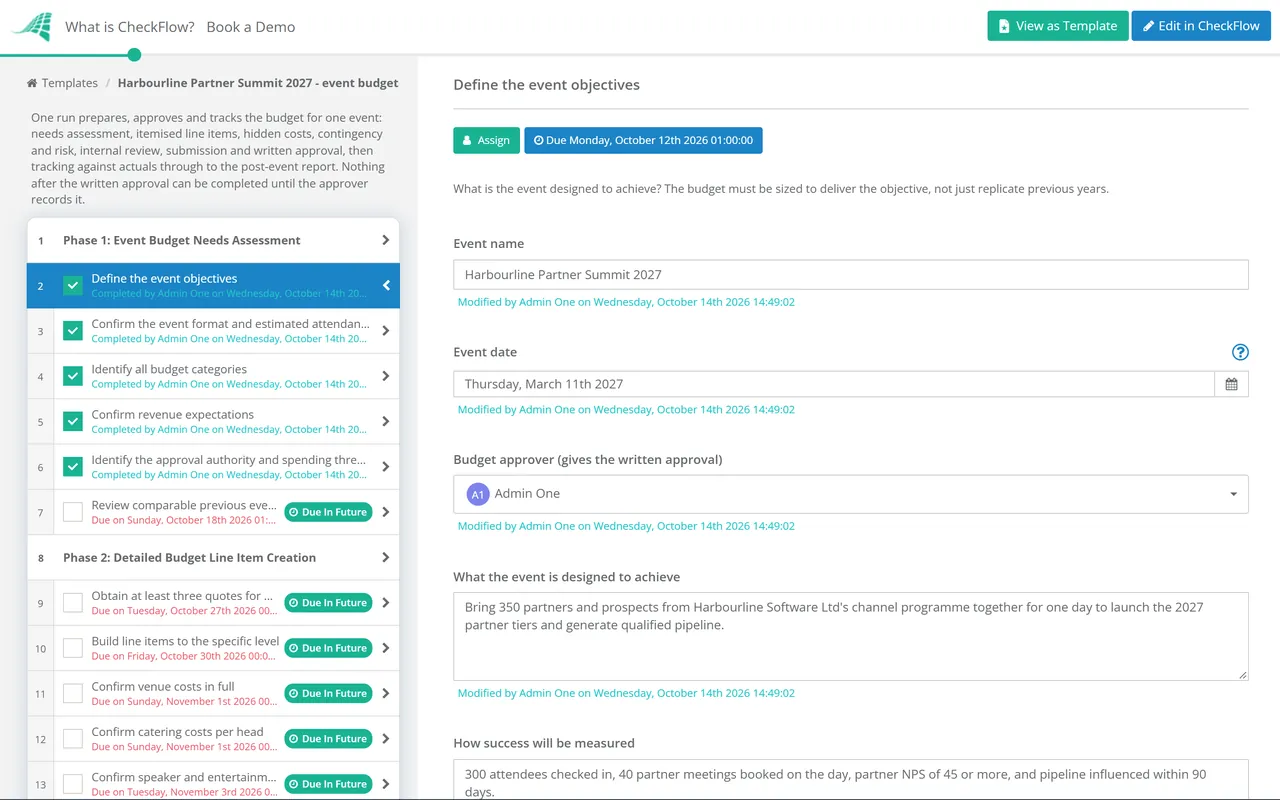
The event budget that gets approved first time is the one that anticipated every hidden cost, assigned every line item, and answered every stakeholder question before it was asked.
Event budgets that arrive at the approval stage as a round number with vague categories get rejected or delayed. The questions are always the same: who approved the AV quote, is the venue service charge included, what is the contingency, how does this compare to last year, and what happens if attendance is lower than projected? A structured budget preparation and approval process documents the answers to all of these questions before they are asked — producing a budget that is specific, justified, and supported by evidence rather than optimism. This free event budget approval checklist gives event planners and corporate event teams a structured framework for preparing, reviewing, and securing approval for any event budget, at any size.
Why Event Budgets Get Rejected or Come Back for Multiple Rounds
Budget approval failures follow a pattern. The budget was prepared quickly, the line items are categories rather than quotes, the contingency is absent or arbitrary, the approval authority is unclear, and the budget lands on a stakeholder’s desk with no supporting documentation. The result is a round of questions, a revision cycle, and a delayed approval that compresses the planning timeline.
The hidden costs are the second failure. Venue service charges (typically 22–28% on food and beverage), Wi-Fi infrastructure (up to $20,000 in major conference venues), audiovisual overages, and union labour premiums are consistently underestimated by event planners who receive initial venue quotes excluding these items. A structured budget process forces every category to be fully costed before the budget is submitted for approval.
What the Event Budget Approval Checklist Covers
Phase 1
Event Budget Needs Assessment
The budget should be built from event objectives down — not from last year’s spend up. What does this event need to achieve, and what resources does achieving it require?
Define the event objectives — what is the event designed to achieve? The budget must be sized to deliver the objective, not just replicate previous years
Confirm the event format and estimated attendance — in-person, virtual, or hybrid; expected number of attendees; duration; and whether the event is single or multi-day
Identify all budget categories — venue, AV and technology, catering, speakers and entertainment, marketing and promotion, staffing, travel and accommodation, materials and printing, virtual event platform, and contingency
Confirm revenue expectations — ticket sales, sponsorship, exhibitor fees, or other income; the net budget (cost minus revenue) is what requires approval
Identify the approval authority and spending thresholds — who can approve at each budget level; confirm multi-level approval requirements before the budget is drafted
Review comparable previous event actuals — last year’s actual spend by category is the most reliable baseline; identify any category where this year is expected to differ significantly
Phase 2
Detailed Budget Line Item Creation
Obtain at least three quotes for major expense categories — venue, AV, catering, and production; a single quote is not a budget, it is a wish
Build line items to the specific level — “AV” is not a line item; “PA system, LED screen, lighting rig, technician (2 days)” is
Confirm venue costs in full — hire fee, service charge, minimum spend requirements, Wi-Fi infrastructure costs, security, parking, and any exclusivity or setup/breakdown charges
Confirm catering costs per head — including service charges, dietary requirement uplifts, and any minimum spend guarantees based on guaranteed numbers
Confirm speaker and entertainment costs — fees, travel, accommodation, and any technical or production requirements specific to the speaker
Confirm technology costs — event management platform, registration system, virtual event platform, event app, and any streaming or recording requirements
Confirm staffing costs — internal staff time, freelance support, venue staff, security, and any outsourced event management costs
Confirm marketing costs — design, print, paid promotion, email campaigns, and any PR or press activity
Phase 3
Identifying and Including Hidden Costs
Hidden costs are not hidden to experienced event planners — they are simply omitted from initial venue and vendor quotes. Never submit a budget without verifying what the quoted price excludes.
Confirm venue service charges — typically 22–28% on food and beverage; confirm the exact percentage and apply it to all catering line items
Confirm Wi-Fi infrastructure costs — major conference venues charge for dedicated event-grade bandwidth; confirm the quote before budgeting
Confirm union labour premiums — applicable at certain venues in the US and internationally; confirm whether union rules affect setup, breakdown, or AV staffing
Confirm insurance requirements and costs — public liability, event cancellation, and any venue-required insurance; include as a specific budget line
Identify any permit or licensing costs — music licences, alcohol licences, outdoor event permits, or any other regulatory requirements
Identify payment surcharges — credit card processing fees, platform transaction fees, or currency conversion costs for international events
Include post-event costs — survey platform, recording editing, content distribution, thank-you gifts, and any venue damage deposit return process
Include pre-event costs that are often missed — site visit travel, RFP preparation time, and early marketing spend
Phase 4
Contingency Planning & Risk Provision
Set the contingency allocation — 10–15% of total budget as standard; 15–20% for outdoor events, first-time venues, or events with significant weather dependency
Identify the top three budget risk scenarios — attendance shortfall, speaker cancellation, technical failure; quantify the cost impact of each
Confirm whether event cancellation insurance is appropriate — for high-cost events where cancellation would produce significant unrecoverable costs
Define the approval process for drawing on contingency — who can approve contingency spend and at what level; confirm this before the budget is submitted
Document budget assumptions — attendance numbers, price escalation assumptions, and any variables that could cause the budget to change materially
Identify any revenue risk — if the event is part-revenue funded, what is the financial exposure if ticket sales or sponsorship falls short?
Phase 5
Internal Review & Validation
Conduct an internal review against event objectives — does the budget allocation match the event’s priorities? Are the right categories funded at the right level?
Compare to industry benchmarks — catering typically 25–35% of total budget for conferences; AV 15–25%; venue 25–30%; marketing 10–15%; flag any significant deviations for justification
Review for missing items — a final completeness check against the event plan; is every planned element represented in the budget?
Confirm the ROI story — can the budget be justified against the expected business outcomes? Prepare the ROI narrative for stakeholder presentation
Get a peer review — have a colleague or senior event planner review before submitting; a second pair of eyes catches errors and omissions
Phase 6
Stakeholder Submission & Approval Workflow
Confirm the approval authority for this budget level — who needs to approve and in what order; confirm any multi-level sign-off requirements
Prepare the budget submission pack — executive summary of the event, objectives, key budget assumptions, itemised budget, revenue projection, and ROI justification
Submit through the appropriate channel — confirm the submission method (finance system, email, formal approval form) and documentation requirements
Set a review deadline — confirm when approval is needed by to maintain the event timeline; flag any planning decisions that cannot proceed without budget approval
Respond to stakeholder questions promptly and with evidence — questions about specific line items should be answered with supplier quotes, not estimates
Obtain written approval — email confirmation or formal sign-off document; a verbal approval is not a budget approval
Document the approval — record who approved, what was approved, any conditions, and the date
Set up the budget tracker — approved budget versus actual spend, tracked by category, updated in real time as commitments are made
Confirm a named budget owner — one person responsible for tracking and reporting budget status throughout the planning period
Establish approval thresholds for overspend — what variance triggers a re-approval request? Confirm with the approving stakeholder at the time of original approval
Conduct weekly budget reviews — actual versus committed versus approved; flag any categories trending to overspend
Report budget status to stakeholders at key milestones — at 60 days, 30 days, and 7 days before the event
Produce the post-event budget actuals report — final actual spend versus approved budget, variance analysis, and explanation of any significant deviations
Available as a free, runnable CheckFlow template — with approval workflow tasks assigned to finance and stakeholder team members, budget categories tracked through to post-event actuals, and a complete documented approval trail.
The Hidden Costs That Kill Event Budgets After Approval
Venue service charges
22–28% on food and beverage spend
A £50 per head catering quote for 200 guests looks like £10,000. With a 25% service charge, the actual cost is £12,500 — added on top of the quoted per-head price.
Wi-Fi infrastructure
$5,000–$20,000 at major conference venues
Quoted internet access at a major hotel does not cover the bandwidth required for 500 simultaneous device connections. The upgrade is invoiced separately.
Union labour premiums
30–50% added to AV and setup staffing costs
An AV company provides a crew quote, but the venue contract requires all on-site labour to be union-affiliated — at a premium rate not included in the original quote.
Payment processing and platform fees
2–4% on ticketing platforms
A £50 ticket with a 3.5% processing fee generates £48.25 net. On 500 tickets, that is £875 in fees not reflected in the headline ticket revenue.
Post-event costs
Often 5–8% of total budget
Recording editing, survey platform fees, thank-you gifts, content distribution, and venue damage deposit administration — none of which appear in pre-event budget drafts.
Overtime and overruns
Up to 10% of events exceed approved budget by 15%+
An event that runs 30 minutes over schedule incurs additional venue hire time, catering extension fees, and AV overtime — none of which were in the approved budget.
A structured budget process that explicitly asks about each of these categories before submission is the only reliable way to prevent them derailing your approval.
Why Run Event Budget Approval in CheckFlow?
1
A single budget approval trail everyone can see
When a budget approval involves finance, procurement, marketing, and senior leadership, the approval status is often unclear — “I think finance approved it but I’m not sure if legal has seen it.” CheckFlow’s task structure assigns each approval step to the right person, tracks their completion, and gives the event planner a live view of where the budget stands in the approval workflow.

2
Catch omissions before submission, not after
CheckFlow’s structured budget preparation phases ensure every cost category is reviewed before the budget goes to stakeholders. Hidden cost checks, contingency allocation, and internal peer review are all required tasks in the process — not optional steps that get skipped when time is short.
3
Post-event actuals tracking for smarter future budgets
The gap between what was approved and what was actually spent is the most valuable input for next year’s budget. CheckFlow’s post-approval tracking phase ensures actuals are recorded against every line item, and the variance analysis is completed before the team moves on — building the institutional knowledge that makes future budget approvals faster.
Event budget approval is one element of the broader event planning process. CheckFlow’s Event Planning Checklist covers the full event lifecycle — with budget approval as a gated phase that must complete before venue and vendor commitments proceed. See the Event Planning Checklist →
Campaign budgets for event marketing spend follow a similar approval process. CheckFlow’s Campaign Launch Checklist covers the marketing spend approval that often runs alongside the event operations budget. See the Campaign Launch Checklist →
Event budget approval is the structured process of creating a fully-costed event budget, reviewing it against objectives and benchmarks, identifying all hidden and additional costs, allocating contingency, and submitting it through the appropriate approval authority at the correct level. A well-designed approval process ensures the budget is specific and fully costed before approval, not revised multiple times because key items were missed. It also establishes the post-approval tracking framework that maintains budget control through the planning and execution period.
How much contingency should an event budget include?
+
Industry practice is 10–15% of total budget for standard corporate events in familiar venues. Increase to 15–20% for outdoor events, first-time venues, events in international locations with currency risk, or events with significant technology complexity. Contingency should be a specific, visible line item in the approved budget — not an informal margin built into other categories. The approval authority should understand the contingency is there, what triggers its use, and who can approve drawing on it.
What are the most commonly missed event budget items?
+
The five most commonly missed items are: venue service charges (22–28% on food and beverage, not included in initial catering quotes), Wi-Fi infrastructure costs ($5,000–$20,000 at major venues for event-grade bandwidth), ticketing or platform transaction fees (2–4% of revenue), post-event costs (survey platforms, recording editing, thank-you gifts), and overtime costs when events run beyond the contracted venue or AV time. A structured budget review checklist that explicitly asks about each of these categories prevents most of them.
Who should approve an event budget?
+
Approval authority depends on budget size and organisation structure. Most organisations have tiered approval: an event manager or team lead approves small events up to a defined threshold, a director or head of department approves medium budgets, and CFO or board-level sign-off is required for large events above a defined threshold. Finance typically reviews all events above a certain spend level. Procurement may be involved where vendor contracts exceed procurement policy thresholds. Confirm your organisation’s specific approval matrix before preparing the budget.
Is CheckFlow free for this template?
+
Yes — 14-day free trial, no card required. The Business plan is $10 per user per month after the trial. Full details at checkflow.io/pricing.
Get Your Event Budget Approved First Time
Free trial — no credit card required.
Do you like cookies? 🍪 We use cookies to ensure you get the best experience on our website. Learn more