Owned by the deal team before signing
Covers: the target’s finances, contracts, people, technology and risks, the price and the protections in the SPA.
Ends: with an investment decision and the findings the integration has to manage.
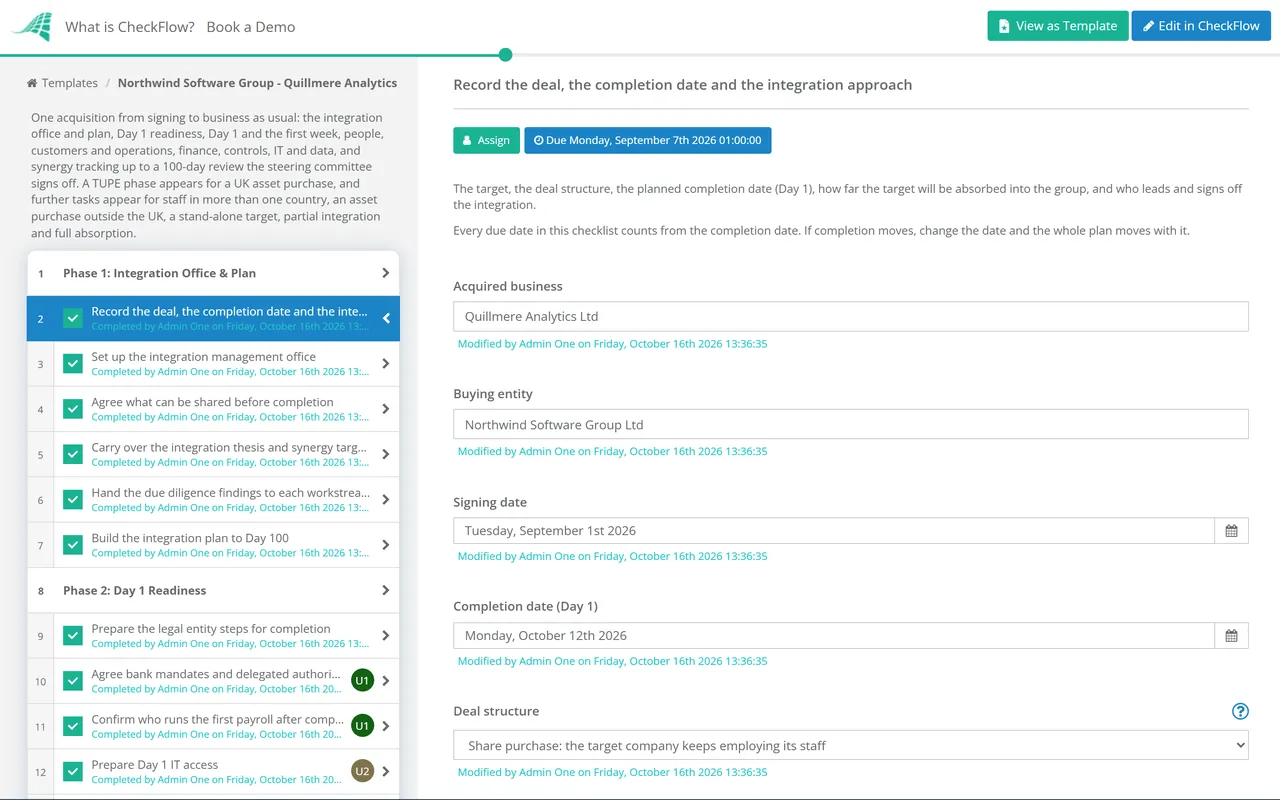
This free post-merger integration checklist is for integration leads, corporate development, HR and finance teams bringing an acquired business into the group. One run covers one acquisition, from signing to the 100-day review and the handover to business as usual, with every due date counted from the completion date. It starts with the integration office, the synergy targets from the deal model and the due diligence findings, then covers Day 1 readiness, Day 1 itself and the first week. After that it runs the people, customer, supplier, operations, finance, controls, IT and data workstreams, reports synergies against target every month, and ends with a 100-day review the steering committee signs off. Answers on the first task add a TUPE phase for a UK asset purchase, a local employment check for staff in more than one country or an asset purchase abroad, and tasks that depend on whether the target stands alone, is partly integrated or is fully absorbed.
Due diligence decides whether to buy and at what price. The M&A Due Diligence Checklist ends with an integration plan, and the Purchase of a Business Checklist runs the deal to completion. This checklist picks up from signing: it turns the integration plan into tasks with owners and due dates, and runs them until the integration is handed to business as usual.
It is also not a restructuring checklist. If the plan changes or removes roles, run that work through the Redundancy & Layoff Process Checklist, which covers pools, selection and consultation, and keep it in the integration timeline here. In the UK, the deal structure matters too: an asset purchase can move employees to the buyer under TUPE, and a share purchase does not change the employer at all.
Covers: the target’s finances, contracts, people, technology and risks, the price and the protections in the SPA.
Ends: with an investment decision and the findings the integration has to manage.
Covers: the integration office, Day 1 readiness, Day 1, people, customers, operations, finance, IT, data and synergy tracking for the first 100 days.
Ends: with a signed-off 100-day review and every open item owned by someone in the business.
Covers: selection pools, consultation, notice and exits when roles change or close. The Redundancy & Layoff Process Checklist runs it.
Ends: when every affected employee has been through a fair process. It is one workstream inside an integration, not the integration.
Eight phases take one acquisition from signing to business as usual, with every date counted from completion. The checklist halts at the 100-day sign-off in Phase 8, and the answers on the first task add Phase 3 and tasks in Phases 1, 2, 6 and 7.
Start at signing, or earlier if you can. The answers on the first task decide what appears: the deal structure adds Phase 3 or a task in Phase 2, staff in more than one country add a task in Phase 2, and the integration approach adds tasks in Phases 1, 6 and 7.
Day 1 must-haves only. The executive sponsor confirms readiness on the last task; it does not hold the checklist, because completion happens on the date the SPA sets.
Applies only to a UK asset purchase or business transfer, where employees move to the buyer under the TUPE Regulations 2006. A share purchase does not change the employer, so this phase is hidden for one. Take employment law advice throughout.
The people tasks go to the HR lead named on the first task. After a UK asset purchase, TUPE limits changes to the transferring employees’ terms.
The last task appears only when the target is fully absorbed into the group.
Finance tasks go to the finance lead and IT tasks to the IT lead named on the first task. The migration task appears when the target is partly integrated or fully absorbed.
The executive sponsor signs off the 100-day review for the steering committee. The checklist halts there, so nothing is handed to business as usual until it is approved.
Every due date in the template counts from the completion date on the first task: before it for planning and Day 1 readiness, after it for everything else. The timeline assumes about five weeks between signing and completion. If you sign and complete on the same day, start the checklist before signing so that Phases 1 and 2 are done in time.
| When | What happens | Owner | Phase |
|---|---|---|---|
| 5 weeks before completion | Deal recorded, integration office set up, information rules agreed, TUPE scope confirmed | Integration lead, legal and HR | 1 and 3 |
| 4 weeks before | Synergy targets and due diligence findings carried over; employee liability information checked and measures sent to the seller | Integration lead, finance and HR | 1 and 3 |
| 3 weeks before | Integration plan to Day 100, legal entity steps, local employment checks, consultation with representatives | Integration lead, legal and HR | 1, 2 and 3 |
| 2 weeks before | Bank mandates and delegated authorities, the first payroll, Day 1 IT access | Finance, HR and IT leads | 2 |
| 1 week before | Day 1 communications ready; readiness confirmed by the executive sponsor 3 days before | Integration lead and executive sponsor | 2 |
| Day 1 (completion) | Completion confirmed, announcements made, Day 1 sessions held, Day 1 access given | Integration lead, leaders of both businesses and IT | 4 |
| Weeks 1 and 2 | Companies House filings, first-week review, leadership and retention, key customers, operations check, SPA deadlines, IT security review, TUPE payroll | All workstream leads | 3–7 |
| Weeks 4 to 9 | Terms compared, consents and retention, first group month-end close, first synergy report, organisation design, suppliers, controls, data protection, HR policies, pricing, completion accounts, steering committee report, system migrations | HR, finance, commercial and IT leads | 5–8 |
| Weeks 12 and 13 | Terms harmonised where lawful, customers and brand moved (fully absorbed targets only), 100-day review | HR and commercial leads, integration lead | 5, 6 and 8 |
| Day 100 and after | Steering committee sign-off, then open items handed to business as usual and the integration office closed | Executive sponsor and integration lead | 8 |
A share purchase does not change the employer. When you buy a company’s shares, that company keeps employing its staff. GOV.UK’s guidance on TUPE says the identity of the employer must change for a business transfer to be protected, so nobody transfers under TUPE at completion. It can apply later if the business, or part of it, moves to another group company, so take advice before any such move.
In a UK asset purchase, staff move with the business. Under the Transfer of Undertakings (Protection of Employment) Regulations 2006, the contracts of employees assigned to the transferring business continue with the buyer, together with the seller’s rights and liabilities under them (regulation 4). The seller must give the buyer employee liability information at least 28 days before the transfer (regulation 11). Each employer must inform the representatives of its affected employees long enough before the transfer to allow consultation, and the buyer must give the seller information about any measures it envisages (regulation 13). A tribunal can award up to 13 weeks’ pay per affected employee for a failure to inform or consult, and the buyer is jointly and severally liable with the seller for an award made against the seller (regulations 15 and 16).
Harmonising terms has limits. After a TUPE transfer, a change to a transferring employee’s contract is void if the sole or principal reason is the transfer (regulation 4(4)). It can be valid if the reason is an economic, technical or organisational reason entailing changes in the workforce and the employee agrees, or if the contract already allows it (regulation 4(5)). A dismissal whose sole or principal reason is the transfer is automatically unfair (regulation 7). GOV.UK’s guidance adds that employers can improve terms if employees agree.
Companies House and payroll. A UK company must tell Companies House about new directors and secretaries, a new registered office and changes to its people with significant control, the last within 14 days of confirming the change, and filing a new director’s appointment needs that director’s Companies House personal code. If employees move to a payroll under a different PAYE employer reference, HMRC’s guidance is to send the last Full Payment Submission under the old reference before the first under the new one, and to give transferring employees their pay and deductions to date rather than a P45.
People tasks go to the HR lead, finance tasks to the finance lead and IT tasks to the IT lead named on the first task. Each lead sees their own work in the Tasks Grid, and each acquisition sits in the Reports Grid with its progress, so the integration lead can see what is late without a status meeting.
The deal structure, the integration approach and where the target employs people decide what appears. A UK asset purchase adds the TUPE phase, a stand-alone target gets a task to record what stays separate, and a fully absorbed one adds the move of customers, contracts and brand. Conditional logic keeps the rest out of the way.
The review ends in an approval step assigned only to the executive sponsor. The checklist halts there, so open items move to business as usual only once the steering committee has signed off, and the decision records who approved it and when. Due dates count from the completion date, so if completion moves, the whole plan moves with it.
Before you get here, the M&A Due Diligence Checklist and the Financial Due Diligence Checklist produce the findings that Phase 1 hands to each workstream, and the Purchase of a Business Checklist runs the deal through to completion. Sellers preparing a business for sale can use the Investor Data Room Checklist.
Some workstreams have templates of their own. The Redundancy & Layoff Process Checklist runs any role reductions, the ERP & Accounting Software Implementation Checklist and the Email Migration Checklist cover system moves, the Month-End Finance & Accounting Close Checklist runs the target’s first closes in the group, and the Vendor Offboarding Checklist ends supplier contracts the group no longer needs.
Describe the process in a sentence and the AI checklist generator drafts the phases and tasks for you.
It should cover the first 100 days, not only Day 1. Start with an integration office, the synergy targets from the deal model and the due diligence findings, then build a plan to Day 100. Get the Day 1 must-haves ready: legal entity steps, bank mandates and authorities, payroll, IT access and communications. After completion, run the people, customer, supplier, operations, finance, controls, IT and data workstreams, report synergies against target every month, and finish with a 100-day review that the steering committee signs off before handover.
It is the plan for the first 100 days after completion: what each workstream will deliver, by when, who owns it and what depends on what. It separates the Day 1 must-haves, which keep people paid and customers served, from the changes that can wait for proper planning. In this checklist the plan is built in Phase 1 and every due date counts from the completion date, so each deal runs on the same timetable. The 100-day review then checks what was actually delivered.
Only what the business needs to keep running and what the deal or the law requires on the day. That usually means the completion documents, changes to bank mandates and signing authorities, a payroll that runs on time, the access people need to do their jobs, and announcements to employees, customers and suppliers in an agreed order. In the UK, changes of directors and people with significant control are also filed at Companies House. Most other changes, such as new systems or policies, are better made after Day 1, to plan.
The integration management office, or IMO, runs the integration as a programme. It is usually a small team under an integration lead, with a lead for each workstream and a steering committee chaired by an executive sponsor. It keeps the plan, the synergy register, the risks, the issues and the decisions in one place, holds a regular meeting, reports progress and escalates what is late. It closes once the 100-day review is signed off and every remaining item has an owner in the business.
Not at completion. In a share purchase the company that employs the staff stays the same, and GOV.UK’s guidance says the identity of the employer must change for a business transfer to be protected by TUPE. It can apply later if the business or part of it moves to another group company. In a UK asset purchase or business transfer, TUPE usually does apply: employees move to the buyer on their existing terms, and both employers have duties to inform and consult before the transfer. Take employment law advice either way.
Sometimes, with care. After a TUPE transfer, a change to a transferring employee’s terms is void if the sole or principal reason is the transfer. It can be valid where there is an economic, technical or organisational reason entailing changes in the workforce and the employee agrees, or where the contract already allows it, and GOV.UK’s guidance says improvements can be made with agreement. After a share purchase TUPE does not apply, but the ordinary rules on changing employment contracts do. Compare the terms first and take advice before proposing a change.
Carry each synergy over from the deal model into a register with its type, annual value, one-off cost to achieve, owner and target date, keeping revenue and cost synergies apart. Report actual against target every month, with the reason for any slippage and the one-off costs spent so far. Count only what has been delivered, not what has been planned. At the 100-day review, give each synergy still to come an owner in the business and keep reporting it through normal management reporting until it is delivered.
14-day free trial, no card required. The Business plan is $10 per user per month after the trial. Full details at checkflow.io/pricing.
14-day free trial, no credit cardFull refund in your first 30 daysUS or EU hosting