
Run by the fund
Question: should we invest, and on what terms?
Work: requests, review, reference calls, investment memo.
Output: an investment committee decision.
Last reviewed: October 2026
No Credit Card Required
Printed from checkflow.io/templates/due-diligence/investor-data-room-checklist
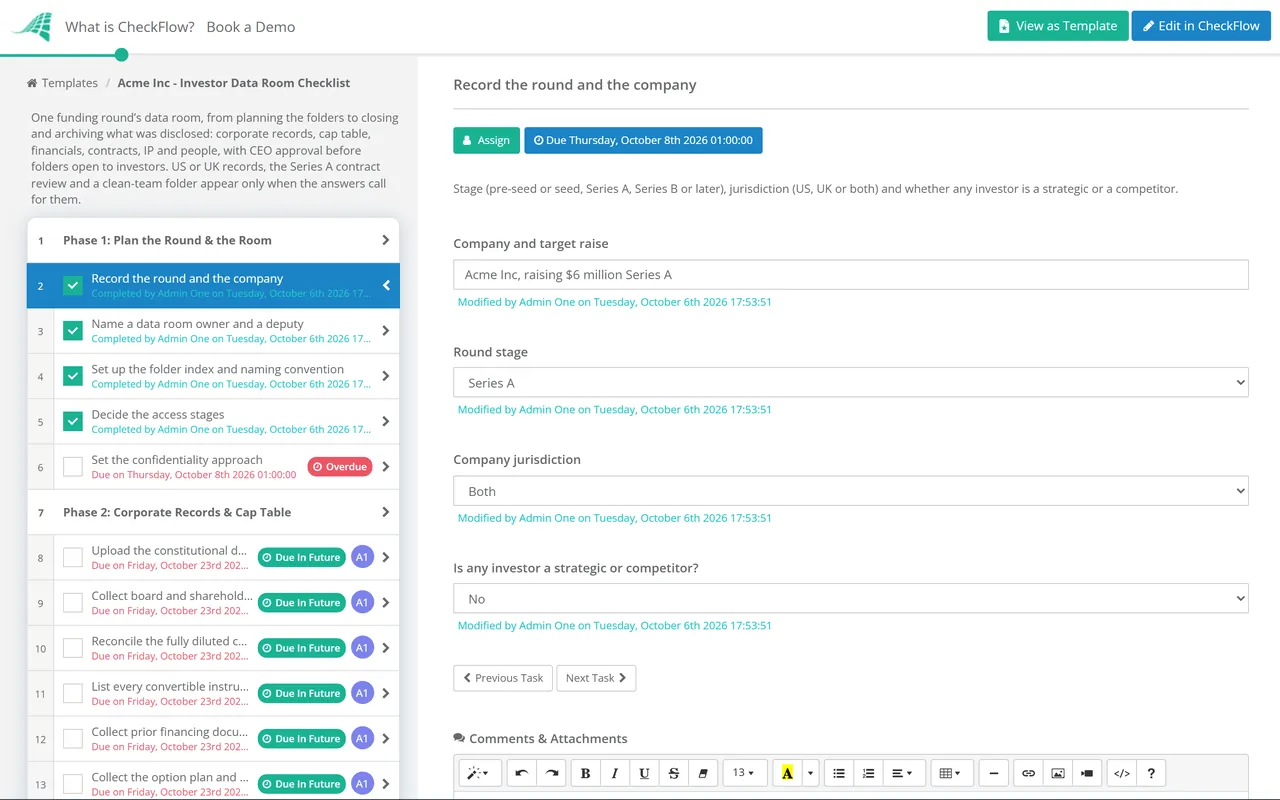
This free checklist is for founders, CFOs and operations leads preparing a data room for an equity round, from seed to growth stage. It covers the folder structure, what to include at each stage, the corporate and cap table records investors check first, financials and metrics, commercial, product and IP documents, staged access and permissions, the Q&A log and close-out. Choose the company’s jurisdiction and the checklist adds the Delaware and US securities records or the Companies House and HMRC scheme records. The CEO approves each folder before investors can see it.
Investors run their own process. Our Venture Capital Due Diligence Checklist and Private Equity Due Diligence Checklist are written for the fund: what to ask, what to test and how to reach an investment decision. This template is for the company. Its job is to have the answers ready, organised and accurate before anyone asks, and to control who sees what and when.
A good data room does not need to be large. At seed, investors mostly want a clean cap table, the constitutional documents and evidence that the founders own the IP. By Series B they expect audited accounts, customer contracts and a full legal folder. The most common delays are not missing documents but inconsistent ones: a deck metric that does not match the model, or a cap table that does not reconcile to the share register.
Question: should we invest, and on what terms?
Work: requests, review, reference calls, investment memo.
Output: an investment committee decision.
Question: can we answer every reasonable request fast and consistently?
Work: collect, reconcile, fix gaps, stage access, log Q&A.
Output: a closed round with no surprises in the disclosures.
Question: how do we sell the whole company?
Work: vendor reports, auction rounds, a disclosure process.
Output: a signed purchase agreement.
Five phases run on every round. The US and UK record phases appear from the jurisdiction answer, and a company with both, such as a UK business with a Delaware parent, gets both.
Owned by the CEO or CFO. The answers recorded here decide which later phases and tasks appear.
Shown only when the jurisdiction is US or both. Prepared with company counsel.
Shown only when the jurisdiction is UK or both. Prepared with company counsel and the accountant.
Tasks marked Series A or later are shown from the stage answer in Phase 1.
The CEO approves each folder before it opens to investors. A Not approved answer returns it to the data room owner.
Investors’ expectations grow with the round. The table reflects common practice, not a rule: a lead investor’s counsel will send its own request list, and this structure should answer most of it.
| Folder | Pre-seed and seed | Series A | Series B and later | Phase |
|---|---|---|---|---|
| Corporate | Constitution, minutes, consents | Plus all side letters and investor rights | Plus subsidiaries and group structure | 2–4 |
| Cap table | Fully diluted, reconciled to the register | Plus pro forma for the new round | Plus waterfall analysis | 2 |
| Financials | Management accounts, simple model | Historical accounts, KPI definitions | Audited accounts, often a quality of earnings review | 5 |
| Commercial | Pipeline, pilots, letters of intent | Top customer contracts, churn data | Full contract set, cohort analysis | 5 |
| Product and IP | IP assignments, architecture overview | Open-source inventory, security policies | Pen test results, certifications | 3–5 |
| People | Founder agreements, option plan | Key contracts, org chart | Full HR folder, anonymised where possible | 5 |
| Legal and regulatory | Any disputes | Licences, privacy documentation | Full litigation and compliance history | 5 |
The second table lists filings that investors’ counsel commonly check. A missed one is usually fixable, but fixing it in the middle of a round costs time.
| Record | Deadline or rule | Source | Phase |
|---|---|---|---|
| 83(b) election | Within 30 days of the transfer of restricted stock | US Internal Revenue Code s.83(b) | 3 |
| 409A valuation | Independent appraisal presumed reasonable if no more than 12 months old and nothing material has changed | Treas. Reg. 1.409A-1(b)(5)(iv)(B) | 3 |
| Form D | Within 15 days after the first sale in a Regulation D offering | SEC Rule 503 | 3, 7 |
| Return of allotment (SH01) | Within one month of allotment | Companies Act 2006 s.555 | 4, 7 |
| Amended articles | Filed within 15 days | Companies Act 2006 ss.26 and 30 | 7 |
| EMI grant notification | By 6 July after the tax year of grant, for grants from 6 April 2024 | ITEPA 2003 Sch. 5 para. 44, as amended | 4 |
| Director and PSC identity verification | Required since 18 November 2025 | Economic Crime and Corporate Transparency Act 2023 | 4 |
Some of this is moving. For US stock issued after 4 July 2025, the qualified small business stock rules allow a partial gain exclusion after three or four years, a larger per-company cap and a higher gross assets limit of $75 million, so the date and terms of each issue matter more than before. In the UK, the government confirmed in March 2026 that it will change the NSI Act mandatory sectors, adding water and splitting out critical minerals and semiconductors, but the changes take effect only when secondary legislation, expected later in 2026, is in force, so check the schedules that apply on the day.
Assign the cap table to the CFO, IP assignments to counsel and customer contracts to the commercial lead, each with a due date. You see what is missing weeks before the first investor logs in.
Conditional logic adds 83(b), 409A and Form D tasks for a Delaware company, Companies House and EMI tasks for a UK one, and the clean-team folder only when a strategic investor is in the round.
The CEO’s approval of each folder is assigned to a named member and holds the checklist until answered. The activity trail shows who approved what and when, which helps when disclosures are argued over later.
CheckFlow is not a virtual data room. It does not host documents for investors, set viewer permissions or watermark files. Keep the documents in your data room provider and use CheckFlow to run the preparation around it: who is collecting what, which folders are approved, and which questions are still open. The fintech overview shows other workflows growing companies run the same way.
Sending investor NDAs? The NDA Processing Workflow Checklist tracks each one. After closing, the Investor Communication & Reporting Framework Checklist covers the reporting you have just promised. Selling the company rather than raising? Buyers will run the Financial Due Diligence Checklist on your numbers.

Venture Capital Due Diligence Checklist
Private Equity Due Diligence Checklist
NDA Processing Workflow Checklist
Investor Communication & Reporting Framework Checklist

Intellectual Property Registration Checklist
Describe the process in a sentence and the AI checklist generator drafts the phases and tasks for you.
At minimum: constitutional documents, board and shareholder approvals, a fully diluted cap table reconciled to the register, every SAFE or convertible note, the option plan and grants, IP assignments, financial statements and the model, and key contracts. Investors expect more at later stages, such as audited accounts, the full customer contract set and security documentation. Organise it in numbered folders so a lawyer can find anything from the index.
Build it before you start meetings, and open it in stages. A small pre-term sheet folder with the deck, model and key metrics helps investors decide quickly. The full room opens for confirmatory diligence after a term sheet, when the lead investor’s counsel sends its request list. Preparing early leaves time to fix gaps such as missing board approvals without delaying the close.
Many venture investors decline NDAs at an early stage because they see many similar companies. The practical answer is to stage access: share what you would be comfortable seeing in a competitor’s hands early, and hold customer names, pricing and source-level technical detail until a term sheet or an NDA is in place. Strategic investors who compete with you are different: use an NDA and a clean-team arrangement.
Usually the cap table and the corporate approvals behind it, then IP ownership. They want to know who owns the company, whether every share and option was validly issued, and whether the company owns what it sells. In the US that means 83(b) elections and 409A valuations; in the UK, SH01 filings, pre-emption waivers and EMI notifications. Inconsistencies between the deck, the model and the accounts are the next thing they notice.
A fundraising room serves minority investors buying new shares, so it focuses on the cap table, growth and the terms of earlier rounds. An M&A room serves a buyer taking the whole company, so it goes deeper into liabilities, tax, employees and every contract, and usually supports a formal disclosure process. A well-kept fundraising room is a strong start for an eventual sale.
14-day free trial, no card required. The Business plan is $10 per user per month after the trial. Full details at checkflow.io/pricing.
14-day free trial, no credit cardFull refund in your first 30 daysUS hosting, EU on request