TUPE Transfer Checklist Template

Handing over or taking on staff under TUPE? Check that TUPE applies, agree who transfers, send or check the employee liability information on time, inform and consult every affected group, and sign off that it is done before the transfer date.

Last reviewed: November 2026

Printed from checkflow.io/templates/human-resources/tupe-transfer-checklist

This free TUPE transfer checklist is for HR teams and managers in Great Britain on either side of a relevant transfer: the outgoing employer (the transferor) or the incoming employer (the transferee), in a business transfer or a service provision change such as outsourcing, re-tendering or bringing a service back in-house. One run covers one transfer, planned back from the transfer date. It checks that TUPE applies, identifies who is assigned and who else is affected, records the measures each employer envisages and the representatives who must be informed and consulted, with an election or the small-business route where they apply. It sends or checks the employee liability information well before the 28-day limit, informs and consults, writes to staff, handles objections, and prepares payroll, pensions and right to work records. A named person signs off that informing and consulting are complete before the transfer day, and the run ends with fresh right to work checks and a review. It reflects the Employment Rights Act 2025 changes in force on 3 November 2026.

TUPE Transfer, Post-Merger Integration or Redundancy?

This checklist runs one relevant transfer under TUPE, from the side of the outgoing or the incoming employer: a business transfer, or a service provision change such as outsourcing a service, moving a contract to a new contractor, or bringing it back in-house. It covers the statutory steps from deciding that TUPE applies to the review after the transfer day, and works the same whether the transfer comes from a sale, a tender or a restructure.

A deal that buys a business has its own integration plan in the Post-Merger Integration Checklist, whose TUPE phase covers the buyer’s side of a UK asset purchase. Any dismissal connected with the transfer goes through the Redundancy & Layoff Process Checklist or the Employee Termination Checklist. A move to another role with the same employer is not a TUPE transfer: use the Internal Transfer & Role Change Checklist. Ending a supplier contract, where TUPE may apply to the supplier’s staff, starts in the Vendor Offboarding Checklist.

This checklist

One TUPE transfer

Covers: whether TUPE applies, who transfers and who is affected, measures, representatives and any election, the employee liability information, informing and consulting, staff letters, objections, payroll, pensions, right to work records, the sign-off, transfer day and the review.

Planned around: the transfer date, from either employer’s side.

Output: every statutory step done and recorded before the employees move.

A deal

Post-merger integration

Covers: bringing an acquired business into the group after completion: leadership, Day 1, systems, customers and synergies, with a TUPE phase for a UK asset purchase.

Planned around: the completion date and the first 100 days.

Output: an integrated business. Use this checklist for the TUPE steps in more depth.

Dismissals

Redundancy and layoff

Covers: consultation, selection, notice and redundancy pay when roles go, including any after a transfer for an economic, technical or organisational reason.

Planned around: its own consultation timetable.

Output: a fair redundancy process. This checklist hands any dismissals to it.

What the TUPE Transfer Checklist Covers

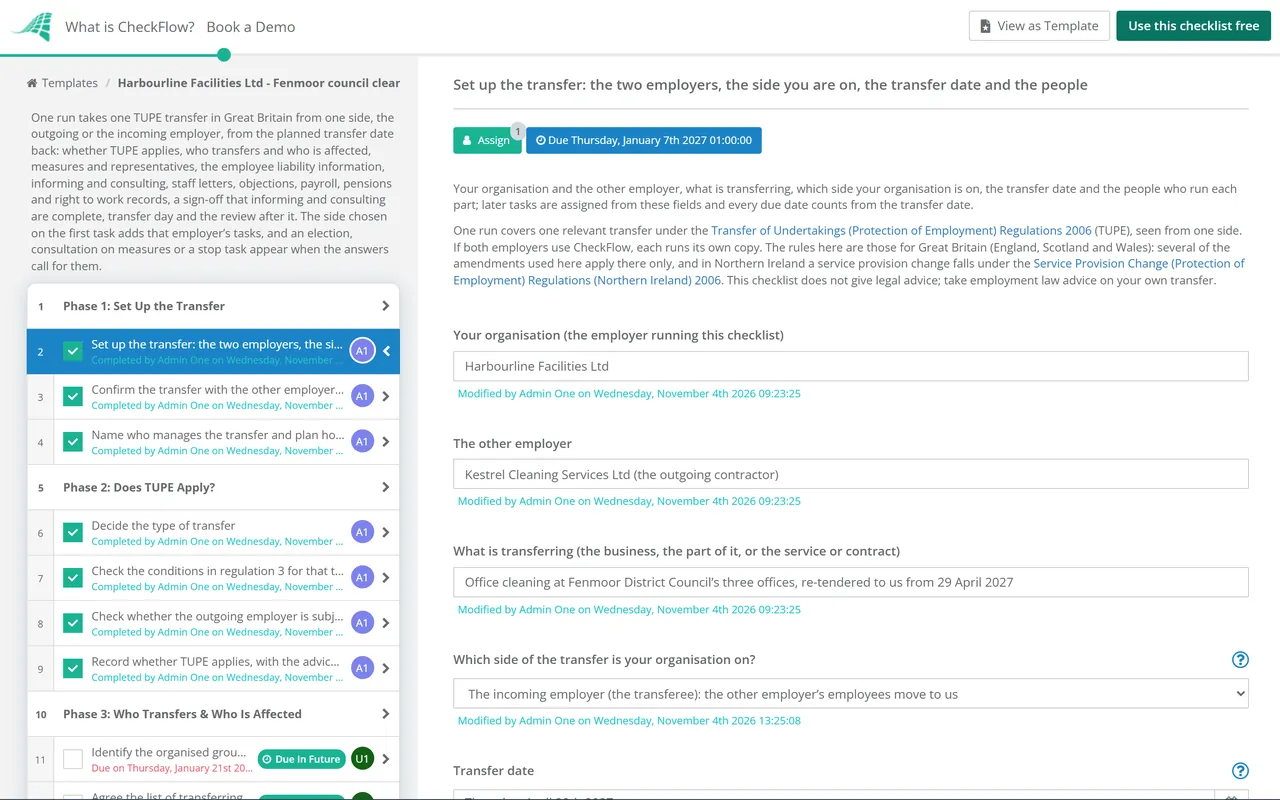
Nine phases take one transfer from the first conversation with the other employer to the review after it. The first task records the transfer date, which sets every due date, and the side your organisation is on, which adds the outgoing or the incoming employer’s tasks. Later answers add an election of representatives, consultation on measures, or a task to stop the run if TUPE does not apply. The sign-off in Phase 8 is assigned to one person, and nothing after it can be completed until they confirm that informing and consulting are complete.

  1. Phase 1

    Phase 1: Set Up the Transfer

    3 tasks

    Owned by the transfer lead. Enter the transfer date on the first task: every due date counts back from it in working days, and the tasks after the transfer count forward. Say which side of the transfer your organisation is on, and the tasks for that side appear. This checklist follows the rules for Great Britain.

    • Set up the transfer: the two employers, the side you are on, the transfer date and the people — your organisation and the other employer, what is transferring, which side your organisation is on, the transfer date and the people who run each part; later tasks are assigned from these fields and every due date counts from the transfer date
    • Confirm the transfer with the other employer: what moves, the date and the contacts — the business, part or service that is transferring, the planned transfer date, the reasons for the transfer, and one named contact on each side for the employee side of the transfer
    • Name who manages the transfer and plan how staff will be kept informed — one person who manages the transfer and is the point of contact, a transfer plan with the dates in this checklist, and how and when affected employees will hear about it
  2. Phase 2

    Phase 2: Does TUPE Apply?

    5 tasks

    Decide what kind of transfer this is and check it against regulation 3. The answer on the last task of this phase confirms the run, or shows a task to stop it.

    • Decide the type of transfer — a business transfer, or a service provision change by outsourcing, re-tendering or insourcing; the next task shows the conditions for the type you choose
    • Check the conditions in regulation 3 for that type — the tests the regulations set for the type chosen on the task before, with the facts that meet each one
    • Check whether the outgoing employer is subject to insolvency proceedings — bankruptcy, liquidation, administration or another insolvency proceeding changes how TUPE applies (regulations 8 and 9), and this checklist does not cover it
    • Record whether TUPE applies, with the advice taken — the conclusion, who advised and when; if TUPE does not apply, or advice is still awaited, a task appears to stop or pause the run
    • Stop this run if TUPE does not apply — record why TUPE does not apply and archive this checklist now: the tasks after this one stay on the checklist but do not apply. If staff will still move or lose their jobs, the ordinary rules on contracts, dismissals and redundancy apply instead
  3. Phase 3

    Phase 3: Who Transfers & Who Is Affected

    6 tasks

    Work out who is assigned to what is transferring, who else is affected, and what warranties and indemnities the employers give each other. Affected employees are wider than the people who move: they include employees on both sides whose work may be affected by the transfer or by measures taken in connection with it.

    • Identify the organised grouping and the employees assigned to it — everyone assigned to the business, part or service immediately before the transfer, including anyone on sick leave, parental leave or holiday, with how much of their time they spend on the work
    • Agree the list of transferring employees with the other employer — one list both employers work from, with anyone in doubt marked and the reason
    • List every other employee affected by the transfer or its measures — employees of your organisation who are not transferring but whose work may change, such as colleagues who stay behind or the team the transferring staff will join, including anyone on leave
    • Record the agency workers your organisation uses — the number of agency workers working for you, the parts of the organisation they work in and the type of work they do, which the information to representatives must include
    • Collect the terms that will transfer — contracts and written statements, policies and handbook terms, collective agreements, union recognition, pay and bonus schemes, benefits, pensions and any terms agreed but not written down
    • Agree warranties and indemnities, with legal advice — written confirmations about the employees, their terms and liabilities, and who pays if a claim follows, such as a failure to inform and consult
  4. Phase 4

    Phase 4: Measures & Representatives

    7 tasks

    Decide what measures your organisation envisages, get or give the incoming employer’s measures in writing, and find out who must be informed and consulted. The representatives answer decides whether an election is needed.

    • Decide the measures you envisage for your own affected employees — measures are changes in connection with the transfer that will affect employees, such as a new place of work, new hours, a change of pay date, different pension arrangements or redundancies; if your organisation envisages none, record that
    • Tell the outgoing employer in writing about the measures you envisage for the transferring staff — the changes you plan for the employees who will join you, or that you envisage none, in time for the outgoing employer to inform its representatives
    • Get the incoming employer’s envisaged measures in writing — the changes the incoming employer envisages for the employees who will join it, or confirmation that it envisages none, so they can go in the information to your representatives
    • Find out who the appropriate representatives are — a recognised trade union for these employees, existing employee representatives with authority to be informed and consulted about the transfer, or neither; with neither, count the employees to see whether the small-business route can apply
    • Invite the affected employees to elect representatives — the number of representatives, whether employees are represented as one group or in groups, how long the representatives will serve, and the timetable, sent long enough before the information is due
    • Hold the election of representatives — a fair election in which every candidate is an affected employee, no affected employee is unreasonably excluded from standing, every affected employee can vote for as many candidates as there are places, voting is secret where possible and the votes are counted accurately
    • Give the representatives access, facilities, time off and training — access to the affected employees they represent, a room and other facilities as appropriate, and paid time off for their duties and for training
  5. Phase 5

    Phase 5: Employee Liability Information

    5 tasks

    The outgoing employer must give the incoming employer the employee liability information at least 28 days before the transfer. The outgoing employer compiles and sends it; the incoming employer checks it.

    • Agree with the other employer how and when the information will be given — the format, a secure way to send it, the date it will be compiled to and the date it will be sent, and who answers questions about it
    • Compile the employee liability information as at a specified date — for every assigned employee, including anyone who would have been assigned had they not been dismissed because of the transfer: identity and age, the written statement particulars, disciplinary and grievance procedures in the last two years, claims in the last two years or that you reasonably believe may be brought, and any collective agreement that will apply after the transfer
    • Send the employee liability information at least 28 days before the transfer — in writing or in a readily accessible form, in one go or in instalments, directly or through a third party, and keep proof of when it went
    • Check the employee liability information as soon as it arrives — against the agreed list, the due diligence and, where you can, what the transferring employees tell you; record if it has not arrived 28 days before the transfer
    • Resolve inconsistencies and record every update — answers to the incoming employer’s questions, and every change after the information was sent (a leaver, an objection, a pay rise), notified in writing
  6. Phase 6

    Phase 6: Informing & Consulting

    6 tasks

    Give every representative the information in writing long enough before the transfer to allow consultation, consult on any measures with a view to seeking agreement, and answer what they say. Both employers have this duty for their own affected employees.

    • Write the information for the representatives — the fact of the transfer, its date or proposed date and the reasons for it; its legal, economic and social implications for affected employees; the measures your organisation envisages, or that there are none; the outgoing employer adds the incoming employer’s measures, or that there are none; and the agency worker information
    • Give the information to each representative — delivered to each representative, or sent by post to an address they gave, or for a trade union posted to its head or main office, and the dates recorded
    • Keep every affected employee informed, including anyone on leave — briefings, letters or emails to all affected employees in formats they can use, with a way to ask questions, so that people who are not union members or are away from work hear the same facts
    • Consult on the measures with a view to seeking agreement — meetings with the representatives about each measure your organisation envisages, with their questions and proposals recorded and genuinely considered
    • Reply to the representations, giving reasons for any you reject — a written reply to each representation, with the reasons for any that are rejected
    • Keep a record of the information and consultation — the information given, the dates, the meetings, the replies and anything agreed, in one place, ready for the sign-off and for any later complaint
  7. Phase 7

    Phase 7: Staff Letters, Objections & Hand-Over

    8 tasks

    Write to the transferring employees, deal with anyone who objects, tell customers, and prepare payroll, pensions and right to work records for the transfer day.

    • Write to each transferring employee — a letter confirming the transfer date, the new employer, that their terms and continuous service move with them, what changes if anything, and who to ask
    • Record any objection to transferring and tell the other employer — who objected, the date and what they were told would happen, with the employee liability information updated
    • Tell customers or the client about the transfer — who needs to know, what changes for them and the contacts from the transfer date
    • Plan the final payroll and the payroll hand-over — the last pay run for the transferring employees, their year-to-date pay and deductions, and what HMRC says about which employer reference to use
    • Set up payroll for the transferring employees — every employee on the new payroll with their pay, pay date, tax code and year-to-date figures as HMRC’s answer requires, ready for the first pay day
    • Set up the pension arrangements the transferring employees need — what each employee has today, an occupational pension, a personal pension the old employer pays into, or none, and the arrangement that meets the law from the transfer date
    • Hand over or receive the right to work check records — copies of each transferring employee’s right to work check, and the dates any follow-up check is due
    • Plan the transfer day — who meets the transferring employees, what they hear, systems, equipment and access ready, and how the employees who stay are supported
  8. Phase 8

    Phase 8: Sign-Off & Transfer Day

    5 tasks

    The person named on the first task signs off that informing and consulting are complete before the transfer date. Nothing after the sign-off can be completed until it is done. The transfer happens on its date by law whatever is recorded here.

    • Agree a later transfer date and finish informing and consulting — after ‘Not complete: a later transfer date is being agreed’ only: agree the new date with the other employer, change the transfer date on the first task so every due date moves, finish what was left, then change the decision on the sign-off to Complete and complete it
    • Sign off that informing and consulting are complete before the transfer — the information given to every representative or affected employee, consultation on every measure finished with replies given, the employee liability information sent or received, and objections dealt with
    • Record why informing and consulting could not be finished, and finish what still can be — after ‘Not complete: the transfer goes ahead on this date’ only: the special circumstances, every step taken towards each duty, the advice taken, and the information or replies still given before the transfer
    • Welcome the transferring employees and check everyone has arrived — every expected employee welcomed and introduced to their manager and team, the induction started, and the contact for questions about their terms given
    • Confirm with the incoming employer that every employee has transferred — the employees who transferred, anyone who objected or left, and support for the employees who stay
  9. Phase 9

    Phase 9: After the Transfer

    7 tasks

    Confirm the change of employer, finish the payroll hand-over and the right to work checks, carry out any measures as consulted on, and review the transfer. Any dismissal goes through its own process.

    • Confirm the change of employer to each transferred employee in writing — that the employer has changed, and that their length of service and contractual rights are the same as before the transfer
    • Report the payroll change to HMRC in the right order — the payroll reports for the transfer, made as HMRC told you: where it is a succession, the last report under the old employer reference goes before the first under the new one
    • Carry out any measures as consulted on, and start any dismissals properly — each measure as it was consulted on; a change to a transferred employee’s terms or any dismissal only after advice, and any redundancies through their own process
    • Check in with the employees who stayed — how the work is covered without the employees who left, workload, and any concerns
    • Do fresh right to work checks within 60 days of the transfer — a fresh check on every transferred employee, with the dates recorded and any follow-up check scheduled
    • Hold the post-transfer review — what went well, what did not, any claim or concern raised, and what to do differently next time
    • Keep the transfer records — the information, consultation record, employee liability information, objections, letters and sign-off, kept securely for at least as long as a claim could be brought

What Each Employer Does Under TUPE, and What Has Changed

What each employer does

The side chosen on the first task adds the tasks in that column. Both employers have their own duty to inform and consult.

Duty Outgoing employer (transferor) Incoming employer (transferee) Source
Employee liability informationGives it in writing or in a readily accessible form at least 28 days before the transfer, as at a date no more than 14 days before it is sent, and notifies any change in writing.Checks it. Can complain to a tribunal if it is late, incomplete or wrong; compensation is not less than £500 for each employee unless the tribunal considers it just and equitable to award a lesser sum.Regulations 11 and 12
MeasuresTells its representatives the measures the incoming employer envisages, or that there are none.Gives the outgoing employer that information in time for it to inform its representatives.Regulation 13(2)(d) and (4)
InformingInforms the representatives of its own affected employees, including those who stay, long enough before the transfer to allow consultation.Informs the representatives of its own affected employees, such as the team the newcomers join.Regulation 13(2) and (2A)
ConsultingConsults on the measures it envisages for its own affected employees, with a view to seeking agreement, and replies to representations with reasons.The same, for the measures it envisages for its own affected employees.Regulation 13(6) and (7)
Who is informed and consultedA recognised trade union’s representatives; otherwise existing or elected employee representatives, as the employer chooses.The same, for its own affected employees.Regulations 13(3) and 14
The small-business routeWith fewer than 50 employees, or fewer than 10 transferring, no representatives and no invitation to elect: each affected employee directly.The same test, applied to its own organisation.Regulation 13A, for transfers from 1 July 2024
ObjectionsAn employee who objects does not transfer; the transfer ends their contract and they are not treated as dismissed.May be the employer the employee tells; passes it on.Regulation 4(7) and (8)
PensionsPension rights built up to the transfer are protected.Where a transferring employee was in, or eligible for, the outgoing employer’s occupational scheme, offers a pension at the legal minimum, for example matching their contributions up to 6% of pay.Pensions Act 2004, ss. 257 and 258; SI 2005/649
Collective redundancies before the transferCan agree to the incoming employer’s election, and may give it information or help.May elect to consult the transferring employees’ representatives before the transfer, with the outgoing employer’s agreement, where it proposes 20 or more redundancies at one establishment within 90 days.TULRCA 1992, s.198A
Right to workIts checks are deemed to have been done by the incoming employer.Advised to do fresh checks, with a grace period of 60 calendar days from the transfer.Home Office employer’s guide, 1 October 2026

The Employment Rights Act 2025 and TUPE

As legislation.gov.uk shows the Act on 3 November 2026. More of it comes into force during 2027, so check again before each transfer.

Change What it does In force
Tribunal time limitsComplaints about the employee liability information (regulation 12) and about informing and consulting (regulation 15) can be made within six months, up from three.Transfers on or after 1 October 2026 (Schedule 12; SI 2026/954)
Unfair dismissal qualifying period and compensationThe qualifying period falls from two years to six months, and the cap on the compensatory award is removed (section 25), which matters for any dismissal connected with a transfer.Dismissals whose effective date of termination is on or after 1 January 2027 (SI 2026/559, regulations 3 and 4)
Collective redundancy protective awardThe longest protected period for failing to consult on collective redundancies rises from 90 to 180 days (section 30).6 April 2026, with transitional provisions (SI 2026/323)
Dismissal for refusing a contract changeMakes a dismissal automatically unfair where the reason is that the employee did not agree to certain contract changes, or to replace or re-engage them on varied terms for the same duties (section 28).Only for making regulations so far; not yet for dismissals
Regulations 11, 13 and 13ANot changed by the Act.Not applicable

Where this comes from. The TUPE Regulations 2006 and the Employment Rights Act 2025 on legislation.gov.uk, read on 3 November 2026 (regulations 11, 13 and 13A up to date to that day); gov.uk’s Business transfers, takeovers and TUPE; Acas’s guidance on informing and consulting (updated 30 October 2026) and its two transfer plan checklists; and the Home Office’s Right to work checks: an employer’s guide (1 October 2026). These are the rules for Great Britain; in Northern Ireland some differ, and service provision changes fall under the Service Provision Change (Protection of Employment) Regulations (Northern Ireland) 2006. Take employment law advice on your own transfer.

Why Run TUPE Transfers in CheckFlow?

1

A sign-off before the transfer date

The sign-off is assigned to one person alone, and the checklist halts there: the transfer day tasks cannot be completed until they confirm that informing and consulting are complete. If a later transfer date is being agreed, the sign-off stays open and a task above it says what to finish. The employee liability information, the measures, the information and the consultation all come before it.

2

Only the tasks for your side

The outgoing employer gets the employee liability information, the incoming employer’s measures, objections and the final payroll. The incoming employer gets the check of that information, its measures in writing, payroll, pensions, the welcome and fresh right to work checks. An election, consultation on measures or a task to stop the run appear only when the answers call for them.

3

Every duty has a date and an owner

Name the transfer lead, the HR contact, the payroll and pensions contact and the person who signs off on the first task, and every task is assigned from those fields. Due dates count back from the transfer date in working days, with the employee liability information well before the 28-day limit, so moving the date moves the whole plan. Track every transfer in the Reports Grid.

CheckFlow does not give legal advice, decide whether TUPE applies or contact anyone for you: those stay with your HR team and your advisers. CheckFlow makes sure every step is done in order, by the right person, with the record kept.

Run any dismissals with the Redundancy & Layoff Process Checklist, a deal’s wider integration with the Post-Merger Integration Checklist, and each right to work check with the Right to Work Check Checklist.

AI generator

Didn’t find what you need? Describe it.

Describe the process in a sentence and the AI checklist generator drafts the phases and tasks for you.

Frequently Asked Questions

What should a TUPE transfer checklist include?

Whether TUPE applies, who is assigned and who else is affected, the measures each employer envisages, who the representatives are and any election, the employee liability information at least 28 days before the transfer, the information and consultation, letters to staff, objections, payroll, pensions and right to work records, transfer day and a review. This template covers those steps for one transfer from one side, with a sign-off that informing and consulting are complete before the transfer date.

What is a service provision change under TUPE?

Regulation 3 covers three: a client’s own activities moving to a contractor, a contract moving to a new contractor, and a contract ending with the client taking the work back. TUPE applies where an organised grouping of employees in Great Britain has the activities for that client as its principal purpose, the work is not a single event or short-term task, it is not wholly or mainly the supply of goods, and the activities afterwards are fundamentally the same.

When must employee liability information be provided?

The outgoing employer must give it to the incoming employer not less than 28 days before the transfer, or as soon as reasonably practicable after if special circumstances make that not reasonably practicable (regulation 11). It covers each assigned employee’s identity and age, written statement particulars, disciplinary and grievance cases and claims in the last two years, likely claims and collective agreements, as at a date no more than 14 days before it is sent. Changes are notified in writing.

Who do you have to inform and consult before a TUPE transfer?

Each employer informs the appropriate representatives of its own affected employees: a recognised trade union’s representatives, or otherwise existing or elected employee representatives. Affected employees include people on either side who are not transferring but may be affected by the transfer or its measures, and employees on leave. An employer that envisages measures must also consult the representatives about them, with a view to seeking their agreement.

Can a small business consult employees directly instead of electing representatives?

Yes, for transfers on or after 1 July 2024, where the employer has fewer than 50 employees or fewer than 10 employees are transferring, there are no appropriate representatives and the employer has not invited the affected employees to elect any (regulation 13A). It may then inform and consult each affected employee directly, as if each were a representative. An employer that qualifies can still hold an election instead.

What happens if an employee objects to a TUPE transfer?

Their contract does not transfer. The transfer ends it, but they are not treated as dismissed, so gov.uk says they will not normally be able to claim unfair dismissal or redundancy pay. They can tell either employer. Acas says the outgoing employer should write back to explain what will happen, pay outstanding wages and holiday, and tell the incoming employer. An employee facing a substantial change in working conditions to their material detriment can be treated as dismissed.

What happens to pensions in a TUPE transfer?

Pension rights built up to the transfer are protected. Rights under the old employer’s occupational scheme for old age, invalidity and survivors do not transfer (regulation 10). Where an employee was a member of that scheme, or eligible to join it, the new employer must offer a pension at a legal minimum, such as matching their contributions up to 6% of pay (Pensions Act 2004, sections 257 and 258). Contractual payments into a personal pension do transfer. Take pensions advice on your schemes.

Has the Employment Rights Act 2025 changed TUPE?

Not regulations 11, 13 or 13A, as legislation.gov.uk shows them on 3 November 2026. For transfers on or after 1 October 2026, tribunal claims about the employee liability information or about informing and consulting can be made within six months instead of three. From 1 January 2027 the unfair dismissal qualifying period falls to six months and the compensatory award cap goes, which matters for any dismissal connected with a transfer. More of the Act comes into force in 2027; check before each transfer.

What happens if you fail to inform and consult under TUPE?

Representatives, a trade union or affected employees can complain to an employment tribunal, which can award up to 13 weeks’ pay for each affected employee (regulations 15 and 16). The incoming employer is jointly and severally liable with the outgoing employer for compensation ordered against the outgoing employer. Acas says each employer should get an indemnity from the other before agreeing the transfer.

Is CheckFlow free for this template?

14-day free trial, no card required. The Business plan is $10 per user per month after the trial. Full details at checkflow.io/pricing.

Run Every TUPE Transfer to the Same Timetable

Free trial — no credit card required.

14-day free trial, no credit cardFull refund in your first 30 daysUS hosting, EU on request