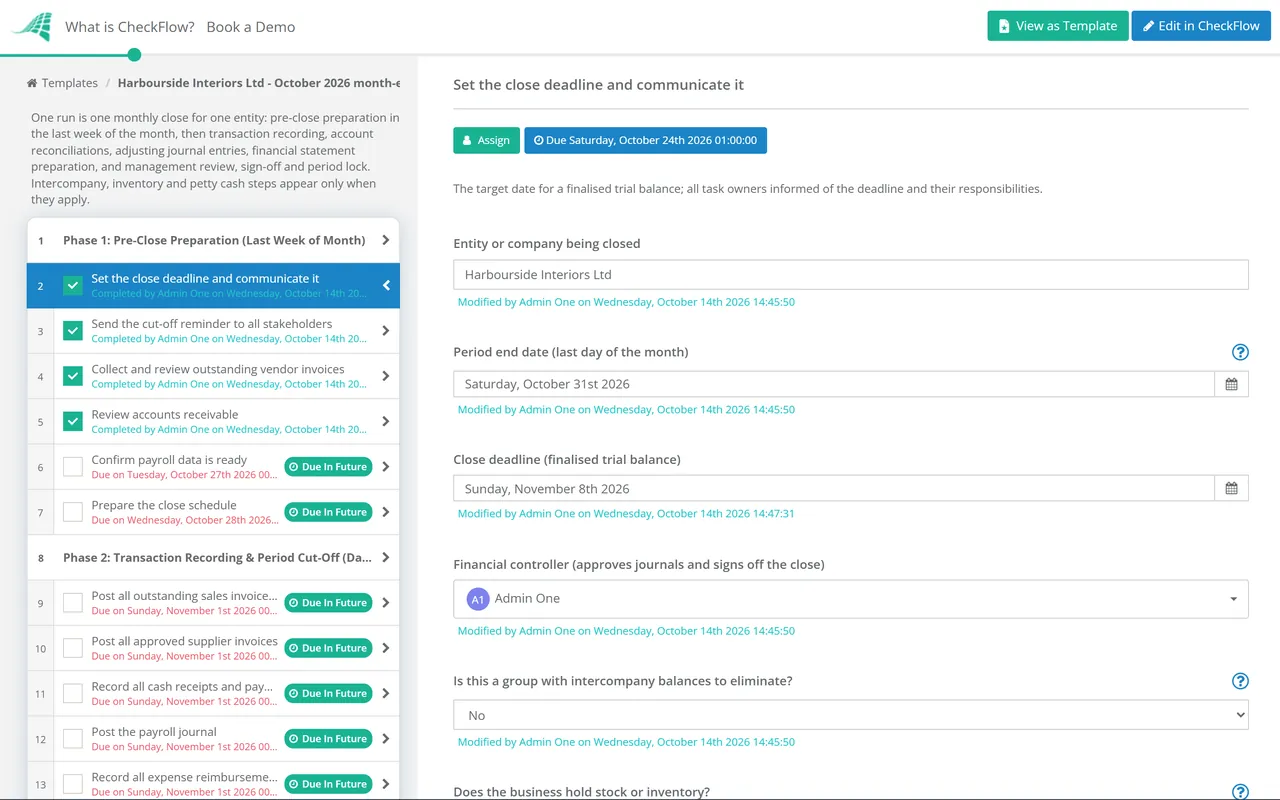
For most finance teams, the first week of the month is a high-pressure blackout period. Everyone is chasing the same information from different systems — invoices not yet posted, expense reports not yet approved, payroll journals waiting on HR, bank statements not yet reconciled. The close process that should take five days takes ten because there is no shared framework defining what needs to happen, in what sequence, by whom, and by when. The result is rushed reconciliations, journal entries posted late in the process, management accounts that arrive two weeks after month-end, and a finance team that spends the first two weeks of every month under avoidable pressure. A structured month-end close checklist replaces the first-week scramble with a defined, sequenced process where every task has an owner, every deadline is visible, and the management accounts land on time. This free checklist gives accounting managers, controllers, and finance teams a repeatable framework for a controlled, accurate, and efficient monthly close.
What the Month-End Close Checklist Covers
This checklist covers six phases of the monthly close cycle — beginning in the final week of the month and completing with management review and period lock. Each phase builds on the last, with pre-close tasks reducing the first-week burden significantly.
- 1
Pre-Close
Phase 1: Pre-Close Preparation (Last Week of Month)
6 tasksPre-close work done in the last week of the month is work that does not block the close in the first week. The teams that close in five days start pre-close tasks before the month ends.
- Set the close deadline and communicate it — the target date for a finalised trial balance; all task owners informed of the deadline and their responsibilities
- Send the cut-off reminder to all stakeholders — the deadline by which all invoices, expense reports, and purchase requisitions must be submitted to be included in the current period
- Collect and review outstanding vendor invoices — chase any expected invoices not yet received; accrue for known obligations not yet invoiced
- Review accounts receivable — confirm invoices are raised for all revenue earned in the period; chase outstanding invoice queries that would delay posting
- Confirm payroll data is ready — confirm the payroll journal will be available for posting at close; confirm payroll cut-off date is consistent with accounting period
- Prepare the close schedule — a detailed day-by-day task list for the close week with named owners and deadlines
- 2
Day 1
Phase 2: Transaction Recording & Period Cut-Off
6 tasks
- Post all outstanding sales invoices and credit notes — revenue for goods delivered or services provided in the period must be recognised in the period
- Post all approved supplier invoices — all invoices approved for the period posted to the correct accounting period
- Record all cash receipts and payments — bank transactions posted and coded to the period
- Post the payroll journal — gross pay, employer NI/FICA, employer pension, net pay, and all deductions posted to the correct accounts and cost centres
- Record all expense reimbursements — approved expense reports posted to the correct period and accounts
- Enforce the period cut-off — confirm no transactions for the following period are posted in the current period; cut-off is a common source of restatement risk
- 3
Day 2
Phase 3: Account Reconciliations
7 tasksReconciliations are the primary accuracy control in the close process. An unreconciled balance is an unexplained balance — and unexplained balances compound over time if not resolved monthly.
- Reconcile all bank accounts — confirm the GL balance matches the bank statement; investigate and resolve every reconciling item
- Reconcile credit card accounts — all transactions coded and posted; statement balance reconciled to GL
- Reconcile the accounts receivable ledger — to the AR control account in the general ledger; review the AR ageing for overdue items requiring provision
- Reconcile the accounts payable ledger — to the AP control account in the general ledger; confirm all approved invoices are posted and outstanding items explained
- Reconcile payroll liabilities — PAYE/payroll tax, NI/FICA, pension, and net pay clearing account all reconciled to what has been paid or is outstanding
- Reconcile all other balance sheet accounts — prepayments, accruals, fixed assets, intercompany, deferred revenue; no account left unreconciled
- Confirm petty cash reconciliation — if applicable; physical cash matches the ledger balance
- 4
Day 3
Phase 4: Adjusting Journal Entries
8 tasks
- Post accruals for expenses incurred but not yet invoiced — goods received but not invoiced, services delivered but not yet billed; based on estimated amounts
- Post prepayment amortisation — release the portion of prepaid expenses relating to the period (insurance, rent, subscriptions)
- Post depreciation — fixed asset depreciation for the period calculated and posted
- Apply revenue recognition adjustments — confirm revenue is recognised in the period in which it is earned; adjust deferred revenue if applicable
- Post any foreign currency revaluations — outstanding foreign currency balances restated at the closing exchange rate
- Post any stock or inventory adjustments — following physical count or system-based review
- Post intercompany eliminations — for consolidated entities; confirm intercompany balances agree before posting
- Obtain approval for all journal entries — particularly for non-routine journals; a second review before posting is good practice for all adjusting entries
- 5
Day 4
Phase 5: Financial Statement Preparation & Review
6 tasks
- Generate the trial balance — confirm it balances; review for obvious anomalies before producing financial statements
- Prepare the income statement — revenue, cost of goods sold, gross margin, operating expenses, EBITDA, and net profit for the period and year to date
- Prepare the balance sheet — all asset, liability, and equity accounts as at month-end
- Prepare the cash flow statement — or at minimum a cash movement summary showing opening, closing, and net movement with major items explained
- Produce the management accounts pack — financial statements with prior month, prior year, and budget comparatives; variance analysis on significant movements
- Conduct the first-pass review — sense-check all key ratios and line items; investigate any unexpected movements before distribution
- 6
Day 5–8
Phase 6: Management Review, Sign-Off & Close
7 tasks
- Distribute the management accounts to the CFO, finance director, or senior management — with a summary of the key variances and any explanations
- Manage the review feedback process — a structured channel for questions and any post-review adjustments; set a deadline for queries
- Post any approved post-review adjustments — with a second sign-off required for any adjustment above a defined threshold
- Formally close the period — in the accounting system; confirm the period is locked so no further postings can be made without reopening authority
- Archive all close documentation — reconciliations, journal entries, management accounts, and review sign-offs retained in a structured archive for audit purposes
- Record close completion date and review against target — tracking close cycle time over months identifies trends and improvement opportunities
- Update the close checklist for next month — any issues encountered this month should be addressed in the process before the next close
A Best-Practice Month-End Close Timeline
Days −5 to −1
Pre-close tasks. Cut-off reminders sent. Outstanding invoices chased. Bank and credit card statements obtained. Payroll data confirmed. Close schedule issued to all task owners.
Day 1
Transaction recording completed. All approved invoices, cash receipts, and payroll journal posted. Period cut-off enforced.
Day 2
All balance sheet account reconciliations completed. Reconciling items investigated and resolved. Bank, AR, AP, payroll liabilities, prepayments, and accruals all reconciled.
Day 3
All adjusting journal entries posted (accruals, prepayments, depreciation, revenue recognition, foreign currency). Peer review of journals completed.
Day 4
Trial balance reviewed. Management accounts pack prepared. First-pass review completed by controller. Variance analysis documented.
Day 5
Management accounts distributed to senior management. Review period opens.
Days 7–8
Management review queries resolved. Any final adjustments posted with sign-off. Period formally locked in the accounting system.
25% of organisations take 10+ days to close. A structured checklist with pre-close tasks starting before month-end and a defined daily schedule is the primary driver of closing in five days or fewer.
Why Run the Month-End Close in CheckFlow?
1The same close process runs automatically every month
CheckFlow’s recurring checklist feature starts the month-end close checklist at the defined time each month — with all tasks pre-assigned to their owners, pre-dated to their deadlines, and ready to run from day one. The controller does not set up the close; the close starts itself.
Real-time visibility of where the close stands
The finance manager running a month-end close needs to know at any moment which reconciliations are complete, which journals are outstanding, and whether the team is on track to hit the close deadline. CheckFlow’s dashboard shows every task’s status in real time — the equivalent of a shared close tracker that updates as tasks are completed, not as people send status emails.
A close archive for audit and process improvement
Every month’s close is archived in CheckFlow — all reconciliations marked complete, all journals posted, management accounts distributed, and the actual close completion date recorded. When the year-end audit asks for documentation of the monthly close process and a specific reconciliation from eight months ago, it is there.
The month-end close reconciles AP and AR as standard steps. CheckFlow’s Accounts Payable Process Checklist and Invoice Approval Workflow Checklist ensure the transactions entering the close are already well-controlled. See the AP Process Checklist →
Groups add a step before consolidation. The Intercompany Reconciliation Checklist matches every counterparty pair, clears FX differences and disputes, and books the eliminations, so the group close starts from balances that agree.
The month-end close is one of the strongest recurring checklist use cases on the platform. CheckFlow’s recurring feature starts the close automatically every month — at the right time, with all tasks assigned and deadlines set. Learn about recurring checklists →