Dates that work backwards
Enter the planned first exit date once. The HR1, the WARN notices, the consultation meetings and the survivor briefings are all due relative to it, so a slipped date moves every deadline with it.
A redundancy programme has a fixed order. The business case comes first, then the pool and the selection criteria, then consultation, then notice, pay and the exit itself. Skip a step or take them out of order and a decision that was commercially sound can still be unfair in a UK tribunal or expensive under US notice laws. This free redundancy and layoff checklist covers both countries in one process. A jurisdiction question switches on the UK or US tasks, and a second question adds the collective consultation and WARN phase only when the numbers trigger it. It ends with the part most plans forget: the people who stay.
In the UK, redundancy is a fair reason for dismissal only if the process is fair. The role must genuinely disappear or shrink, the pool and criteria must be reasonable, the employee must be consulted and suitable alternative work must be offered. Employees with two years’ service also get statutory redundancy pay. When 20 or more redundancies are proposed at one establishment within 90 days, collective consultation and an HR1 notification to the Insolvency Service are added on top.
In the US, most employment is at will, so the risk sits elsewhere. There is no general duty to consult and no statutory severance under federal law. Instead, larger layoffs trigger advance notice under the federal WARN Act and, often, a stricter state law. Releases signed by employees aged 40 or over must meet the Older Workers Benefit Protection Act. And the selection itself can be challenged as discriminatory, so the paper trail behind each choice matters as much as in the UK.
The rules also move. The UK doubled the maximum protective award in April 2026, and further changes to the collective consultation threshold are expected in 2027. State notice laws in the US have been amended several times since 2023. Treat this checklist as the process, and take advice from an employment lawyer on the specific programme before notices go out.
Trigger for collective duties: 20 or more proposed redundancies at one establishment within 90 days.
Consultation: individual consultation always; collective consultation of at least 30 or 45 days when triggered.
Pay: statutory redundancy pay after two years’ service, plus notice.
Key risk: unfair dismissal claims and protective awards.

Trigger for notice duties: WARN plant closings and mass layoffs at employers with 100 or more employees, plus state mini-WARN laws.
Consultation: none required by federal law, except bargaining obligations where there is a union.
Pay: final pay on the state’s deadline; severance is contractual or policy-based, except for covered layoffs in New Jersey.
Key risk: WARN back pay, discrimination claims and invalid releases.
Seven phases from the business case to the review. Phase 3 appears only when collective consultation or a WARN notice is required, and UK or US tasks appear according to the jurisdiction chosen at the start.
Shown when Phase 1 records that collective consultation or a WARN notice is required. UK and US tasks follow the jurisdiction.
Due dates in this phase are set from the planned first exit date recorded in Phase 1.
Work backwards from the first exit date. The longest notice period that applies sets the date the programme has to start, and in the UK, the HR1 has to be in before any individual notice of dismissal is issued. The table shows the minimums for common scenarios. The state rows are examples, not a full list, and every state law has its own counting rules.
| Scenario | When it applies | Minimum period | Who must be told |
|---|---|---|---|
| UK, 20–99 redundancies | Proposed at one establishment within 90 days | Consultation and HR1 at least 30 days before the first dismissal | Employee representatives; the Insolvency Service by online HR1 |
| UK, 100 or more | As above | 45 days | As above |
| UK, fewer than 20 | Any redundancy | No fixed collective period; individual consultation still expected | Each affected employee |
| US federal WARN | Employers with 100 or more employees; a plant closing affecting 50 or more at a site, or a mass layoff of 500 or more, or 50–499 if at least 33% of the site | 60 calendar days | Employees or their union, the state dislocated worker unit, the chief elected local official |
| New York | 50 or more full-time employees in the state; closings of 25 or more, or layoffs of 25 or more (if 33%) or 250 or more | 90 days | Employees, representatives, the state labour department, local workforce boards and others named in the rules |
| New Jersey | 100 or more employees, part-time included; 50 or more job losses | 90 days, plus mandatory severance of one week per year of service | Employees, union representatives and the state |
| California | Establishments with 75 or more employees; layoffs of 50 or more in 30 days, closures and relocations of 100 miles or more | 60 days | Employees, the EDD, the local workforce board and local officials |
| Illinois | 75 or more full-time employees; layoffs of 25 or more (if one-third) or 250 or more | 60 days | Employees, representatives, the state commerce and labour departments and local officials |
Selection is where fairness is usually tested. Agree the criteria and their weightings before anyone is scored, score from evidence rather than impressions, and have a second person check every score. The example below follows the approach in the Acas guidance on selecting employees: weight what the future business needs most.
| Criterion | Points | Evidence |
|---|---|---|
| Performance against objectives | 3–15 | The last two performance reviews |
| Skills the new structure needs | 3–15 | A skills matrix agreed before scoring |
| Qualifications and certifications | 2–10 | Certificates on file |
| Disciplinary record | 1–5 | Live warnings only |
| Attendance | 1–5 | Records excluding absence linked to disability, pregnancy or maternity |
Show each employee their own scores and give them a chance to challenge them during individual consultation. In the US, run the selected list against the wider group by age, sex and race before notices go out, so that any adverse impact is spotted while the decision can still change.
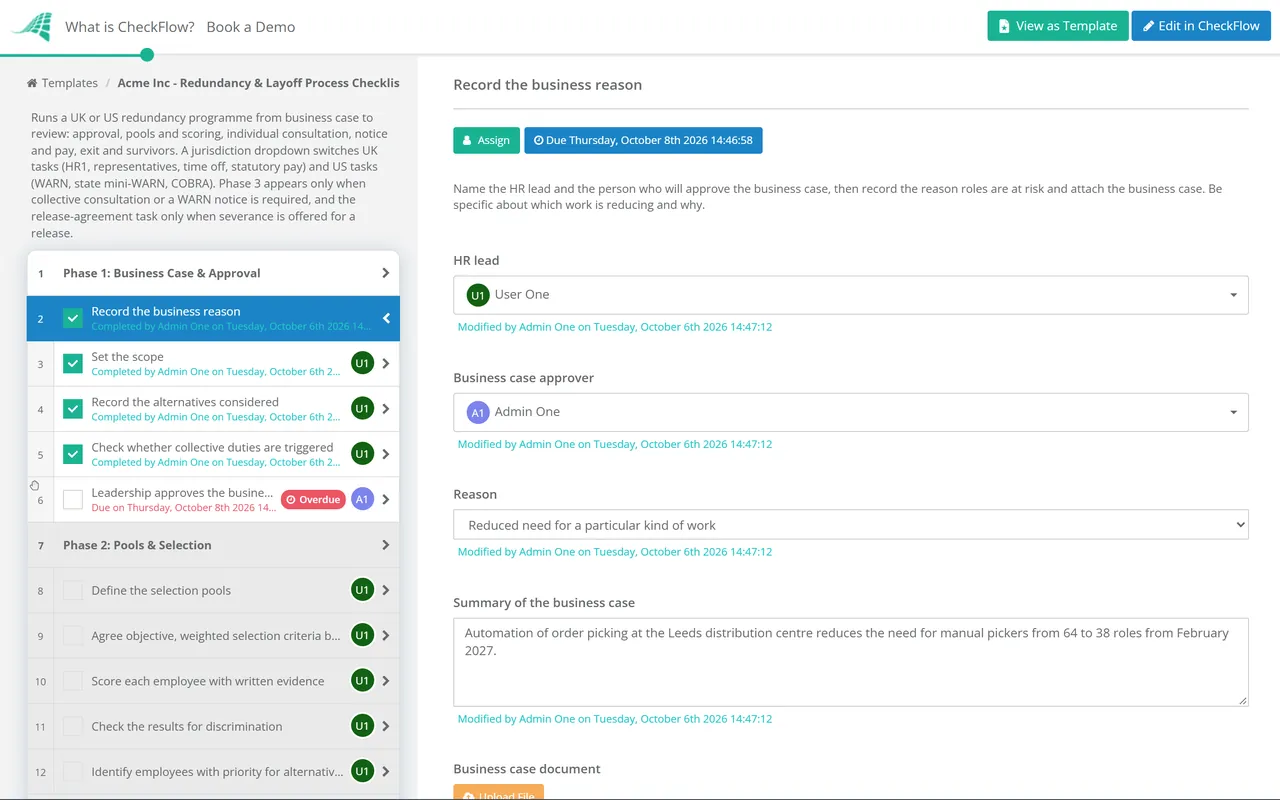
Enter the planned first exit date once. The HR1, the WARN notices, the consultation meetings and the survivor briefings are all due relative to it, so a slipped date moves every deadline with it.
Answer the jurisdiction question and whether collective duties are triggered. A ten-person US layoff never sees the HR1, and a UK programme never sees WARN. The business case is an approval that halts the checklist until it is signed off.
Scores, consultation notes, letters and agreements are uploaded to the task they belong to, with an audit trail of who completed what and when. If a claim arrives months later, the evidence is in one place.
Redeployment is the first alternative to redundancy. When someone moves into a new role instead of leaving, the Internal Transfer & Role Change Checklist handles the new terms, the access changes and the handover. CheckFlow’s HR checklist software runs both from templates.
Access removal is the part of an exit that can least afford to slip. CheckFlow’s IT offboarding checklist software shows how IT teams remove accounts and recover devices on the agreed date, and the Employee Offboarding Checklist covers each individual leaver.
In the UK, redundancy is a legal term: a dismissal because a workplace closes or the need for a particular kind of work reduces. It carries rights to consultation, notice and, after two years’ service, statutory redundancy pay. In the US, “layoff” is the everyday term for cutting roles, and it is usually permanent. The legal duties there come mainly from the WARN Act, state notice laws, anti-discrimination law and the rules on releases.
If you propose 20 to 99 redundancies at one establishment within 90 days, consultation must start at least 30 days before the first dismissal takes effect. For 100 or more, it is 45 days. The HR1 notification to the Insolvency Service, now submitted through an online form, has the same deadlines and must be made before any individual notice of dismissal is issued. These are minimums: consultation has to be meaningful, and it can take longer.
In the UK, a tribunal can make a protective award to each affected employee. For dismissals on or after 6 April 2026, the maximum is 180 days’ pay, double the previous 90 days. Failing to submit the HR1 is a separate criminal offence. In the US, an employer that breaks WARN can owe each affected employee back pay and benefits for up to 60 days, and faces a civil penalty for failing to notify local government.
Employees with two or more years’ service get half a week’s pay for each full year under age 22, one week’s pay for each year aged 22 to 40, and one and a half weeks’ pay for each year aged 41 or over. Service is capped at 20 years. For redundancies from 6 April 2026, weekly pay is capped at £751, so the maximum statutory payment is £22,530. Contractual schemes can pay more. Use the GOV.UK redundancy pay calculator to check each figure.
Under the Older Workers Benefit Protection Act, a valid waiver of age discrimination claims must name the ADEA, be written so the employee can understand it, give something of value beyond what they are already owed and advise them in writing to consult a lawyer. An individual gets at least 21 days to consider it. In a group programme it is 45 days, with written information on the decisional unit and the ages and job titles of those selected and not selected. Every signer then has 7 days to revoke. The EEOC’s guidance on waivers explains each requirement.
Yes. In the UK, failing to look for suitable alternative work can make a dismissal unfair, and an employee who accepts a different role gets a four-week trial period without losing their right to redundancy pay if it does not work out. Employees protected during pregnancy and family leave must be offered any suitable vacancy ahead of others. In the US there is no equivalent duty, but redeployment keeps skills and avoids severance cost.
14-day free trial, no card required. The Business plan is $10 per user per month after the trial. Full details at checkflow.io/pricing.