
Are the accounts fairly stated?
Looks at: one year end, against GAAP.
Ignores: whether profit will recur or cash conversion holds.
Output: an opinion addressed to shareholders.
Last reviewed: October 2026
No Credit Card Required
Printed from checkflow.io/templates/due-diligence/financial-due-diligence-checklist
Financial due diligence tests whether a target’s reported numbers support the price. This free checklist is for buy-side deal teams, corporate development and the advisers who run quality of earnings work for them. It covers normalised EBITDA, revenue and cash proof, working capital and the peg, net debt and debt-like items, tax exposures and the forecast. Answers recorded at the start switch on what each deal needs: a leakage review for locked box deals, the peg for completion accounts, and US or UK tax tasks. The deal lead approves the findings before they reach the investment committee.
A clean audit opinion says the accounts are free of material misstatement. It does not say the earnings will recur, that working capital is at a normal level or that every inherited liability is in the net debt schedule. Financial due diligence answers those questions, and its output goes straight into the price: adjusted EBITDA for the multiple, a peg or locked box balance sheet, and debt-like items to deduct.
A quality of earnings report is not an audit and gives no assurance opinion, so the scope, data cut-off and basis of preparation matter: lenders and warranty insurers look for them first. Our M&A Due Diligence Checklist coordinates all nine acquisition workstreams; this template is the detailed finance workstream under it.
Looks at: one year end, against GAAP.
Ignores: whether profit will recur or cash conversion holds.
Output: an opinion addressed to shareholders.
Looks at: monthly data over two to three years plus the trailing twelve months.
Work: normalise EBITDA, set the peg, find debt-like items, prove cash.
Output: numbers that move the price and the SPA.
Looks at: commercial, legal, tax, people, technology and ESG as well as finance.
Work: parallel workstreams run by different advisers.
Output: an investment committee paper.
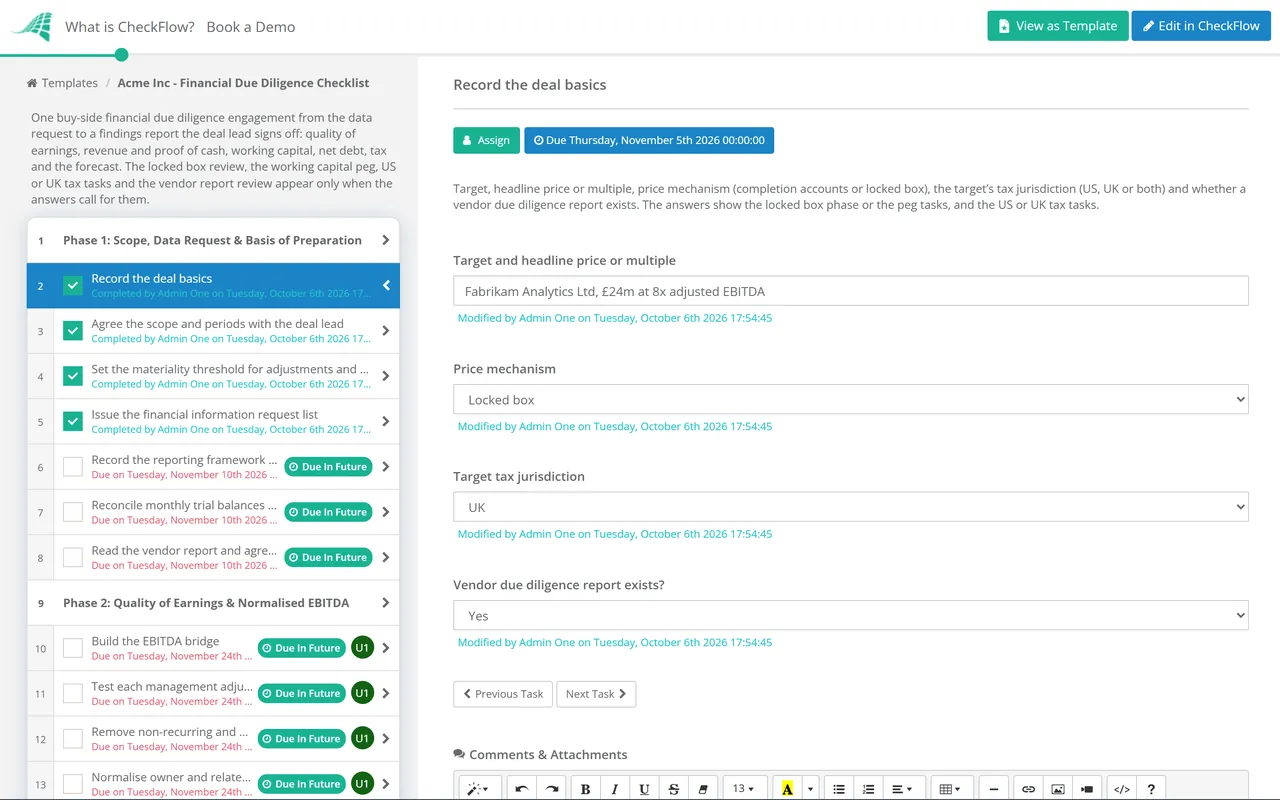
Six phases run on every deal. The locked box phase appears only when the price mechanism is a locked box, and individual tasks switch on for a vendor report, a completion accounts deal or the target’s tax jurisdiction.
Owned by the deal lead. The answers recorded here decide which later phases and tasks appear.
Owned by the financial due diligence lead. Every adjustment carries its evidence as an attachment.
The two peg tasks are shown only when the price mechanism is completion accounts.
Shown only when the price mechanism is a locked box. There is no post-completion true-up, so the work happens before signing.
US and UK tasks are shown from the jurisdiction answer in Phase 1. Specialist tax advisers usually own this phase.
The deal lead approves the findings report. A Not approved answer returns it to the due diligence lead and holds the checklist.
Most findings land in the earnings the multiple applies to, the net debt deducted from enterprise value, or the working capital adjustment. Treatment is negotiated deal by deal, so read the table as a starting point, not a rule.
| Item | Usual home | What to ask | Phase |
|---|---|---|---|
| One-off legal or restructuring costs | EBITDA adjustment | Has the same “one-off” appeared every year? | 2 |
| Owner salary below market | EBITDA adjustment, downwards | What will a replacement cost after completion? | 2 |
| Stretched creditors before the sale | Working capital or debt-like | Are payment days longer than the historical pattern? | 4 |
| Deferred revenue | Working capital or debt-like, by agreement | What does it cost to deliver the service already paid for? | 3, 4 |
| Accrued bonuses and unpaid prior-year tax | Debt-like | Was it earned or incurred before completion? | 4, 6 |
| Earn-outs from the target’s own acquisitions | Debt-like | What is the likely payout, and when? | 4 |
| Dividends or fees paid to sellers after the locked box date | Leakage, repaid pound for pound | Was it on the permitted leakage list? | 5 |
The second table compares the two price mechanisms. US deals usually use a closing working capital adjustment, which works like completion accounts. Locked boxes are common in UK and European auctions.
| Question | Completion accounts or closing adjustment | Locked box |
|---|---|---|
| When is the balance sheet fixed? | At completion, then trued up afterwards | At a past date before signing |
| Who bears trading risk between those dates? | The seller, until completion | The buyer, from the locked box date |
| Key diligence output | Working capital peg and accounting policies | Locked box balance sheet and leakage list |
| Main dispute risk | Post-completion argument over the accounts | Leakage claims |
Watch lease accounting when comparing EBITDA. Under IFRS 16, lease costs leave EBITDA and reappear as depreciation and interest; under US GAAP (ASC 842), an operating lease stays in operating costs as a straight-line charge. Amendments to FRS 102 for periods beginning on or after 1 January 2026 bring most UK leases onto the balance sheet and add a five-step revenue model, so a UK target’s 2026 EBITDA may not compare with 2025. Check the lender’s covenant definitions too.
The price mechanism, tax jurisdiction and vendor report answers shape the checklist. Conditional logic hides the locked box phase on a completion accounts deal and the US tax tasks on a UK target.
Each adjustment task holds the schedule, the support and the comments that settled it, so when the seller challenges a number the reasoning is on the task.
Due dates are offsets from the day the checklist starts, so the plan moves with the deal timetable. The approval task on the findings report stops anything going to committee unsigned, and the activity trail exports with timestamps.
CheckFlow is not a data room, spreadsheet model or accounting system. Documents stay in the data room and the analysis stays in your workbooks. CheckFlow runs the workflow around them: who owns each analysis, what is still waiting on the seller, and who approved the report. Advisers running several deals see every open task in the Tasks grid; the professional services overview shows other client workflows.
For the full acquisition, pair this with the M&A Due Diligence Checklist or, for a sponsor-backed buyout, the Private Equity Due Diligence Checklist. If the target owns its premises, the Commercial Property Acquisition Due Diligence Checklist covers title, environmental and condition work. Sellers preparing for a process can use the Investor Data Room Checklist to get their documents in order first.
Describe the process in a sentence and the AI checklist generator drafts the phases and tasks for you.
The core is a quality of earnings analysis that turns reported EBITDA into a sustainable, diligence-adjusted figure. Around it sit revenue and customer analysis, a proof of cash, working capital and the peg, net debt and debt-like items, tax exposures and a forecast review. The findings feed the price, the purchase agreement and the lender’s credit paper.
No. An audit gives an opinion on whether year-end accounts are fairly stated. A quality of earnings report gives no assurance opinion; it analyses monthly data to show which earnings recur, adjusts for one-off and owner-related items, and tests cash conversion. In the US it is commonly performed as a consulting engagement. Audited targets still need one.
The peg is the level of working capital the buyer expects to receive with the business. It is commonly the average of normalised monthly balances over the trailing twelve months, so seasonal peaks and troughs even out, then adjusted for growth or known changes. If completion working capital is below the peg, the price falls by the shortfall; above it, the price rises.
They are obligations that are not borrowings but will cost the buyer cash after completion for something that happened before it. Common examples are unpaid prior-period tax, accrued bonuses, deferred consideration from earlier acquisitions, pension deficits, dilapidations and deferred maintenance. Buyers deduct them from enterprise value alongside net debt; sellers argue some belong in working capital, deferred revenue most often.
A sell-side report, often called vendor due diligence in the UK, is commissioned by the seller before a sale so bidders work from the same analysis and problems surface early. A buy-side review is commissioned by the buyer and tests the numbers from the buyer’s point of view. Where one exists, buyers usually agree reliance terms and run targeted top-up work rather than starting again.
14-day free trial, no card required. The Business plan is $10 per user per month after the trial. Full details at checkflow.io/pricing.
14-day free trial, no credit cardFull refund in your first 30 daysUS hosting, EU on request