
Purchase of a Business Checklist Template

70–75% of acquisitions fail to deliver their intended value. The failure is almost never in the deal — it is in the preparation before the deal and the integration after it.

A business acquisition is the largest single capital allocation decision most organisations will make. McKinsey’s analysis of decades of M&A data consistently shows that 70–75% of acquisitions fail to deliver the value that justified the price paid — and the failure almost never begins at closing. It begins earlier: in the acquisition strategy that was not specific enough, the due diligence that was not thorough enough, the price that was driven by competition rather than valuation, or the integration plan that did not exist. A structured acquisition process addresses all of these: defining the acquisition strategy before the search, running a disciplined due diligence process before the offer is finalised, ensuring the SPA contains the protections that due diligence findings require, and beginning integration planning before completion rather than after. This free business acquisition checklist gives buyers, acquirers, corporate development teams, and private investors a structured framework for the full buy-side M&A lifecycle.

Disclaimer: This checklist provides a framework for the business acquisition process. M&A transactions involve significant legal, financial, tax, and regulatory complexity. Always engage qualified legal, financial, and tax advisers. This checklist does not constitute legal or financial advice.
Use This Template Free See Live Example
No Credit Card Required

The Three Reasons 70–75% of Acquisitions Fail to Deliver Value

Insufficient Due Diligence

The due diligence process was rushed or superficial — driven by deal momentum, time pressure, or fear of losing the target to a competitor. Hidden liabilities, customer concentration risks, key person dependencies, or cultural mismatches were not identified before the price was locked in. The SPA did not reflect findings because there were no findings to reflect.

Prevention: A structured, comprehensive DD process covering financial, legal, commercial, operational, HR, and technology dimensions — with sufficient time and independent advisers for each.

Price Paid Beyond Value Created

Competitive bid processes and the psychological pressure of deal momentum drive prices above disciplined valuation levels. The synergies used to justify the premium are optimistic rather than modelled; the integration costs are underestimated; the value that was projected was not achievable at the price paid.

Prevention: A price discipline framework — a maximum walk-away price defined before the bidding process starts and maintained regardless of competitive pressure.

Integration Failure

The deal closes; the integration plan does not exist or is not executed. Cultural clashes are not managed. Key employees leave. Customers are disrupted. Synergies are not realised because no one owns them. Integration failure is the most commonly underestimated risk in M&A.

Prevention: Integration planning begins during due diligence, not after completion. A named integration lead with authority and resources from day one.

What the Purchase of a Business Checklist Covers

Seven phases covering the full buy-side M&A lifecycle — from acquisition strategy through target identification, approach, LOI, due diligence, SPA negotiation, and post-acquisition integration.

Phase 1

Acquisition Strategy & Mandate Definition

Strategic clarity before the search is the most underinvested phase in M&A. An acquisition mandate that is too broad is not a mandate — it is an open door to opportunistic distraction.

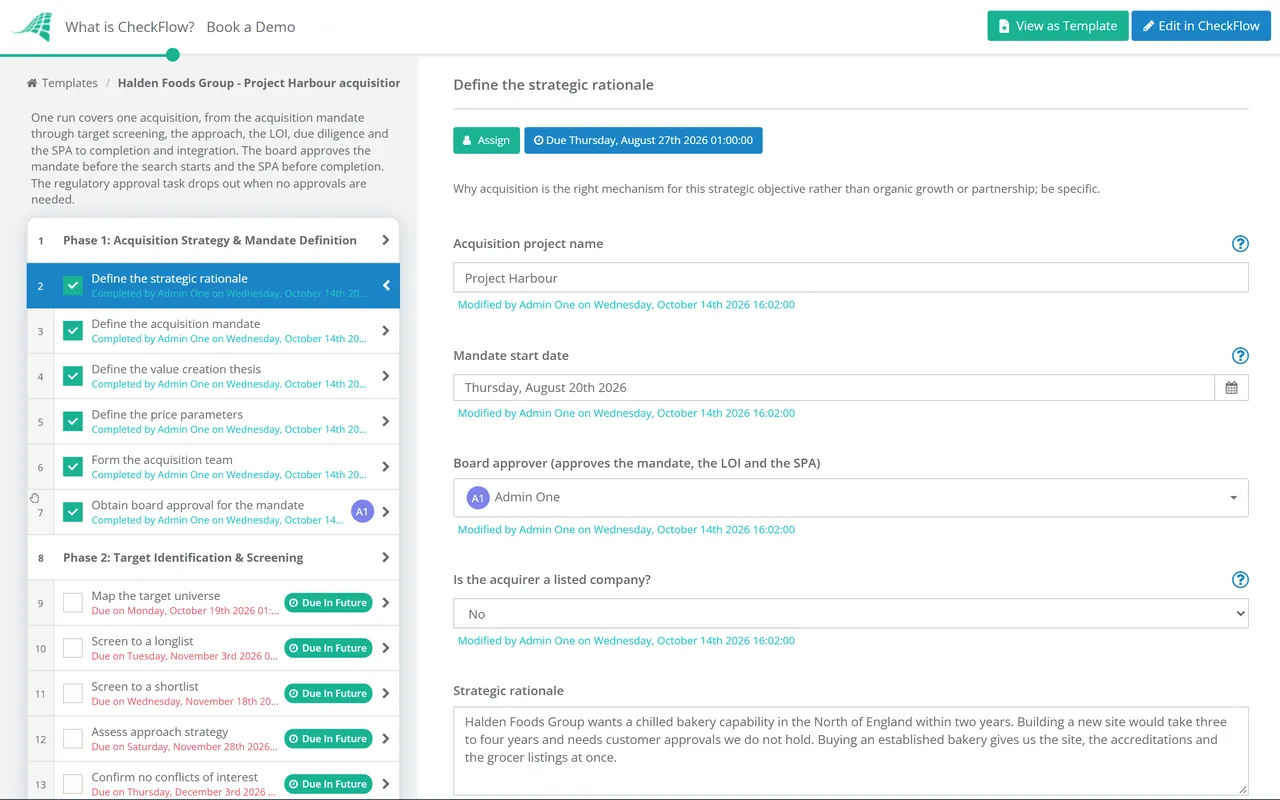
  • Define the strategic rationale — why acquisition is the right mechanism for this strategic objective rather than organic growth or partnership; be specific
  • Define the acquisition mandate — sector, size (revenue or EBITDA range), geography, business model, customer profile, and cultural characteristics of the ideal target
  • Define the value creation thesis — what will the acquiring entity do with the target that the target cannot do alone? Revenue synergies, cost synergies, capability acquisition, or market access?
  • Define the price parameters — the maximum valuation multiple that is consistent with creating value; agreed by the board before any process begins
  • Form the acquisition team — internal (corporate development, finance, legal, operations), external advisers (M&A lawyer, financial adviser, tax adviser); roles defined
  • Obtain board approval for the mandate — before resource is committed to a search
Phase 2

Target Identification & Screening

  • Map the target universe — all companies fitting the acquisition mandate; from market research, industry contacts, advisers, and proprietary databases
  • Screen to a longlist — applying the mandate criteria; surface-level financial and strategic fit assessment from public information
  • Screen to a shortlist — deeper analysis; ownership structure, likely sale readiness, strategic fit quality, cultural compatibility, and any known issues
  • Assess approach strategy — for each shortlisted target: is the business likely for sale? Who is the right first contact? Direct approach or via adviser?
  • Confirm no conflicts of interest — any adviser relationship with the target; any board member connection; disclosed and managed before approach
Phase 3

Initial Approach & Exclusivity Negotiation

  • Make the initial approach — via the defined contact; expressing interest without committing price or structure; confidentiality maintained
  • Execute a Non-Disclosure Agreement (NDA) — before receiving any confidential information about the target; review carefully for scope and standstill provisions
  • Receive and review the information memorandum (IM) — the seller’s presentation of the business; treat with appropriate scepticism; management accounts and independent verification to follow
  • Conduct preliminary management meetings — to assess the business and its leadership before committing to detailed diligence
  • Submit Indicative Offer (non-binding) — based on publicly available and IM information; confirms interest and indicative valuation range
  • Negotiate exclusivity — an exclusivity period (typically 4–8 weeks) during which the seller will not engage other bidders; enables detailed diligence investment
Phase 4

Letter of Intent / Heads of Terms

  • Draft the LOI / Heads of Terms — indicative price, deal structure (share vs asset purchase), exclusivity terms, conditionality, and key protections required
  • Confirm deal structure — share purchase (buyer acquires the legal entity and all its liabilities) vs asset purchase (buyer acquires specified assets and liabilities); tax and legal implications confirmed with advisers
  • Confirm financing structure — cash, debt, equity, or combination; financing confirmed as available before LOI is signed
  • Agree exclusivity period and break fee — if applicable; confirmed with legal counsel
  • Obtain board approval — for the LOI; not binding on price but significant reputational commitment
Phase 5

Due Diligence

Due diligence is the most important phase of any acquisition. The time pressure to close the deal is the primary threat to diligence quality. Sufficient time and independent advisers are not optional; they are the primary risk management tools.

  • Open the data room — confirm the virtual data room is established; all requested documents uploaded; access confirmed for the full due diligence team
  • Conduct financial due diligence — quality of earnings analysis, working capital, normalised EBITDA, capital expenditure, cash flow, net debt and debt-like items
  • Conduct legal due diligence — corporate structure, material contracts, litigation, IP ownership, data protection, regulatory compliance, employment agreements
  • Conduct commercial due diligence — market size validation, competitive positioning, customer concentration, NPS, pipeline quality, churn analysis
  • Conduct operational due diligence — operational processes, IT systems, key person dependencies, supply chain, property
  • Conduct HR due diligence — key employee assessment, retention risk, compensation structures, employment liabilities, cultural assessment
  • Conduct tax due diligence — tax compliance history, deferred tax liabilities, transfer pricing, tax structure of the deal
  • See the full DD framework: M&A Due Diligence Checklist →
  • Compile the due diligence findings report — all issues categorised by materiality; price adjusters; SPA protections required; deal-breakers flagged
Phase 6

SPA Negotiation & Conditions to Closing

  • Negotiate the Sale and Purchase Agreement (SPA) — with qualified M&A legal counsel; reflecting due diligence findings in warranties, indemnities, and price adjustments
  • Confirm the price adjustment mechanisms — locked-box vs completion accounts; working capital adjustment; earnout structure if applicable
  • Confirm the warranty and indemnity package — seller warranties covering key DD findings; warranty and indemnity insurance (W&I) considered
  • Confirm conditions to closing — regulatory approvals (competition clearance, sector-specific approvals), financing conditions, material adverse change provisions
  • Manage the regulatory approval process — filings submitted; timetable confirmed; any undertakings or remedies managed
  • Sign the SPA — board approval confirmed; all conditions noted; completion mechanism confirmed
Phase 7

Completion & Post-Acquisition Integration

  • Execute completion mechanics — share transfer or asset transfer; consideration paid; completion accounts process initiated
  • Announce the acquisition — per SPA terms; regulatory filings for listed companies; press release; employee communication plan
  • Begin Day 1 integration activities — pre-planned; the Day 1 plan should have been ready before completion, not started after
  • Retain key employees — identify and execute retention arrangements for key talent identified in HR due diligence; the first 90 days are the highest flight-risk period
  • Execute the integration plan — customer communication, system integration, brand alignment, process harmonisation; named integration lead with authority
  • Track synergy realisation — against the case that justified the acquisition price; quarterly review for the first two years
  • Conduct a 12-month post-acquisition review — what was delivered vs the investment thesis; learnings for the next acquisition

Share Purchase vs Asset Purchase — the Structural Decision That Affects Every Element of the Deal

Share Purchase

What transfers: The entire legal entity — all assets, liabilities (including contingent and historic), contracts, employees, and IP, whether or not they are identified in the transaction documents.

Buyer’s perspective: Simpler for third parties (contracts, employees, and permits transfer automatically) but takes on all historic liabilities — known and unknown.

Seller’s perspective: Often preferred — clean exit; all liabilities stay with the entity they know.

Most common for: Established businesses where the company has valuable contracts, relationships, and licences that cannot easily be transferred as assets.

Asset Purchase

What transfers: Specified assets and liabilities only — those expressly named in the purchase agreement.

Buyer’s perspective: Takes only what it wants; leaves historic liabilities with the seller. But requires renegotiation of contracts, employment transfers, and regulatory permits.

Seller’s perspective: More administratively complex; may retain residual liabilities in the entity after the sale.

Most common for: Asset-heavy businesses, distressed acquisitions, carve-outs, or where specific liabilities must be excluded.

Specific tax and legal advice is essential for both structures. The optimal choice depends on jurisdiction, asset profile, and liability exposure.

Why Run the Acquisition Process in CheckFlow?

1

A structured process from mandate to integration — not just due diligence

Most acquisition checklists focus on due diligence. CheckFlow’s acquisition checklist covers the full lifecycle: the acquisition strategy that defines what to look for, the DD that determines what is there, the SPA that reflects what was found, and the integration plan that delivers the value that justified the price. The phases most commonly underprepared — acquisition strategy and post-acquisition integration — are given equal structural weight.

2

Multi-party coordination across internal and external teams

A business acquisition involves six to ten parties working in parallel — corporate development, finance, legal, HR, and IT internally; M&A lawyers, financial advisers, tax advisers, and specialist due diligence consultants externally. CheckFlow assigns tasks across all parties, tracks outstanding items, and gives the deal lead a single view of the process status — replacing the weekly DD meeting as the primary coordination mechanism.

3

A complete acquisition record for post-closing disputes

SPA warranty claims require evidence of what was disclosed in due diligence, when, by whom, and what action was taken. Every document reviewed, every finding recorded, and every decision made during the CheckFlow acquisition process is timestamped and archived — providing the evidential record that post-closing disputes depend on.

The due diligence phase within a business acquisition is covered in detail in CheckFlow’s dedicated M&A Due Diligence Checklist — covering financial, legal, commercial, operational, HR, and technology dimensions. See the M&A Due Diligence Checklist →

For investors evaluating whether a business partnership — rather than an acquisition — is the right structure, CheckFlow’s Business Partnership Due Diligence Checklist covers the DD process specific to partnership structures. See the Business Partnership DD Checklist →

Frequently Asked Questions

What does the process for buying a business involve?

+

Buying a business involves seven phases: acquisition strategy and mandate definition (defining what type of business, at what price, and why), target identification and screening (mapping and shortlisting candidates fitting the mandate), initial approach and exclusivity (NDA, management meetings, indicative offer, exclusivity), Letter of Intent and Heads of Terms (non-binding agreement on price, structure, and key terms), due diligence (comprehensive financial, legal, commercial, operational, HR, and tax investigation), SPA negotiation and conditions to closing (reflecting DD findings in legal protections, managing regulatory approvals), and completion and post-acquisition integration (Day 1 execution, employee retention, and integration plan delivery). The phases most commonly underinvested are acquisition strategy (done too broadly) and post-acquisition integration (begun too late).

What is the difference between a share purchase and an asset purchase?

+

In a share purchase, the buyer acquires the target company’s shares — taking on the legal entity with all its assets, liabilities, contracts, employees, and regulatory permits, including contingent and historic liabilities not yet identified. In an asset purchase, the buyer acquires specified assets and named liabilities only, leaving historic liabilities with the seller. Share purchases are simpler for third-party relationships (contracts and employees transfer automatically) but expose the buyer to all historic liabilities. Asset purchases give the buyer more control over what it takes on but require active transfer of each contract, employee, and permit. The optimal structure depends on the specific business, the liability profile, and the tax implications in the applicable jurisdiction — always take specific legal and tax advice.

Why do most acquisitions fail to deliver value?

+

Research consistently shows 70–75% of acquisitions fail to deliver their intended value, with three primary causes. First, insufficient due diligence: hidden liabilities, customer concentration, key person dependencies, or cultural mismatches were not identified before price was finalised. Second, price paid beyond value: competitive bid dynamics and deal momentum drive prices above levels consistent with the synergy assumptions required to justify the premium. Third, integration failure: integration was planned as an afterthought rather than prepared during due diligence, and the key employees and customer relationships that created the value were not retained. The common thread is insufficient process discipline at each phase.

What is warranty and indemnity insurance (W&I)?

+

Warranty and indemnity (W&I) insurance provides coverage to the buyer (buy-side policy) or the seller (sell-side policy) for losses arising from breaches of the seller’s warranties and indemnities in the SPA. Buy-side W&I policies allow the buyer to claim directly against the insurer for warranty breaches rather than the seller — useful where the seller is a PE fund distributing proceeds to LPs, or where the sellers are founders who cannot provide meaningful personal warranty cover. W&I has become standard in mid-market PE-backed transactions and increasingly common in private M&A. It requires a thorough due diligence process as a precondition.

Is CheckFlow free for this template?

+

14-day free trial, no card required. The Business plan is $10 per user per month after the trial. Full details at checkflow.io/pricing.

Run a Disciplined Acquisition Process That Creates Value — Not Just Closes Deals

Free trial — no credit card required.