
M&A due diligence
Covers: strategy, finance, legal, tax, operations, technology, people and ESG, with legal as one phase.
Ends: with the investment decision on the whole deal and integration planning.
Last reviewed: October 2026
No Credit Card Required
Printed from checkflow.io/templates/due-diligence/legal-due-diligence-checklist
This free legal due diligence checklist is for in-house lawyers, law firms and deal teams on the buy side of an acquisition. One run covers one target company or business, with every due date counted back from the target signing date. It agrees the scope and the materiality threshold, sends the legal request list, sets up data room access and one Q&A log, then reviews corporate records and ownership, material contracts and change of control, leases, intellectual property, data protection, disputes, employment and regulatory status, and flags the approvals the deal may need for your advisers. It ends with a red-flag report, a decision on the findings before signing, and the warranties, indemnities and conditions that go into the purchase agreement. The first task’s answers add tasks for a share or an asset purchase and for the UK, the US and other countries; a red flag and the decision add their own.
The M&A Due Diligence Checklist runs the whole deal and gives legal due diligence one phase of ten tasks. This checklist is that phase run in full: the request list, the data room review area by area, a red-flag report, a decision before signing and the protections that go into the purchase agreement. Run it beside the deal’s other workstreams and feed its findings into the same decision.
The money, the people and the buildings have checklists of their own. The Financial Due Diligence Checklist covers the quality of earnings, net debt and working capital; the Management Due Diligence Checklist covers the leadership team; and title, searches and environmental reports on the target’s sites belong to the Commercial Property Acquisition Due Diligence Checklist. This checklist lists the sites and reviews the leases, and hands title work to the property lawyers.
Covers: strategy, finance, legal, tax, operations, technology, people and ESG, with legal as one phase.
Ends: with the investment decision on the whole deal and integration planning.
Covers: corporate records and ownership, material contracts and change of control, leases, IP, data protection, disputes, employment, regulatory status and the approvals the deal may need.
Ends: with a decision on the findings before signing, and warranties, indemnities and conditions in the purchase agreement.
Covers: the numbers behind the price, the leadership team, and title and environmental work on each site, in the Financial Due Diligence Checklist, the Management Due Diligence Checklist and the Commercial Property Acquisition Due Diligence Checklist.
Ends: with findings that join the legal ones in one issues list and one decision.
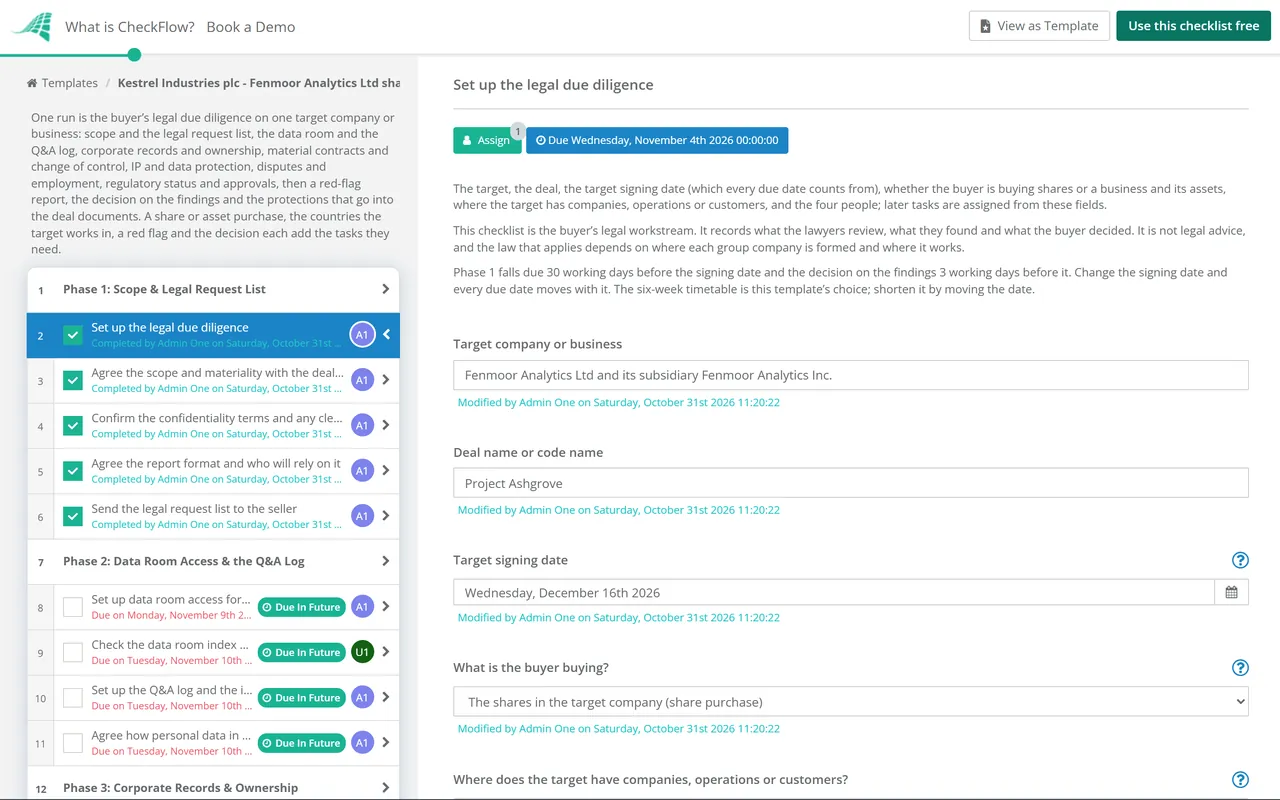
Nine phases take one target from scope, six weeks before signing, to the deal documents. The checklist halts at the decision in Phase 8. The first task’s answers add tasks for a share or an asset purchase and for each country the target works in, and a red flag and the decision add their own.
Start about six weeks before the target signing date. The first task names the four people and asks two questions: a share purchase or an asset purchase, and where the target has companies, operations or customers. Every due date counts back from the signing date, in working days.
Get the review team into the data room, see what is missing, and keep one Q&A log and one issues list for the whole review. Answer the red-flag question on the issues list as soon as a red flag is found.
Confirm who owns the target, what it owns and who controls it, from the public registers and the target’s own records. The deal structure adds a task for the shares or for the assets that transfer.
Review every contract above the materiality threshold, find each consent the deal needs, and review the property the target occupies. Property title and environmental searches stay with the property workstream.
Confirm the target owns what it sells and uses, and that it handles personal data lawfully. The countries answered on the first task add the register notes.
Find every claim for or against the target and review the people who come with it. The leadership team’s own contracts and incentives belong to management due diligence. An asset purchase adds a task on the employees who transfer.
Check the target holds what it needs to trade, and flag every approval the deal itself may need. Merger control and foreign investment screening are for specialist advisers: this phase finds the questions and records their answers.
Bring the findings together, agree what each red flag means for the deal, and get the decision before signing. Nothing after the decision task can be completed until it is done.
Turn the findings into the purchase agreement: warranties, indemnities, conditions and the disclosure review. The issues list then goes to the team that runs completion and integration.
Where to look, and what the deal may need, depends on where each group company is formed and where it works. The table sets out the sources this checklist cites for the UK and the US, read on the official sites on 31 October 2026. It is a summary, not legal advice. Thresholds and forms change, so your advisers check each one on the day.
| Area | Where | What the source says | Source |
|---|---|---|---|
| Company records | United Kingdom | Companies House gives free details of a company, including its registered address and date of incorporation, current and resigned officers, document images, mortgage charge data, previous names and insolvency information. | GOV.UK: Get information about a company |
| People with significant control | United Kingdom | Usually anyone with more than 25% of the shares or voting rights, the power to appoint or remove a majority of the directors, or the ability to influence or control the company. Changes must be reported to Companies House within 14 days of confirming them. | Companies House: People with significant control (PSCs) |
| Company status | Delaware | The Division of Corporations’ status service shows an entity’s status but does not generate an official certificate. A certificate of status or a long-form certificate of good standing is ordered from the Division. For other states, ask your lawyers which records to search. | Delaware Division of Corporations |
| Registered IP | United Kingdom and United States | The UK Intellectual Property Office’s searches find trade marks by owner and show who owns UK patents. The USPTO’s trademark database finds marks by mark, owner or number. | GOV.UK: Search for a trade mark; Search for a patent; USPTO |
| Federal court records | United States | PACER gives public access to federal court records, searched by court or through a national index. For state courts, ask your lawyers which records to search. | PACER |
| National security screening | United Kingdom | An entity formed outside the UK is in scope if it carries on activities in the UK or supplies goods or services to people in the UK. Acquisitions of some entities in 17 sensitive areas need mandatory notification and approval; one completed without it is void, and the acquirer may face civil or criminal penalties. Other qualifying acquisitions can be notified voluntarily; one that was not notified can be assessed up to 5 years after it took place and up to 6 months after the government becomes aware of it. The review period is up to 30 working days. | GOV.UK: National Security and Investment Act guidance on acquisitions |
| Merger control | United Kingdom | Merger notification in the UK is voluntary. The CMA can still investigate a merger that completed without its approval. | GOV.UK: Tell the CMA about your merger |
| Premerger notification (HSR) | United States | The parties to certain deals must file with the FTC and the Department of Justice and may not close until the waiting period has passed or early termination is granted. The minimum size-of-transaction threshold, adjusted every year, is $133.9 million from 17 February 2026. A federal court vacated the new form on 12 February 2026; since 19 March 2026, when the appeals court refused to stay that ruling, the agencies accept the form in place before 10 February 2025. The appeal may change this. | FTC: Premerger Notification Program; New HSR thresholds and filing fees for 2026 |
| Foreign investment review | United States | CFIUS reviews certain transactions involving foreign investment into United States businesses and certain real estate transactions by foreign persons. | US Treasury: CFIUS |
| Employees on a business transfer | United Kingdom | TUPE can apply when a business or part of one moves to another employer, and the identity of the employer must change. The seller gives employee liability information not less than 28 days before the transfer, and employers inform representatives of affected employees long enough before it to allow consultation. | GOV.UK: Business transfers, takeovers and TUPE; TUPE regulations 3, 11 and 13 |
| Personal data in due diligence | United Kingdom | When a merger or acquisition means data goes to a different or additional controller, data sharing must be considered as part of the due diligence: what data, the purposes it was obtained for, the lawful basis, and a record of the sharing. The ICO says the guidance is under review after the Data (Use and Access) Act. | ICO: Data sharing code, due diligence following mergers and acquisitions |
| Everything else | Other countries and US states | Not covered by this template. Company registers, merger control, investment screening, employee transfers and data protection rules differ by country and state. | Take local legal advice |
The approvals are flags, not answers. The Phase 7 tasks record whether each regime may apply and what the advisers concluded. Merger control and foreign investment screening are specialist work, and the answer can change with the deal structure, the buyer and the figures on the day.
Share or asset purchase? On a share purchase the target company stays the employer and keeps its contracts, so the review looks for change of control terms and title to the shares. On an asset purchase the buyer lists what transfers and how each contract moves, and in the UK TUPE may apply to the employees. The first task’s answer adds the tasks for each.
The decision maker named on the first task is the only person who can complete the decision, and the checklist halts there: nothing after it can be completed until they record proceed, proceed with specific protections or stop. Specific protections add a task to draft them, and a stop adds a task to close the review. See how approvals that halt a checklist work.
A share purchase adds the title and rights over the shares; an asset purchase adds the schedule of what transfers and the employees who move with the business. Each country ticked adds its register notes and an approvals task for your advisers, and a red flag adds the escalation. Conditional logic keeps the rest out of the way.
Enter the signing date and every task falls due a set number of working days before or after it. Tasks go to the lead lawyer, the reviewing lawyer and the deal lead named on the first task, and each sees their work in the Tasks Grid. Every review sits in the Reports Grid with its progress.
CheckFlow runs the review: who does what and by when, the request list, the findings and the decision. It does not give legal advice or search registers itself. Your lawyers and advisers do that, and the checklist records what they found.
The M&A Due Diligence Checklist and the Private Equity Due Diligence Checklist run the whole deal; this checklist is their legal workstream in full, beside the Financial Due Diligence Checklist and the Management Due Diligence Checklist. Title work on the target’s sites is in the Commercial Property Acquisition Due Diligence Checklist, and the buying process from mandate to completion is in the Purchase of a Business Checklist. Sellers preparing the documents buyers ask for can start from the Investor Data Room Checklist. After completion, the Post-Merger Integration Checklist picks up the issues list, and the Contract Review & Approval Checklist runs the review of any new contract the integration needs.
Describe the process in a sentence and the AI checklist generator drafts the phases and tasks for you.
It is the buyer’s legal review of a target company or business before an acquisition: who owns it, what it owns, the contracts it depends on and what the deal does to them, its intellectual property, disputes, employees, data protection and regulatory standing. The aim is to find what could change the price or stop the deal, and to decide what the purchase agreement must protect before the buyer signs. It sits beside the financial, tax and management workstreams.
This template has nine stages: scope and the legal request list, data room access and the Q&A log, corporate records and ownership, material contracts, leases and change of control, intellectual property and data protection, disputes and employment, regulatory status and the approvals the deal may need, the red-flag report and the decision, and the deal documents. Answers on the first task add tasks for a share or asset purchase and for each country the target works in.
M&A due diligence covers the whole deal: strategy, finance, legal, tax, operations, technology and people. Legal due diligence is one workstream within it, led in this template by the buyer’s lead lawyer. The M&A Due Diligence Checklist gives it one phase of ten tasks; this checklist runs that workstream in full, from the request list to the protections in the purchase agreement, and its findings feed the same investment decision.
A report that lists only the issues that matter to the deal, rather than describing every document reviewed. In this template each finding is rated red, amber or green: red could change the price or stop the deal, amber needs a protection in the deal documents, and green needs no action. Each red or amber finding carries the protection proposed, so the decision maker sees what the purchase agreement needs before signing.
It depends on the size of the target, the number of countries and how quickly the seller fills the data room. This template allows six weeks, with Phase 1 due 30 working days before the target signing date and the decision 3 working days before it. That timetable is the template’s choice: change the signing date on the first task and every due date moves with it.
Partly. On a share purchase the buyer takes the company with everything in it, so the review confirms title to the shares and every right over them, and looks for change of control terms. On an asset purchase the buyer chooses what it takes, so the review lists what transfers and how each contract moves. In the UK, GOV.UK says TUPE can apply when a business moves to a new employer. This template adds the tasks for each.
It depends on the countries and the business. In the UK, acquisitions of some entities in 17 sensitive areas need mandatory notification under the National Security and Investment Act, and CMA merger notification is voluntary. In the US, certain deals need an HSR filing with the FTC and the Department of Justice, and CFIUS reviews some foreign investment. Other countries have their own rules. This template flags each for your advisers and records what they concluded.
As warranties where the buyer relies on the seller’s answers, specific indemnities, money held back or a price change for the red flags, conditions and steps the seller must take before completion, and a check of the disclosure letter against what the review found. In this template the decision maker chooses which before signing, and Phase 9 drafts them and confirms they are in the final documents.
14-day free trial, no card required. The Business plan is $10 per user per month after the trial. Full details at checkflow.io/pricing.
14-day free trial, no credit cardFull refund in your first 30 daysUS hosting, EU on request