Sell-Side Due Diligence Checklist

Prepare your business for buyers before they arrive: the financial and legal clean-up, red flags fixed or disclosed, the data room and presentation, a launch decision, then bidder questions and the disclosure letter or schedules.

Last reviewed: November 2026

Printed from checkflow.io/templates/due-diligence/sell-side-due-diligence-checklist

This free sell-side due diligence checklist is for owners, founders and finance leads preparing a company or business for sale, and the advisers and lawyers who work with them. One run covers one sale, with every due date counted from the date the data room opens to bidders. It sets the objectives, advisers and timetable, cleans up the accounts, the forecast, tax and the corporate records, reviews contracts, IP, people, IT and property, and puts every red flag on one log to fix, disclose or price. It builds the data room and the management presentation, and ends with the sale approver’s launch decision, the bidders’ questions, the disclosure letter or schedules and a dated copy of the data room. Where the business is and how it is likely to be sold add the UK or US notes and, for a UK asset sale, the TUPE task; a vendor due diligence report adds its own tasks.

The Seller’s Side of the Deal

Sell-side due diligence is the seller’s review of its own business before a sale process starts: the questions a buyer’s due diligence will ask, answered early, with the problems fixed, disclosed or priced before bidders find them. It ends in a data room, a management presentation and, once a buyer is chosen, the disclosures against the warranties in the purchase agreement.

The M&A Due Diligence Checklist is the buyer’s review of a target, and its card for sellers describes this preparation from the outside; this checklist is the seller’s own run of it. The Financial Due Diligence Checklist is the buyer’s review of the numbers, and the Legal Due Diligence Checklist the buyer’s review of the contracts and records. The Investor Data Room Checklist sets up a data room for raising investment rather than for selling the company. A buyer’s whole acquisition is in the Purchase of a Business Checklist, and closing a company down rather than selling it is in the Business Closure Checklist. A UK sale of a business and its assets runs its staff transfer in the TUPE Transfer Checklist.

The buyer

M&A due diligence

Covers: the buyer’s review of a target: commercial, financial, legal, tax, operational, people and ESG, in the M&A Due Diligence Checklist.

Ends: with the buyer’s decision on the deal and its integration plan.

This checklist

Sell-side due diligence

Covers: the seller’s own clean-up of finance, tax, records, contracts, IP, people, IT and property, the red flags, the data room and presentation, the bidders’ questions and the disclosures, with UK and US terms.

Ends: with the launch decision, the disclosure letter or schedules and a dated copy of the data room.

Fundraising

Investor data room

Covers: a company’s data room for investors in a funding round, in the Investor Data Room Checklist.

Ends: with the round closed and the data room archived.

What the Sell-Side Due Diligence Checklist Covers

Nine phases take one sale from scope and advisers, about 16 weeks before the data room opens, to the disclosures and signing. The checklist halts at the sale approver’s launch decision in Phase 7. The first task’s answer adds the UK or US notes and, for a UK asset sale, the TUPE task; a vendor due diligence report adds three tasks; and the launch decision decides whether the bidder phases follow.

  1. Phase 1 — about 16 weeks before the data room opens

    Phase 1: Scope, Advisers & Timetable

    5 tasks

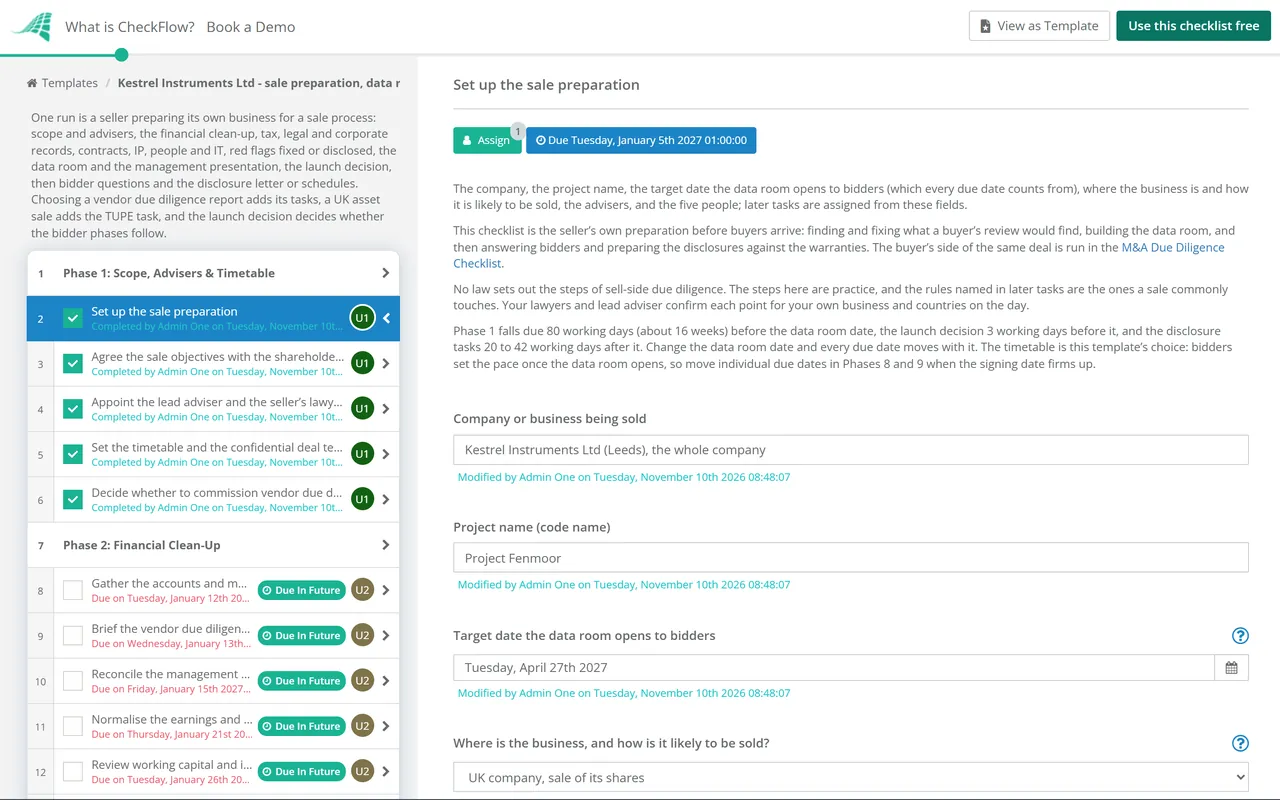
    Start about 16 weeks before the target date the data room opens to bidders. The first task names the company, that date and the five people, and asks where the business is and how it is likely to be sold. Every due date counts from the data room date, in working days.

    • Set up the sale preparation — the company, the project name, the target date the data room opens to bidders (which every due date counts from), where the business is and how it is likely to be sold, the advisers, and the five people; later tasks are assigned from these fields
    • Agree the sale objectives with the shareholders — what the shareholders want from the sale (all or part of the company, timing, who stays on after it), the buyers likely to be interested, any terms that would end the sale, and who decides for the shareholders
    • Appoint the lead adviser and the seller’s lawyers — the engagement terms and fees, the kind of process (a negotiated sale with one party or an auction between several), and what the adviser, the lawyers and the company team each do
    • Set the timetable and the confidential deal team — the code name, the few people inside the company who know about the sale and why, the time each can give alongside the day job, and the key dates from now to the data room opening
    • Decide whether to commission vendor due diligence — whether the seller pays an independent firm for a report on the business that bidders can read (financial, tax, legal or commercial), its scope, the provider, the cost, and how bidders may use it
  2. Phase 2 — about 15 weeks before

    Phase 2: Financial Clean-Up

    7 tasks

    Buyers start with the numbers. Get the accounts, the management accounts and the forecast to agree with each other, and explain every adjustment before a bidder has to ask.

    • Gather the accounts and management accounts for the last three years — the filed or audited accounts, the monthly management accounts, the trial balances by company, and the current year to date, in one place and in the form bidders will see
    • Brief the vendor due diligence provider — the agreed scope, the periods, access to the finance team and the documents, the timetable to a draft before the data room opens, and the terms on which bidders and the winning buyer may see and rely on the report
    • Reconcile the management accounts to the statutory accounts — each year’s management accounts against the filed or audited accounts, the differences explained (year-end adjustments, accruals, stock, revenue timing), and the bridge kept for the data room
    • Normalise the earnings and test the adjustments — one-off and non-recurring items, owner costs that will stop after the sale, and other adjustments to profit (such as adjusted EBITDA), each with evidence a bidder can check, and a sell-side quality of earnings review where the seller wants one
    • Review working capital and its seasonal pattern — monthly debtors, stock, creditors and accruals for at least the last 24 months, the normal level and why it moves through the year, ready for the discussion of the level the price assumes
    • List the debt and debt-like items — loans, overdrafts, leases, unpaid tax, deferred income, deferred consideration on past purchases, unpaid bonuses, provisions and anything else a bidder may treat as debt and take off the price
    • Prepare the forecast and the assumptions behind it — the budget and forecast for this year and the next, the assumptions behind each line, the trading so far against the budget, and the pipeline that supports it
  3. Phase 3 — about 11 weeks before

    Phase 3: Tax, Legal & Corporate Clean-Up

    6 tasks

    A buyer’s lawyers will read the company’s own records first. Make sure the company owns what it says it owns, has filed what it should, and knows which approvals and consents the sale may need.

    • Review tax compliance and open matters — returns filed and taxes paid for each tax, open enquiries or audits, reliefs and credits claimed and their evidence, payroll taxes and sales taxes or VAT, and any exposure to put right or disclose
    • Check the statutory books and public filings — the registers of shareholders and directors and of people with significant control or beneficial owners, every share issue and transfer, and the filings at the company registry, against each other
    • Confirm who owns the shares and what the sale needs from them — the shareholders and their holdings, options, warrants and convertible instruments and what happens to each on a sale, the shareholder agreement and articles (consents, pre-emption, drag and tag rights), and anyone whose signature the sale will need
    • Put right gaps in the corporate records — missing board minutes and shareholder resolutions, late or missing filings, share issues or transfers without the right paperwork, and the steps and advice each fix needs
    • Review disputes, claims and regulatory matters — litigation and threatened claims, complaints, regulator correspondence and inspections, licences and permits the business depends on, and what each would mean for a buyer
    • Identify the approvals and consents the sale may need — government approvals (merger control and investment screening), regulator approvals for a change of control of a regulated business, landlord, lender and customer consents, and how long each may take
  4. Phase 4 — about 8 weeks before

    Phase 4: Contracts, IP, People & IT

    7 tasks

    These are areas where a buyer’s review can find issues that change the price: a customer that can walk away on a sale, IP the company does not own, people the business depends on, and systems or data that are not secure.

    • Review the key customer and supplier contracts — the largest customers and suppliers, change of control and assignment clauses, exclusivity, termination rights, unusual liabilities, and contracts that are unsigned, expired or running on old terms
    • Check the company owns and protects its IP — registered rights and their renewal dates, assignments from founders, employees and contractors who created the products, software licences in and out, open-source use, and domain names held by the company
    • Gather the people information — an anonymised list of employees with roles, pay and benefits, the standard contracts and policies, contractors and how they are engaged, bonus, commission and share schemes, pensions, and open disputes
    • Plan how to keep the key people through the sale — who the business depends on, who is told about the sale and when, retention or transaction bonuses and who pays them, and the roles the founders and managers will have after the sale
    • Plan the TUPE steps for the asset sale — the employees assigned to the business being sold, the employee liability information for the buyer, informing and consulting the employees’ representatives, and where the steps will be run
    • Review IT, data protection and cyber security — the main systems and who owns the licences, security incidents and how they were handled, the privacy notices and records of processing, data breaches reported, and the policies a buyer will ask to see
    • Review property, insurance and key assets — leases and their break dates and consents on a sale, owned property, the insurance policies and the claims history, and the equipment and other assets the business needs
  5. Phase 5 — about 5 weeks before

    Phase 5: Red Flags & Fixes

    4 tasks

    Every issue the clean-up found goes on one log and gets one decision: fix it before launch, disclose it, or explain it in the price or the terms. Raising an issue first lets the seller explain it on its own terms.

    • Log every red flag and decide how to deal with it — each issue from Phases 2 to 4, its area, what it could cost, and the decision: fix before launch, disclose, or explain in the price or the terms, with an owner
    • Fix the issues that can be fixed before launch — the record fixes, missing IP assignments, unsigned contracts, filings and policy gaps that can be put right in time, each checked and its evidence filed for the data room
    • Draft the early disclosures for issues that stay — a short, factual note on each issue that will not be fixed, with the documents behind it, ready for the data room and later for the disclosure letter or schedules
    • Check the draft vendor due diligence report for accuracy — the draft read by the finance team for factual accuracy, errors corrected with evidence, the findings matched to the red flag log, and the final report date agreed
  6. Phase 6 — about 3 weeks before

    Phase 6: Data Room & Buyer Materials

    7 tasks

    Build the data room around the questions buyers will ask, decide who sees what and when, and make sure the presentation, the data room and any vendor report tell the same story with the same numbers.

    • Set up the data room structure and index — a numbered folder for each area a buyer reviews (corporate, finance, tax, contracts, IP, people, IT, property, disputes), a naming rule, the provider and its settings, and one index that will become the record of what was disclosed
    • Set the rules for access and for personal data — a signed non-disclosure agreement before any access, staged access (what every bidder sees and what only the preferred bidder sees), view-only and watermark settings, personal data anonymised wherever possible, and how competitively sensitive information is handled if a bidder is a competitor
    • Send the information memorandum and collect the signed NDAs — the teaser and information memorandum the lead adviser sends to the buyer list, a non-disclosure agreement signed by each bidder before it receives the memorandum or data room access, and the shortlist of bidders who will get access when the data room opens
    • Agree how bidders may see and rely on the vendor report — the release terms bidders sign before reading the report, the reliance the winning buyer (and its lenders) will get, and the provider’s limits on liability, as agreed with the provider
    • Upload the documents and check them against the index — every document final, signed, complete and readable, in the right folder under the index number, with nothing uploaded that is not meant for bidders
    • Prepare the management presentation — the business, its markets and customers, the team, the financial history and the forecast, and the plan, using the same numbers as the data room and any vendor report
    • Check the numbers agree across every document — revenue, profit, adjustments, headcount and forecast figures the same in the information memorandum, the presentation, the data room and any vendor report, or each difference explained
  7. Phase 7 — the week before

    Phase 7: Readiness Review & Launch Decision

    5 tasks

    Rehearse the presentation, sum up what is ready and what is not, and let the sale approver decide whether to open the data room. The checklist halts at that decision.

    • Rehearse the presentation and the questions buyers will ask — a full run-through with the adviser, the hard questions on each red flag and adjustment, who answers what, and the answers checked against the data room
    • Write the readiness summary for the sale approver — what is ready, the red flags and how each is dealt with, the gaps still open, the state of any vendor report, and the adviser’s view on whether to launch on the date set
    • Fix the readiness gaps and set a new data room date — each gap the approver named, its owner and the date it is fixed, then a new data room date on the first task, and the launch decision taken again
    • Record the decision and pause the sale preparation — the reasons, who was told (advisers, the deal team), the work kept for a later sale, the data room left closed, and the confidentiality that continues
    • Sale approver decides whether to open the data room to bidders — the approver reads the readiness summary and decides Go, Not yet, or Do not go ahead with a sale now; complete this task with the decision, and nothing after it can be completed until it is done
  8. Phase 8 — the data room opens

    Phase 8: Bidder Due Diligence & Q&A

    5 tasks

    Applies only when the launch decision is Go, or has not been made yet. Open the data room to bidders who have signed, give the management presentations, and answer every question once, in writing, through one channel.

    • Open the data room to the bidders who have signed — access only for bidders with a signed non-disclosure agreement, at the stage the access rules set, with the bidders’ deadlines and the rules for questions sent with the access
    • Give the management presentations — one session for each bidder, the same core material for all, the questions asked recorded, and the follow-up answers sent through the question process
    • Answer bidders’ questions through one process — each question logged, routed to the person who knows, answered in writing, checked by the legal lead where it touches a warranty, and the answer added to the data room where every bidder should see it
    • Open the last stage of the data room to the preferred bidder — the documents held back for the last stage (named employee data, customer prices, sensitive contracts), under the confidentiality terms and any clean team arrangements the access rules set
    • Keep the record of what each bidder has seen — the data room’s access reports, the documents added after it opened and when, and the question log, kept so the disclosures can point to what the buyer actually received
  9. Phase 9 — to signing

    Phase 9: Disclosure & Signing

    7 tasks

    Applies only when the launch decision is Go, or has not been made yet. Check the warranties, disclose against them, settle the insurance position, keep a dated copy of the data room, and hand the open items to the completion plan.

    • Review the warranties and indemnities in the draft purchase agreement — each warranty against what the clean-up found, the limits on the seller’s liability (caps, time limits, thresholds), the specific indemnities the buyer asks for, and which warranties need a disclosure
    • Prepare the disclosure letter or disclosure schedules — a specific disclosure against each warranty it qualifies, each one fair and with enough detail to identify the matter, the documents it refers to, and any general disclosures the buyer agrees
    • Agree how far the data room counts as disclosed — whether the buyer accepts the data room and the question log as generally disclosed, the index that defines it, and the copy that will be kept
    • Settle the warranty insurance position — whether the buyer is taking warranty and indemnity insurance (UK term) or representations and warranties insurance (US term), the seller’s answers to the insurer’s questions, and the seller’s own liability cap that results
    • Archive a dated copy of the data room as disclosed — a complete, dated copy of the data room, its index and the question log at signing, given to both sides’ lawyers and kept for as long as claims under the agreement can be made
    • Hand the open items to the completion plan — the conditions to completion, consents and approvals still to come, the TUPE or employee steps, the completion documents, and the post-sale undertakings the seller gives
    • Close access for the other bidders and confirm their data is returned or destroyed — access removed for every bidder that is not the buyer, the return or destruction their non-disclosure agreements require confirmed in writing, and the record kept

UK and US Terms for the Same Sale

Most of the preparation is the same in any country. These are the terms and rules that differ, as the official sources put them on 10 November 2026. The first task’s answer adds the matching notes and tasks.

Area UK US Phase
Disclosures against the warrantiesA disclosure letter from the seller to the buyerDisclosure schedules attached to the agreement, numbered to match the representations and warranties (some agreements call them a disclosure letter)5, 9
Warranty insuranceWarranty and indemnity (W&I) insuranceRepresentations and warranties (R&W) insurance9
Company recordsCompanies House identity verification for directors and people with significant control, a legal requirement since 18 November 2025State filings and evidence of good standing, which differ by state3
Government approvalsNational Security and Investment Act 2021: a notifiable acquisition of an entity in one of 17 sensitive areas needs approval before completion and is void if completed without it; asset acquisitions can be called inHart-Scott-Rodino Act: above the size thresholds, both sides (the acquiring and the acquired person) file and wait for the waiting period to end3
Employees on an asset saleTUPE: the seller gives the employee liability information at least 28 days before the transfer (14 days in Northern Ireland) and informs employee representatives long enough before it to consult; run it in the TUPE Transfer ChecklistWARN Act (employers of 100 or more employees, as the Act counts them): the seller gives any notice of a plant closing or mass layoff up to the date of the sale, and the buyer after it4
Personal data in the data roomUK GDPR and the ICO’s guidance: anonymise wherever possible, and hand over named worker data only on assurances of use, confidentiality and return or destructionState privacy laws and the company’s own contracts; share the minimum6

The government has published its response to a consultation on changing the National Security and Investment Act’s sensitive areas, so check the current list on GOV.UK, and the HSR thresholds in force, on the day. None of this replaces advice from your own lawyers.

Why Prepare a Sale in CheckFlow?

1

The launch decision comes before buyers see anything

The sale approver named on the first task is the only person who can complete the launch decision, and the checklist halts there: nothing after it can be completed until they decide Go, Not yet or Do not go ahead. Not yet and Do not go ahead hide the bidder phases and add the task that follows from each. See how approvals that halt a checklist work.

2

The sale sets the checklist

A vendor due diligence report adds the tasks to brief the provider, check the draft and agree how bidders rely on it. A UK sale adds notes on Companies House identity checks, the National Security and Investment Act and the disclosure letter, and a UK asset sale the TUPE task; a US sale adds state records, the HSR Act and disclosure schedules. Conditional logic keeps the rest out of the way.

3

Timed from the data room date, owned by name

Enter the date the data room opens and every task falls due a set number of working days before or after it. Tasks go to the sale lead, finance lead, legal lead, operations lead and sale approver named on the first task, and each sees their work in the Tasks Grid. Every sale preparation sits in the Reports Grid with its progress.

CheckFlow runs the preparation: who does what and by when, the red flag log, the data room checks and the launch decision. It does not give legal, tax or financial advice, host the data room or value the business. Your advisers, lawyers and accountants do that, and the checklist records what they found and decided.

For due diligence in general, see the glossary. To track the non-disclosure agreements bidders sign, use the NDA Processing Workflow Checklist.

AI generator

Didn’t find what you need? Describe it.

Describe the process in a sentence and the AI checklist generator drafts the phases and tasks for you.

Frequently Asked Questions

What is sell-side due diligence?

It is the seller’s own review of its business before a sale, done to find what a buyer’s due diligence would find while there is still time to fix it or explain it. It covers the accounts and forecast, tax, corporate records, contracts, IP, people, IT and property, and ends in a data room, a management presentation and, once bidders are in, the disclosures against the warranties. This template runs it as one checklist with named owners and dates.

What should a sell-side due diligence checklist include?

This template has nine stages: scope, advisers and the timetable; the financial clean-up; tax, legal and corporate records; contracts, IP, people and IT; red flags and fixes; the data room and buyer materials; a readiness review and the launch decision; bidder due diligence and questions; and the disclosures and signing. Optional tasks cover a vendor due diligence report and, for a UK asset sale, the TUPE steps.

What is vendor due diligence, and does a seller need it?

A vendor due diligence report is commissioned and paid for by the seller from an independent firm, then given to bidders so they start from the same analysis. It can be financial, tax, legal or commercial. No rule requires one. In this template the answer on the vendor due diligence task decides whether the tasks to brief the provider, check the draft and agree how bidders may rely on the report appear.

How long before a sale should a business start preparing?

There is no set period. This template starts about 16 weeks (80 working days) before the data room opens and puts the launch decision three working days before it, which is its own choice. A business with clean records may need less; one with missing IP assignments, gaps in its company records or management accounts that do not reconcile may need more. Enter the data room date and every due date moves with it.

What is the difference between a disclosure letter and disclosure schedules?

Both are how the seller qualifies the warranties in the purchase agreement, by telling the buyer about matters the warranties would otherwise cover. UK deals use a disclosure letter from the seller to the buyer. US agreements attach disclosure schedules numbered to match the representations and warranties, though some call them a disclosure letter. The agreement says what counts as fairly disclosed and what effect a disclosure has.

What goes in a data room when selling a company?

The documents a buyer’s review needs, in folders that follow its areas: corporate records and the cap table, accounts, management accounts and the forecast, tax, contracts, IP, people (anonymised), IT and data protection, property and insurance, and disputes. This template builds it from one numbered index, stages access so sensitive documents reach only the preferred bidder, and keeps a dated copy at signing as the record of what was disclosed.

How should a seller handle personal data in the data room?

In the UK, the ICO’s guidance on employment records says worker information shared for a prospective acquisition should be anonymised wherever possible, and that before a final decision the seller should only hand over workers’ personal information once assured it will be used solely to evaluate the deal, kept confidential and destroyed or returned after use. The ICO says the guidance is under review. In the US, state privacy laws and the company’s contracts set the limits.

Which red flags should a seller deal with before buyers see them?

The ones a buyer will find anyway: management accounts that do not reconcile to the statutory accounts, adjustments to profit without evidence, gaps in the share records or filings, IP created by people who never assigned it, key contracts a customer can end on a change of control, and open disputes. This template logs each one and records a decision: fix it before launch, disclose it, or explain it in the price or the terms.

Is CheckFlow free for this template?

14-day free trial, no card required. The Business plan is $10 per user per month after the trial. Full details at checkflow.io/pricing.

Find the Issues Before Your Buyer Does

Free trial — no credit card required.

14-day free trial, no credit cardFull refund in your first 30 daysUS hosting, EU on request