A structured framework for PE diligence — from desk research to investment committee, with LBO analysis, management alignment, and exit planning built in from the start.
Private equity due diligence is built on a single question that every other workstream serves: can we acquire this business, create meaningful value over three to seven years, and exit at a return that justifies the investment? The process that answers that question runs in phases — desk diligence before the NDA is signed, exploratory diligence to validate the investment thesis, confirmatory diligence with specialist advisors to interrogate every material assumption, and final structuring diligence to set the working capital peg and negotiate the SPA. A structured checklist ensures every workstream is scoped and resourced in the right phase, every material risk is surfaced before the IC paper is written, and every assumption in the deal model is supported by documented diligence evidence. This free private equity due diligence checklist covers all nine workstreams of a comprehensive PE diligence process — from preliminary desk research through to value creation planning and exit analysis.
PE, VC, and M&A Due Diligence — Three Distinct Processes With Different Objectives
VC due diligence evaluates early-stage potential — it accepts significant uncertainty and concentrates on founder quality, market opportunity, and technology differentiation. M&A due diligence, conducted by strategic buyers, focuses on confirming what is being acquired and identifying synergies that justify the premium. PE due diligence is different from both: the PE firm is a financial buyer investing for a defined return on a defined timeline. The question is not “does this business have potential?” (VC) or “does this acquisition fit our strategy?” (M&A) but “can we buy this business, improve it materially, and sell it at a sufficient multiple to return the fund?” Every workstream in PE diligence ultimately feeds that answer.
Four elements are specific to PE diligence and require dedicated treatment: LBO modelling and debt capacity analysis (the financial architecture of the deal and the leverage it can support); management assessment and alignment (the PE firm is co-investing with the management team and must assess investability, capability, and incentive structure); value creation planning (the operational improvement plan, bolt-on acquisition strategy, and key value creation levers that will be executed during the holding period); and exit analysis (modelling credible exit routes and validating the returns are achievable at the expected exit multiple).
What the Private Equity Due Diligence Checklist Covers
This checklist follows the PE diligence process across nine workstreams and four phases — desk diligence, exploratory diligence, confirmatory diligence, and final structuring. Not every workstream runs in every phase; resource allocation should match the phase’s purpose.
Phase 1
Preliminary Desk Diligence (Pre-NDA)
Desk diligence is conducted before the NDA is signed — using only publicly available information. Its purpose is simple: is this opportunity worth pursuing? Do not deploy expensive third-party advisors until the investment thesis is directionally validated.
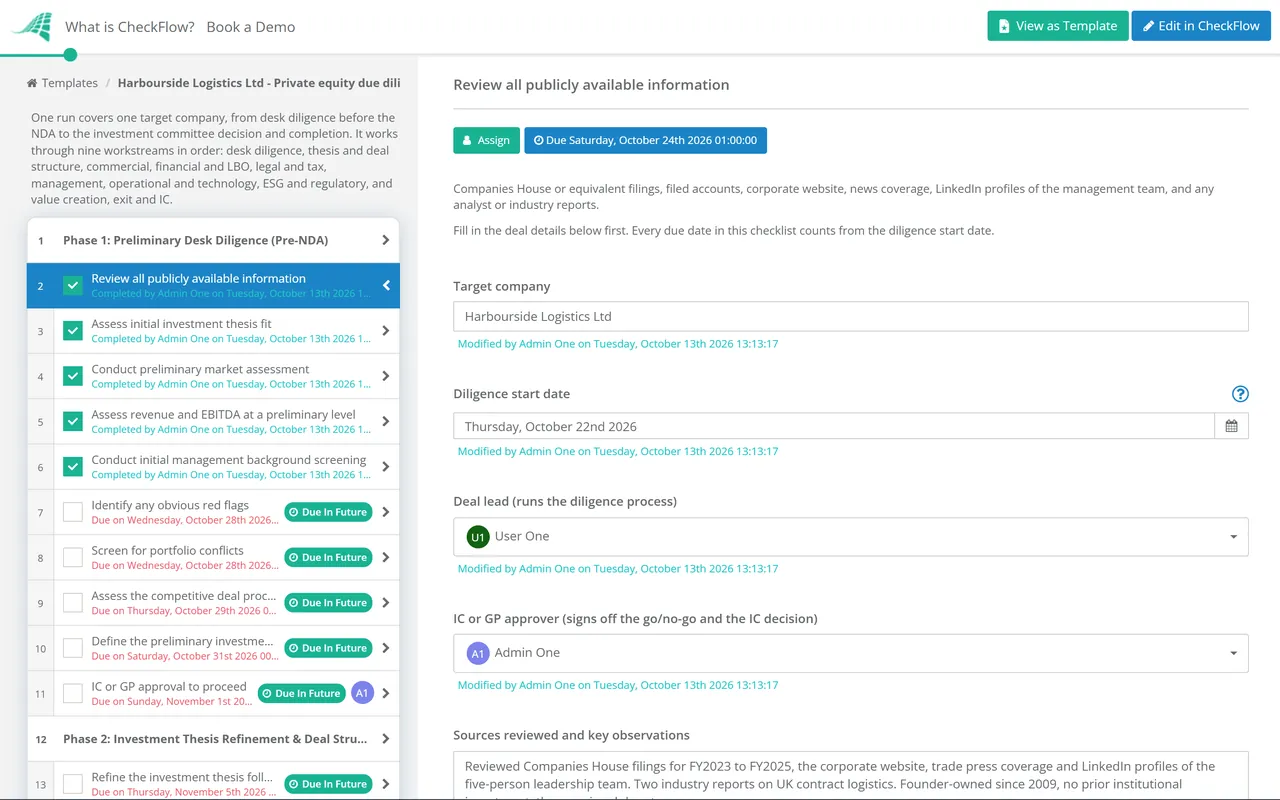
Review all publicly available information — Companies House or equivalent filings, filed accounts, corporate website, news coverage, LinkedIn profiles of management team, and any analyst or industry reports
Assess initial investment thesis fit — does the opportunity match the fund’s sector focus, size criteria, stage preference, and geographic mandate?
Conduct preliminary market assessment — market size, growth trajectory, competitive dynamics, and structural tailwinds or headwinds using publicly available industry data
Assess revenue and EBITDA at a preliminary level — using filed accounts; apply broad preliminary multiple range to assess whether the entry valuation is plausible
Conduct initial management background screening — LinkedIn profiles, prior company histories, public records, and any network references available without NDA
Identify any obvious red flags — public litigation, regulatory issues, adverse media, or structural business model concerns
Screen for portfolio conflicts — does the fund have any current portfolio companies that compete with or are complementary to this target?
Assess the competitive deal process context — is this a marketed process or a proprietary opportunity? What is the likely timeline?
Define the preliminary investment thesis — one or two paragraphs articulating why this business could be a strong PE investment and the primary value creation hypothesis
IC or GP approval to proceed — confirm internal sign-off before NDA is executed and management engagement begins
Phase 2
Investment Thesis Refinement & Deal Structure
Refine the investment thesis following initial management meetings — articulate the core value creation hypothesis, key risks to that hypothesis, and the critical diligence questions that must be answered
Define the deal structure — buyout (MBO, MBI, secondary buyout), growth capital, or other; confirm the appropriate structure given the situation and management team
Confirm the transaction perimeter — is this a full business acquisition, a carve-out, or a partial stake?
Define the diligence scope and phase plan — which workstreams are required, at what depth, and in which phase; assign lead responsibility for each workstream
Engage advisors — financial DD firm, legal counsel, tax advisors, sector consultants, and any technical specialists required; brief all advisors on the investment thesis and key questions
Establish the data room — confirm NDA is executed; issue the information request list; establish VDR access and review protocols
Develop the preliminary LBO model — initial returns modelling based on management information; stress test entry multiples and exit assumptions
Define the debt financing approach — preliminary leverage structure, expected debt quantum, and potential lending bank or debt fund engagement
Identify the key IC questions — what are the two or three questions the investment committee will ask that the diligence process must answer?
Confirm the deal timeline — indicative offer date, confirmatory diligence period, preferred bidder date, and target completion
Phase 3
Commercial & Market Due Diligence
Independently validate market size and growth — challenge management’s TAM and SAM with independent analysis; confirm growth drivers are structural not cyclical
Conduct sector expert interviews — engage independent industry professionals to validate market dynamics, competitive positioning, and growth assumptions
Assess the competitive moat — is the target’s advantage real and durable over the investment horizon? Test with customers and competitors
Conduct customer reference calls — minimum five to eight independent customer conversations; at least two back-channel; assess satisfaction, switching intent, and reasons for choosing the target
Validate revenue quality and durability — recurring vs non-recurring, contract lengths, renewal rates, pricing power, and cross-sell potential
Assess revenue concentration risk — customer and sector concentration; sensitivity of the investment thesis to the loss of key customers
Validate the growth plan — is the revenue growth assumed in the LBO model achievable? What are the key growth levers and their credibility?
Assess go-to-market maturity — sales team quality, pipeline management, pricing discipline, and whether growth is person-dependent or systematised
Identify value creation opportunities — pricing, new customer segments, geographic expansion, product extensions, and digital transformation
Document commercial findings — market validation, revenue quality assessment, growth plan credibility, and identified value creation levers
Phase 4
Financial Due Diligence & LBO Analysis
The LBO model is the translation of all other diligence findings into a return. Every assumption the model makes — EBITDA entry point, growth rate, margin progression, capex, working capital, exit multiple — must be supported by documented diligence evidence.
Conduct quality of earnings (QoE) analysis — normalise reported EBITDA for one-time items, related-party costs, owner benefits, and accounting adjustments to arrive at maintainable EBITDA
Analyse revenue and margin by cohort, product, geography, and customer segment — understand the drivers of margin and where the best and worst quality earnings sit
Review and stress test the management financial model — challenge revenue growth assumptions, margin progression, capex requirements, and hiring plan
Conduct working capital analysis — normalise working capital; identify seasonal patterns and working capital traps; establish the basis for the completion accounts or locked box mechanism
Define the net debt position — all debt-like items including pension obligations, finance leases, earnouts, deferred revenue, and any off-balance-sheet liabilities
Assess debt capacity — how much leverage can the business support given its free cash flow profile, capex cycle, and working capital requirements?
Develop the full LBO model — entry price, capital structure, interest cost, amortisation schedule, operating model (base, upside, downside), and exit analysis at multiple scenarios
Stress test the LBO model — what entry multiple, growth rate, and exit multiple combination is required to achieve the fund’s hurdle rate? What downside does the deal survive?
Engage financing banks or debt funds — term sheets for senior debt, unitranche, or mezzanine as appropriate; confirm debt quantum and pricing in the model
Document financial findings — normalised EBITDA, working capital assessment, net debt, LBO returns analysis, and debt financing terms
Phase 5
Legal & Tax Due Diligence
Review corporate structure and ownership — confirm the target can be cleanly acquired; identify any corporate structural issues requiring pre-completion reorganisation
Review the cap table — all equity, options, warrants, and convertible instruments; confirm completion accounts for all minority interests and leaver provisions
Identify all change of control provisions in material contracts — customer agreements, supplier contracts, banking facilities, licences, and real estate; flag all requiring consent or triggering termination
Review all material contracts and obligations — assess duration, key terms, and any unusual liabilities or restrictions on the business
Confirm IP ownership — all IP material to the business is owned by the target entity and unencumbered; review any licence-in arrangements for key technology
Review outstanding and threatened litigation — confirm all claims are disclosed, quantified, and assessed for materiality
Assess regulatory status and licences — required operating licences are current, in the correct entity, and transferable on change of control
Review tax structure and confirm optimal acquisition structure — engage tax advisors to confirm the most efficient structure for the acquirer and management
Review historic tax compliance and identify any material exposures — open years, disputes, transfer pricing, and any deferred tax positions material to the deal
Document legal and tax findings — issues, deal-critical conditions, W&I insurance scope, and structural recommendations
Phase 6
Management Assessment & Incentive Alignment
PE returns are generated by management execution. Backing a business with a weak or misaligned management team is the most common single cause of PE underperformance. Management assessment is not a reference check — it is a judgement about whether these individuals can deliver the value creation plan.
Assess the CEO — track record, quality of strategic thinking, operational capability, PE experience, and cultural fit with the PE firm
Assess the senior leadership team — CFO, CTO, CCO, and other key roles; assess capability, completeness, and depth below the current senior team
Conduct structured management reference checks — minimum three references per key individual; at least one back-channel per individual; focus on delivery under pressure, PE alignment, and integrity
Assess management’s understanding of the business — do they know their own numbers? Can they articulate the key value drivers and the risks?
Assess management’s value creation ambition — do they have a vision for what the business can become? Are they aligned with the PE firm’s value creation hypothesis?
Assess PE readiness — have they worked with PE before? Are they comfortable with the reporting requirements, board governance, and performance accountability of a PE-backed business?
Identify management team gaps — roles that need to be recruited or strengthened before or shortly after investment
Confirm management retention — which individuals are essential to the investment thesis? What are their current contractual positions and departure risk?
Structure the management incentive plan (MIP) — equity pool, strike price, good/bad leaver provisions, vesting schedule, and ratchet structure; confirm alignment between management returns and PE investor returns
Document management assessment findings — team quality assessment, key person risks, incentive alignment summary, and any hires required as a condition of investment
Phase 7
Operational & Technology Diligence
Review operational model and processes — assess the efficiency, scalability, and resilience of core operations; identify operational improvement opportunities
Identify operational value creation levers — margin improvement initiatives, procurement savings, capacity utilisation improvements, and operational efficiencies that can be delivered during the holding period
Review the technology stack — core systems, proprietary vs third-party, architecture quality, and scalability; engage specialist IT advisor for technology-intensive businesses
Assess technical debt and IT investment requirements — quantify the capital required to maintain and modernise IT systems during the holding period
Review cybersecurity posture — confirm adequate controls are in place; assess cyber incident history and insurance coverage
Assess digital transformation opportunity — where can technology investment create competitive advantage or operating leverage during the holding period?
Review supply chain and key supplier dependencies — single points of failure, pricing exposure, and geographic concentration
Assess bolt-on acquisition pipeline — are there credible acquisition targets that could accelerate the investment thesis? Is the target platform-ready?
Confirm business continuity arrangements — adequate for the risk profile of the business and the fund’s requirements
Document operational findings — value creation opportunity assessment, IT investment requirements, supply chain risks, and bolt-on pipeline
Phase 8
ESG & Regulatory Diligence
Define the ESG scope — which ESG factors are material for this sector, investment thesis, and the fund’s ESG commitments and LP requirements
Assess environmental compliance and liability — environmental permits, contamination risk (Phase I/II assessment where relevant), and any ongoing environmental obligations
Review climate risk exposure — physical and transition risk relevant to the business’s sector and geography
Assess ESG as a value creation opportunity — sustainability initiatives that could improve the multiple at exit by expanding the buyer universe or improving ESG ratings
Confirm CSRD and other ESG reporting obligations — applicable to European portfolio companies; assess readiness and any investment required
Confirm LP ESG requirements — does this investment meet the fund’s ESG policy and any specific LP ESG requirements?
Confirm competition clearance requirements — jurisdiction thresholds, timeline, and risk of remedies; engage competition counsel where material
Review any sector-specific regulatory requirements — licences, approvals, or regulatory notifications required for the transaction
Confirm sanctions and trade compliance — screen the target and its customer and supplier base against applicable sanctions lists and export control regulations
Document ESG and regulatory findings — material ESG risks, value creation ESG opportunities, regulatory clearance timeline, and LP ESG compliance assessment
Phase 9
Value Creation Plan, Exit Analysis & IC Execution
The value creation plan is the PE firm’s investment thesis made concrete — the specific initiatives, owners, timelines, and quantified impact that will generate the return. Without it, the deal thesis is aspiration, not strategy.
Develop the 100-day plan — what must happen in the first 100 days to establish PE governance, install reporting, and begin value creation initiatives?
Develop the full value creation plan — specific initiatives with named owners, timelines, quantified financial impact, and required investment; covering revenue growth, margin improvement, multiple expansion, and bolt-on acquisitions
Validate value creation plan feasibility — confirm each initiative is operationally achievable with the current management team and resource base
Identify operating partner support — where will the PE firm’s operating partners or portfolio support team add value? Define the engagement model
Conduct exit analysis — model all credible exit routes (strategic sale, secondary buyout, IPO) at Year 3, 4, and 5; identify the most likely exit and validate the return profile
Identify the potential exit buyer universe — which strategic buyers would value this asset? Which PE firms would be natural secondary buyers? Does an IPO path exist?
Confirm the returns profile meets the fund’s hurdle — base case, upside, and downside scenarios; sensitivity to entry multiple, growth rate, margin, and exit multiple
Compile the investment committee paper — investment thesis, key diligence findings, value creation plan, LBO returns analysis, key risks and mitigations, and recommended conditions
Present to the investment committee — address IC questions; document IC decision and any conditions
Execute the transaction — SPA negotiation, final conditions precedent, debt drawdown, management MIP documentation, and completion
This checklist is available as a free, runnable template in CheckFlow — with tasks assigned across the deal team and all advisor workstreams, each phase tracked from a single dashboard, and a complete documented record for the investment committee and LP reporting.
The checklist coordinates every workstream across the four-phase process — ensuring resources are deployed efficiently, no material question goes unanswered before the IC paper is written, and every assumption in the LBO model is supported by documented evidence. It also creates the formal record that LPs require as evidence of rigorous investment governance.
CheckFlow use: Track all nine workstreams from a single dashboard, assign tasks across the internal deal team and external advisors, and build the IC evidence file automatically as the process runs.
For management teams (MBO/MBI)
The Preparation Framework
The same checklist is a preparation framework. Management teams pursuing an MBO or preparing to engage with a PE buyer who understand exactly what the buyer’s diligence team will investigate — and have prepared systematically — run faster processes, maintain team confidence through diligence, and achieve better deal terms. Understanding the management assessment workstream in particular allows management to present their team, track record, and value creation ambition with the clarity and structure a PE investor expects.
CheckFlow use: Assign data room preparation tasks across finance, legal, and operations, track completion, and coordinate management presentation preparation.
The Four Phases of the PE Diligence Process
PE diligence is explicitly phased — resources are deployed progressively as the investment thesis is validated. Understanding the phase structure prevents the most common PE diligence mistake: deploying expensive specialist advisors before the deal is directionally viable.
Phase 1 — Desk Diligence
Timing: Pre-NDA
Focus: Preliminary market and company assessment using only public information. Determines whether to pursue.
Resources: Internal deal team only.
Outcome: Go/no-go decision to sign NDA and engage management.
Phase 2 — Exploratory Diligence
Timing: Post-NDA, pre-LOI
Focus: Initial management meetings, early data room review, preliminary financial model. Refines investment thesis and frames the LOI valuation.
Resources: Deal team plus initial commercial and financial advisors.
Outcome: LOI submission at the appropriate price and structure.
Phase 3 — Confirmatory Diligence
Timing: Post-LOI, pre-SPA
Focus: Full specialist advisor engagement across all workstreams. Validates all material assumptions in the LOI and surfaces issues affecting price, structure, or deal certainty.
Resources: Full advisor team — FDD firm, legal, tax, commercial, operational, technical.
Outcome: IC-recommended investment with fully documented diligence findings.
Phase 4 — Final Structuring
Timing: Post-preferred bidder, pre-completion
Focus: Resolution of outstanding diligence items, SPA negotiation, working capital peg setting, W&I insurance, and debt finalisation.
Resources: Legal and financial advisors; financing banks; W&I insurance broker.
Outcome: Signed SPA and completed transaction.
Why Run PE Diligence in CheckFlow?
CheckFlow coordinates the diligence process — workstream assignment, phase tracking, and documentation. It complements, but does not replace, specialist PE advisors, FDD firms, legal counsel, tax advisors, and operating partners.
1
Track every workstream across every phase
PE diligence involves nine workstreams running across four phases, managed by multiple specialist advisors simultaneously. The deal lead needs to know, at any point in the process, which workstreams are in which phase, what is outstanding, and what has produced findings material enough to affect the IC recommendation. CheckFlow’s grid dashboard makes every workstream’s status visible from a single view — without aggregating weekly advisor status reports.

2
Nothing material is missed as the deal accelerates
PE deal timelines accelerate under competitive auction pressure. The workstreams cut shortest in compressed timelines — management reference checks, change of control provision review, operational value creation validation — are consistently the ones that produce post-completion surprises. CheckFlow’s structured checklist and enforced phase sequence ensure every workstream is completed or explicitly risk-accepted before the IC paper is written.
3
IC and LP-ready documentation builds automatically
PE investment committees and LPs both require evidence of rigorous process. Every completed diligence task is logged in CheckFlow with a timestamp and named owner — across the deal team and all advisor workstreams. The full diligence record builds automatically and is ready for IC presentation, LP reporting, and post-deal performance review without reconstruction.
PE due diligence overlaps significantly with M&A due diligence in many workstreams — financial, legal, operational, and ESG. CheckFlow’s M&A Due Diligence Checklist covers the same workstreams from a strategic buyer perspective, and the two templates are frequently used together for sell-side preparation across both buyer types. See the M&A Due Diligence Checklist →
Post-investment, PE portfolio companies require ongoing governance and compliance processes — including periodic insurance reviews, IT security assessments, and operational audits. CheckFlow’s due diligence and compliance templates are used by PE operations teams to run consistent processes across the portfolio. View all due diligence templates →
What is private equity due diligence and how does it differ from M&A diligence?
+
Private equity due diligence is the structured process PE firms use to evaluate an investment opportunity before committing fund capital. While it shares several workstreams with M&A due diligence — financial review, legal, commercial, operational — PE diligence has four distinct characteristics that separate it from strategic M&A. First, the economics are underwritten by an LBO model requiring debt capacity analysis and returns modelling that strategic buyers do not require. Second, management assessment and incentive alignment is a primary workstream — PE firms back management teams and co-invest through MIPs. Third, value creation planning is built into the diligence process — the PE firm must articulate and validate the specific operational, commercial, and acquisition initiatives that will generate the return. Fourth, exit analysis models the investment from entry to exit and validates that credible exit routes exist at the required multiple.
What is LBO modelling and why is it central to PE diligence?
+
A leveraged buyout (LBO) model is the financial model that underpins a PE investment decision. It models the acquisition of a business using a combination of equity (PE fund capital and management MIP) and debt (senior bank debt, unitranche, or mezzanine), and projects the returns to equity holders at exit based on assumed EBITDA growth, debt repayment, and exit multiple. LBO modelling is central to PE diligence because every diligence finding ultimately flows into the model — the quality of earnings analysis determines the entry EBITDA; the commercial due diligence informs the growth rate; the operational review informs the margin improvement assumption; the debt capacity analysis determines the leverage structure. A deal that looks attractive on entry multiples may not generate the required return at the fund’s expected exit timing and multiple — the LBO model is the test.
What is a management incentive plan (MIP) and how is it structured in PE transactions?
+
A management incentive plan (MIP) is the equity participation structure that gives management a share of the value created during the PE holding period. It is designed to align management interests with PE investor interests — management generates returns only if the PE firm generates returns above its hurdle rate. MIPs typically take the form of sweet equity issued to management at a strike price equal to or above the investor’s entry point, with management receiving a leveraged share of value above the hurdle. Key MIP terms include the equity pool size (typically 10–20% of the total equity on a fully diluted basis), the ratchet structure (how management’s percentage increases with returns), good/bad leaver provisions (what happens to management equity if an individual leaves), and vesting schedules (time and/or performance-based). MIP design is a critical element of deal structuring negotiated during Phase 4 of the diligence process.
What is a quality of earnings report and who produces it in PE?
+
A quality of earnings (QoE) report is produced by a specialist financial due diligence firm — typically an accounting firm or boutique FDD specialist — engaged by the PE buyer during the confirmatory diligence phase. It reviews and adjusts the target’s reported financial results to arrive at a normalised, maintainable EBITDA that reflects the sustainable earnings of the business under new ownership. Adjustments typically include removing one-time costs, non-recurring income, owner personal expenses, related-party transactions, and accounting policy-driven distortions. The normalised EBITDA from the QoE report is the EBITDA on which the deal multiple is applied — a significant downward adjustment materially affects the deal economics and often triggers price renegotiation.
How should a management team prepare for PE due diligence?
+
Management teams pursuing an MBO or engaging with PE buyers should prepare across five areas. Financial: ensure management accounts are current, accurate, and accompanied by a clear financial model with documented assumptions; understand the quality of earnings story before the buyer’s FDD team investigates it. Commercial: be able to articulate revenue quality, customer concentration, growth drivers, and competitive position with supporting data. Operational: document the key operational value creation opportunities clearly — buyers value management teams who have a credible plan, not just a business. Team: be prepared for management reference checks on every senior individual; have a clear narrative for any career gaps or company failures. Legal and data room: organise the data room in advance; identify any known issues and prepare disclosure and remediation plans — proactive disclosure builds trust; discovery builds suspicion.
Is CheckFlow free to use for this template?
+
You can start a free 14-day trial with no credit card required, giving you full access to all features including this template. The Business plan is $10 per user per month after the trial. Full details at checkflow.io/pricing.
Run Every PE Deal Through a Process That Earns the Return
Free trial — no credit card required.
Do you like cookies? 🍪 We use cookies to ensure you get the best experience on our website. Learn more