
Getting a transaction to close
Focus: offer, contingencies, mortgage, completion.
Typical user: agent, conveyancer, home buyer.
Output: a completed sale.
Last reviewed: October 2026
No Credit Card Required
Printed from checkflow.io/templates/due-diligence/property-acquisition-due-diligence-checklist
This free checklist is for investors, asset managers and in-house real estate teams buying an office, retail, industrial or mixed-use property, and for the lawyers and consultants working for them. It runs from the letter of intent to closing: title and survey, leases and the rent roll, environmental and physical condition, zoning or planning, service charges and financing. Choose the jurisdiction at the start and the checklist shows the US route (title commitment, ALTA/NSPS survey, Phase I ESA, estoppels) or the England & Wales route (CPSE enquiries, searches, report on title). Tenant tasks appear only when the property is let, and the investment committee approves before the deposit goes hard or contracts are exchanged.
In the US, the buyer usually signs the purchase and sale agreement first and investigates afterwards, inside a due diligence or feasibility period. If the buyer does not terminate by the deadline, the deposit typically becomes non-refundable. In England and Wales, the buyer investigates before exchange of contracts, and the seller gives few warranties about the property’s condition. Either way, the diligence is front-loaded into a fixed window and every report has to land inside it.
This template investigates the asset. Our Purchase and Sales Agreement Process Checklist tracks the transaction milestones of a sale, mainly residential, from offer to completion. Use this one when you are buying income-producing or owner-occupied commercial property and need to decide whether to proceed, renegotiate or walk away. The UK tasks follow England and Wales; Scotland and Northern Ireland have their own systems.
Focus: offer, contingencies, mortgage, completion.
Typical user: agent, conveyancer, home buyer.
Output: a completed sale.
Focus: title, leases, environmental, condition, zoning.
Typical user: investor, asset manager, corporate occupier.
Output: a go, renegotiate or walk decision.
Focus: valuation, title insurance or certificate of title, SNDAs.
Typical user: lender and its counsel.
Output: conditions precedent to funding.
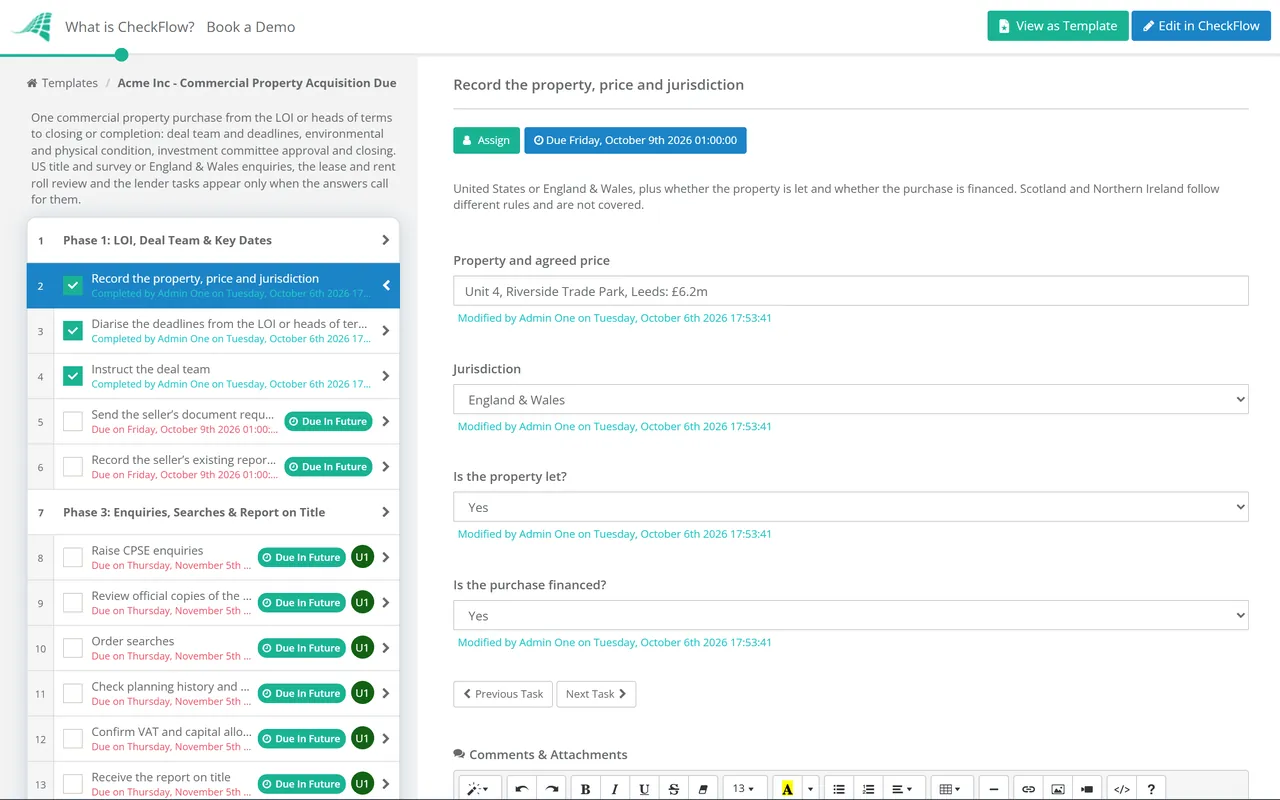
Four phases run on every acquisition. The jurisdiction answer shows either the US or the England & Wales title phase, and the lease phase appears only when the property has tenants.
Owned by the acquisitions lead. The answers recorded here decide which later phases appear.
Shown only when the jurisdiction is United States. Owned by buyer’s counsel.
Shown only when the jurisdiction is England & Wales. Owned by the buyer’s solicitor.
Shown only when the property is let. US and UK tasks follow the jurisdiction answer.
US and UK tasks follow the jurisdiction answer. Owned by the environmental consultant, reviewed by counsel.
The investment committee approval halts the checklist until answered. A Not approved answer leads to termination or renegotiation before the deadline.
Each workstream produces a report written to a recognised standard or form. The table maps them for both jurisdictions. It is a starting point for scoping with your advisers, not legal advice.
| Workstream | United States | England & Wales | Phase |
|---|---|---|---|
| Title | Title commitment and owner’s policy | Official copies, report on title | 2, 3 |
| Boundaries | ALTA/NSPS Land Title Survey, 2026 Standards | Title plan; measured or boundary survey if needed | 2, 3 |
| Seller information | Contract diligence deliveries | CPSE.1, plus CPSE.2 for let property | 1, 3 |
| Use | Zoning report, certificates of occupancy | Planning history, building control records | 2, 3 |
| Tenancies | Estoppels, SNDAs | Lease review, CPSE.2 replies | 4 |
| Service charge | CAM reconciliations under the leases | RICS Service charges in commercial property, 2nd edition | 4 |
| Environmental | Phase I ESA, ASTM E1527-21, for AAI | Environmental search or desk study; asbestos register | 5 |
| Condition | PCA, ASTM E2018-24 | RICS Technical due diligence of commercial property | 6 |
| Energy | Local benchmarking rules where they apply | EPC and minimum energy efficiency standards | 4, 6 |
The second table lists dates that commonly catch buyers out.
| Date | Rule | Source |
|---|---|---|
| Phase I ESA components | Inquiry within one year before acquisition; interviews, lien search, records review, site visit and the environmental professional’s declaration within 180 days | 40 CFR 312.20 |
| Due diligence period expiry | Terminate by the deadline or the deposit usually goes hard | Purchase and sale agreement |
| Title objection date | Objections after it are often waived | Purchase and sale agreement |
| Land Registry priority search | 30 working days of priority to apply for registration | Land Registration Rules 2003 |
| Land tax return | England: SDLT within 14 days of completion. Wales: LTT within 30 days | Finance Act 2003; Land Transaction Tax and Anti-avoidance of Devolved Taxes (Wales) Act 2017 |
Several standards changed recently. Surveys contracted on or after 23 February 2026 must follow the 2026 ALTA/NSPS Standards. ASTM E1527-13 stopped satisfying AAI on 13 February 2024, so older reports written to it should be refreshed to E1527-21. EPA designated PFOA and PFOS as CERCLA hazardous substances in 2024 and the D.C. Circuit upheld that designation in August 2026; further appeal was still possible when this page was reviewed, so ask your consultant how PFAS is scoped. In the UK, the second edition of the RICS service charge standard took effect on 31 December 2025, and in June 2026 the government said larger let commercial buildings will need an EPC of B from 2031, a change that still needs secondary legislation.
Due dates are offsets from the start of the checklist, so each consultant’s report has a deadline inside the due diligence period. Overdue tasks show up in analytics while there is still time to chase.
Conditional logic shows title commitment, survey and estoppel tasks for a US deal, and CPSE, searches and land tax for England & Wales. A vacant building skips the lease phase entirely.
Keep properties, lenders and consultants in data sets and pick them from live dropdowns on each acquisition. The committee approval is assigned to a named member, and the activity trail exports with timestamps.
CheckFlow is not a title platform, data room or document store. Reports stay with your advisers and in your data room; CheckFlow runs the workflow around them, so you know which report is late, which issue is open and who approved going hard on the deposit. The real estate overview shows other property workflows run the same way.
Buying the company that owns the building rather than the building itself? Run the Financial Due Diligence Checklist and the M&A Due Diligence Checklist alongside this one. After closing, the Property Management Checklist takes over the day-to-day running of the asset.
Purchase and Sales Agreement Process Checklist
Real Estate Client Onboarding Checklist
Property Management Checklist
Tenant Onboarding Checklist

Company Insurance Due Diligence Checklist
Describe the process in a sentence and the AI checklist generator drafts the phases and tasks for you.
Title and survey, the leases and rent roll for a let property, environmental investigation, a physical condition assessment, zoning or planning compliance, service charge or CAM accounts, insurance and the financing conditions. In the US the core reports are a title commitment, an ALTA/NSPS survey, a Phase I ESA and a property condition assessment. In England and Wales they are the replies to CPSE enquiries, searches, a report on title and a technical due diligence report.
In the US it is whatever the purchase and sale agreement says; 30 to 60 days is common, with extensions negotiated for complex assets. In England and Wales there is no formal period: the buyer investigates between agreed heads of terms and exchange, and the timetable is agreed between the solicitors. Either way, set every report’s due date well inside the window so there is time to negotiate on findings.
Under EPA’s All Appropriate Inquiries rule, the inquiry must be conducted within one year before the acquisition. The interviews, lien search, government records review, site visit and the environmental professional’s declaration must be done or updated within 180 days before it. Outside those windows the report is updated or redone. Since 13 February 2024 only ASTM E1527-21 satisfies AAI.
An estoppel certificate is a tenant’s signed confirmation of its lease terms: rent, term, deposit, defaults and any claims against the landlord. The buyer relies on it, and the tenant cannot later contradict it. An SNDA (subordination, non-disturbance and attornment agreement) makes the lease subordinate to the new mortgage, protects the tenant if the lender forecloses and commits the tenant to the new owner. Both are mainly US practice.
The Commercial Property Standard Enquiries are the standard pre-contract questions buyers’ solicitors in England and Wales send to the seller, endorsed by the British Property Federation. CPSE.1 is used on every transaction, and CPSE.2 is added when the property is let. The replies matter more than the forms: read them against the title, leases and searches, and follow up anything answered “not so far as the seller is aware”.
14-day free trial, no card required. The Business plan is $10 per user per month after the trial. Full details at checkflow.io/pricing.
14-day free trial, no credit cardFull refund in your first 30 daysUS hosting, EU on request